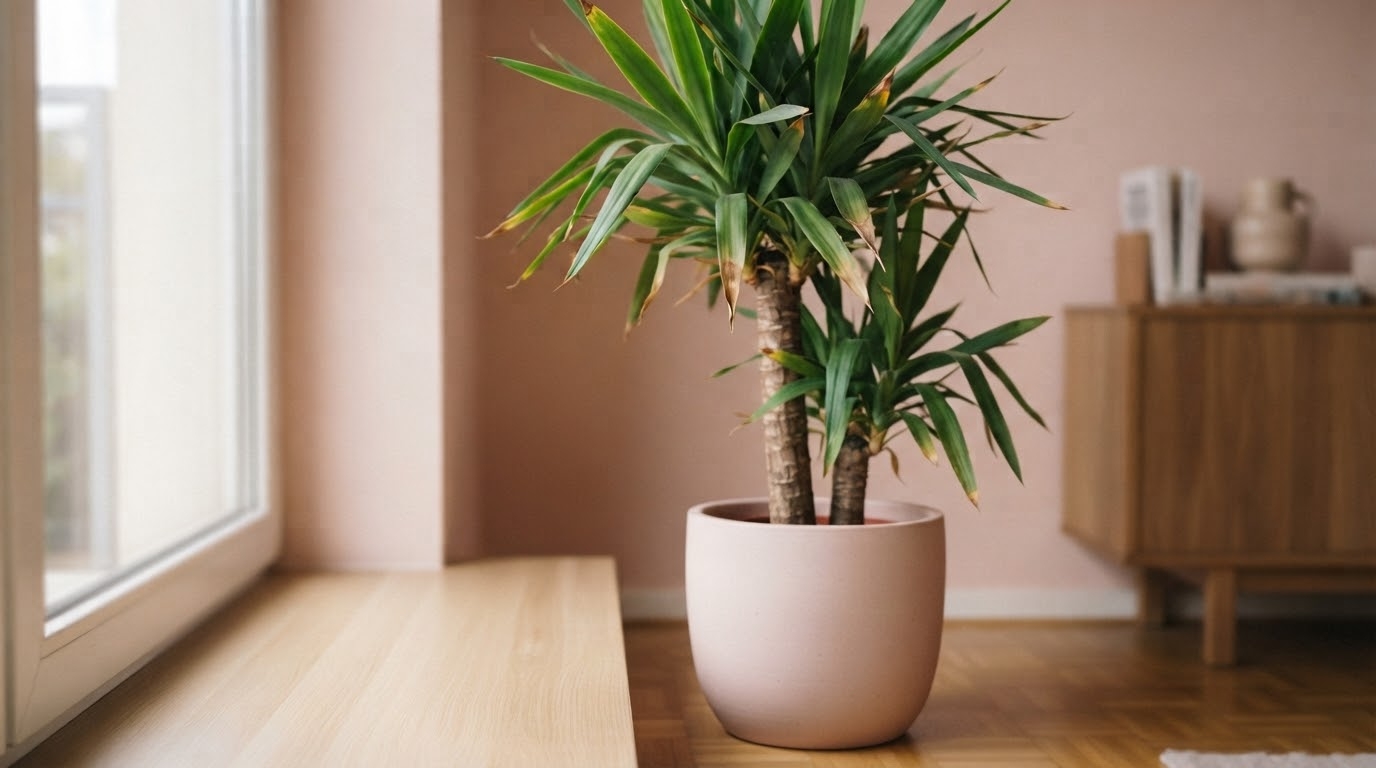
Yucca cane problems almost all trace back to one thing: the plant is built for dry, bright conditions, and most homes give it the opposite. The good news is that the symptoms are unusually legible: a yucca tells you what is wrong through which leaves fail and how they feel when you touch them.
This guide works through the failures in order of how often they kill the plant, starting with the one that does most of the damage.
| Symptom | Most likely cause |
|---|---|
| Yellow, mushy leaves throughout the plant | Root rot from overwatering |
| Yellow, dry leaves at the bottom only | Normal aging, no action needed |
| Soft or spongy trunk | Trunk rot, often fatal |
| Brown, crispy leaf tips | Dry air, salt buildup, or underwatering |
| Brown spots with a yellow halo on older leaves | Fungal leaf spot, usually cosmetic |
| Drooping, floppy leaves | Root rot, or severe underwatering |
| Pale, stretched growth | Insufficient light |
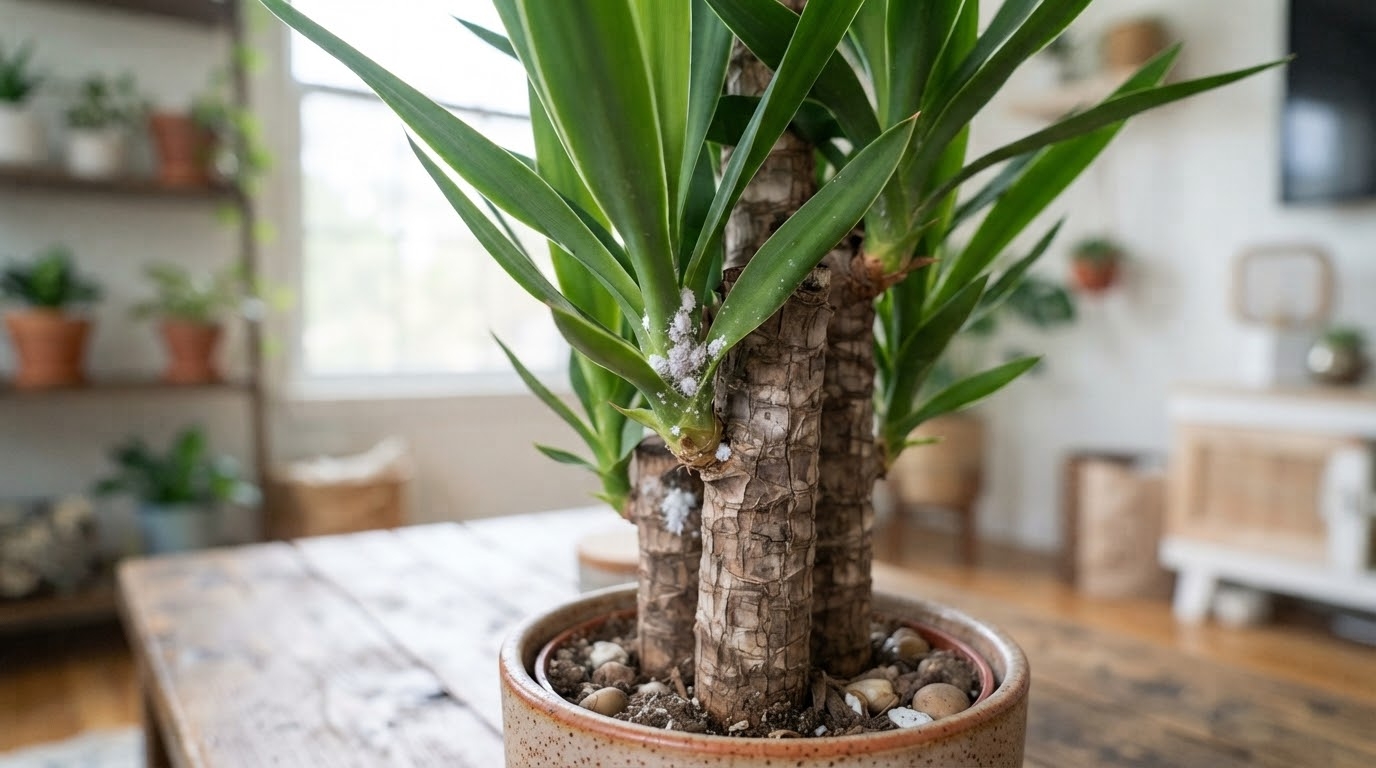
| White cottony spots | Mealybugs |
Why Is My Yucca Turning Yellow?
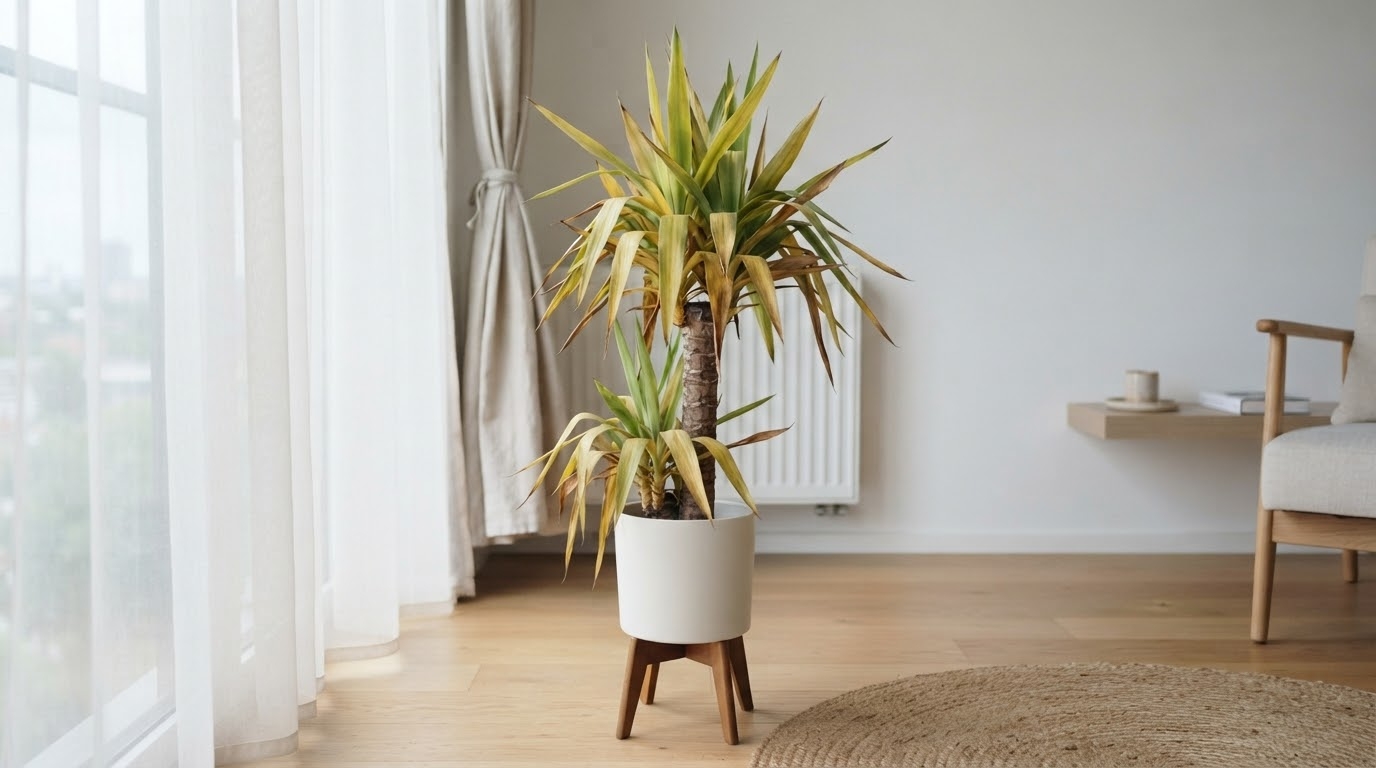
Two entirely different situations produce yellow leaves on a yucca, and separating them takes one touch.
| Normal aging | Root rot | |
|---|---|---|
| Which leaves | Lowest and oldest only | Anywhere, including new growth |
| Feel | Dry, papery | Soft, limp, mushy |
| Progression | Slow, one or two at a time | Several at once, spreading |
| Trunk | Firm | May give under thumb pressure |
| Soil | Dries normally | Stays damp for days |
A yucca’s lower leaves have a finite life. The plant withdraws nutrients from them, they yellow, dry and drop, and the bare trunk beneath the crown gets taller. That is the natural architecture of the species, not a symptom. Trim them off at the trunk once fully brown if you dislike the look. Palms follow a similar rule: on an areca, one old frond browning within a few days is normal, while fronds that stay half yellow for months point to a potassium shortage, as our guide to areca palm yellow leaves explains.
Soft yellowing anywhere else is the plant telling you its roots are failing. NC State names overwatering and the resulting root rot as the primary problem with this plant, and UF/IFAS states that no diseases are of major concern “except root rot in soils kept too moist.”
How Do You Save an Overwatered Yucca?
Quickly, and by looking at the roots rather than guessing.
- Stop watering immediately. Not “water less”: stop, until you know what you are dealing with.
- Take the plant out of the pot. This feels drastic and is not. You cannot diagnose root rot from above the soil line.
- Look and smell. Healthy yucca roots are firm and cream-colored. Rotted roots are brown or black, soft, and often smell sour.
- Cut away every rotted root with clean scissors, back to firm white tissue.
- Repot into fresh gritty mix. NC State’s recommendation for indoor yucca is one part potting mix to three parts perlite or sand. Do not reuse the sodden old medium.
- Wait a few days before watering, then water sparingly while it recovers.
If more than about half the root system is gone, the odds are poor, but the top of the cane may still be salvageable as a cutting. That is often the better outcome than nursing a rotted base.
Preventing the repeat
Most overwatering is a scheduling error rather than a volume error. Missouri Botanical Garden’s instruction is to water regularly but let the soil dry between waterings, and specifically, “during indoor winter months, reduce watering to the minimum.”
The plant slows in winter, the room is cooler, the soil dries far more slowly, and a routine that was correct in July becomes lethal in January. Check the soil two inches down instead of counting days.
Why Is My Yucca Trunk Soft?
This is the serious one. A yucca trunk should be hard as wood. If it gives under thumb pressure, particularly near the soil line, rot has moved from the roots into the cane itself.
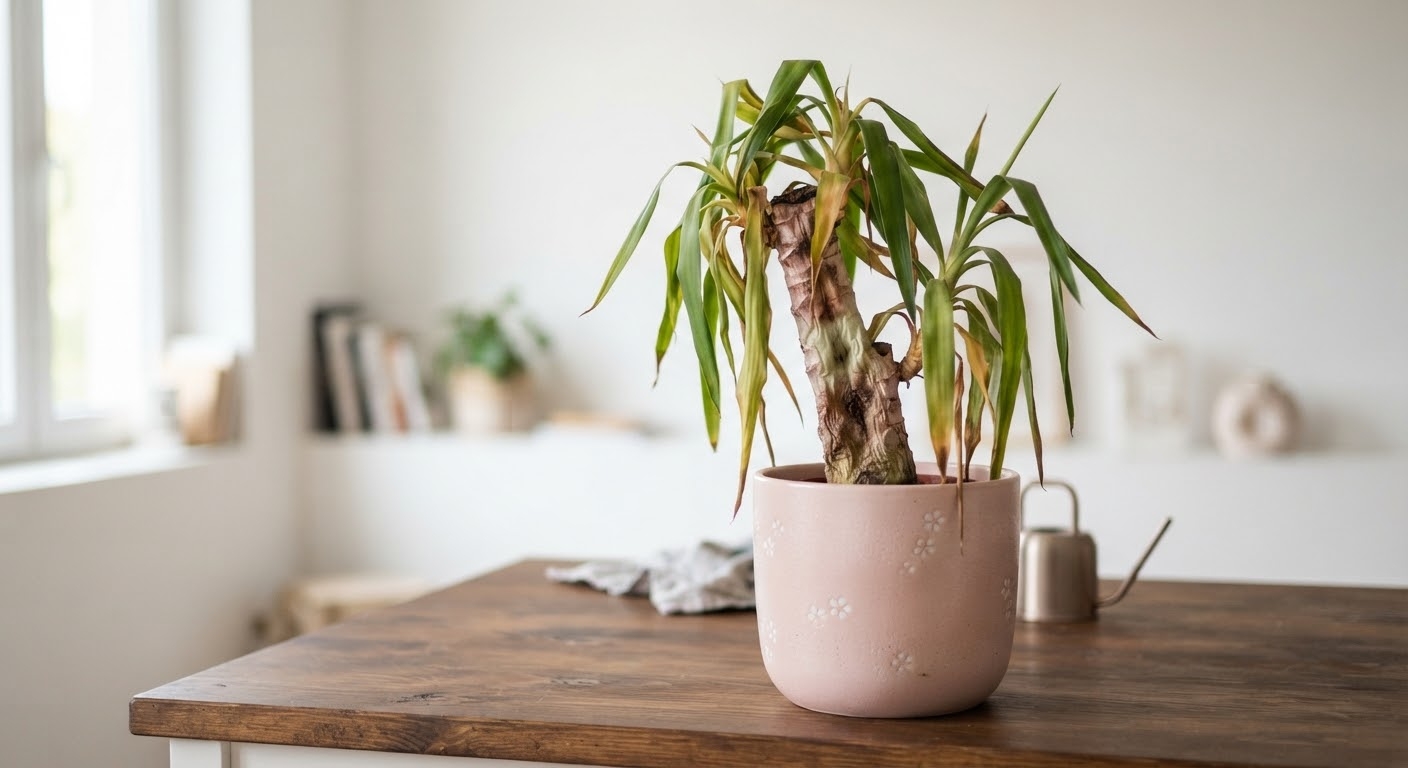
By the time the trunk is soft, saving the whole plant is unlikely. What you can often save is the healthy portion above the damage.
- Feel down the trunk to find where soft becomes firm.
- Cut well above that line with a clean saw, into solid, dry, white tissue.
- Check the cut face. Discolored or damp means cut higher.
- Let the section callus for two to three days in a dry spot.
- Pot it into gritty mix and treat it as a cutting.
Discard the rotted base and the old soil. Do not attempt to nurse a spongy trunk back: rot in a cane moves upward and does not reverse.
Why Are My Yucca’s Leaf Tips Brown?
Brown tips are cosmetic rather than dangerous, but they have several causes and the internet’s favourite is the least supported.
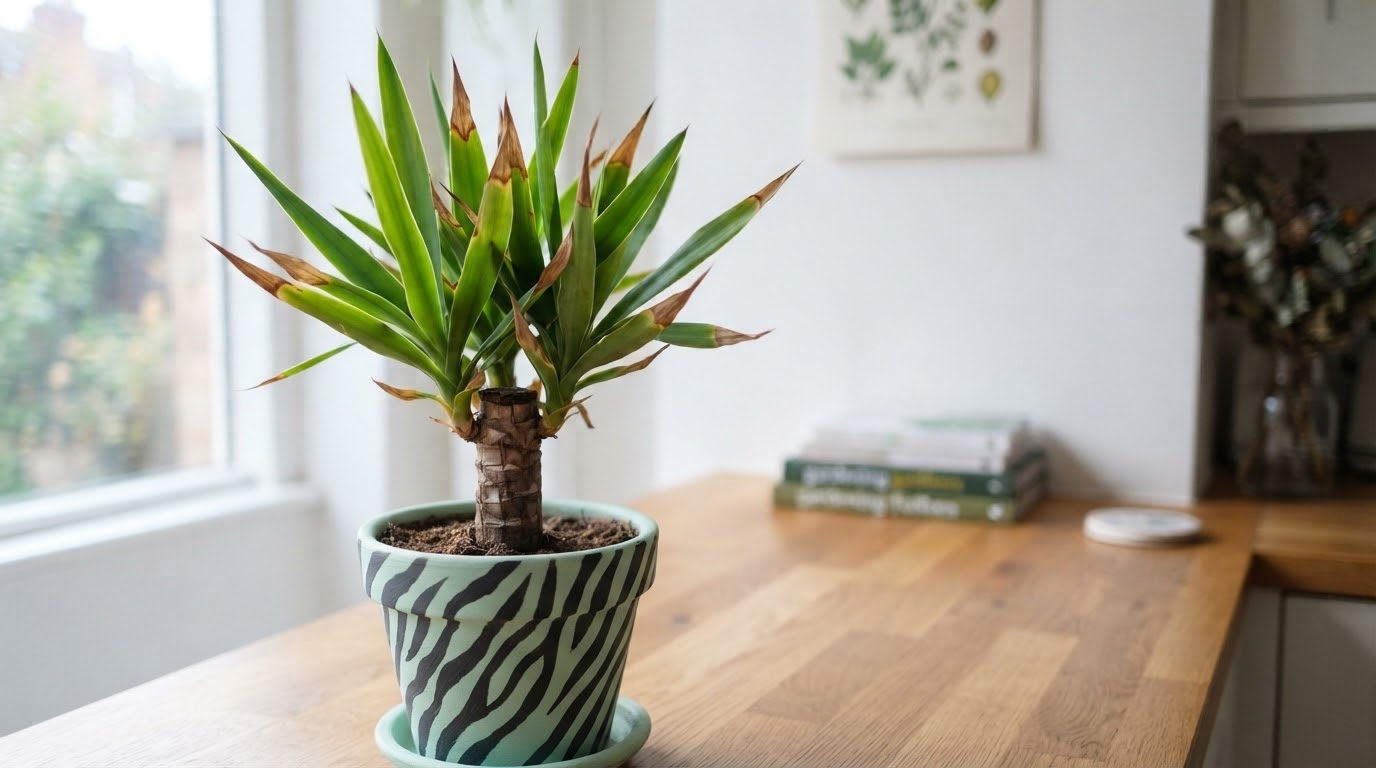
The well-supported causes:
- Dry indoor air. Heated homes often run 20–35% humidity in winter.
- Salt accumulation from tap minerals or over-fertilizing. Flush the pot (water until it runs freely from the drainage holes, several times) to clear built-up salts.
- Underwatering. Less common than overwatering, but tips go first when it happens.
The popular explanation worth hedging: fluoride in tap water. Extension sources document fluoride sensitivity in dracaena, cordyline and spider plant, but not in yucca. Dracaena is a related cane plant in the same family, so it is plausible, and switching to distilled water costs nothing once the other causes are ruled out. It simply is not established for this species, whatever plant blogs assert.
Once a tip is brown it stays brown. Trim the dead portion with scissors, following the leaf’s natural taper, and judge your fix by whether new growth comes in clean.
What Are the Spots on My Yucca Leaves?
Scattered brown spots that start on the older leaves are most often fungal leaf spot, and on a yucca it is a cosmetic problem rather than a dangerous one. UF/IFAS, in its fact sheet on Yucca gigantea, says leaf spots “sometimes infect yucca but do no real harm to the plant.” The fix is keeping the leaves dry, not a spray.
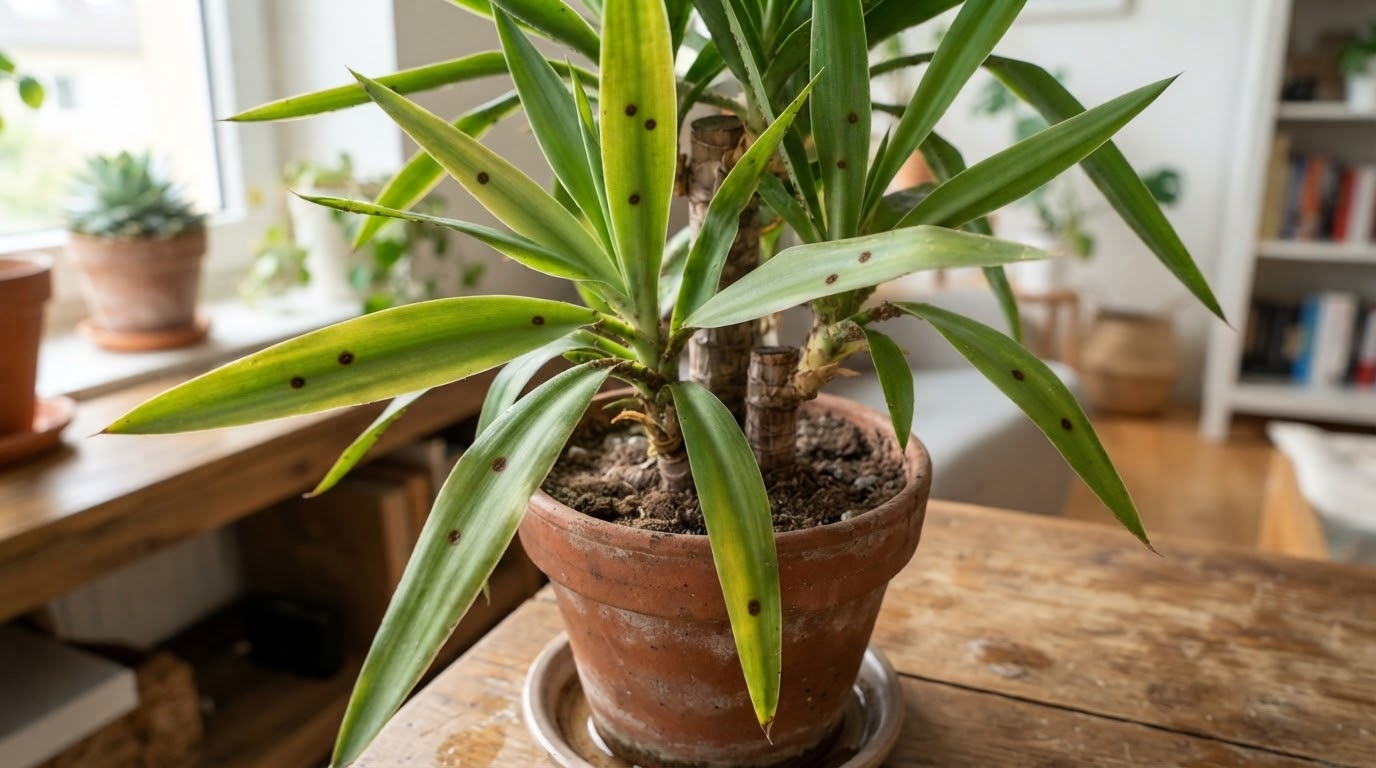
The RHS names Coniothyrium concentricum as the main cause, with Colletotrichum much less common. University of Illinois Extension adds Cercospora and Cylindrosporium to the list and calls Coniothyrium the most common of them, also known as brown leaf spot. The California Department of Food and Agriculture has also recorded Phyllosticta yuccae on nursery stock of Y. elephantipes. You do not need to know which fungus you have: they spread the same way and are handled the same way.
How yucca leaf spot develops
The RHS describes the sequence: tiny pale spots appear first on older leaves, turn yellow, then purple-brown, and settle into oval spots scattered across the upper surface. Illinois Extension notes that the brown lesions often carry a yellow halo. After about four months, tiny black fruiting bodies form in concentric rings on the sunken spots, and badly affected leaves can look scorched, especially at the tips.
The disease needs water sitting on the leaf. The RHS links it to long wet spells and says the spores travel in splashing water. Outdoors that means rain; indoors, the usual sources are misting and watering over the top of the plant.
Spots that are not leaf spot
Several other problems leave marks on yucca leaves. What the damage looks like up close, and where it sits, tells them apart.
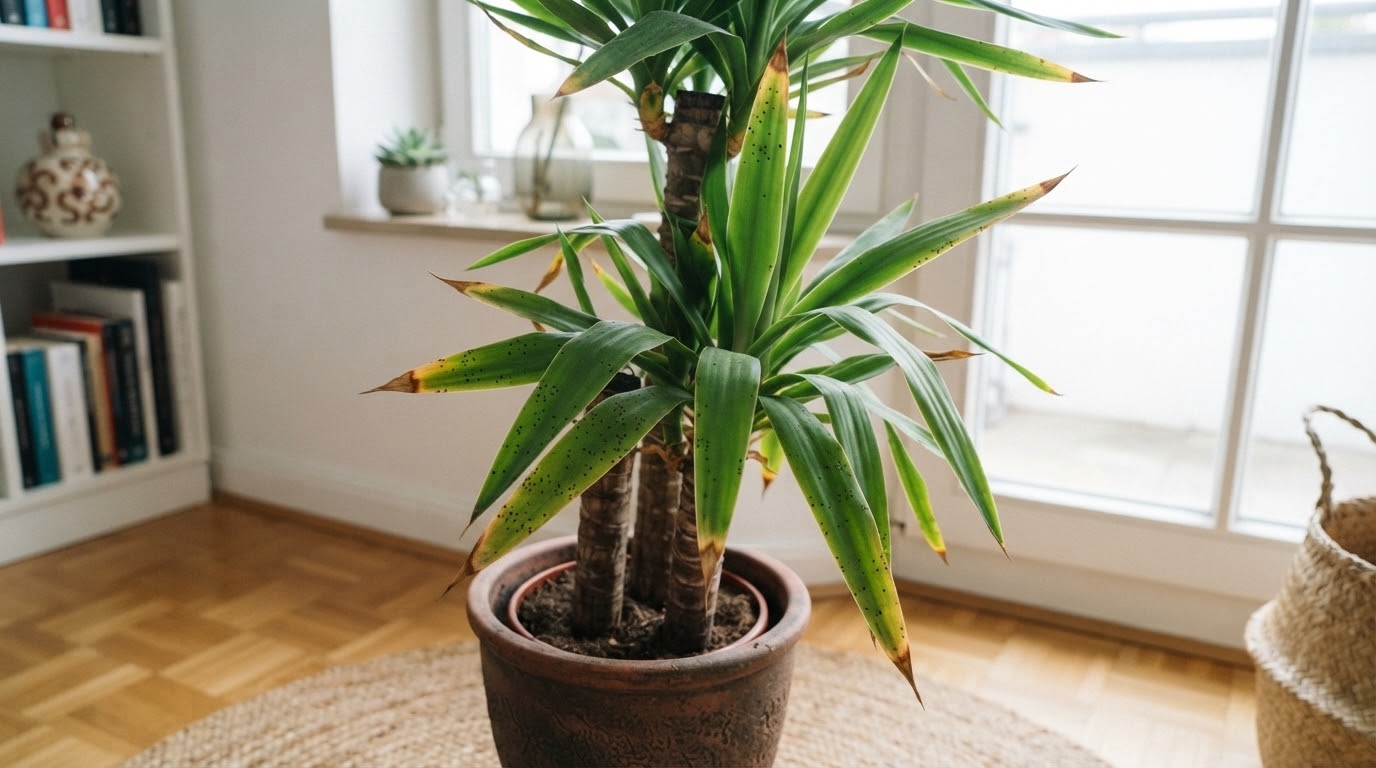
| What you see | Likely cause | Source |
|---|---|---|
| Oval brown or purple-brown spots, often with a yellow halo, starting on older leaves; black dots in rings later | Fungal leaf spot | RHS, Illinois Extension |
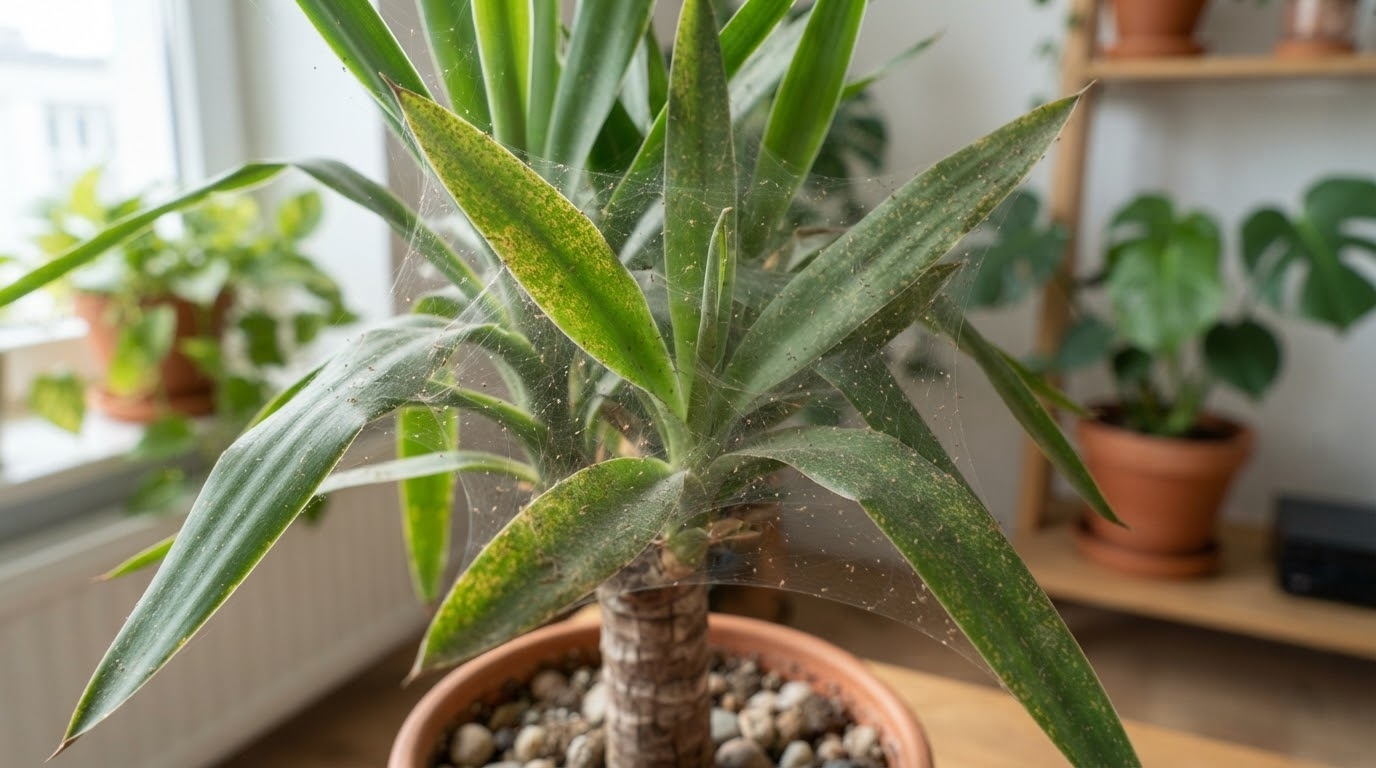
| Fine pale speckling and a faded look, sometimes with webbing | Spider mites (see pests below) | Clemson HGIC |
| Silvery or speckled patches | Thrips | Clemson HGIC |
| Pale speckling with tiny black specks of excrement, on plants kept outdoors in summer | Yucca plant bug | NC State Extension |
| Bleached patches on sun-facing leaves after a move from indoors into full sun | Sun scorch | UGA Extension |
| White or straw-colored spots where cold water landed | Cold water splash | Clemson HGIC |
Browning that starts at the tip or edge and moves inward is a different problem, covered in the brown tips section above.
How to treat leaf spot on a yucca
- Cut off the worst leaves at the trunk and throw them away. The RHS advises removing heavily infected leaves and clearing fallen ones, and Illinois Extension notes that the fungus keeps producing spores on spotted leaves.
- Keep water off the foliage. Water the soil directly and stop misting. Clemson’s houseplant guidance puts it plainly: “Do not mist leaves.”
- Give it air. A yucca packed into a tight group of plants stays damp longer; Clemson recommends good air circulation.
- Judge by new growth. Existing spots will not fade. If new leaves come in clean, the problem is under control.
Fungicide is where the sources split. The RHS recommends against using one on yucca leaf spot, while Illinois and Arkansas extension list copper-based products for outdoor plants that cannot avoid overhead watering. For a yucca indoors, I would not spray at all: you control the watering, so you can remove the cause directly. If only a few old leaves are marked, my advice is to leave them until they yellow and drop on their own, and watch the new growth instead.
Why Is My Yucca Drooping?
Drooping means the plant cannot move water to its leaves, and there are two opposite reasons for that.
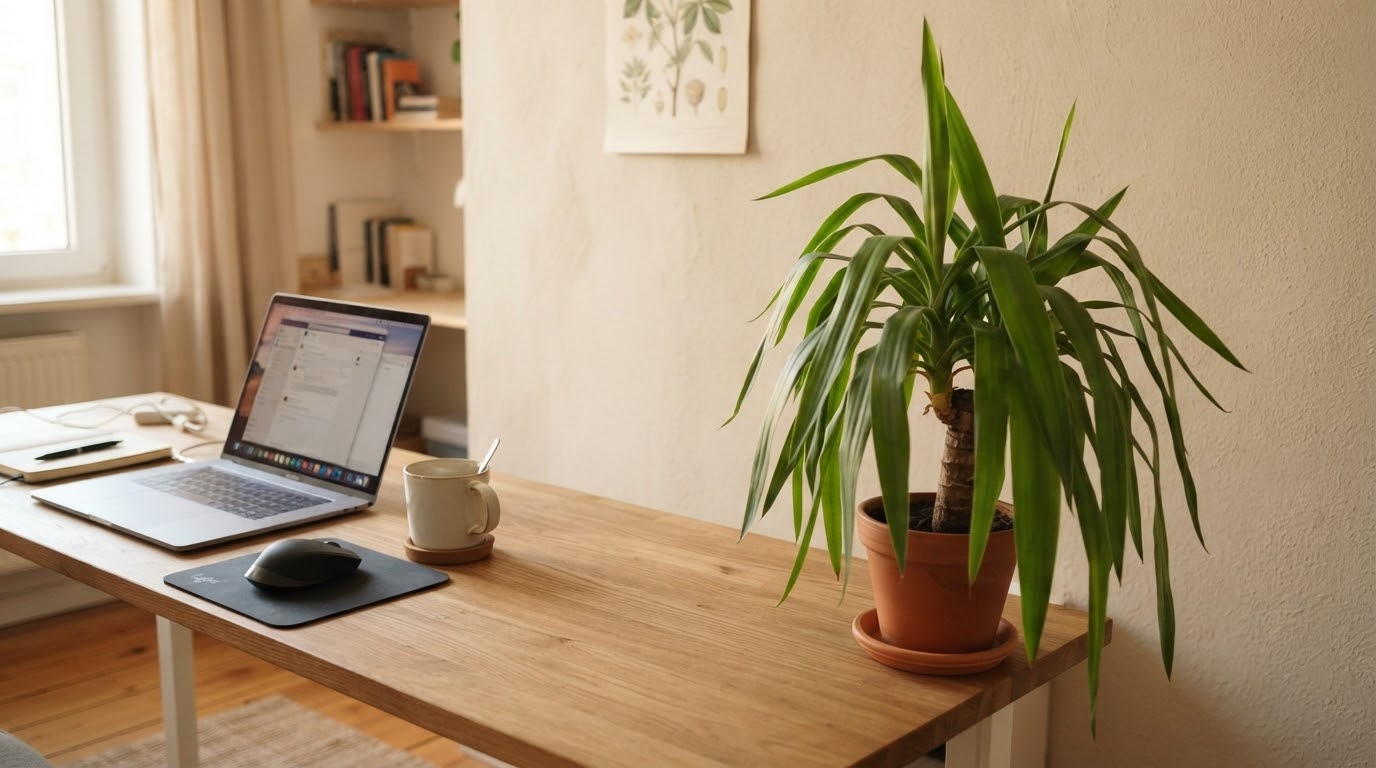
Root rot is the more common. Damaged roots cannot take up water no matter how wet the soil is, so the plant wilts while sitting in moisture. Check: soil damp, leaves soft, possibly yellowing. Treat as overwatering above.
Severe underwatering produces the same limpness with dry, light soil and crisping leaf edges. This one is easy: water thoroughly, let it drain completely, and the plant usually firms up within a day or two.
The diagnostic is the soil, not the leaves. Wet soil plus drooping means the roots are the problem. Bone-dry soil plus drooping means it is simply thirsty.
Why Is My Yucca Stretching and Pale?
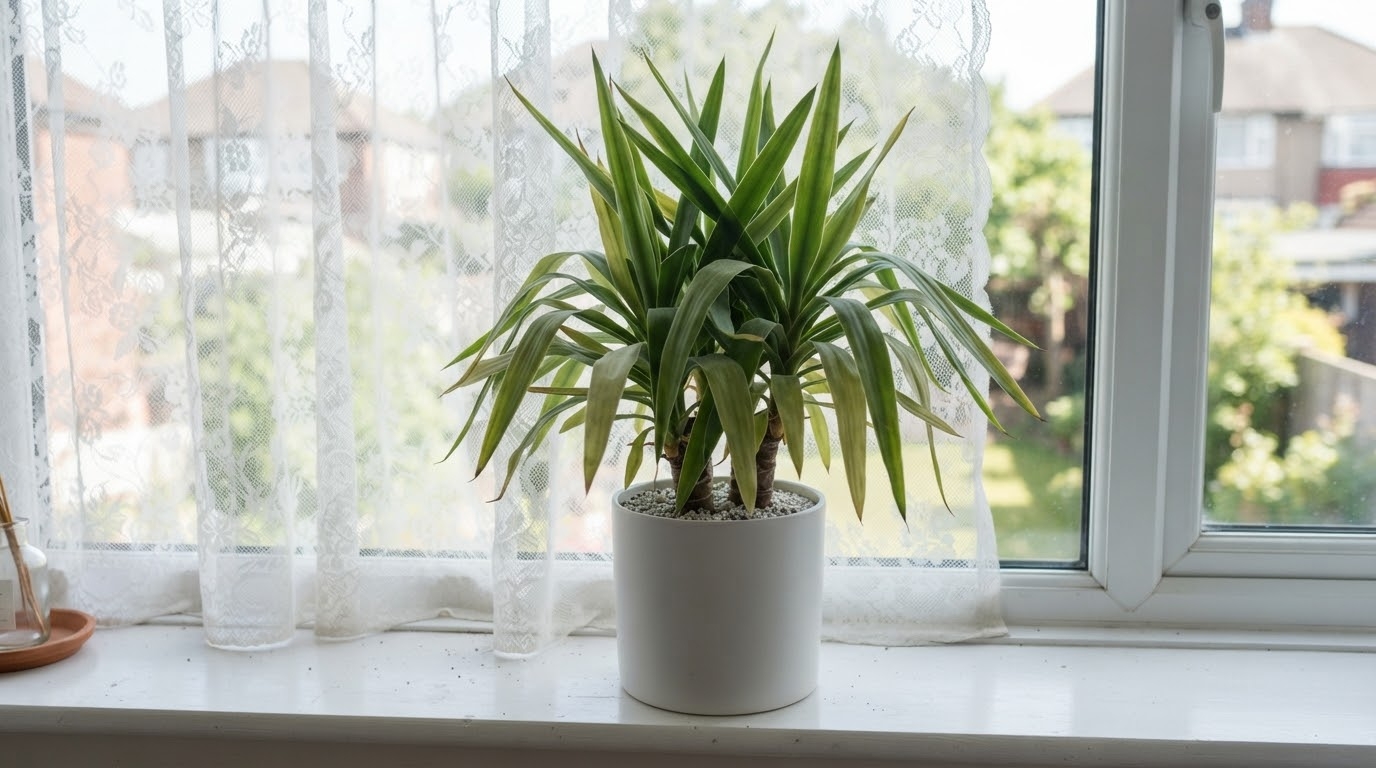
Not enough light. Yucca is a full-sun plant pressed into indoor service, and it responds to shade by etiolating, stretching toward the nearest window with weak, widely-spaced, pale growth.
UF/IFAS puts the indoor minimum at 150 foot-candles, and NC State lists the plant for full sun or partial shade. For scale, Illinois Extension classifies 50–250 foot-candles as low light, so a yucca at that stated minimum is surviving, not thriving. Commercial growers raise these under 6,000–7,000 foot-candles.
Move it to the brightest window you have, ideally south or west facing. Stretched growth will not retract, but new growth comes in compact.
One thing that will not help: fertilizer. Illinois Extension notes a foliage plant needs at least 200 foot-candles for 12 hours daily before fertilization benefits it at all. Feeding a light-starved yucca adds salts it cannot use, which circles back to the brown-tip problem above.
What Pests Attack Indoor Yucca?
NC State and UF/IFAS list mealybugs, aphids, scale insects, black weevils and yucca moth borers between them. Indoors, realistically only the first three appear; borers and root weevils are outdoor pests that will not find a houseplant.
Mealybugs
White cottony masses tucked where leaves meet the trunk. The extension-standard treatment is a cotton swab dipped in rubbing alcohol, applied directly to each cluster. Check weekly for a month afterward, because they hide.
Scale
Small brown bumps on leaves or trunk that do not brush off. Hand-picking works well on yucca because the leaves are few and large enough to inspect properly.
Spider mites
Fine stippling on leaves and webbing in the crown, thriving in dry indoor air. A vigorous jet of water knocks them off; repeat every few days.
For persistent infestations of any of the three, insecticidal soap is the extension-recommended option.
The prevention that matters more than any treatment: Colorado State Extension notes that high-nitrogen fertilizer produces soft, succulent growth that scale, mealybugs and aphids thrive on. Over-feeding does not just waste fertilizer. It manufactures pest problems. And quarantine any new plant for at least three weeks before placing it near others.
My Yucca Is Too Tall and Leggy
Cut it. This is the standard fix, the plant tolerates it well, and you get a second plant out of it.
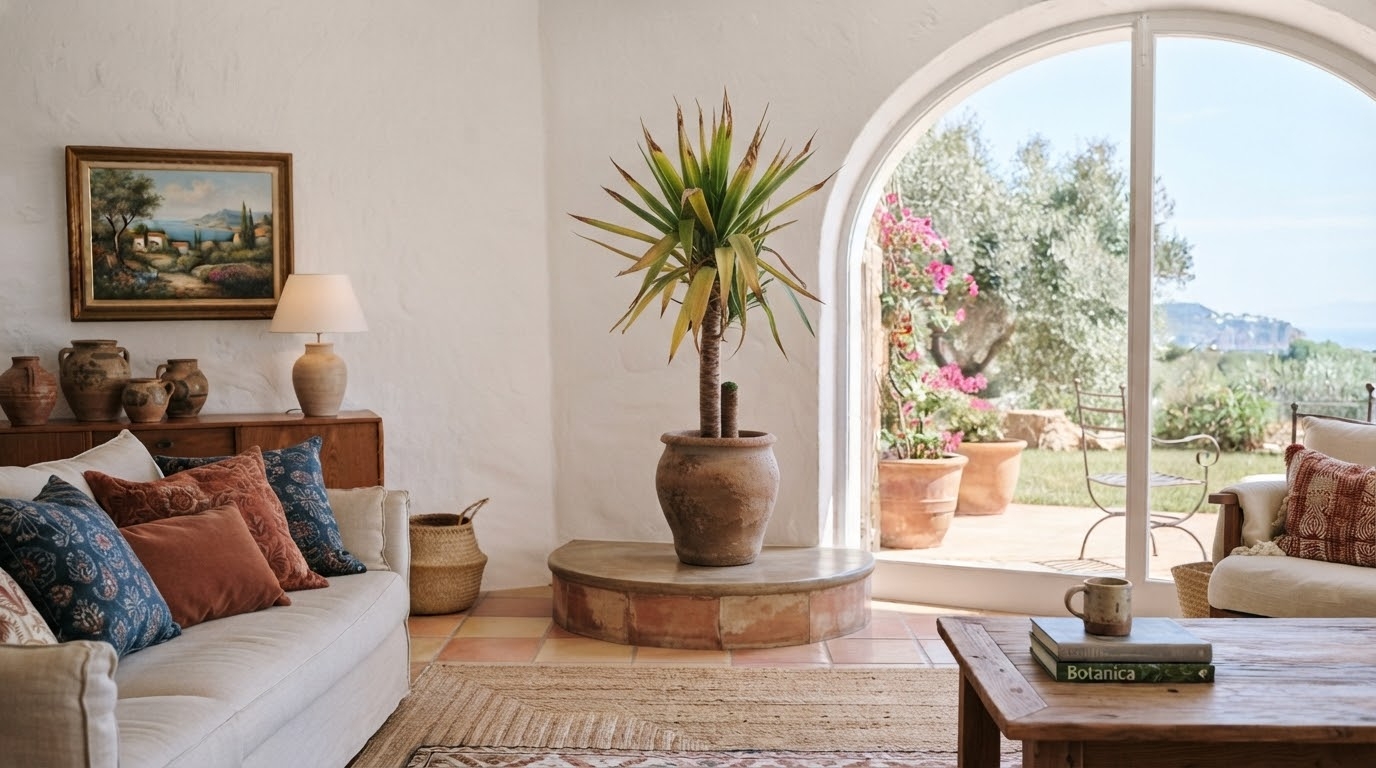
Saw the trunk cleanly at whatever height suits the room. The stump sprouts new rosettes below the cut, usually two or three, which gives a fuller plant than the single crown you started with. The removed top becomes a cutting: callus the cut end for two to three days, pot it in gritty mix, and expect roots in three to four weeks.
Timing matters. Do this in spring or early summer while the plant is actively growing. A cane cut in midwinter sits dormant at the wound and is more vulnerable to rot.
If the legginess came with pale, stretched growth, cutting alone will not fix it: the new rosettes will stretch too unless the light improves.
What Doesn’t Work
Watering a drooping yucca without checking the soil. Half the time drooping means too much water already. Wet soil plus limp leaves means the roots are rotting, and more water accelerates it.
Treating normal leaf drop as a problem. Lower leaves yellowing and falling while the crown stays green is how this plant grows. Nothing needs fixing.
Misting for brown tips. Misting raises humidity for minutes. If dry air is genuinely the cause, a humidifier or grouping plants does something; misting does not.
Fertilizing a struggling yucca. A plant failing from root rot or low light cannot use nutrients, and the unused salts make brown tips worse. Fix the light and the watering first.
Repotting into a much larger pot. More soil means more water held around the roots for longer, precisely the conditions that cause the rot you are trying to escape. Go up one size at most.
Assuming brown tips mean fluoride. Documented for dracaena and spider plant, not for yucca. Check humidity, salts and watering first.
Frequently Asked Questions
Why are the bottom leaves of my yucca turning yellow?
If they are dry and papery and the upper growth is green and firm, that is normal aging: yucca sheds its oldest leaves as the trunk gains height. Soft, mushy yellowing that spreads through the plant indicates root rot instead.
Can a yucca recover from root rot?
Yes, if caught before the trunk softens. Remove the plant from its pot, cut away all brown or mushy roots, repot into a gritty mix of one part soil to three parts perlite, and water sparingly. Once the trunk itself is soft, saving the whole plant is unlikely, so cut above the damage and root the top instead.
Why is my yucca trunk soft and squishy?
Rot has reached the cane, usually from prolonged overwatering. Cut well above the soft section into firm white tissue, callus the cut for two to three days, and pot the healthy top as a cutting. Discard the rotted base and the old soil.
Should I cut brown tips off my yucca?
You can. Trim the dead portion with scissors, following the leaf’s natural taper. It is cosmetic. Brown tissue will not recover, so judge whether your fix worked by looking at new growth rather than old leaves.
What are the brown spots on my yucca leaves?
Usually fungal leaf spot, most often caused by Coniothyrium concentricum. It starts on older leaves, spreads in splashing water and, according to UF/IFAS, does no real harm to the plant. Remove the worst leaves, water the soil rather than the foliage, and stop misting. Fine, pale speckling is more likely spider mites.
How do I know if I’m overwatering or underwatering my yucca?
Feel the leaves and the soil. Overwatering gives soft, mushy, yellowing leaves with damp soil. Underwatering gives dry, crisp, curling leaves with light, bone-dry soil. Overwatering is far more common and far more dangerous.
Why won’t my yucca grow?
Usually light. Yucca needs the brightest window available, and Illinois Extension notes a foliage plant needs 200 foot-candles for 12 hours daily before fertilizer helps at all. Feeding a plant in poor light does not substitute for the light.
Can I cut the top off my yucca if it’s too tall?
Yes. Cut the trunk at the height you want in spring or early summer; the stump sprouts new rosettes below the cut, and the removed top can be rooted as a new plant.