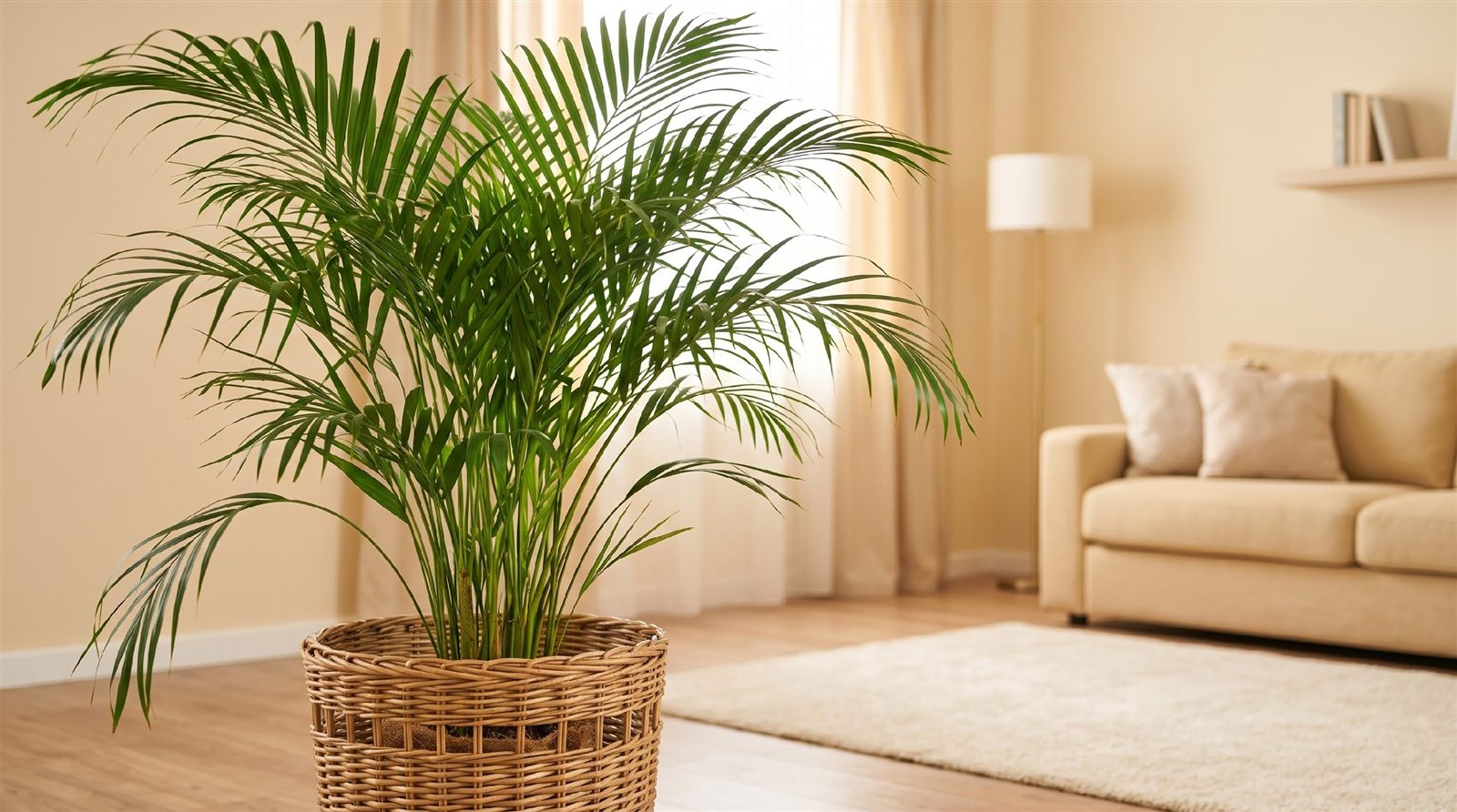
The areca palm you bought is probably not one plant. Growers sow its seed thickly, dozens of seeds to a pot, and sell the seedlings together as a single bushy specimen. That one fact explains most of what goes wrong with it at home: the crowding, the thinning after a year or two, the yellow stems, and why “dividing” it is really separating seedlings.
This areca palm care guide covers the plant’s two botanical names and why both appear on labels, how much light “bright indirect” actually means in numbers, the palm-specific feeding that general houseplant advice skips, how to read yellow fronds by their position on the plant, and why you should not cut most of them off. If you only take one thing from this page, I would make it that last point: it is the most common mistake I see repeated in areca care advice, and the easiest one to stop making.
| Areca Palm Care at a Glance | |
|---|---|
| Botanical name | Chrysalidocarpus lutescens (sold as Dypsis lutescens) |
| Other names | Butterfly palm, golden cane palm, yellow palm |
| Native range | Eastern Madagascar only |
| Indoor height | 6–7 feet, growing 6–10 inches a year (Clemson HGIC) |
| Light | 150–300 foot-candles for adequate growth (University of Kentucky) |
| Water | Water thoroughly when the surface dries; never let it stand in water |
| Temperature | 65–70°F at night, 75–85°F by day; keep above 45°F |
| Fertilizer | Slow-release palm fertilizer (8-2-12 or 12-4-12), 2–3 times a year |
| Main pest | Spider mites |
| Pets | Non-toxic to cats, dogs and horses (ASPCA) |
Is It Dypsis lutescens or Chrysalidocarpus lutescens?
Both names are on sale, and only one is current. Hermann Wendland described the species as Chrysalidocarpus lutescens in 1878. In 1995, palm botanists Henk Beentje and John Dransfield folded Chrysalidocarpus into the large genus Dypsis, and the plant became Dypsis lutescens. That is still the name on most plant tags.
That merger did not survive DNA work. A 2022 study by Wolf Eiserhardt and colleagues, including palm botanists at Kew, published in the journal Taxon, found that Dypsis in the broad sense was not a natural group and resurrected Chrysalidocarpus. Because the genus came back, Wendland’s original 1878 name became the accepted one again. Kew’s World Checklist of Vascular Plants and NC State Extension now use Chrysalidocarpus lutescens; the ASPCA and most University of Florida fact sheets still list it as Dypsis lutescens. They are the same plant.
In the wild it grows only in eastern Madagascar, in open areas of wet forest and along riverbanks. It is listed as Near Threatened by the IUCN (2012 assessment). That is an odd status for a palm that UF/IFAS describes as “overused” in Florida landscapes.
Is Areca Palm the Same as Bamboo Palm or Betel Nut Palm?
No to both, and the second mix-up matters.
- Bamboo palm usually means Chamaedorea seifrizii, a smaller, more shade-tolerant palm. NC State does list “bamboo palm” as one of the areca’s common names, which is why the two are confused in stores and online.
- Betel nut palm is Areca catechu, the only plant here that is actually in the genus Areca. Its seed, the areca nut, contains the alkaloid arecoline, and the International Agency for Research on Cancer classifies areca nut as carcinogenic to humans (Group 1). Some plant-ID apps and websites apply Areca catechu data to the areca palm, which is where most “areca palm is toxic” claims come from.
The “areca” in the houseplant’s common name is a holdover, not a botanical link. If a label says Areca catechu, you are holding a different plant.
What Is Actually in the Pot You Bought?
A crowd of seedlings. UF/IFAS describes the nursery method in its palm seed germination bulletin: areca seed is sown “very thickly,” and the germinated seedlings “will be transplanted together to make a dense specimen plant.” A finished areca in a 10-inch pot is usually many separate plants, each with its own root system, competing for the same soil.
Three things follow from this:
- Crowding is built in. Some stems will be shaded out and die over the first couple of years. A few browning stems at the base of a dense pot is normal attrition, not a sign the whole plant is failing.
- Each stem is permanent. Palm stems grow from a single growing point at the tip and cannot branch or regrow if that point dies (UF/IFAS, palm anatomy). A dead stem stays dead; new stems come only from the base.
- Division is separation. When you split an areca, you are mostly untangling individual seedlings rather than cutting one plant in half. The propagation section below walks through it.
How Much Light Does an Areca Palm Need?
More than “bright indirect light” suggests to most people. The University of Kentucky gives the clearest indoor figure: arecas need “150 to 300 foot candles of light for adequate growth.” Clemson HGIC translates that into placement: bright indirect light near an east-, west- or south-facing window.
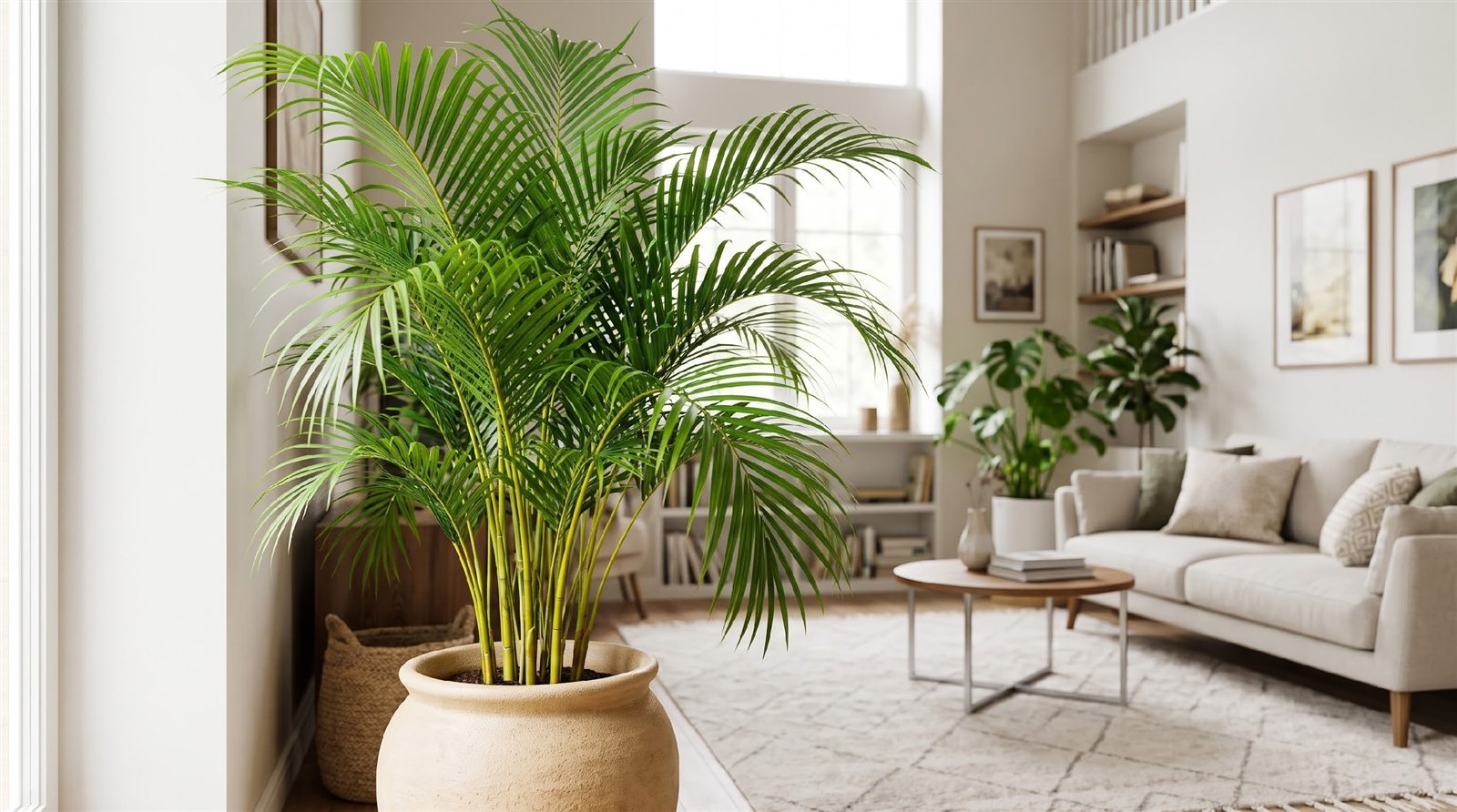
For scale, commercial growers in Florida produce arecas at 5,000 to 6,000 foot-candles, about 50% shade outdoors (UF/IFAS production guide). A living room a few feet from a window delivers a small fraction of that. Arecas tolerate relatively low light and survive in offices, but growth slows and the clump thins.
The opposite extreme also causes problems. UF/IFAS notes that young palms in full sun develop yellow leaves, and that the plant’s yellowing “can be regulated somewhat with shading.” Direct afternoon sun through glass is too much.
How to check your spot: free light-meter phone apps read in lux. One foot-candle is about 10.8 lux, so the 150–300 foot-candle range works out to roughly 1,600–3,200 lux at leaf height. Take the reading at midday, at the height of the fronds, not on the windowsill. I think this two-minute check is worth doing before you buy a large areca, because a spot that looks bright to us is often well under 150 foot-candles.
How Often Should You Water an Areca Palm?
Clemson HGIC’s indoor palm fact sheet has the most practical rule: “Water thoroughly when the surface of the soil dries, and discard the water in the saucer after the pot drains.” The same fact sheet adds that palms “should never be allowed to dry out or allowed to stand in water.”
UF/IFAS production notes say arecas can tolerate low soil moisture, but “best growth is obtained if plants are not subjected to drought conditions.” In practice that means checking the soil surface every few days in summer and less often in winter, when growth and water use drop.
The two failure modes look different:
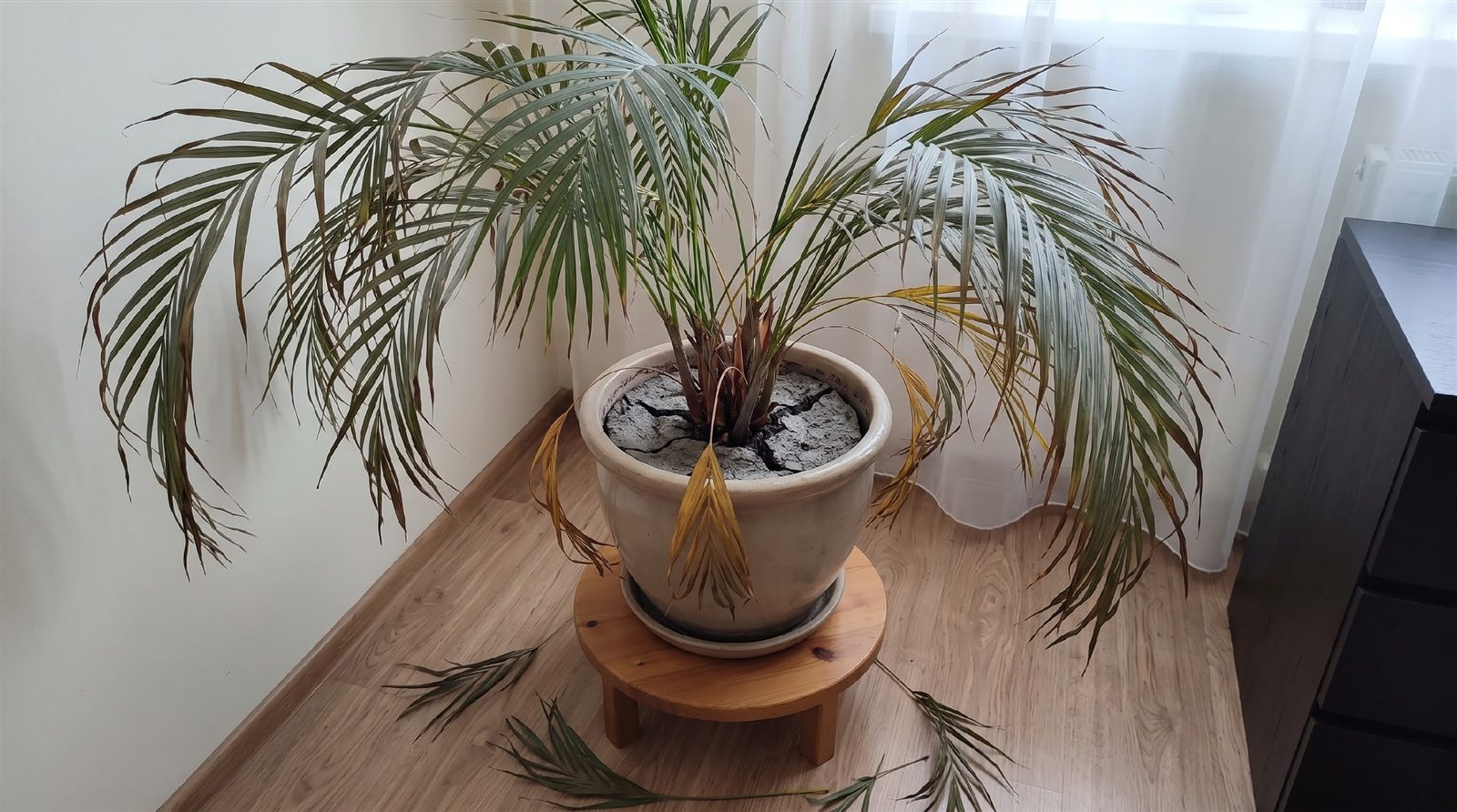
- Too dry: growth slows, older leaflets fold along the midrib, and leaf tips die back, starting on the older fronds (UF/IFAS palm diagnostic tool). Soil pulls away from the pot edge and may crack.
- Too wet: the newest fronds turn yellow. UF/IFAS palm nutrition specialist Timothy Broschat attributes the “vast majority” of iron deficiency in container palms to poor soil aeration. Waterlogged roots cannot take up iron, so the yellowing shows on new growth even when there is plenty of iron in the pot. Severe root rot causes wilting despite wet soil.
What Temperature and Humidity Does an Areca Palm Need?
Clemson gives the ideal range for arecas specifically: “Temperatures at night of 65 to 70 °F and 75 to 85 °F during the day.” Most indoor palms need to stay above 45°F to avoid chilling damage, and should be kept away from drafts near doors, windows and air conditioning.
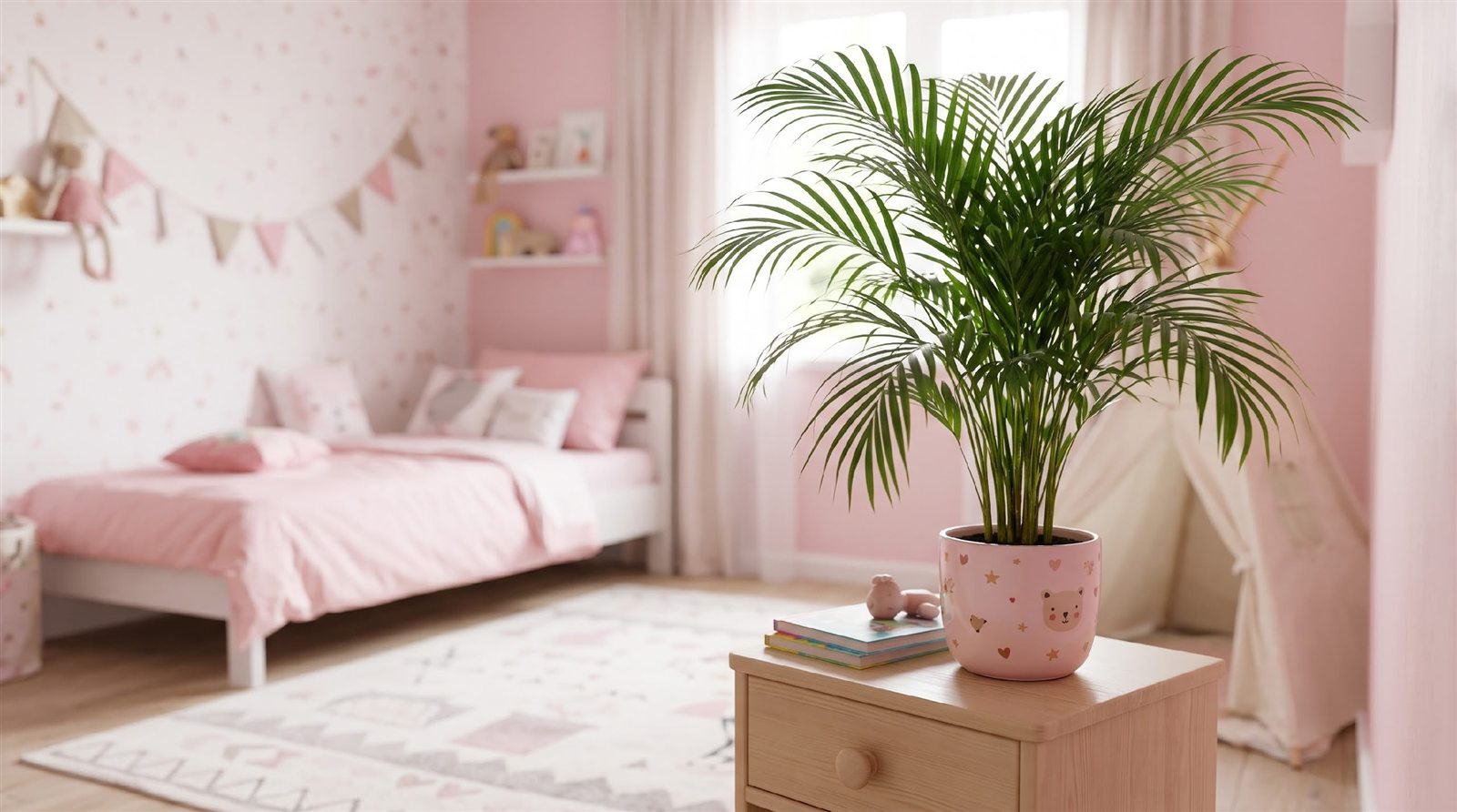
The hard limit is lower but not much lower. UF/IFAS notes arecas tolerate short spells at 32°F with some leaf damage, while “long durations of 32°F or lower will severely damage or kill the plants.” Chilling injury shows as discoloration and reddish or black blotches, and palms that are already short of potassium are hit harder by cold.
Humidity is a pest question as much as a comfort one. Clemson suggests a gravel-filled saucer when humidity drops below 50%, or a humidifier. Dry, warm winter air is exactly what spider mites need. Our guide to raising humidity for houseplants covers what actually moves the number.
Outdoors: UF/IFAS rates the areca for USDA zones 10A through 11. Elsewhere it can spend summer outside in partial shade, but bring it in well before night temperatures approach 45°F.
What Soil and Pot Does an Areca Palm Need?
A porous, well-drained mix with plenty of organic matter (Clemson). UF/IFAS production mixes use peat, pine bark and sand (for example 6:3:1) with dolomite to hold the pH near 6.0. A good-quality bagged mix with added pine bark works for home growers.
Two details are specific to this palm:
- Keep perlite low and pH at 6.0–6.5. Penn State Extension and UF/IFAS both advise avoiding perlite and superphosphate and keeping the pH between 6 and 6.5 for arecas. Both materials release fluoride, which causes small dead spots in chains between the leaf veins. At pH above 6.0, the plant tolerates fluoride well.
- Do not bury the stems. UF/IFAS states that palms are “very intolerant of being planted too deeply, regardless of age or size.” For seedlings, as little as half an inch too deep can set them back badly. Keep the soil line exactly where it was in the old pot.
Clemson notes that palms “do best when their roots are confined” and may only need repotting every two to three years, in spring or early summer. Move up one pot size at a time; Broschat warns that over-potting keeps the mix too wet. If roots are circling the old pot, UF/IFAS says there is no need to cut them on container palms, because new roots grow from the base of the stems and replace them.
What Fertilizer Is Best for an Areca Palm?
A slow-release palm fertilizer, not a general houseplant feed. Clemson recommends “a slow-release palm fertilizer with an analysis like 12-4-12 or 8-2-12,” applied “only two to three times a year while the plant is actively growing during the spring and summer months.”
The reason for a palm-specific product is magnesium and micronutrients. Broschat’s container research found that the dolomite mixed into potting soil to supply magnesium “is usually exhausted after about six months,” and arecas need supplemental micronutrients to avoid chlorosis. Palm fertilizers include both, while many general houseplant feeds contain little or no magnesium. Broschat also found controlled-release fertilizers “slightly better than liquid fertilization” for container palms. My advice is to skip the liquid houseplant feed for this palm entirely: two doses of slow-release palm fertilizer a year is less work and covers the magnesium that general feeds leave out.
More is not better. Arecas are more sensitive to soluble salts than most foliage plants (UF/IFAS), and Clemson notes that the tips of lower leaves “may turn brown and die from excessive fertilization.”
Nutrient shortages show in predictable places. This table, built from Broschat’s UF/IFAS work on container palms, is the fastest way to narrow down a discoloration:
| Shortage | Which fronds | What it looks like |
|---|---|---|
| Nitrogen | Oldest first, then whole canopy | Uniform light green to yellow; golden leaf stalks on potted arecas |
| Potassium | Oldest | Translucent yellow-orange spots, worst toward the leaf tip; dead tips and edges |
| Magnesium | Oldest | Broad yellow bands along the edges, green center; never dead tips |
| Iron (usually wet roots) | Newest only | Uniformly yellow new fronds |
| Manganese | Newest | Yellow with dead streaks, worst at the leaf base |
One finding surprises most owners: Broschat identifies the golden stems and leaf bases commonly seen on container-grown arecas as nitrogen deficiency, and he describes potassium deficiency as relatively uncommon in pots. UF/IFAS county agents also note that some yellowing of the stems is a natural trait of the species. Golden stems on an otherwise green, growing plant are not an emergency.
Why Are My Areca Palm Fronds Turning Yellow or Brown?
Start with where the discoloration is. Old fronds and new fronds point to different causes.
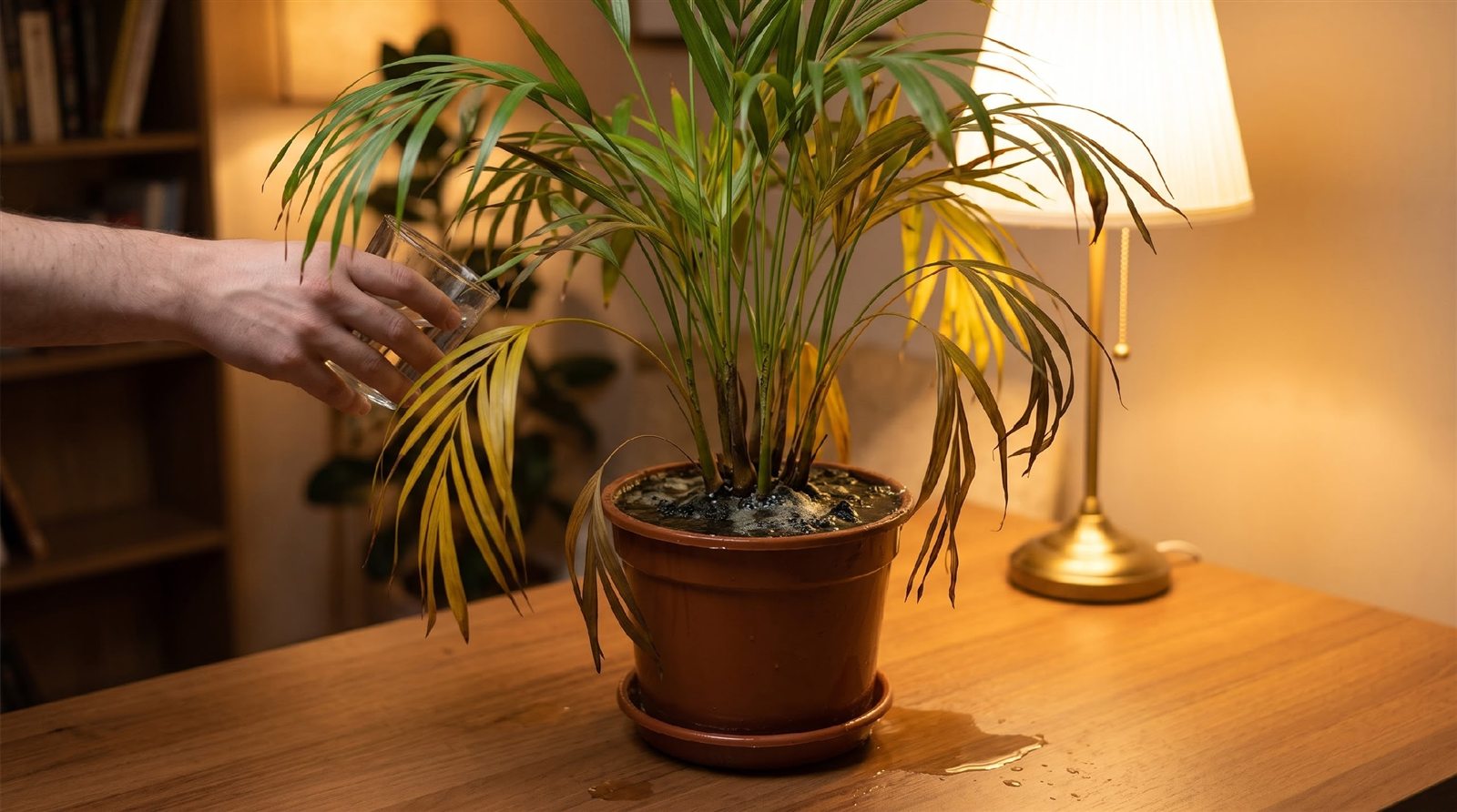
Yellow Fronds: Old Growth or New Growth?
Yellow on the oldest fronds points to normal aging or a nutrient shortage, which the table above helps you narrow down. Yellow on the newest fronds points to wet or worn-out soil around the roots. Every pattern, how to confirm it and how long recovery takes is covered in our guide to areca palm yellow leaves.
Should You Cut Off Yellow Fronds?
Not while they are still partly green. Broschat’s advice, repeated by UF/IFAS extension offices, is that discolored older fronds on a potassium-deficient palm should stay on the plant, because the palm is moving potassium out of them into new growth. A UF/IFAS county office puts it bluntly: removing them on a regular basis “has been shown to accelerate the rate of decline.” The original research was done on pygmy date palms, but the extension service applies it to palms generally. In my opinion this is the single most useful thing to know about areca care, because tidying up yellow fronds feels like good maintenance while it quietly makes the problem worse.
What you can remove at any time: fronds that are completely brown and dry, and dead stems. Cut close to the base with clean shears, without nicking the stems you are keeping. Pruning will not make an areca shorter: Clemson notes that palms cannot be pruned back to reduce their height.
What Causes Brown Leaf Tips?
- Too much fertilizer or salt buildup. Brown tips on the lower, older leaves (Clemson). Flush the pot with plain water until it drains freely, and cut back feeding.
- Dry air or missed waterings. Clemson lists both.
- Fluoride. On arecas it shows as small dead spots in chains between the veins rather than classic tip burn (Penn State). Fix the pH and stop using perlite-heavy mixes.
- Leaf-shine products. Clemson warns they “can severely injure the foliage” of palms.
Brown tips do not turn green again. Trim them along the natural leaf shape if they bother you, leaving a thin brown edge so you do not cut into healthy tissue.
Which Pests Attack Areca Palms Indoors?
Spider mites, by a wide margin. Clemson states that “Areca palms are very susceptible to spider mites infestations,” and that mites are a problem indoors “because of low humidity and warm temperatures.” Look for fine pale stippling on the leaflets, especially older ones, and in heavier infestations, fine webbing between the leaflets.
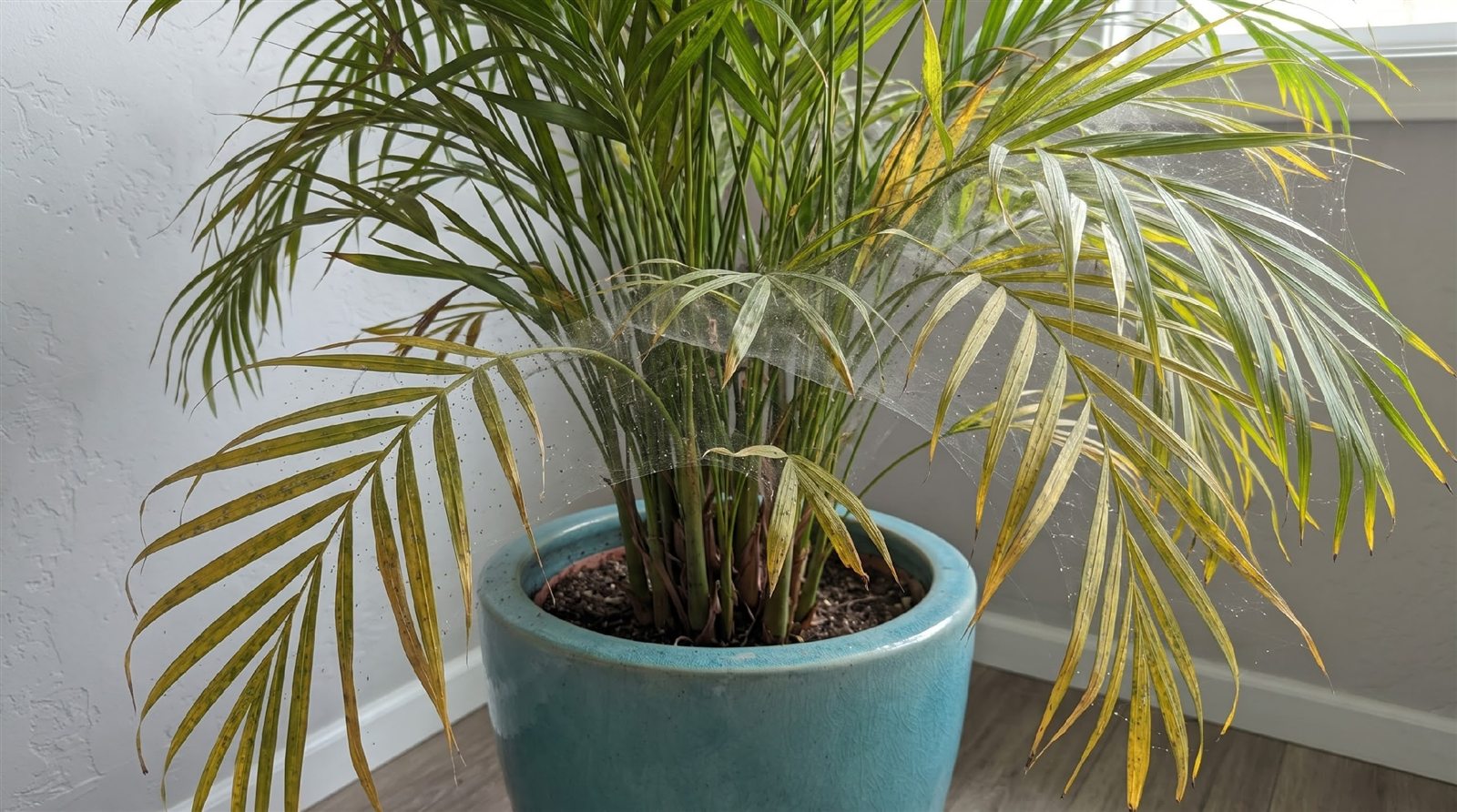
Rinse the whole plant in the shower, including leaf undersides, and raise the humidity around it. For established infestations, use an insecticidal soap or horticultural oil labeled for houseplants, repeating as the label directs. One treatment rarely catches the eggs. If I could recommend one inexpensive tool for areca owners, it would be a 10x hand lens: mites are hard to see with the naked eye, and catching them before the webbing appears saves a lot of trouble.
Scale insects and mealybugs are the other common pests; UF/IFAS lists them as the most common problems on outdoor arecas in Florida. Both look like small bumps or cottony tufts along the stems and leaf midribs. Scale is often noticed first as sticky residue or black sooty mold on the leaves below.
Is Areca Palm Safe for Cats and Dogs?
Yes. The ASPCA lists the areca palm as “Non-Toxic to Dogs, Non-Toxic to Cats, Non-Toxic to Horses.” Its separate entry under the name “cane palm” covers the same plant under both scientific names, Dypsis lutescens and Chrysalidocarpus lutescens.
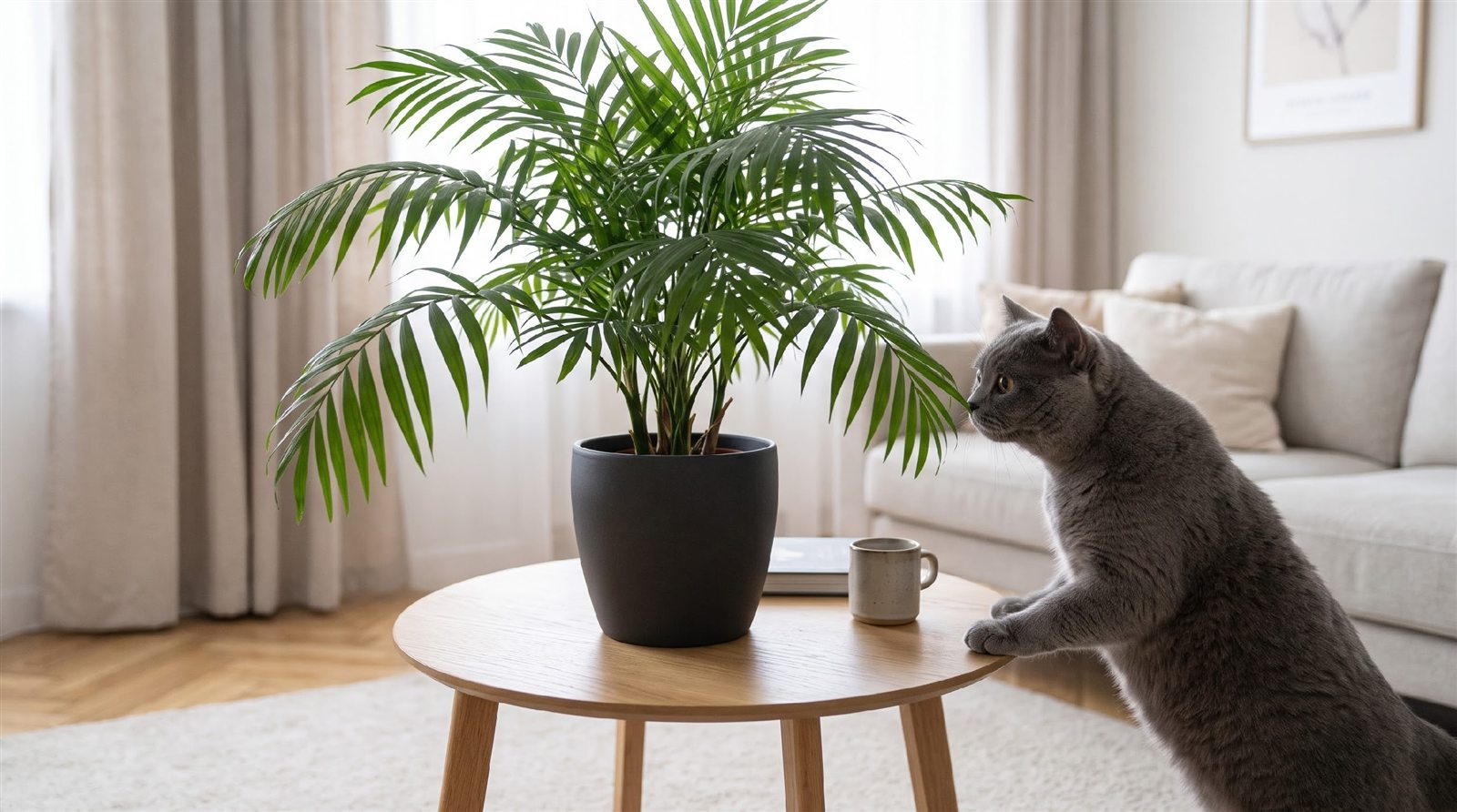
Two other plants cause the confusion:
- Betel nut palm (Areca catechu), covered above, is a different species with a known alkaloid in its seed.
- Sago palm (Cycas revoluta) is not a palm at all but a cycad, and it is one of the most dangerous common plants for pets. The ASPCA lists it as toxic to dogs and cats, with liver failure among the possible effects.

If a plant-ID app tells you your areca is toxic, check which species it matched. If you are choosing between houseplants for a home with pets, our guide to whether ficus is toxic to cats lists other pet-safe trees, including the areca.
How Do You Propagate an Areca Palm?
By division or from seed. Stem cuttings do not work.
Dividing an Areca Palm
UF/IFAS confirms that the areca can be propagated “by seeds or division,” and its container production guide gives the only extension procedure for dividing clustering palms. Divisions are cut “with a sharp spade and carefully lifted with as much of the root ball as can be managed,” then potted and “kept shaded and well-watered until established (4 to 6 months),” with a fungicide drench after potting.
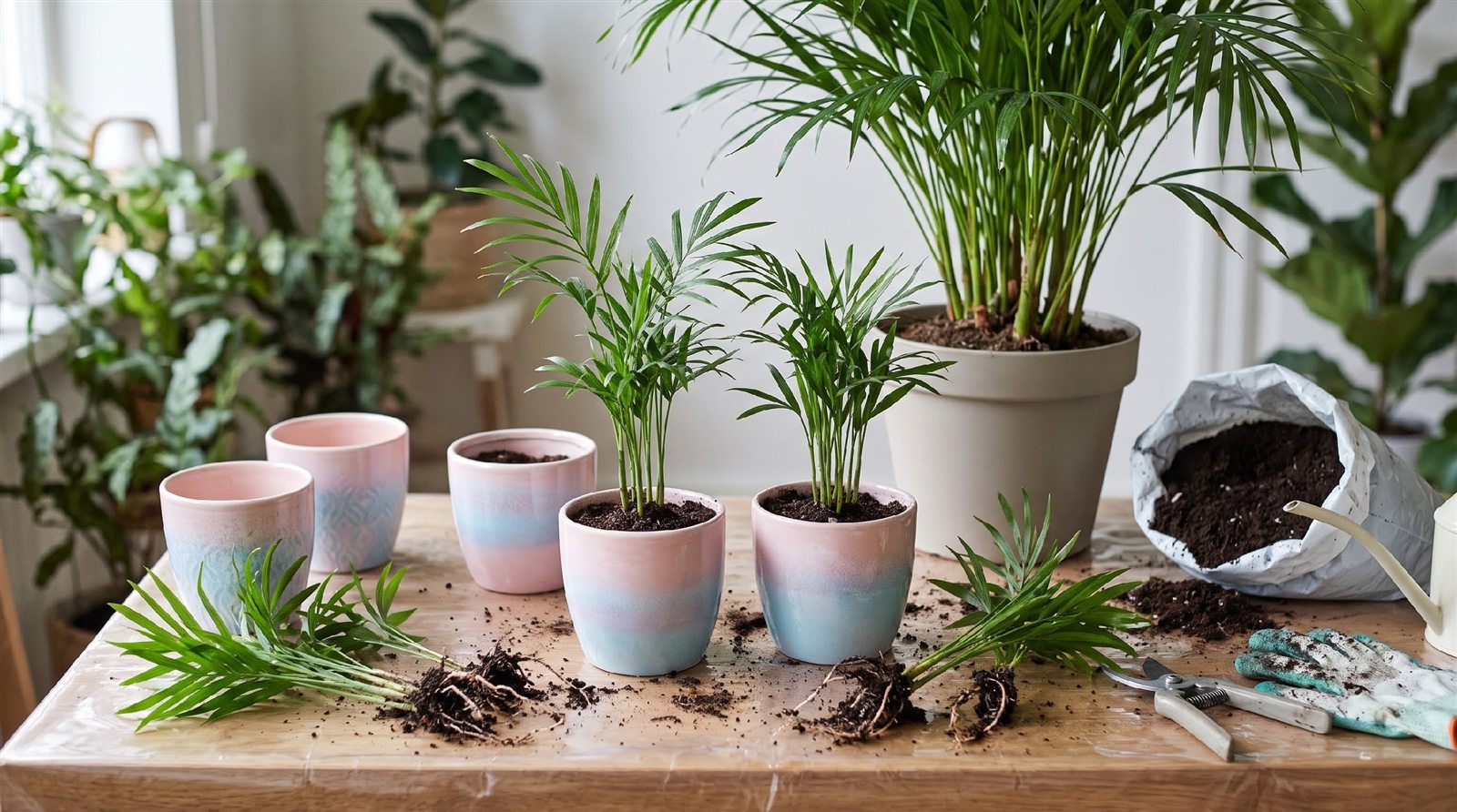
- Divide in late spring or summer, when roots grow fastest (UF/IFAS). Avoid winter, when root activity slows as soil cools.
- Water well the day before. Gardener’s Path notes that this loosens the soil and makes the roots easier to separate.
- Slide the clump out and look for natural gaps between groups of stems. Because the pot is a mass of seedlings, you can often tease groups apart by hand, cutting only where roots are hopelessly tangled.
- Keep divisions large. Iowa State Extension notes that the larger the piece, the faster it recovers; Gardeners’ World suggests four or five stems with roots attached. Single stems survive but look sparse for years.
- Replant at the same depth in fresh mix, water in, and keep out of direct sun.
- Hold off on fertilizer. Iowa State Extension suggests waiting a few weeks; Gardener’s Path waits at least three months. Waiting until a new frond starts to open is a sensible middle ground.
Honestly, I would only divide an areca that has clearly outgrown its pot or that you want to share. A crowded but healthy clump is better left alone than split for the sake of it. Expect a sulk. In UF/IFAS transplanting studies, cut palm roots often died back to the stem and were replaced by new roots (how many survive varies by species), so a division may show no new growth for several weeks. The extension guidance of four to six months to establish is realistic.
Growing Areca Palm From Seed
This is how every commercial areca starts. UF/IFAS states that “with relatively few exceptions, palm species can only be propagated from seed.”
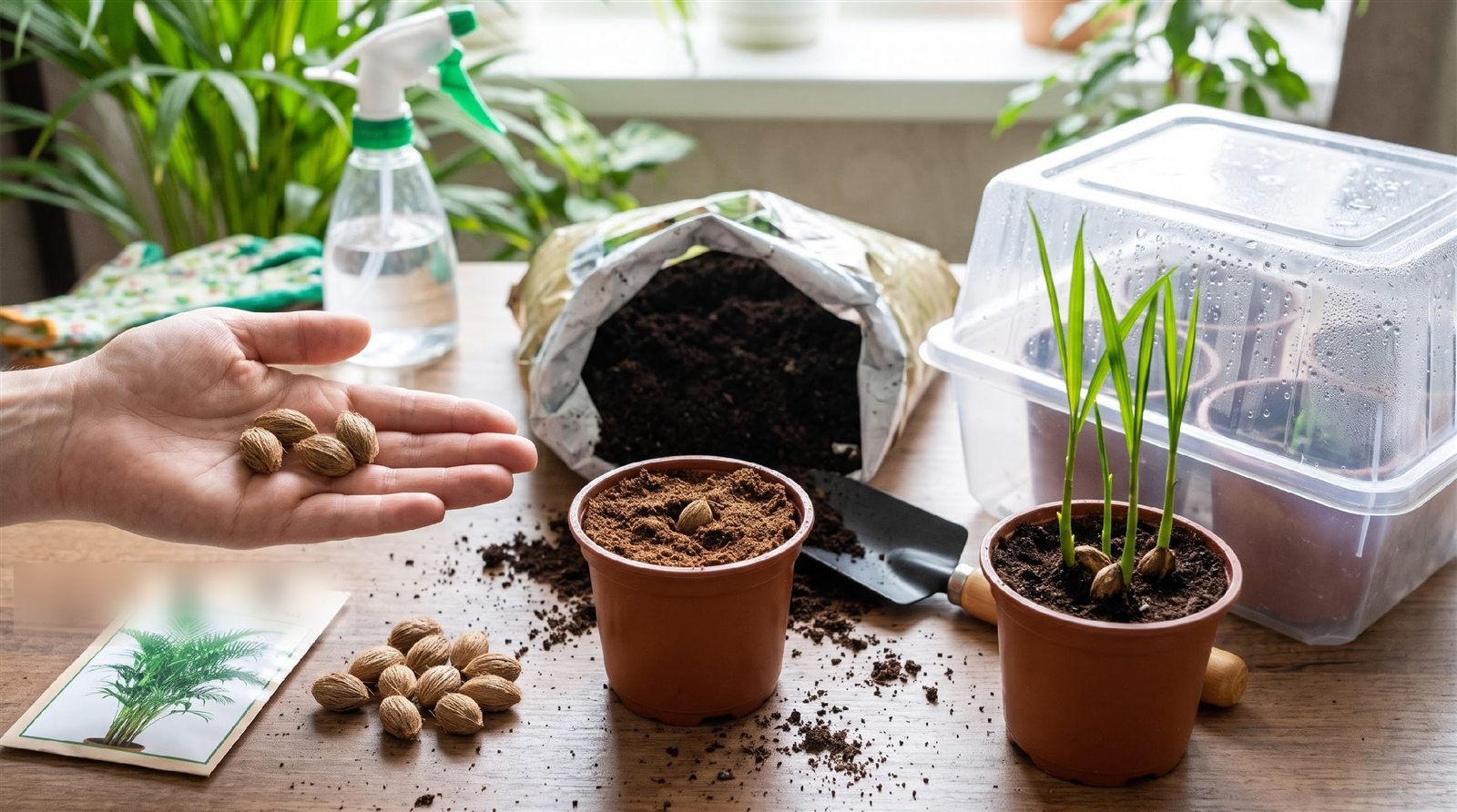
- Use fresh, fully ripe fruit. A 2026 study in the University of California’s PalmArbor journal found the best germination came from soft-ripe fruits, dark yellow to orange, planted immediately.
- Clean and soak. Rub off the thin fruit wall in a bucket of water. UF/IFAS lists areca among the palms that respond to a water soak of one to seven days, changing the water daily; a 72-hour soak combined with bottom heat gave the fastest germination in Hawaii trials.
- Keep it warm. UF/IFAS gives 70–100°F as the working range, with 85–95°F probably best. Indoors, a heat mat under the tray makes the difference.
- Never chill the seed. Areca seed “may be killed after storage for 24 hours at 40°F” (UF/IFAS). Do not keep it in the refrigerator.
- Sow shallowly in a 1:1 mix of peat and perlite under a clear cover, and keep it moist without standing water.
Areca seed can start to germinate in three to four weeks (UF/IFAS); University of Hawaii trials found half the seeds had sprouted at about five to six weeks. When transplanting, keep the seed attached to the seedling and plant several seedlings together if you want the full nursery look. Under commercial conditions, an 8–10 inch pot plant takes about a year and a half from seed. Indoors it takes longer.
Can You Grow Areca Palm From Cuttings?
No. Pages that describe rooting an areca stem in water are wrong. A palm stem has a single growing point at its tip and no cambium, the layer that lets other plants form roots and buds along a cut stem (UF/IFAS, palm anatomy). New stems in a clump come from buds low on existing stems, which is why a rooted basal sucker can be separated, but a cut piece of stem cannot grow.
What Doesn’t Work
- Relying on it to purify your air. The areca was not in NASA’s 1989 Clean Air Study; the palm tested was the bamboo palm, Chamaedorea seifrizii. The areca’s reputation comes from B.C. Wolverton’s 1996 book How to Grow Fresh Air. A 2019 review of 12 chamber studies by Cummings and Waring in the Journal of Exposure Science & Environmental Epidemiology calculated that matching the air exchange of an ordinary building would take 10 to 1,000 plants per square meter of floor.
- Letting tap water sit overnight to remove fluoride. Standing water loses chlorine, not fluoride. Control fluoride damage with pH and by avoiding perlite and superphosphate.
- Stripping yellow fronds to “redirect energy.” On a nutrient-starved palm, it speeds up the decline. Remove only fully dead fronds.
- Cutting it back to control height. A palm stem cannot be topped and regrow. If the plant has outgrown the room, divide it or remove the tallest stems at the base.
- Feeding with whatever houseplant fertilizer is on hand. Without magnesium and micronutrients, potted arecas can start yellowing within months.
My own take on the air-purifying question: buy an areca because you like how it looks and you have the light for it, not because a label promised cleaner air. Many plants sold as “palms” are not palms at all. The yucca cane, for example, belongs to the asparagus family and needs drier, brighter conditions than an areca.
Frequently Asked Questions
How fast does an areca palm grow indoors?
Clemson HGIC puts it at 6 to 10 inches a year, reaching 6 to 7 feet indoors. Arecas “often outgrow their allotted space,” so plan for the mature size when choosing a spot.
Is areca palm toxic to cats?
No. The ASPCA lists it as non-toxic to cats, dogs and horses. Reports that it is toxic usually confuse it with the betel nut palm (Areca catechu) or the sago palm.
Why are the stems on my areca palm yellow?
Some golden color on the stems is natural to the species. On potted arecas, UF/IFAS research links strongly golden stems and leaf bases to nitrogen deficiency, and a slow-release palm fertilizer in spring and summer usually corrects it on new growth.
Can an areca palm live outside?
Year-round only in USDA zones 10A–11 (UF/IFAS). Elsewhere it can summer outdoors in partial shade and come back inside before nights approach 45°F.
How often should I repot an areca palm?
Every two to three years, in spring or early summer, one pot size up. Palms do best with confined roots (Clemson), and an oversized pot stays wet too long.
Does an areca palm need direct sun?
No. It needs bright indirect light, about 150 to 300 foot-candles indoors. Direct sun through a window yellows the fronds, especially on young plants.
Do areca palms clean the air?
Not measurably in a normal home. The air-purifying claim traces to a 1996 book rather than NASA’s 1989 study, and a 2019 review found you would need 10 to 1,000 plants per square meter to match ordinary ventilation.