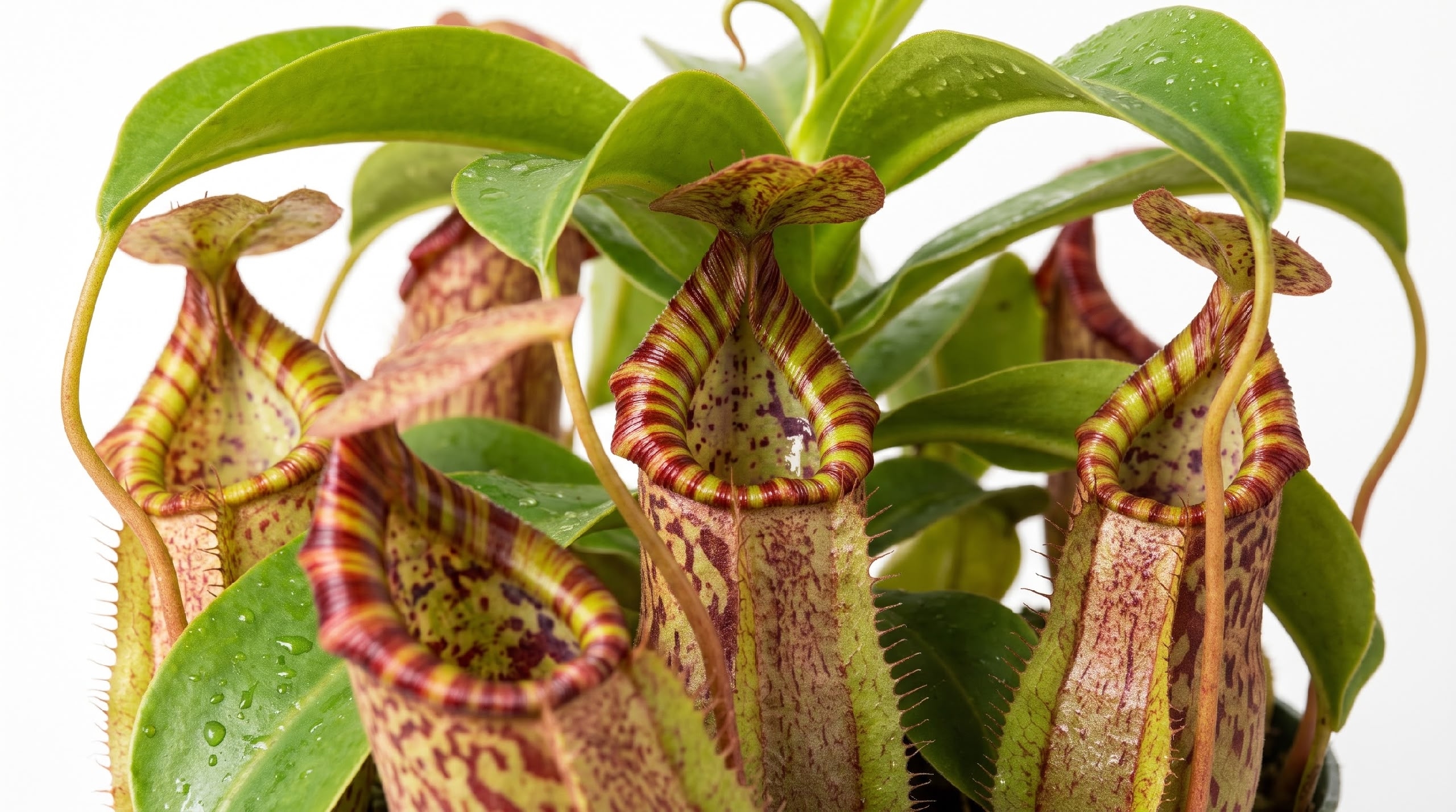
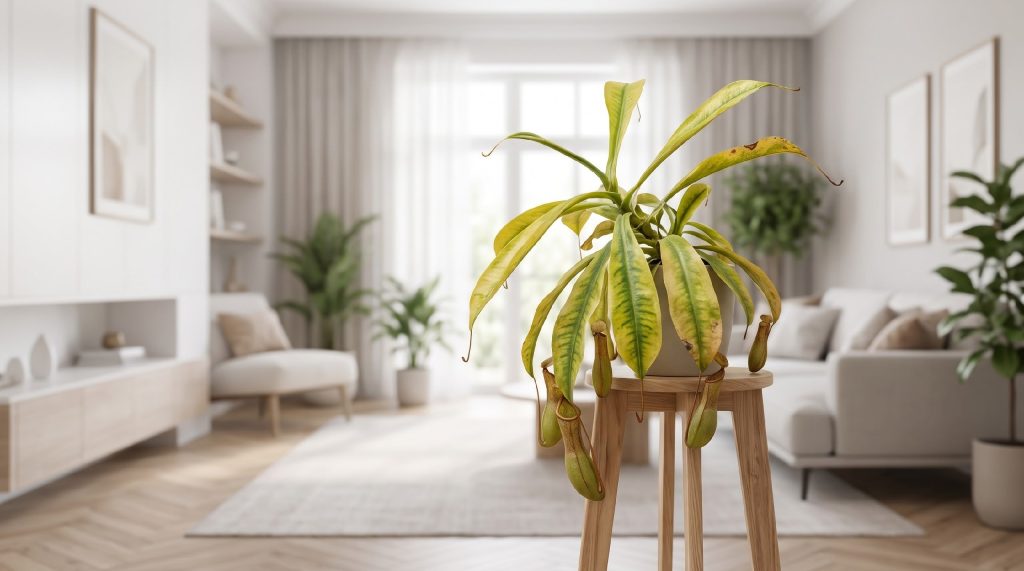
Indoor Nepenthes care comes down to one test: is the plant still making pitchers? When it stops, the cause is almost always one of three things: air that is too dry, light that is too weak, or water carrying too many minerals. Clemson Extension puts the first two plainly: “If plants are not producing pitchers, low light and low humidity levels are usually the reason.” Tap water is the third, and it does slow, cumulative damage that does not show up for months.
The second most common mistake is following care advice written for a different plant. “Pitcher plant” is used for five unrelated groups, and the most widely published instructions (full sun, a tray of standing water, a cold winter rest) belong to North American Sarracenia. Applied to a tropical Nepenthes, they produce exactly the symptoms people then search for. This guide covers what Nepenthes actually need, where authoritative sources disagree, and how to read the plant when pitchers stop forming.
| Nepenthes Care at a Glance | |
|---|---|
| Light | Bright indirect; east or west window, or a grow light 14–16 h/day |
| Water | Distilled, rain or RO only; keep the medium moist, never soggy |
| Humidity | Above 60% (Clemson); some hybrids tolerate household air |
| Temperature | Depends on type: lowland 70–95°F, highland 70–80°F days with nights of 50–60°F |
| Medium | Long-fiber sphagnum with perlite and/or orchid bark; never potting soil |
| Feeding | Optional; an insect or a piece of dried bloodworm in a pitcher occasionally |
| Dormancy | None; grows year-round |
| Pitcher lifespan | 2–3 months on fast growers, 6–12 months on slow ones (Clemson) |
| Pets | Listed as pet safe by Clemson and NC State; no ASPCA entry for the genus |
Is Your Pitcher Plant Actually a Nepenthes?
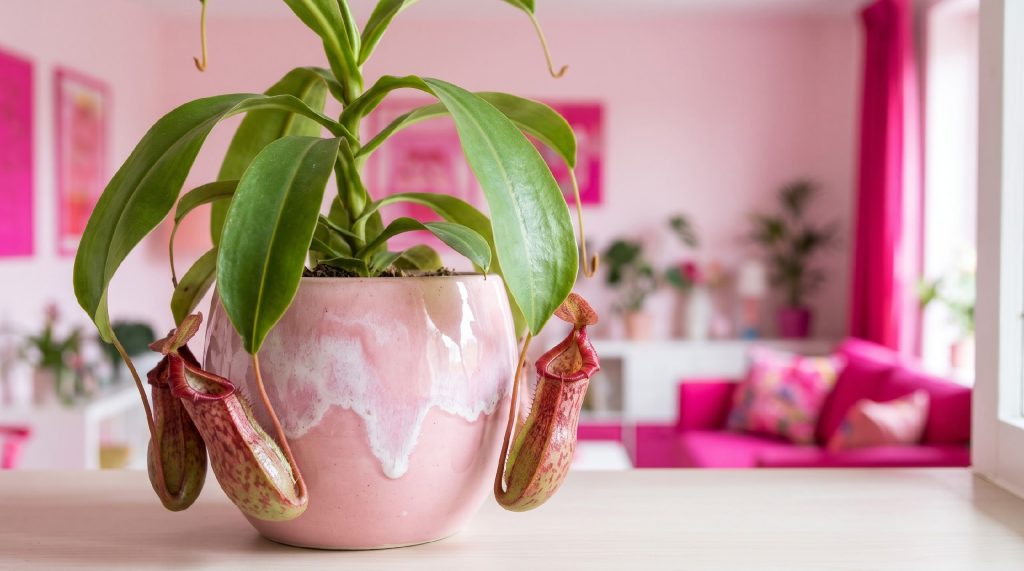
Check this first, because the care rules are close to opposite. A Nepenthes has long strap-like leaves, each ending in a tendril with a hanging, lidded pitcher. It is usually sold in a hanging basket. Every other “pitcher plant” grows its traps upright from the ground.
| Plant | How to recognize it | Care that differs from Nepenthes |
|---|---|---|
| Nepenthes (tropical pitcher plant, monkey cup) | Pitchers hang from leaf-tip tendrils | Warm, humid, bright indirect light; no dormancy |
| Sarracenia (North American pitcher plant) | Upright trumpet-shaped tubes from a rhizome | “As much sun as you can give them” (ICPS); pots stand in 4–6 cm of water; about three months of cool dormancy (Barry Rice) |
| Darlingtonia (cobra lily) | Hooded tubes with a forked “tongue” | Cool roots: ICPS says to keep soil below 80°F; survives freezing when dormant |
| Heliamphora (sun pitcher) | Open-topped tubes with a tiny spoon-like cap | Cool highland conditions; large plants can die from prolonged temperatures above 79°F (ICPS) |
| Cephalotus (Albany pitcher plant) | Small, squat pitchers on the ground, under 2 inches | Grown “as a fen plant” (ICPS); very prone to mildew |
The confusion is widespread in published guides, not just on plant tags. Several popular care pages give a water-filled tray and a low soil pH under a generic “pitcher plant” heading. That is Sarracenia practice, and it is how Nepenthes roots end up rotting.
Highland, Intermediate or Lowland: Which Do You Have?
Temperature is the one care factor that genuinely depends on where your plant’s ancestors grew. Botanist Barry Rice’s Carnivorous Plant FAQ gives the dividing line: species from “0-1000m above sea level are called lowland species… higher than 1000m are called highland species.” Highlanders need cool nights; lowlanders need warmth around the clock.
| Type | Day | Night | Source |
|---|---|---|---|
| Lowland | 70–95°F | Warm; NECPS gives 60–80°F | Clemson, NC State, NECPS |
| Intermediate | 75–85°F | 55–65°F | NECPS |
| Highland | 70–80°F (NC State: 75–85°F) | 50–60°F (NECPS: 40–60°F; NC State: low 60s) | Clemson, NC State, NECPS |
The sources disagree on highland nights by up to 20°F. The safe reading: highlanders need a real nightly drop, and somewhere in the 50s°F works for all three sources. A room that stays at 72°F around the clock suits lowlanders and frustrates highlanders.
Most plants sold in US garden centers are hybrids, and that is good news. Clemson notes hybrids are “more tolerant of temperatures than the species,” and gives N. alata a “wide temperature tolerance from 54°F to 95°F.” The New England Carnivorous Plant Society groups N. alata, N. ventricosa, N. maxima and N. sanguinea as intermediates. For the common supermarket hybrids, N. × ventrata and N. ‘Miranda’, no authoritative source assigns a group. Growers treat them as forgiving, but that is grower consensus, not a published classification.
How Much Light Does a Nepenthes Need?
Bright, mostly indirect light: more than a typical “low light” houseplant, less than a Sarracenia. Clemson recommends a spot “near an east or west-facing window” and says the plant “can tolerate a few hours of direct sun in the morning or late afternoon.” NC State lists the light requirement as partial shade, meaning 2–6 hours of direct sun.
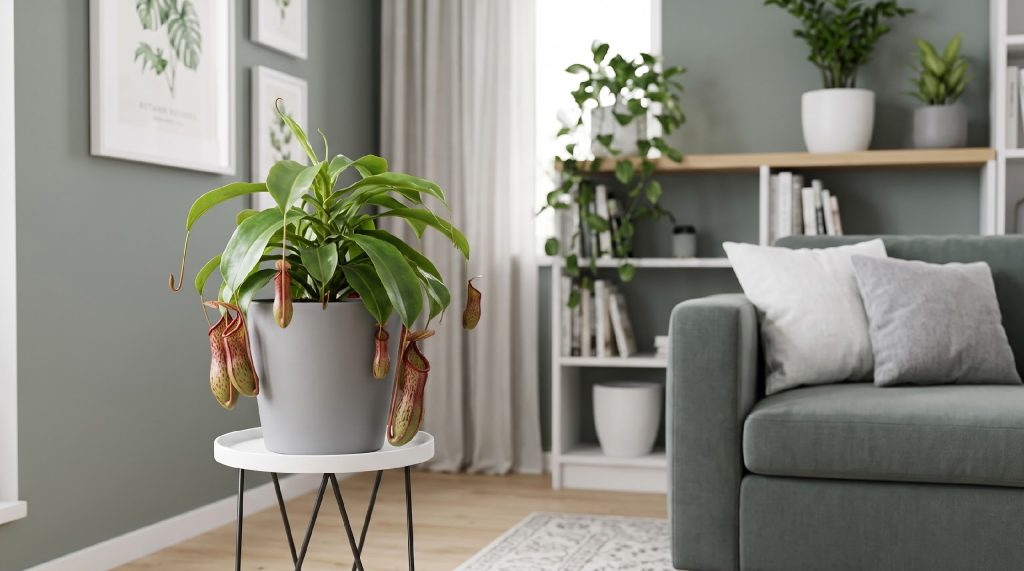
Botanist Barry Rice’s Carnivorous Plant FAQ calls bright, diffuse sunlight excellent for Nepenthes and says artificial lighting “may be adequate if it is bright enough.” The New England Carnivorous Plant Society treats lights as a full substitute: LED shop lights on a 14–16 hour photoperiod, or CFL bulbs at 4000–6500 K hung 6–12 inches above the plant.
Treat a window as the minimum. On a bright east or west sill, many hybrids pitcher fine. In a north window, a room set back from the glass, or a short northern winter, a grow light usually separates a plant that survives from one that pitchers. In a north-facing room, I would skip the windowsill experiment entirely and start with the light.
One limit worth knowing: I could not find an authoritative source giving a measured light level (footcandles, lux or PPFD) for Nepenthes. The figures that circulate online trace back to retailers and wikis, not to research or extension services. The RHS adds a ceiling: direct sun can scorch leaves through glass.
What Water Should You Use for a Nepenthes?
Distilled water, rainwater or reverse-osmosis water. NC State notes that carnivorous plants are “not able to tolerate… watering with tap water.” The US Botanic Garden says the same for carnivorous plants generally: “Do not use tap water or mineral water.”
The mechanism is mineral buildup. These plants come from nutrient-poor habitats, and the RHS explains that “if cooled tap water is used regularly, harmful minerals can build up in the compost.” It happens slowly, which is why a plant can look fine on tap water for months before declining. The RHS does allow boiled and cooled tap water when rainwater is not available, but then advises replacing the compost every six months.
How pure is pure enough?
Barry Rice gives the most widely cited number: “you want the TDS (total dissolved solids) to be around 50 ppm or lower.” Note that he gives it as general carnivorous-plant advice, not a Nepenthes-specific limit. One US nursery, Predatory Plants, accepts tap water under 100 ppm. Rice himself concedes that “many tell me this is not so important,” and some growers report Nepenthes tolerate minerals better than Sarracenia.
You can check your own water in two ways:
- A TDS meter. An inexpensive pen-style meter reads parts per million directly. Test your tap, your filter output and any bottled water before relying on it.
- Rice’s boil test. Boil about a gallon of tap water until it is completely gone. Only if no white residue is left on the pan does Rice suggest the water might be usable.
My advice is to buy a TDS meter once and stop guessing. Tap water varies from town to town and season to season, and a reading settles the question in seconds.
Avoid water from a household softener as well. It swaps calcium for sodium rather than removing the minerals, the same reason softened water is the one firm prohibition in our bromeliad care guide.
How Do You Water a Nepenthes?
Keep the medium consistently moist and let excess water drain away. Clemson: “Keep moist; do not allow plants to dry out.” The New England Carnivorous Plant Society recommends watering from above and letting the pot drain, because plants left sitting in water can develop root rot. Rice adds that “plants sitting in trays often have dwarfed root systems.”
Should the pot stand in a tray of water?
Not permanently, and this is the clearest difference from Sarracenia. The ICPS guide to Sarracenia says the pots “should always be sitting in about 4 to 6 cm of water.” For Nepenthes, its windowsill article allows only that it is “OK for the plants to sit in water for a day or two to give the Sphagnum time to absorb the water.” That is a soak, not a standing arrangement. I would treat a tray as a rescue tool for a pot that dried out completely, and empty it the next day.
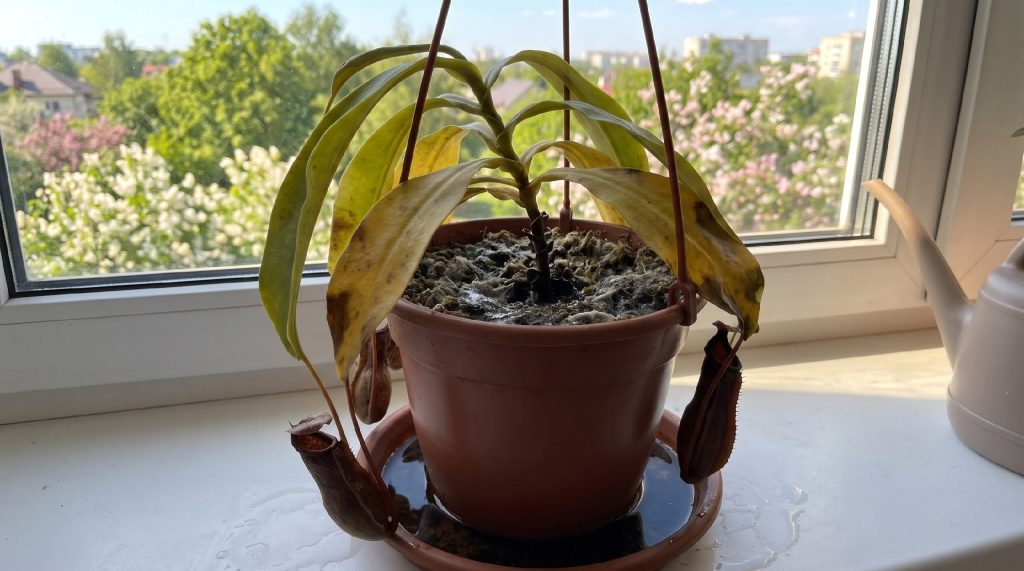
A pebble tray, with the pot sitting on pebbles above the waterline, is a different thing and is fine. It adds a little local humidity without keeping the roots wet. Frequency depends on your home: NECPS’s intermediate care sheet suggests watering “every 2 or 3 days,” but go by the medium. Water when the top of the sphagnum starts to feel only slightly damp.
How Much Humidity Does a Nepenthes Need?
Clemson’s figure is “above 60%,” and NECPS agrees: “60% or above, especially for lowland species.” Humidity matters because it controls whether a pitcher forms at all. NC State: “If the humidity is too low, the traps or pitchers will not develop properly or will die back.” Rice describes what happens: in dry air, “the tendrils will not successfully develop pitchers.”
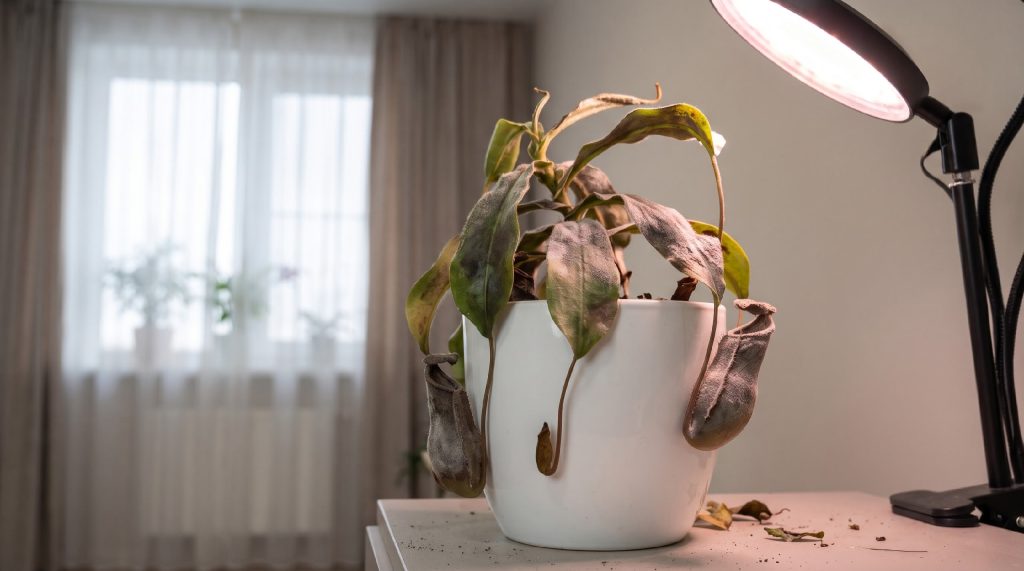
US homes in winter often run 20–35% humidity, well below that line. You have three options, and they work best in this order:
- Choose a tolerant plant. The ICPS says that “lowland, partial sun species with thick, leathery leaves will stand up best to low humidity.” It names N. rafflesiana, N. bicalcarata and N. truncata as good lowland species for beginners, and N. alata, N. khasiana and N. ventricosa as highland plants that should also do well on a windowsill. Clemson describes N. ‘Gaya’ as “tolerant of normal house conditions” and N. veitchii as “adaptable to lower humidity.” NC State says N. sanguinea “can tolerate lower humidity.”
- Measure before you fix. A cheap digital hygrometer next to the plant tells you whether humidity is the problem. Room readings from a thermostat across the house are not useful. If your plant has stopped pitchering, I would check this before anything else; it is the cheapest problem to diagnose.
- Raise it locally. A humidifier near the plant, a bright bathroom or kitchen, or grouping plants together. If you go the humidifier route, our guide to humidifier types and placement applies just as well to a Nepenthes.
More is not automatically better. Tom of Tom’s Carnivores, a specialist grower, writes that keeping humidity at 80–90% has led to mould and fungus problems in his experience, particularly with low airflow. NC State also notes that “poor air circulation can cause fungal diseases.” A closed terrarium needs a small fan or regular venting.
Misting does not solve the problem. It raises humidity for minutes, not hours.
What Should You Plant a Nepenthes In?
An airy, acidic, nutrient-free mix based on long-fiber sphagnum moss. Never use regular potting soil or garden soil. The proportions vary by source, and all of them work:
| Mix | Source | Best for |
|---|---|---|
| 60% sphagnum, 20% perlite, 20% orchid bark | Clemson | General indoor growing |
| 50% long-fiber sphagnum, 50% perlite | Barry Rice; NECPS | Simple starter mix |
| 75% sphagnum, 25% perlite | ICPS (windowsill article) | Dry rooms: holds moisture longer |
| 2/3 sphagnum, 1/3 orchid bark | NECPS | Extra drainage and airflow |
If you use coir, rinse it thoroughly first; NECPS warns it can carry salts. NECPS notes that plastic pots are the most common choice. Hanging baskets suit the plant’s habit, and they keep the pitchers dangling where they grow best.
When should you repot?
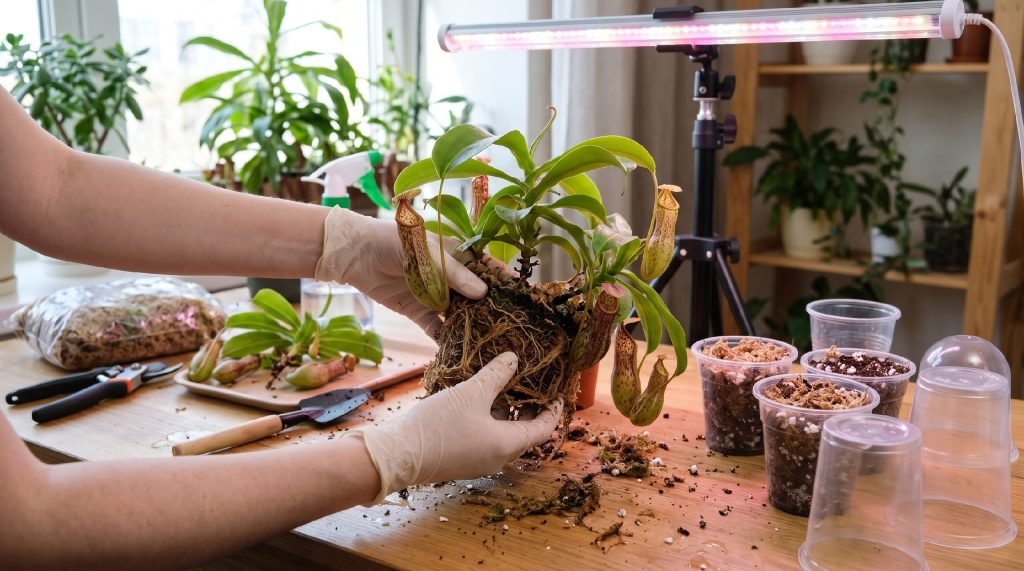
Sources disagree. Clemson advises repotting “every 2 to 3 years,” and the RHS says to repot “once their roots fill the container.” Rice argues against routine repotting: “Do not repot your plants unless you really have good reason,” because it “often sets the plants back a bit.” I side with Rice here: repot when the pot tells you to, not when the calendar does. In practice that means repotting when the sphagnum has broken down and stays soggy, or when the roots have outgrown the pot, and to expect a few weeks of slower growth afterward.
Why Isn’t My Nepenthes Making Pitchers?
Each new leaf grows a tendril, and the tendril only swells into a pitcher if conditions allow. A plant that grows leaves with bare tendrils is telling you exactly what is wrong. The ICPS lists the triggers: plants that are too warm, too cold, too dry or “fertilized too much” will “abort production of traps on new leaves.”
| What you see | Most likely cause | What to change |
|---|---|---|
| New leaves with bare tendrils that dry at the tip | Humidity too low | Measure; move to a humid spot or add a humidifier |
| Dark green, soft leaves, slow growth, no pitchers | Light too low | Brighter window or a grow light 14–16 h/day |
| Pitchering stopped after you started fertilizing | Over-fertilizing | Stop; flush with distilled water |
| Several older pitchers dried at once after purchase or a move | Sudden change of environment | Wait; judge by the new leaves, not the old pitchers |
| Highland plant failing in a warm room | No night temperature drop | Cooler spot at night, e.g. near a window |
| Medium has been drying out between waterings | Dry roots | Water more often; use a moisture-retentive mix |
The shipping or repotting case causes the most unnecessary worry. Clemson notes that “a sudden change in the environment can cause multiple older pitchers to dry out.” A new plant losing the pitchers it arrived with is normal. What matters is whether the next few leaves form pitchers once the plant has settled.
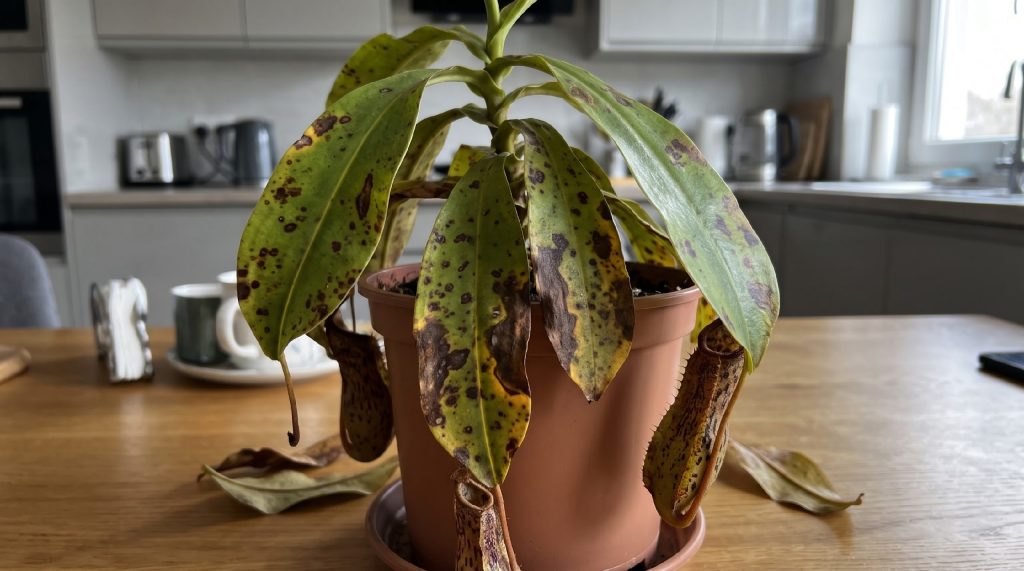
Why Are My Nepenthes Pitchers Turning Brown?
Usually because they are old. Every pitcher has a fixed lifespan. Clemson: “An individual pitcher will turn brown or black as its lifespan comes to an end.” That lifespan is “2 to 3 months on faster-growing varieties and 6 to 12 months on slower-growing varieties.”
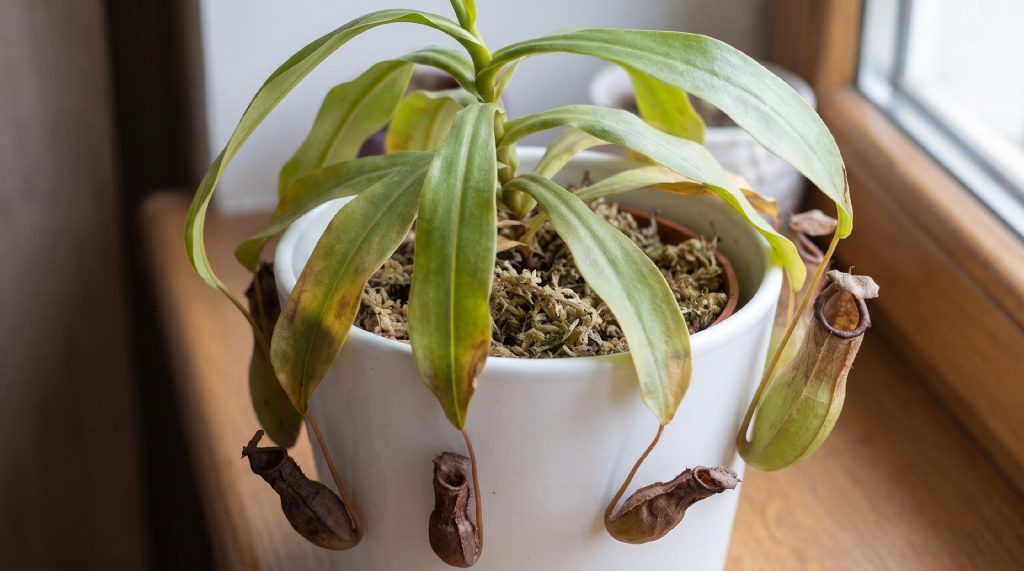
When to cut is a matter of taste rather than plant health. The RHS says to remove old pitchers “once they start to fade.” Some growers wait until a pitcher is fully brown, because a partly green pitcher still photosynthesizes. Cut the pitcher off at the leaf tip and leave the leaf itself, which keeps feeding the plant.
Browning becomes a problem only when young pitchers die early, or when all of them go at once without a recent move. In that case, work through the causes in the table above.
Why do the new pitchers look different?
Nepenthes produce two kinds of pitcher. Young plants make lower pitchers, which Clemson describes as “more colorful” and “the first to develop on young plants.” Once the stem starts climbing, the plant switches to upper pitchers, which are often funnel-shaped, paler, and hang from tendrils that coil around supports. Clemson estimates it “can take 5 to 10 years” to reach the climbing stage, though this varies widely by species and the extension gives no source for the figure. A change in pitcher shape on an older plant is maturity, not a problem.
Do You Need to Feed a Nepenthes?
No. Feeding is optional for a houseplant. The ICPS notes that “many species can do quite well without prey or at least with fewer prey than plants in the wild.” Indoor plants catch the occasional fly and fungus gnat on their own.
If you want to feed:
- What: live or freshly killed insects (crickets and mealworms are on Clemson’s list), or dried bloodworms. For Nepenthes, the ICPS suggests grinding dried bloodworms to a powder and dusting it into the pitchers, and warns that “some DBW brands have additives that can damage your plants.” Test on one or two pitchers first.
- How often: sparingly. Rice’s general rule for carnivorous plants is to feed no “more than about one bug per week.”
- Never: meat or other human food. Rice: “feeding your plants hamburger meat… is a fine way to kill them.” Avoid insects killed with pesticide as well.
Should you fertilize a Nepenthes?
This is the most disputed question in Nepenthes care:
| Source | Position |
|---|---|
| RHS | Carnivorous plants “need no additional fertiliser” |
| Barry Rice | “As a good rule, never fertilize” for carnivorous plants in general; for Nepenthes he allows dilute orchid fertilizer in the pitchers, though he does not use it himself |
| Clemson Extension | Organic fertilizer (fish emulsion, seaweed or kelp) twice a month in the growing season, diluted to about ¼ of the recommended strength, applied to leaves and open pitchers |
| US Botanic Garden | “One-quarter-strength organic fertilizer” |
| ICPS (Nepenthes guide) | One of the smallest slow-release pellets per young plant |
The sources agree on more than the table suggests. None recommends fertilizing the potting medium; feeding goes through the leaves or pitchers. All of them use low strengths. And the ICPS states the downside clearly: over-fertilized plants stop making traps, while “a tiny amount of fertilization makes a huge difference.”
My advice for the first year is not to fertilize at all while you are still sorting out light, water and humidity. If a healthy, pitchering plant later grows slowly despite good conditions, try a light foliar feed at ¼ strength or weaker. Stop at the first sign of fewer pitchers.
Should you fill the pitchers with water?
No need. Rice: “you can do this if you want. I don’t know of anyone I trust who does this.” Healthy pitchers make their own fluid. A 2015 study on N. alata (Buch et al., PLoS One) found digestive enzyme activity already present in pitchers that had not yet opened, produced by the plant itself. Rice adds a useful diagnostic: new pitchers “should start producing their own fluids within a month or so. If they don’t, your humidity may be too low.”
Do Nepenthes Go Dormant in Winter?
No. Rice’s FAQ states that Nepenthes “may be grown all year,” while “Venus flytraps and Sarracenia have a cool dormancy period of about three months.” Clemson describes Nepenthes as evergreen. Slower winter growth indoors comes from shorter days and drier heated air, not from a rest period, so keep watering and keep the light up. Never put a Nepenthes outside or in a cold garage for a “dormancy” borrowed from Sarracenia care.
Nepenthes Flowers: What to Expect
A mature Nepenthes may send up a tall spike of small, reddish-brown flowers. The plants are dioecious, meaning each plant is either male or female. Clemson: “male or female flowers are produced on separate plants.” A single plant cannot set seed; as Rice notes, you “must obtain pollen from another plant” flowering at the same time.
Many online guides say to cut the spike to “save the plant’s energy.” I could not find an authoritative Nepenthes source that recommends it. Rice’s version of that advice is about Venus flytraps. Removing the spike does no harm, and keeping it does no documented harm either.
How to Propagate Nepenthes from Cuttings
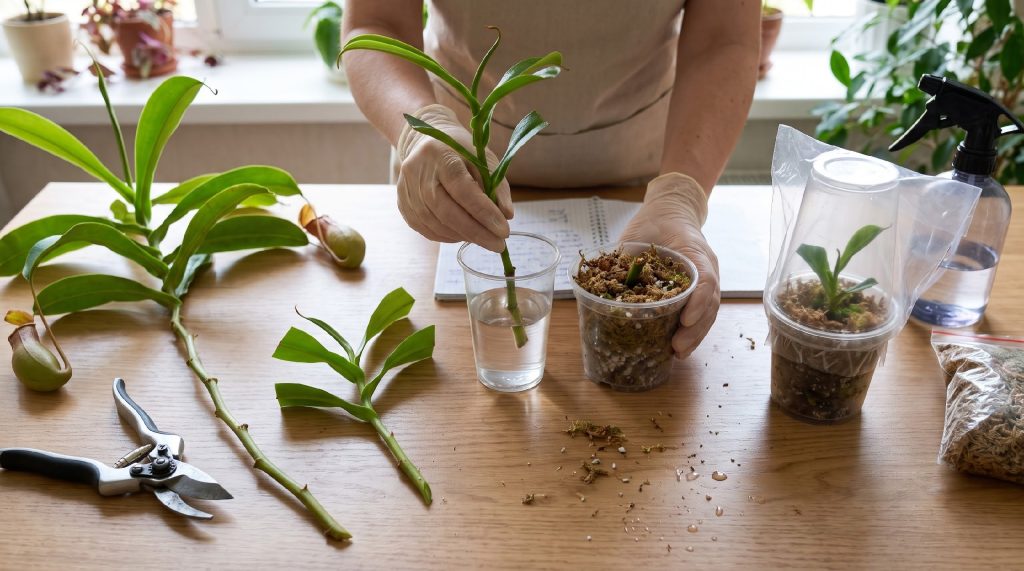
Stem cuttings are the standard home method. The ICPS propagation guide gives the procedure:
- Cut sections with two nodes. “Two-node cuttings are sections of stems with two green leaves and growth buds”; single-node cuttings work for easy species.
- Trimming the leaves is optional. The ICPS notes that some growers cut them in half to reduce water loss, but that this is not necessary if the cuttings are sealed in a plastic bag.
- Insert into “long-fiber Sphagnum moss or 50:50 mix of long-fiber Sphagnum moss and perlite.”
- Seal in a clear plastic bag for near-100% humidity, in bright indirect light.
- Wait. Rooting takes “between a month to a year.” Skip the rooting powder: per the ICPS, “using hormone is not helpful.”
Growing from seed needs a male and a female plant flowering together, so it is impractical for most growers. Large nurseries multiply plants by tissue culture, and the ICPS recommends that beginners “start with inexpensive tissue culture plants.”
Buying a Nepenthes: Why “Artificially Propagated” Matters
The whole genus is listed under CITES, the international treaty on trade in endangered species. Most species are in Appendix II, and N. rajah and N. khasiana are in Appendix I. Wild-collected plants of rare species do turn up for sale. A 2024 study in Conservation Biology (Robinson & Roberts) found that 61% of 83 newly described Nepenthes species were offered for sale online in 2018. For 32 species on sale with no CITES trade records, the countries of origin confirmed permitted trade for only 5.
For a buyer, the rule is simple: purchase from nurseries that state their plants are artificially propagated (tissue culture, cuttings or cultivated seed). The common hybrids sold at garden centers fall into this category. For a first plant, I would choose one of those hybrids over a named rare species from an online listing: it is cheaper, tougher indoors and free of trade questions.
Are Nepenthes Toxic to Cats and Dogs?
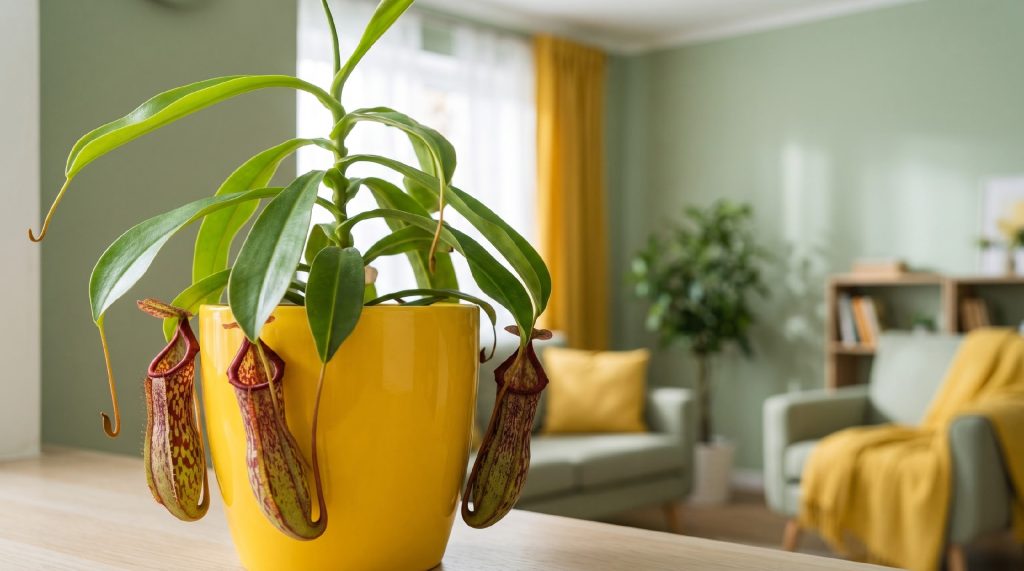
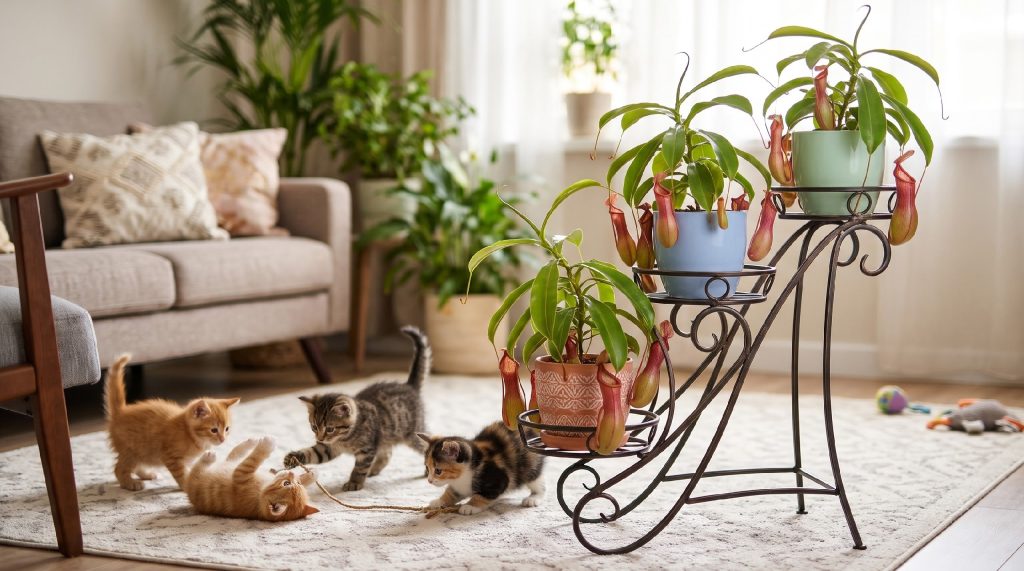
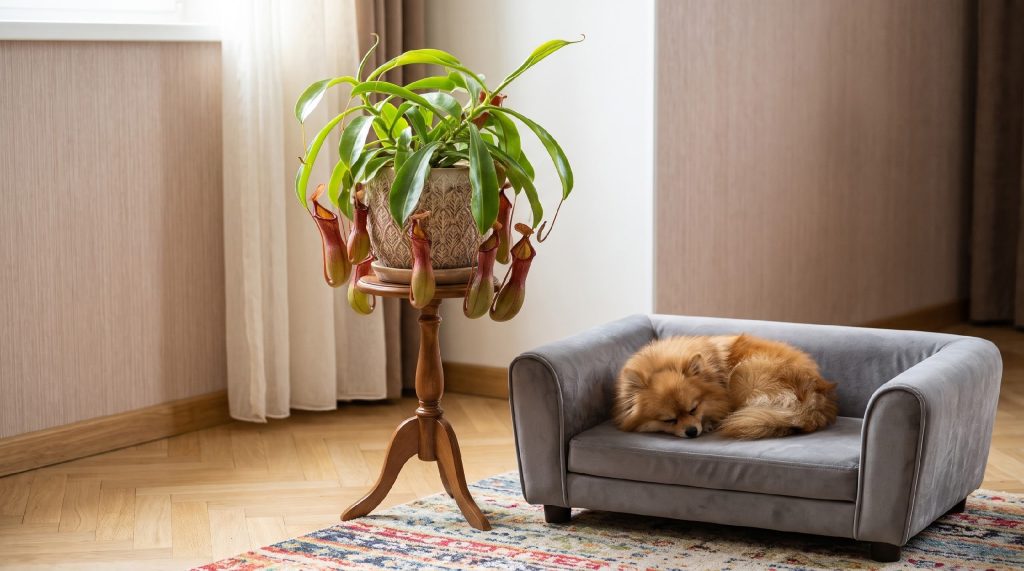
Two university extension services list them as pet safe, but the ASPCA has never evaluated the genus. Clemson’s fact sheet states “Pet Safe: Yes.” NC State’s Plant Toolbox tags Nepenthes as non-toxic for cats and dogs.
The common claim that “the ASPCA lists pitcher plants as non-toxic” needs correcting, and it took checking the full ASPCA cat and dog lists to confirm it. The ASPCA database has no entry for Nepenthes, Sarracenia or “monkey cup.” Its only pitcher-plant entry is the California pitcher plant, Darlingtonia californica, listed as non-toxic to dogs, cats and horses. That is a different family. The Venus flytrap is also listed as non-toxic.
You will also find claims that Nepenthes cause “mild stomach upset in cats.” I could not trace this to any veterinary or extension source. The practical risks are physical: a heavy hanging basket within reach of a climbing cat, and pitcher fluid a pet may lick. Neither is documented as toxic. If a pet eats a lot of any plant and shows symptoms, call the ASPCA Animal Poison Control Center or your vet.
Common Nepenthes Problems
Brown, crispy leaf edges
Low humidity is the usual cause. Rice: “With inadequate humidity, your plant’s leaves will tend to burn on the edges.” The second cause is direct sun through glass, which the RHS warns can scorch leaves. Edges that brown on the sunny side of the plant only point to sun; browning all over points to dry air.
Rotting stem or collapsing plant
Usually a soggy medium: a pot left standing in water, broken-down old sphagnum, or no drainage. Repot into fresh mix and water from above. The RHS lists grey mould (botrytis) as a risk indoors, which is another reason to keep air moving.
Pests
NC State and Clemson list the same four: aphids, mealybugs, thrips and scale. The ICPS adds fungus gnats, whose larvae “damage and eat plant roots,” and advises quarantining every new plant.
Treat with care, because carnivorous plants react badly to many products. Rice: “Carnivorous plants are very sensitive to chemicals.” Of soaps he writes that “this seems to be deadly to carnivorous plants (although some growers seem to use them safely).” He suggests isopropyl alcohol on a cotton swab for spot-treating aphids and mealybugs, while noting that some growers have killed plants with it, and reports “excellent luck” with imidacloprid, with mild damage to Venus flytraps. A 2024 ICPS journal review notes that pesticides “have not been systematically tested for phytotoxic effects” on these plants. Whatever you choose, test it on one leaf first.
One firm prohibition from Clemson: “Avoid copper-based fungicides, as they can kill tropical pitcher plants.”
What Doesn’t Work
Sarracenia care for a Nepenthes. Full sun, a permanent water tray and a cold winter rest are correct for North American pitcher plants and harmful to tropical ones.
Tap water because the plant “looks fine.” Minerals accumulate in the medium over months. By the time leaves show it, the mix needs replacing.
Misting instead of humidity. A mist raises humidity for minutes. Pitcher formation responds to sustained humidity, which needs a better location, a humidifier or a tolerant plant.
Fertilizing a plant that isn’t pitchering. If light or humidity is the limit, fertilizer will not fix it, and the ICPS lists over-fertilizing itself as a cause of aborted traps.
Feeding meat or filling pitchers with water. Meat rots in the pitcher. Added water is unnecessary when humidity is right; healthy pitchers produce their own fluid.
Judging a new plant by the pitchers it arrived with. Older pitchers often dry after a move. Watch the next few leaves instead.
Frequently Asked Questions
Should I cut off dead pitchers?
Yes, once they have faded; the RHS advises removing old pitchers “once they start to fade.” Cut at the leaf tip and leave the leaf on the plant, since it still photosynthesizes.
How long does a Nepenthes pitcher last?
Clemson gives 2–3 months for fast-growing varieties and 6–12 months for slow-growing ones. Browning at the end of that span is normal aging.
Can I use tap water on a Nepenthes?
Not as a habit. NC State says carnivorous plants cannot tolerate tap water, and the RHS warns that minerals build up in the compost. Use distilled, rain or RO water. If you test, the commonly cited target is a TDS of around 50 ppm or lower.
Do Nepenthes need a terrarium?
Not usually. Many hybrids and thick-leaved lowland species grow in normal rooms if humidity is near 50–60% and light is good. Terrariums help with fussy highland species, but they need ventilation to prevent mould.
Can a Nepenthes grow outside?
Only in frost-free, humid climates, and only in bright shade. Never leave one outdoors through a cold winter; unlike Sarracenia, Nepenthes have no dormancy to protect them.
What is the easiest Nepenthes for beginners?
Common hybrids such as N. × ventrata are the usual starting point, though no official body ranks them. Among named plants, N. alata has a wide temperature tolerance (54–95°F per Clemson). Clemson describes N. ‘Gaya’ as tolerant of normal house conditions, and NC State notes N. sanguinea tolerates lower humidity.
Are Nepenthes safe for cats?
Clemson and NC State list them as pet safe. The ASPCA has no entry for Nepenthes; its only pitcher-plant listing, the California pitcher plant, is non-toxic. The bigger risk is a hanging basket a cat can pull down.
Why are my Nepenthes leaves green but no pitchers forming?
Low humidity or low light in most cases, according to Clemson. Check humidity with a hygrometer next to the plant before changing anything else. If the reading is above 60%, give the plant more light.