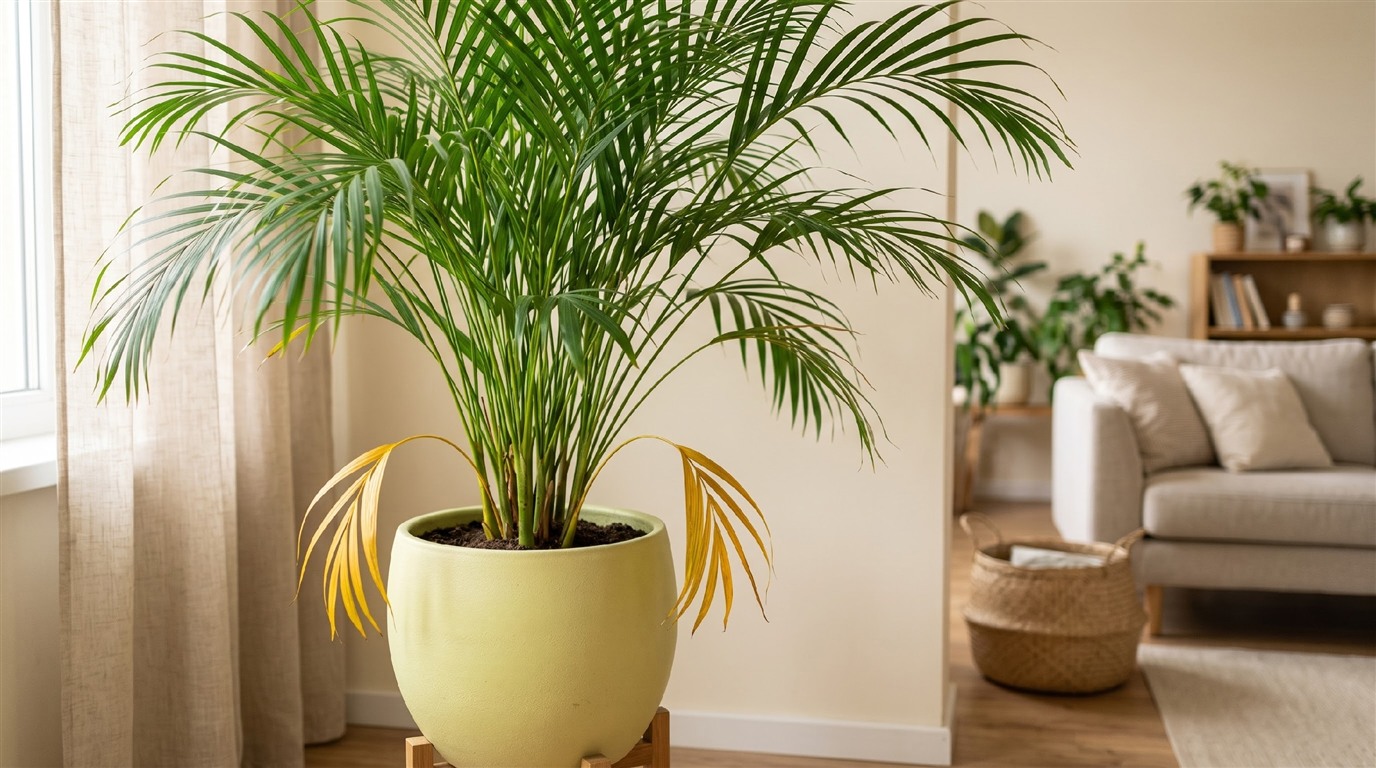
Areca palm yellow leaves usually come down to one of five things: an old frond dying naturally, a nutrient shortage, roots sitting in wet or worn-out soil, too much sun, or spider mites. The fastest way to tell them apart is to look at where the yellow starts. Yellow on the oldest, lowest fronds points to aging or a nutrient shortage. Yellow on the newest fronds points to the roots. Speckled, dull yellow anywhere points to spider mites.
This guide is the troubleshooting companion to our full areca palm care guide. It walks through each pattern, how to confirm it in a few minutes, what fixes it, and how long the plant takes to look right again. My advice is to diagnose before you change anything: most of the damage I see described online comes from fixing the wrong problem, such as repotting a palm that only needed feeding.
Is Some Yellow Normal on an Areca Palm?
Yes. Two kinds of yellow are part of how this palm grows, and neither needs treatment.
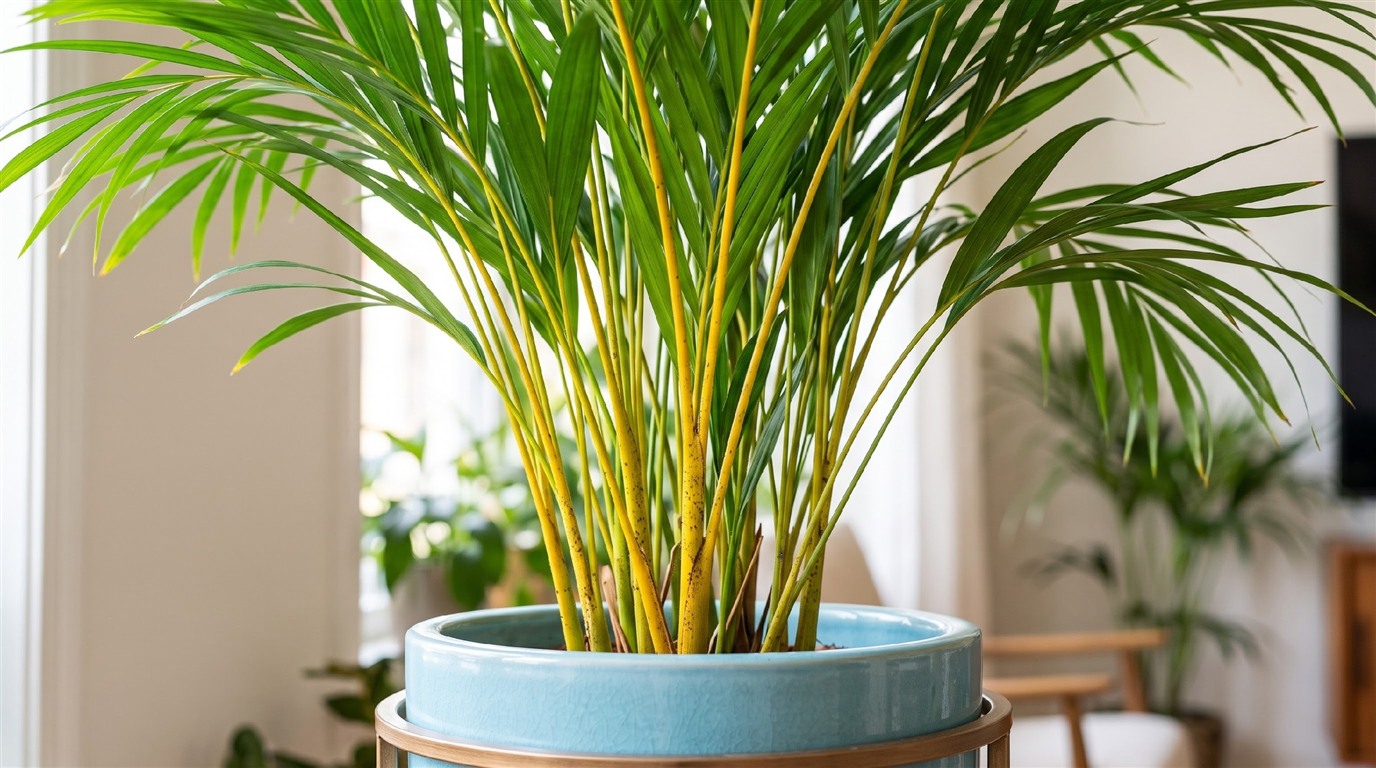
The first is color on the stems. A UF/IFAS extension office in Charlotte County notes that potassium deficiency symptoms “should not be confused with the natural yellowing of the petioles and leaflets which is a characteristic of the plant.” The species name lutescens means growing yellow, and UF/IFAS links common names such as golden cane palm to that yellow color. On potted arecas, strongly golden stems and leaf bases can also mean the plant is short on nitrogen (more on that below), but golden stems on a plant that keeps producing healthy green fronds are not an emergency.
The second is normal frond death. Timothy Broschat of UF/IFAS describes how a healthy old palm leaf dies: “A healthy old leaf will be completely green one day, completely orange-brown the second day, and completely brown the third day.” In other words, natural aging is fast and affects one old frond at a time. The same publication adds the key contrast: “Half-dead old leaves that remain on the palm for months at a time are usually deficient in potassium.”
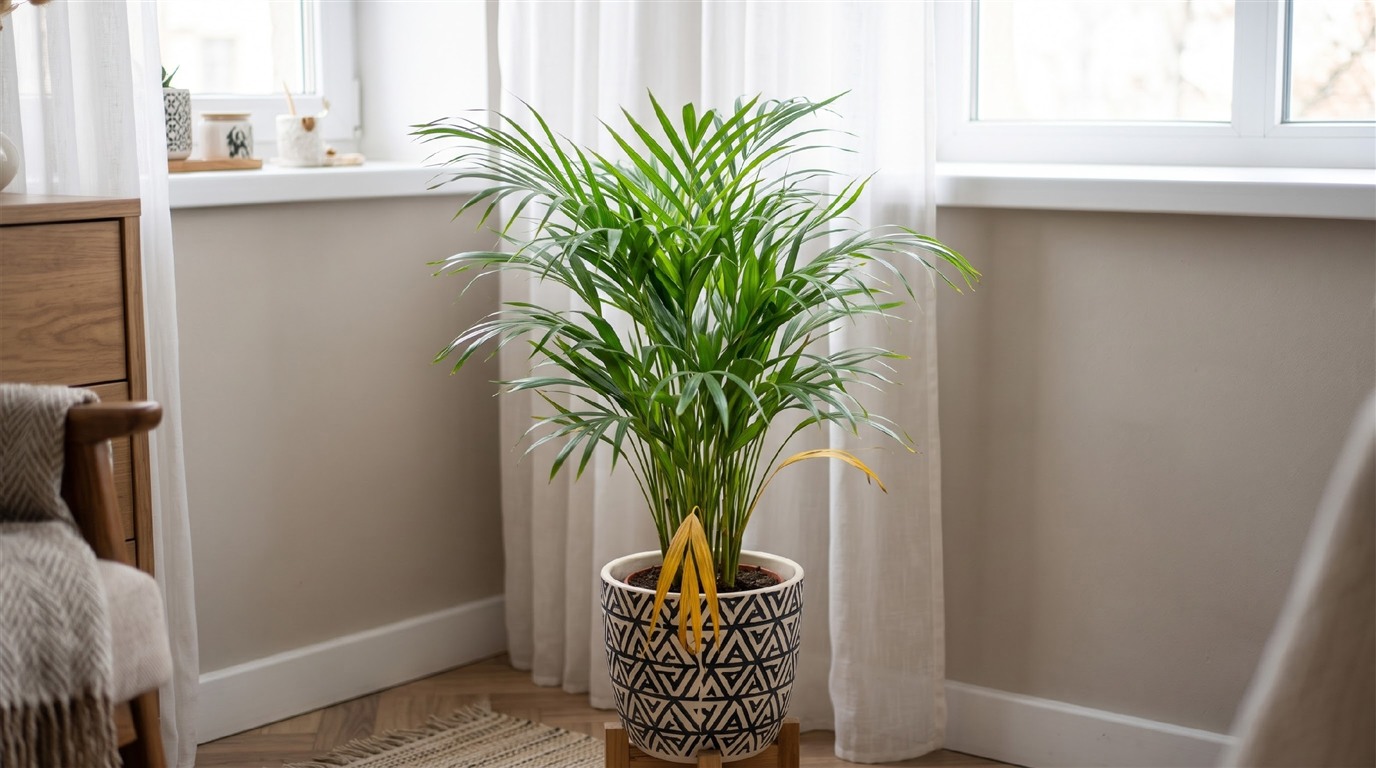
That gives you a simple first test. One low frond going from green to brown within days, while the rest of the plant looks good and a new spear is growing in the center, is aging. Several old fronds that stay half yellow for weeks are telling you something else.
Diagnose Yellow Areca Leaves by Where the Yellow Appears
Palms move some nutrients out of old leaves into new growth, so shortages of mobile nutrients (nitrogen, potassium, magnesium) show up on the oldest fronds first. Problems that block the roots from taking anything up show up on the newest fronds. This table is built from Broschat’s UF/IFAS publications on palm nutrition plus Clemson and Penn State extension guidance.
| What you see | Which fronds | Most likely cause | How to confirm |
|---|---|---|---|
| One frond turns orange-brown, then brown, within a few days | Oldest | Normal aging | Rest of plant green, new spear growing |
| Uniform light green to yellow, golden stems and leaf bases | Oldest first, then most of the plant | Nitrogen shortage | No fertilizer in the last 6 months or more |
| Translucent yellow-orange spots, worse toward the leaf tip, dead tips and edges | Oldest | Potassium shortage | Fronds stay half yellow for months instead of dying off |
| Broad yellow bands along the edges, center stays green, no dead tissue | Oldest and middle | Magnesium shortage | Palm has not had a palm-specific fertilizer |
| Whole new fronds pale yellow, older fronds green | Newest | Wet, compacted or worn-out soil, planted too deep, root rot | Soil still wet days after watering; brown, soft roots |
| New fronds yellow with dead streaks, frizzled look | Newest | Manganese shortage | Cool, poorly drained soil |
| Fine pale speckling, dull or bronzed look, webbing in bad cases | Any, often the whole plant | Spider mites | Tap a frond over white paper and look for moving specks |
| Bleached yellow on the side facing the light | Most exposed fronds | Too much direct sun | Plant recently moved to a sunnier spot or outdoors |
| Reddish-brown dead patches a few days after a cold night | Most exposed fronds | Chilling injury | Temperatures near or below 45°F |
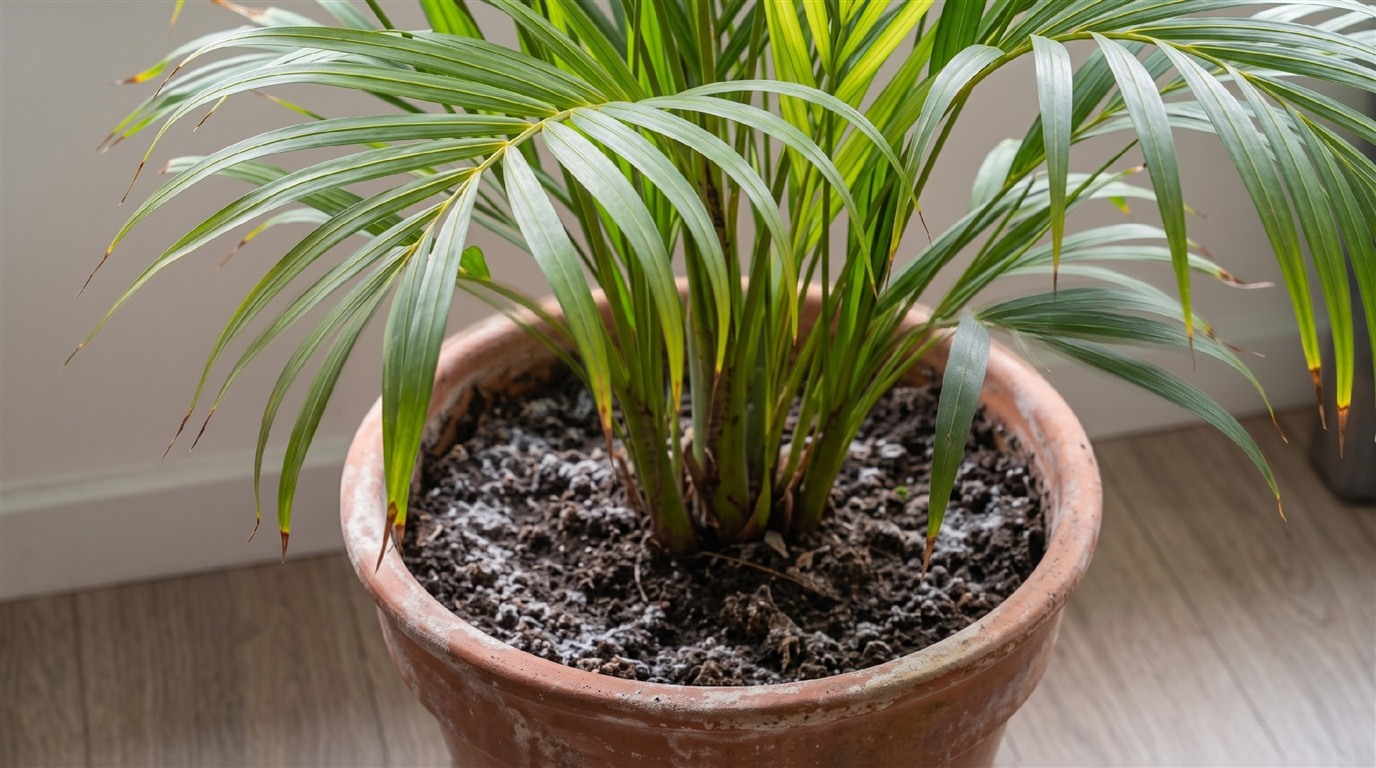
| Brown tips on lower leaves, white crust on the soil or pot rim | Lower | Fertilizer salt buildup | Heavy or frequent feeding |
| Chains of small dead spots between the veins | Any | Fluoride injury | Perlite-heavy mix, low soil pH |
If two patterns show up at once, start with the roots. A palm with damaged roots can look nutrient deficient no matter how much you feed it.
Old Fronds Turning Yellow: Which Nutrient Is Missing?
When the lowest fronds yellow and it is not the quick, one-at-a-time death described above, a nutrient shortage is the usual reason. Three nutrients cause almost all of it, and each leaves a different pattern.
Nitrogen: The Most Common Shortage in Pots
Nitrogen shortage starts as an even, light green fading on the oldest leaves and spreads through the canopy. Broschat states that “the golden-yellow petiole, rachis, and crownshaft color of many Dypsis lutescens (areca palms) is caused by N deficiency.” He also calls nitrogen deficiency “by far the most important deficiency encountered in container production of palms,” partly because microbes breaking down bark and peat in potting mix compete with the roots for nitrogen.
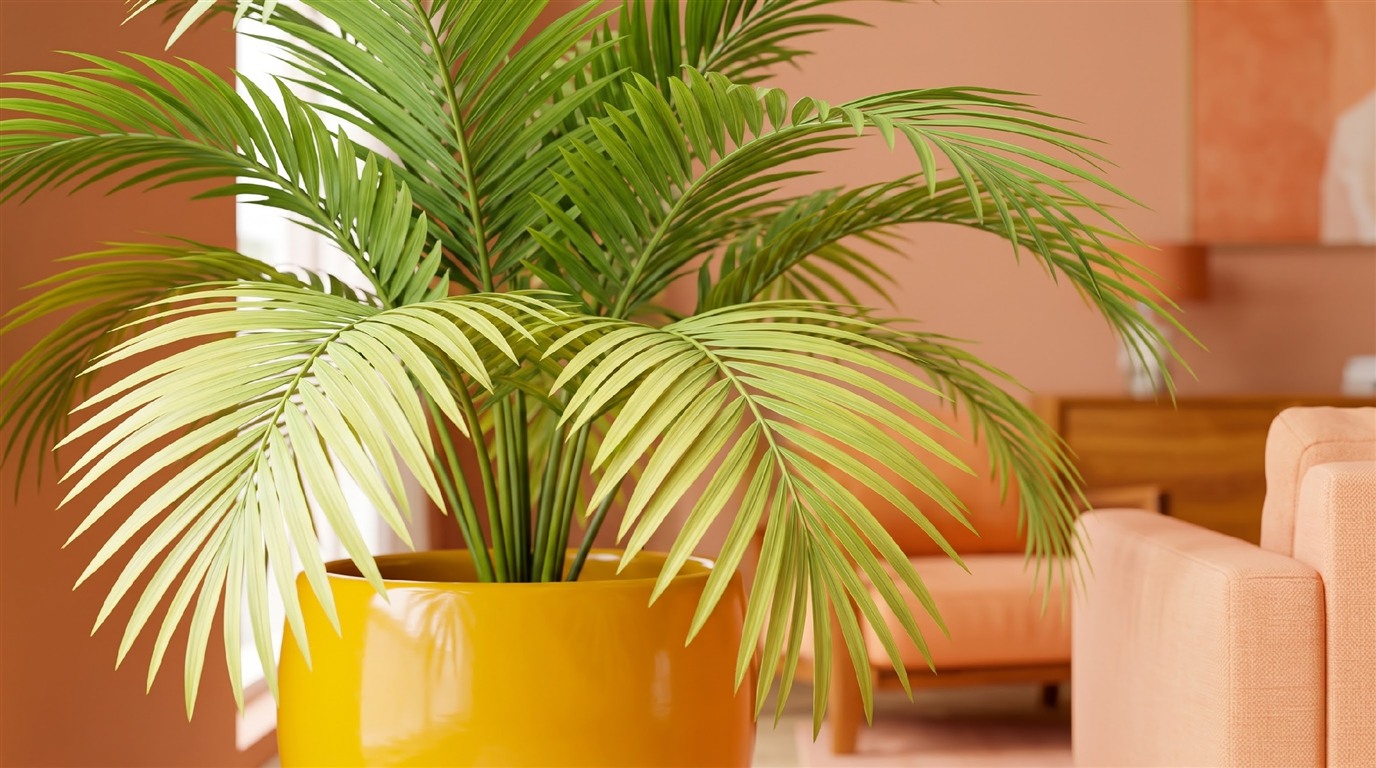
The fix is a slow-release palm fertilizer. Clemson recommends one with an analysis like 12-4-12 or 8-2-12, applied two to three times a year during spring and summer. Nitrogen is also one of the few shortages where yellow leaves can turn green again: Broschat notes that “N-deficient leaves will usually regain their normal green coloration when appropriately fertilized,” and expects re-greening “within a month or two.”
Potassium: Spots, Dead Tips and Fronds That Hang On
Potassium shortage shows as translucent yellow to orange spotting on the oldest fronds. Broschat notes that potassium symptoms “are always more severe towards the tip of a leaf and least so towards the leaf base,” so the outer half of each frond looks worst, often with dead tips and edges. Two of the potassium deficiency photographs in his UF/IFAS publications show areca palms.
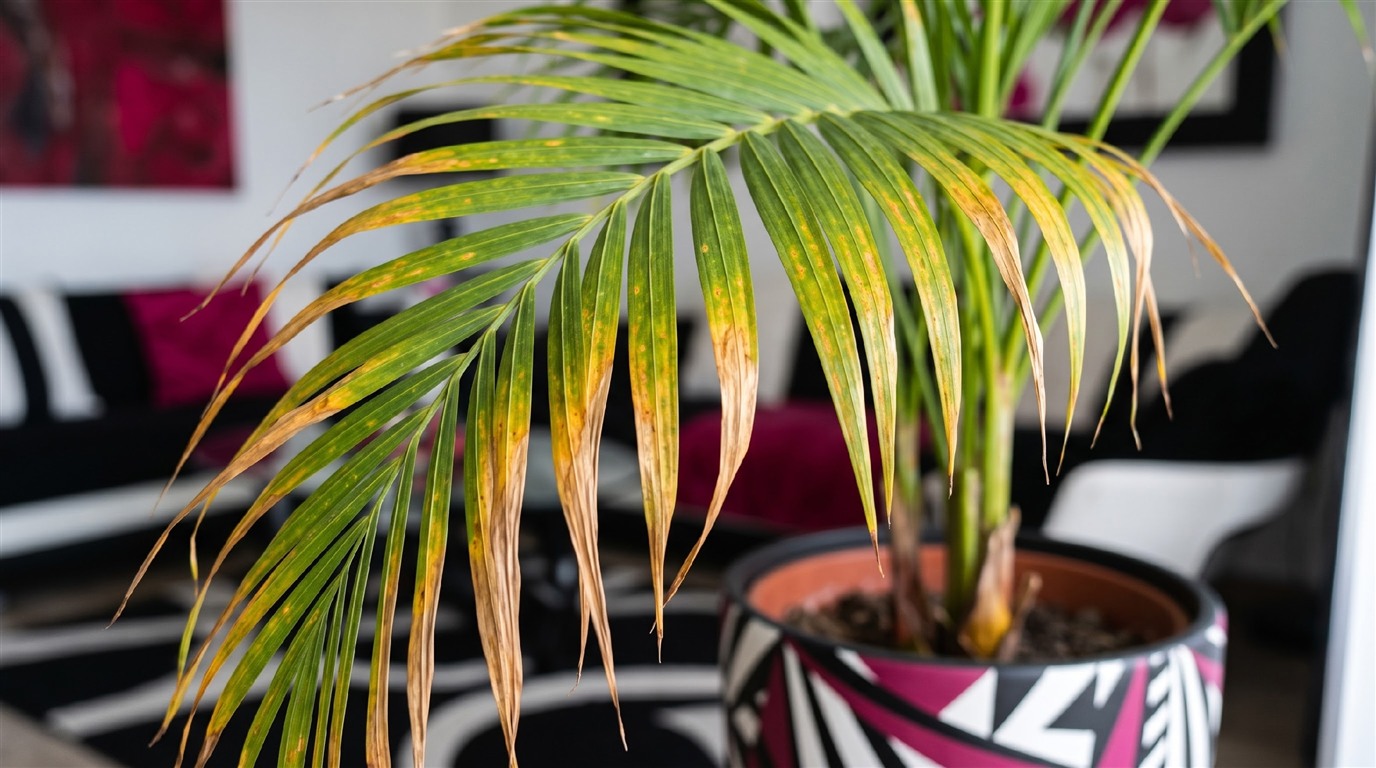
Broschat describes potassium deficiency as the most widespread nutrient problem in field-grown and landscape palms, and much less common in pots. If your areca lives outdoors in Florida or Southern California, think potassium first. If it lives in a pot indoors, think nitrogen first.
Recovery is slow. The spotted fronds will not turn green again, and Broschat warns that treatment “typically requires from one to three years or longer, since the entire canopy of the palm will need to be replaced with new, symptom-free leaves.” When you add potassium, add magnesium as well, at about a third of the potassium rate, so the extra potassium does not trigger a magnesium shortage.
Magnesium: Yellow Edges, Green Center
Magnesium shortage looks different from the other two: broad yellow bands along the edges of older leaves with the central part staying distinctly green. Broschat is specific that “there is never any necrosis associated with Mg deficiency,” so if you see dead brown tissue, look at potassium instead. On palms short of both, potassium symptoms sit on the oldest fronds and magnesium symptoms on the fronds just above them.
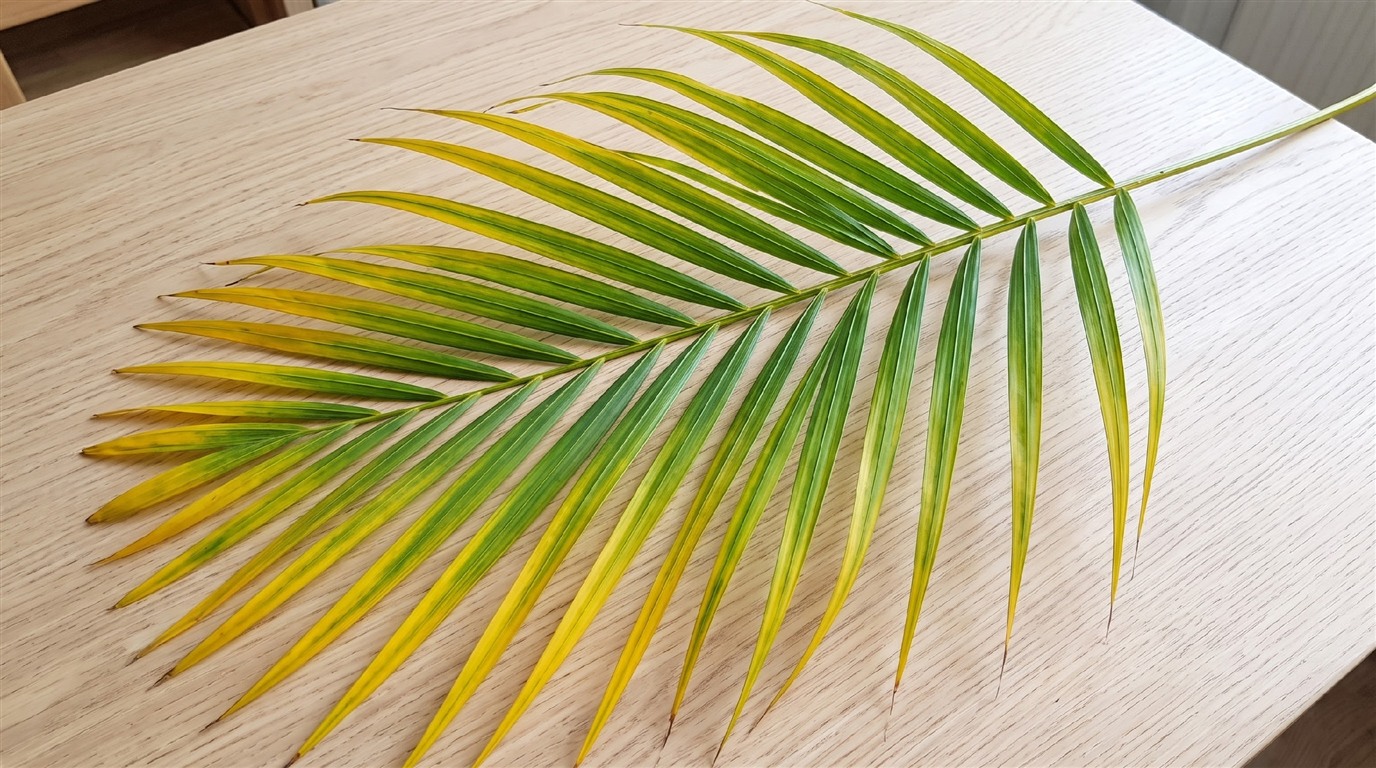
Potted arecas run low on magnesium over time. Most potting mixes contain dolomite to supply it, and Broschat notes that the dolomite in a potting mix “is usually exhausted after about six months.” General houseplant fertilizers often contain little or no magnesium, which is why a palm fertilizer matters. If I had to pick one product for a potted areca, it would be a slow-release palm fertilizer that lists magnesium and micronutrients on the label, because it covers all three of these shortages at once.
Many blogs suggest spraying Epsom salt (magnesium sulfate) on the leaves. UF/IFAS says plainly that “foliar sprays with Mg fertilizers are generally ineffective.” Magnesium works when it goes into the soil, and only when magnesium is actually the problem.
New Fronds Turning Yellow: Check the Roots First
When the newest fronds come in pale yellow while the old ones stay green, the problem is usually below the soil line. Broschat describes this pattern as iron chlorosis and explains that in palms it “is usually not caused by a lack of Fe in the soil, but rather by poor soil aeration or by planting palms too deeply.” Root rot and salt damage show up the same way above ground.
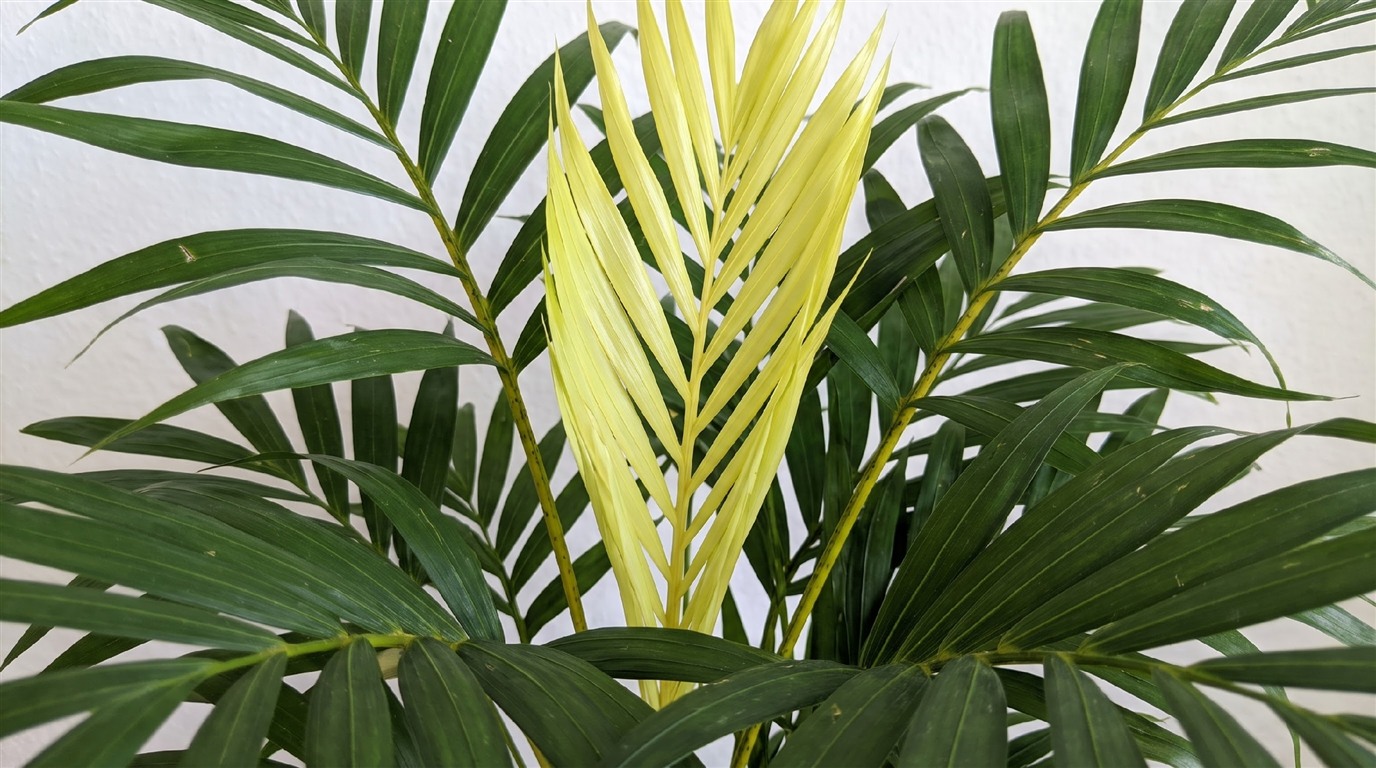
That is why iron supplements rarely help a potted areca. UF/IFAS advises that adding iron fertilizer “is usually not very helpful” in containers, and that the real fix is to knock off the degraded potting mix and replant the palm in fresh mix. Iron chelates can also burn areca foliage at high rates. Unlike potassium damage, iron chlorosis can reverse: yellow tissue can regain its green color once the roots are working again.
How to check the roots in about ten minutes:
- Push a finger or a wooden skewer 2 inches into the soil. If it is still wet several days after watering, the mix is draining too slowly.
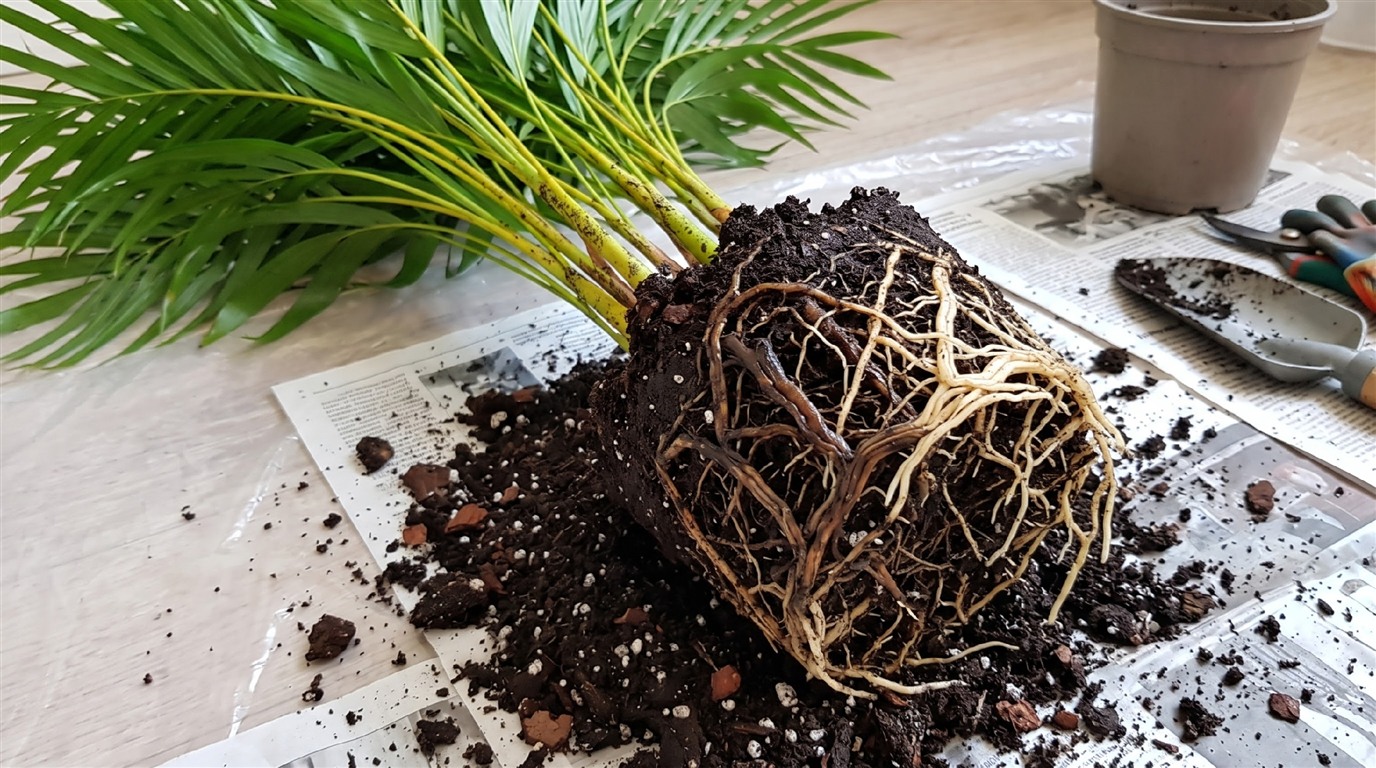
- Tip the pot and slide the root ball out. Healthy roots are firm and pale. Rotting roots are brown or black, soft, and peel away easily.
- Check the depth. The base of the stems should sit at the same level it did in the nursery pot, not buried deeper.
- Look at the mix itself. Old potting mix that has broken down into a dense, soggy mass holds water around the roots.
- If the mix is degraded or the roots are rotting, trim away dead roots, repot into fresh, fast-draining palm mix at the original depth, and use a pot only slightly larger than the root ball.
Clemson warns that many palms “have fragile root systems and can be easily damaged,” so work gently and do not tease the root ball apart unless you are dividing the plant. An oversized pot is a common mistake: the extra soil stays wet long after the roots have taken what they need. UF/IFAS advises against over-potting palms that will stay in one container for a long time, because the extra mix keeps them too wet.
Manganese and Boron: Rare Indoors
Two micronutrient shortages also show up on new growth. Manganese deficiency makes new fronds emerge yellow with lengthwise dead streaks and, as it worsens, a frizzled look. UF/IFAS notes it can occur in containers when drainage is poor or the soil is cool. Manganese sulfate is the treatment, and a response may take three to six months to appear.
Boron deficiency on areca starts as translucent streaks running across the leaflets, and in worse cases new fronds emerge crumpled or fail to open. In pots it has been seen mainly on seedlings. Be careful here: UF/IFAS notes that the gap between too little and too much boron is small. I would not add boron to a potted areca on a guess; a palm fertilizer with micronutrients supplies enough.
Yellowing From Light, Cold or Pests
Not every yellow frond is about soil or nutrients. These three causes are easy to rule in or out because they follow a recent change in the plant’s surroundings.
Too Much Direct Sun
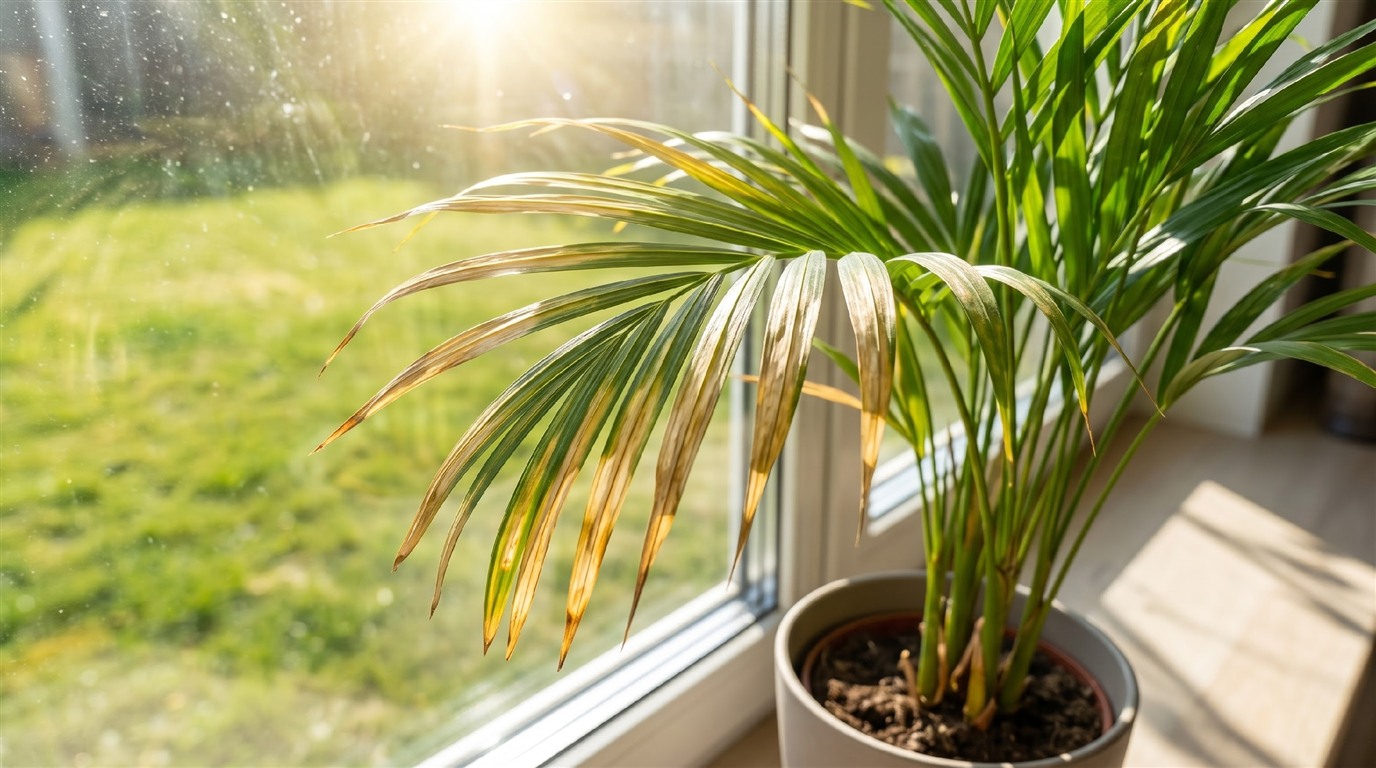
Arecas are sold as bright-light plants, but young ones scorch. UF/IFAS notes that small arecas “benefit from some shade until they are several feet tall,” and that “young palms in full sun and those in high pH soils develop yellow leaves.” Clemson recommends bright indirect light indoors, and advises that plants moved outside for summer should be gradually accustomed to higher light. Sun yellowing shows up on the fronds facing the window or the sky, often as bleached, washed-out patches.
Cold Drafts and Chilling Injury
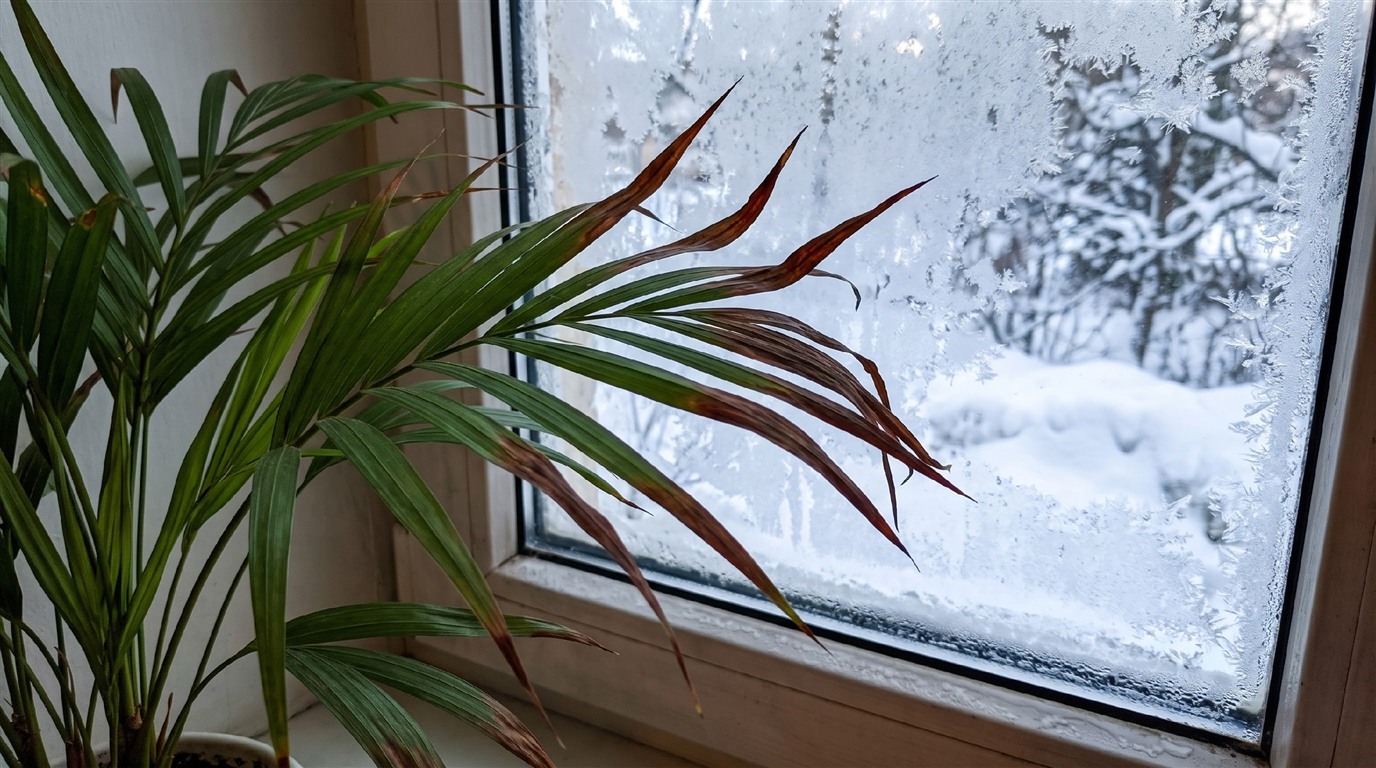
Clemson advises keeping houseplant palms above 45°F to prevent chilling damage, and describes cold injury as reddish-brown dead areas that appear on the leaves after a few days. Broschat notes that chilling injury in tropical palms happens above freezing, and that a palm used to 70°F nights can show dead tissue after a single sudden night at 45°F. A frond pressed against a cold winter window or sitting in the path of an outside door can show this damage while the rest of the plant looks fine. UF/IFAS advises leaving cold-damaged fronds on until the risk of further cold has passed.
Spider Mites, Scale and Mealybugs
Clemson states that “areca palms are very susceptible to spider mites infestations,” and notes that mites thrive in the low humidity and warm temperatures of heated homes. Damage starts as fine pale speckling on the leaves, which then look dull, bronzed or yellow. Fine webbing usually shows up only in heavier infestations. To check, hold a sheet of white paper under a frond and tap it sharply: specks that start moving are mites.
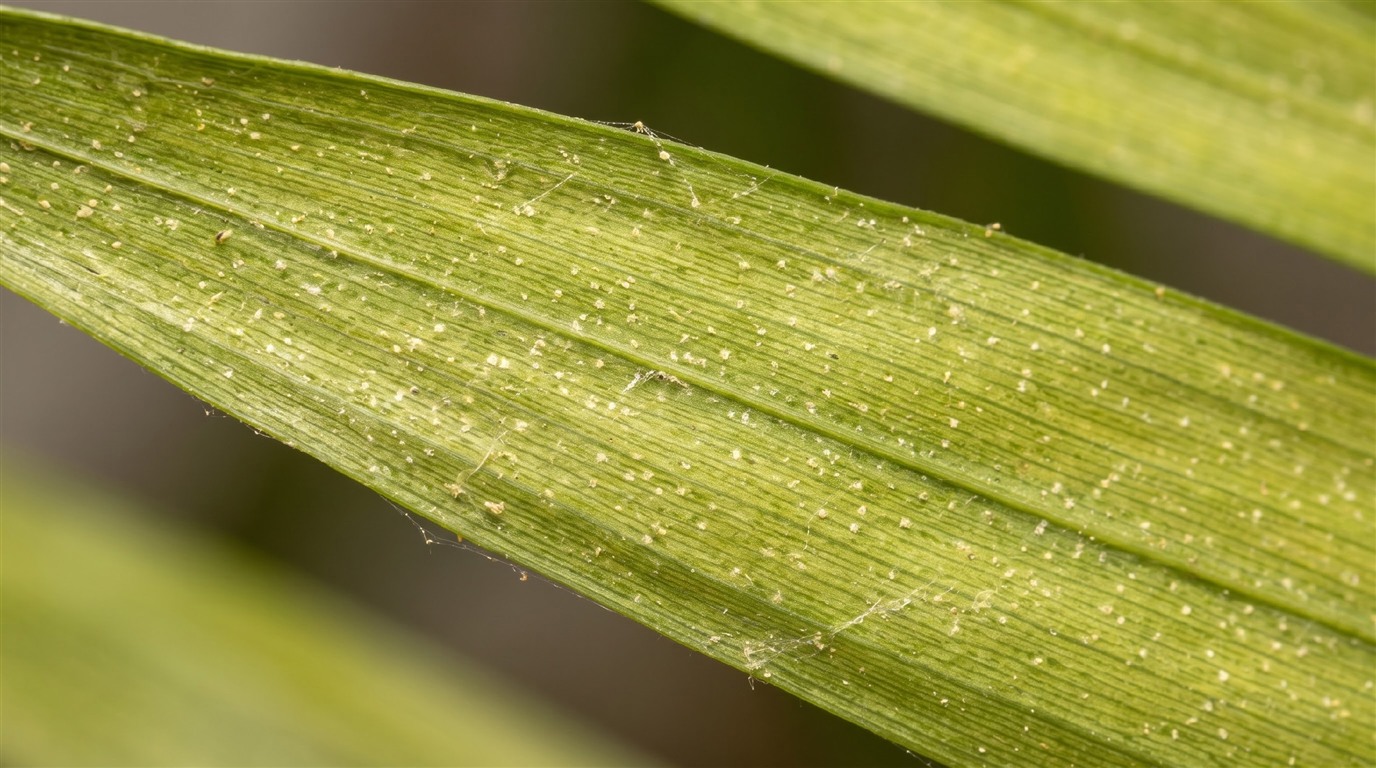
For mites, Clemson suggests forceful sprays of water or insecticidal soap, repeated weekly for several weeks, with attention to the undersides of the leaflets. Clemson also notes that certain palms are sensitive to insecticidal soap, so test it on one frond and wait two days before spraying the whole plant. In my opinion, a shower in the bathtub every week or two is the best thing you can do for a potted areca in a dry winter apartment, because it knocks mites back before they build up.
Scale insects and mealybugs are the other common pests. They suck sap, and mealybugs and soft scales leave sticky honeydew, which turns black as sooty mold grows on it. Check the leaf undersides and the base of the stems for small brown bumps (scale) or white cottony clusters (mealybugs).
Common Scenarios: When Did the Yellowing Start?
The timing often narrows the cause faster than the symptoms do.
Yellow Fronds Right After You Bought It
Arecas are grown in bright greenhouses and nurseries, and indoor light is a small fraction of that. University of Kentucky guidance puts an areca’s indoor light needs at around 150 to 300 foot-candles, while production light levels are many times higher. A plant moving from one to the other can drop a few of its oldest or most shaded fronds while it adjusts. A store pot is also usually a dense clump of many seedlings, and the inner, shaded stems tend to yellow first.
I would not repot a new areca in its first month. Give it the brightest indirect light you have, water when the top inch of soil is dry, and wait. A plant that keeps pushing up new green spears is adjusting, not dying.
Yellow Fronds After Repotting
Yellowing in the weeks after repotting usually comes from one of three things: damaged roots, a pot that is too big and stays wet, or a palm set deeper than it was growing before. UF/IFAS advises that palms planted too deeply should be dug up and replanted at the proper depth. If the new pot is much larger than the old one, water less often until the roots fill it.
Yellow Fronds in Winter
Winter combines several triggers: less light, cooler rooms, soil that stays wet longer, dry heated air that favors spider mites, and cold windows. Cut back watering to match the slower growth, keep the plant a foot or more away from cold glass and drafty doors, and check for mites. Do not respond to winter yellowing with extra fertilizer; Clemson’s schedule is spring and summer only.
Yellow Fronds on an Outdoor Areca in Florida or California
UF/IFAS rates arecas for outdoor planting in USDA zones 10A to 11. In the ground, the picture changes. Potassium and magnesium shortages are the common problems in landscape palms, and Broschat notes that in the field or landscape, nitrogen deficiency is common only in a couple of species, one of which is the areca. Sandy soils lose all three quickly.
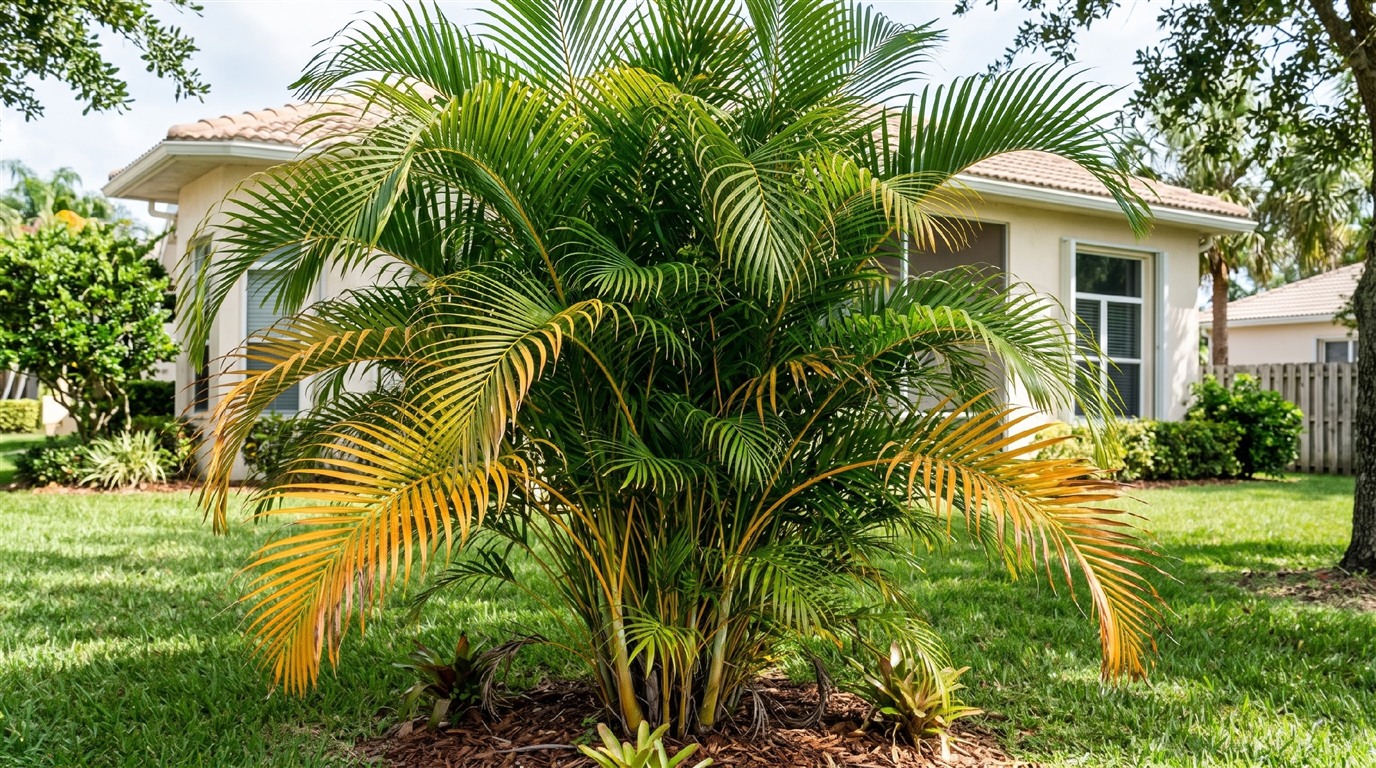
For landscape palms, UF/IFAS recommends an 8-2-12+4Mg palm fertilizer with the nitrogen, potassium and magnesium in slow-release form, applied every three months. Broschat warns that high-nitrogen lawn fertilizers with no magnesium force fast growth that “induces or exacerbates K and/or Mg deficiencies,” so keep lawn fertilizer away from the palm’s root zone.
If you have read that your areca may have lethal yellowing, check the host list first. The current UF/IFAS host table for lethal yellowing does not include areca palm, and neither does the host list for lethal bronzing. Fusarium wilt of palms mainly affects queen palms and Washingtonia. Yellowing on an outdoor areca is far more likely to be a nutrient problem than one of these diseases. UF/IFAS does list Ganoderma root rot among areca diseases, so a clump that declines stem by stem from the base deserves a closer look by a local extension office.
Should You Cut Off Yellow Areca Fronds?
Only when they are completely brown. Broschat’s rule is that removing completely dead leaves “is never a problem,” but partly yellow fronds on a palm short of potassium “should be left on the palm as they are providing K.” Cutting them off makes the palm pull potassium from the next fronds up, and UF/IFAS warns that regular removal of these fronds can accelerate the decline. The full explanation is in the pruning section of our areca care guide.
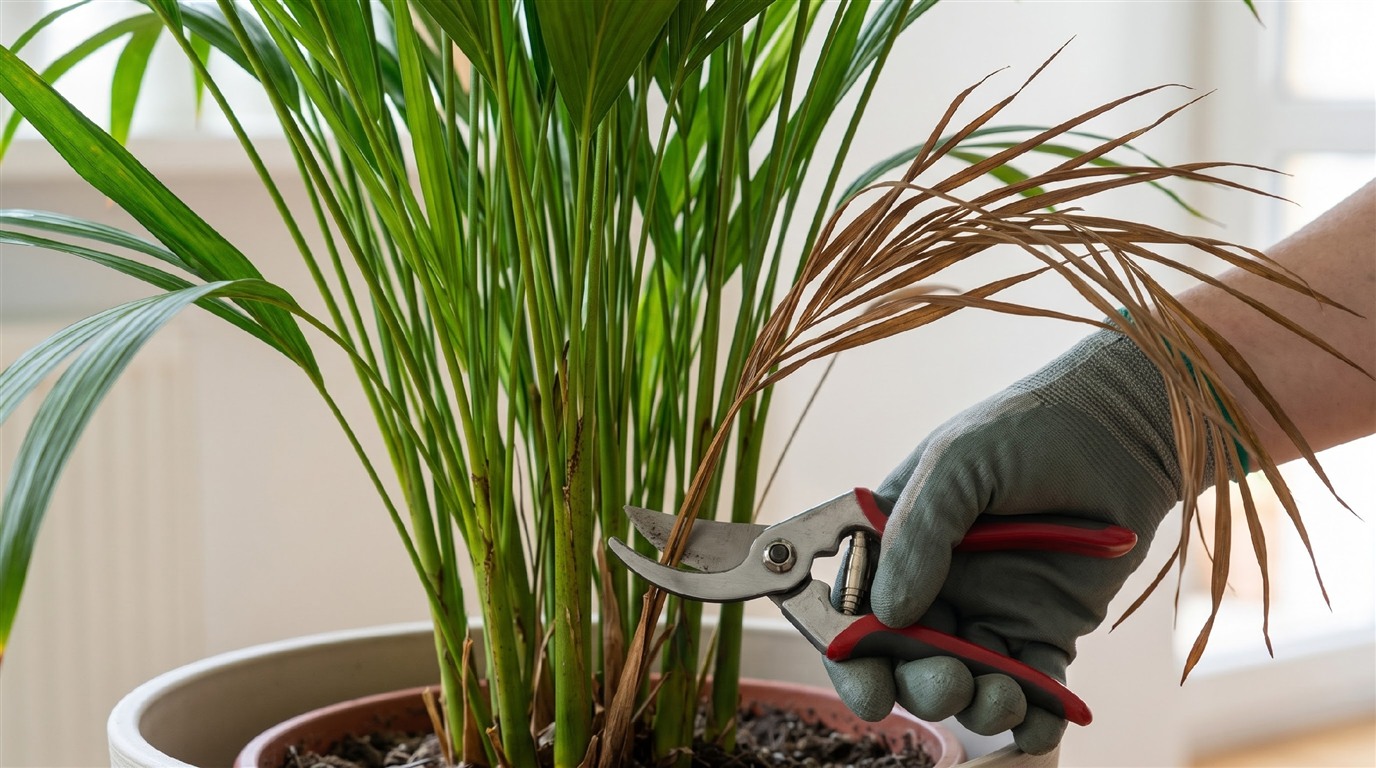
- Completely brown and dry: cut it off close to the base with clean shears.
- Yellow but still partly green: leave it on until it browns.
- Immature fronds at the base of the clump: a UF/IFAS extension blog notes these can be removed for appearance.
I would leave a half-yellow frond on even when it looks untidy. Tidying up is the most natural thing to do and, with this palm, it can make the problem worse.
Will Yellow Areca Leaves Turn Green Again?
It depends on the cause. Fronds yellowed by nitrogen shortage or by iron chlorosis from poor roots can green up once the cause is fixed. Fronds damaged by potassium or magnesium shortage, sun, cold, salts or mites will not. For those, recovery means new healthy fronds replacing the damaged ones.
| Cause | Do yellow fronds recover? | When you see improvement |
|---|---|---|
| Nitrogen shortage | Usually yes | Within a month or two of feeding |
| Iron chlorosis (wet or degraded soil) | Can, once roots recover | Next new fronds |
| Potassium shortage | No | One to three years for a full canopy of healthy fronds |
| Magnesium shortage | No | New fronds; full recovery can take one to two years outdoors |
| Manganese shortage | No | Three to six months after treatment |
| Sun, cold, salts, mites | No | Next new fronds, once the cause is removed |
So judge recovery by the newest frond, not the oldest. If each new spear opens greener than the last, the fix is working.
What Doesn’t Fix Yellow Areca Leaves
- Spraying Epsom salt on the leaves. UF/IFAS calls foliar magnesium sprays generally ineffective, and magnesium does nothing if the real problem is nitrogen or the roots.
- Adding iron to a waterlogged pot. Yellow new fronds from wet roots need fresh, well-draining mix, not more iron.
- Letting tap water sit overnight. This lets chlorine escape but does nothing about fluoride. Penn State links fluoride to chains of small dead spots between the veins on areca and recommends keeping soil pH between 6 and 6.5 and avoiding perlite and superphosphate.
- Doubling the fertilizer. Clemson notes that the tips of lower leaves “may turn brown and die from excessive fertilization.” One correct dose of slow-release palm fertilizer beats several heavy feeds.
- Copper fungicide for “lethal yellowing.” Areca is not on the UF/IFAS host list for lethal yellowing, and the disease is caused by a bacteria-like phytoplasma, not a fungus.
- Cutting off every yellow frond. See the pruning rule above.
The same old-versus-new leaf logic works for other houseplants too. Our guides to ZZ plant yellow leaves and yucca cane problems use it for plants that store water very differently from a palm.
Frequently Asked Questions
Why is my areca palm turning yellow and brown?
Yellow that turns brown at the tips and edges of the oldest fronds usually means potassium shortage, especially outdoors. Brown tips on the lower leaves with a white crust on the soil point to too much fertilizer. A single old frond turning orange-brown and then brown within days is normal aging.
Why are the stems on my areca palm yellow?
Some golden color on the stems is natural for this species. On potted arecas, strongly golden stems and leaf bases are also a sign of nitrogen shortage, which a slow-release palm fertilizer in spring and summer usually corrects.
Does overwatering cause yellow leaves on an areca palm?
Yes. Constantly wet soil damages the roots, and the palm shows it as yellow new fronds. Clemson’s guidance for indoor palms is that they should never be allowed to dry out or to stand in water.
Is Epsom salt good for an areca palm?
Only if the palm is short of magnesium, which shows as yellow bands along the edges of older fronds with green centers. Apply it to the soil, not the leaves. A palm fertilizer that already contains magnesium is the simpler option.
How long does it take an areca palm to recover from yellow leaves?
Nitrogen-yellowed fronds can green up in a month or two. For most other causes, the damaged fronds stay yellow and recovery means new fronds growing in healthy, which takes months for a potted plant and up to a few years for a large outdoor clump short of potassium.