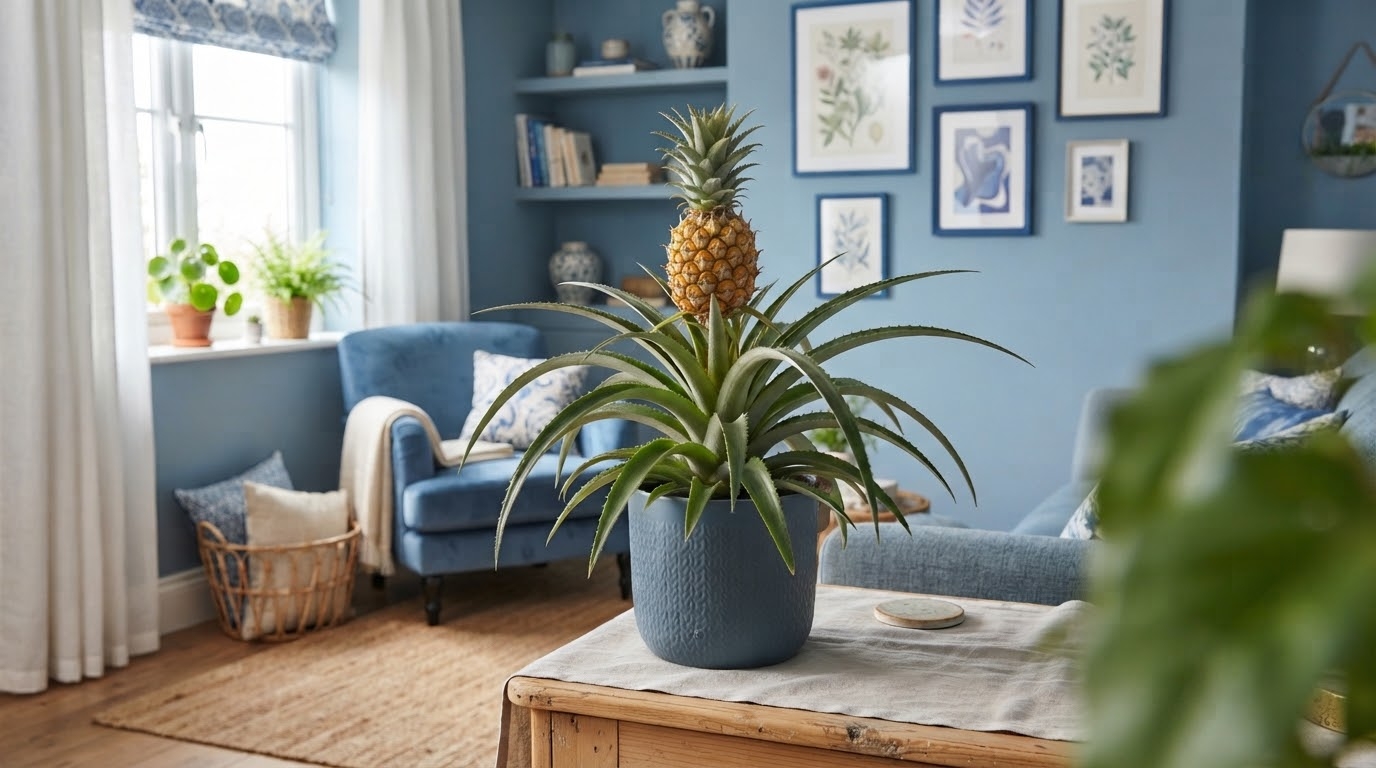
The pineapple bromeliad confuses people for a good reason: it is simultaneously a houseplant and a grocery item, and the plant sold in a 4-inch pot with a miniature fruit on top is the same species as the one that produced the pineapple in your kitchen. Ananas comosus is the only bromeliad most people have eaten, and the only one grown for its edible fruit.
This guide covers what you actually bought, how pineapple care differs from the tank bromeliads it gets shelved next to, how to grow one from a supermarket top, and the honest timeline before anything edible appears.
| Pineapple Bromeliad at a Glance | |
|---|---|
| Botanical name | Ananas comosus |
| Growth habit | Terrestrial: grows in soil, no water-holding tank |
| Light | Bright light; more than the common tank bromeliads need |
| Size | 3–4 ft tall and wide (NC State); dwarf cultivars stay smaller |
| Time to fruit | At least 24 months to flower from a crown; fruit ripens 5–7 months later |
| Hardiness | USDA 10a–12b; indoors before 50°F |
| Handling | Saw-toothed leaf margins; listed as a low-severity poison |
Is the Pineapple Bromeliad a Real Bromeliad?
Yes, and that is not a technicality. Ananas comosus sits inside Bromeliaceae alongside Guzmania, Aechmea and Neoregelia, which is why garden centers file it with them. Missouri Botanical Garden describes the genus Ananas as “5 or 6 species of evergreen terrestrial perennials from South America.” They form spiny rosettes of lance-shaped leaves, and the flower spike develops into the fleshy, edible fruit.
The word doing the work in that sentence is terrestrial. Most bromeliads sold as houseplants are epiphytes: in the wild they grow anchored to tree branches, with roots that function mainly as holdfasts and a central cup that collects water. Pineapple does not live that way. It grows in the ground, feeds through its roots like an ordinary plant, and has no functional tank.
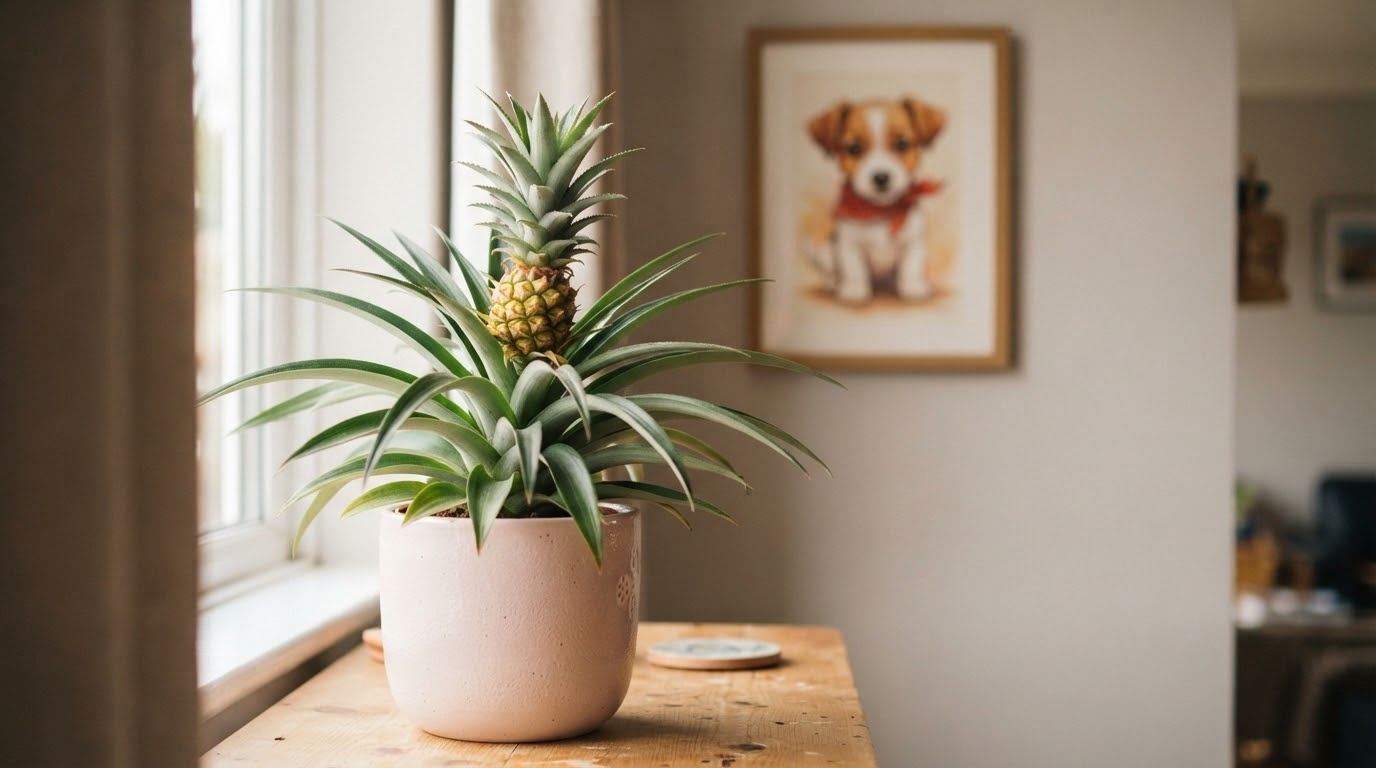
That single difference invalidates most of the bromeliad care advice you will read. Instructions to keep the central cup filled, to flush the tank weekly, to avoid letting water touch the soil: none of it applies to a pineapple. Follow tank-bromeliad watering on a pineapple and you risk rotting its crown.
What Did You Actually Buy?
Three different plants get sold under pineapple-adjacent names, and the label rarely distinguishes them.
The dwarf ornamental
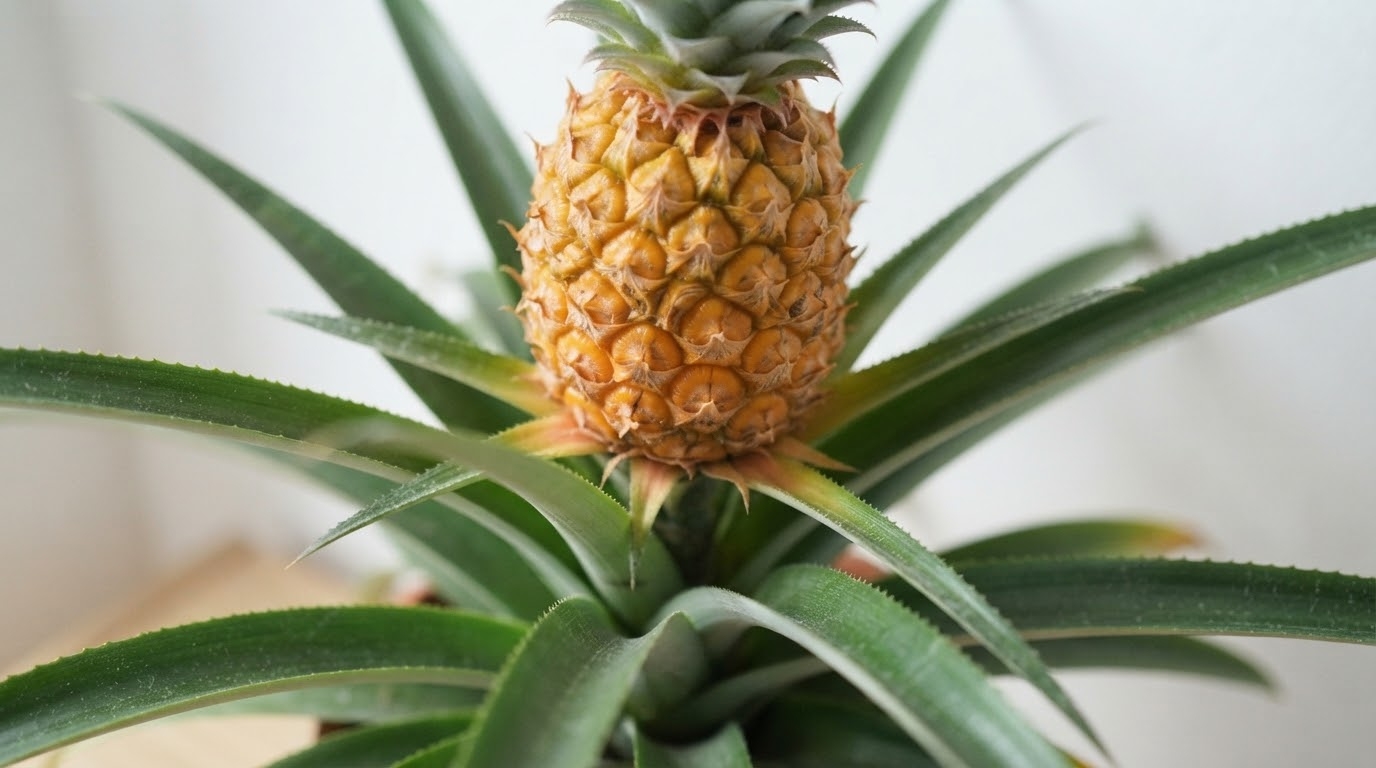
Often sold as Ananas comosus var. microstachys, which NC State Extension describes as a “dwarf pineapple” grown “as a novelty houseplant” with reddish foliage. This is the one sold with a small, hard, decorative fruit already attached. That fruit is the plant’s finale, not a preview (more on why below).
The variegated ornamental
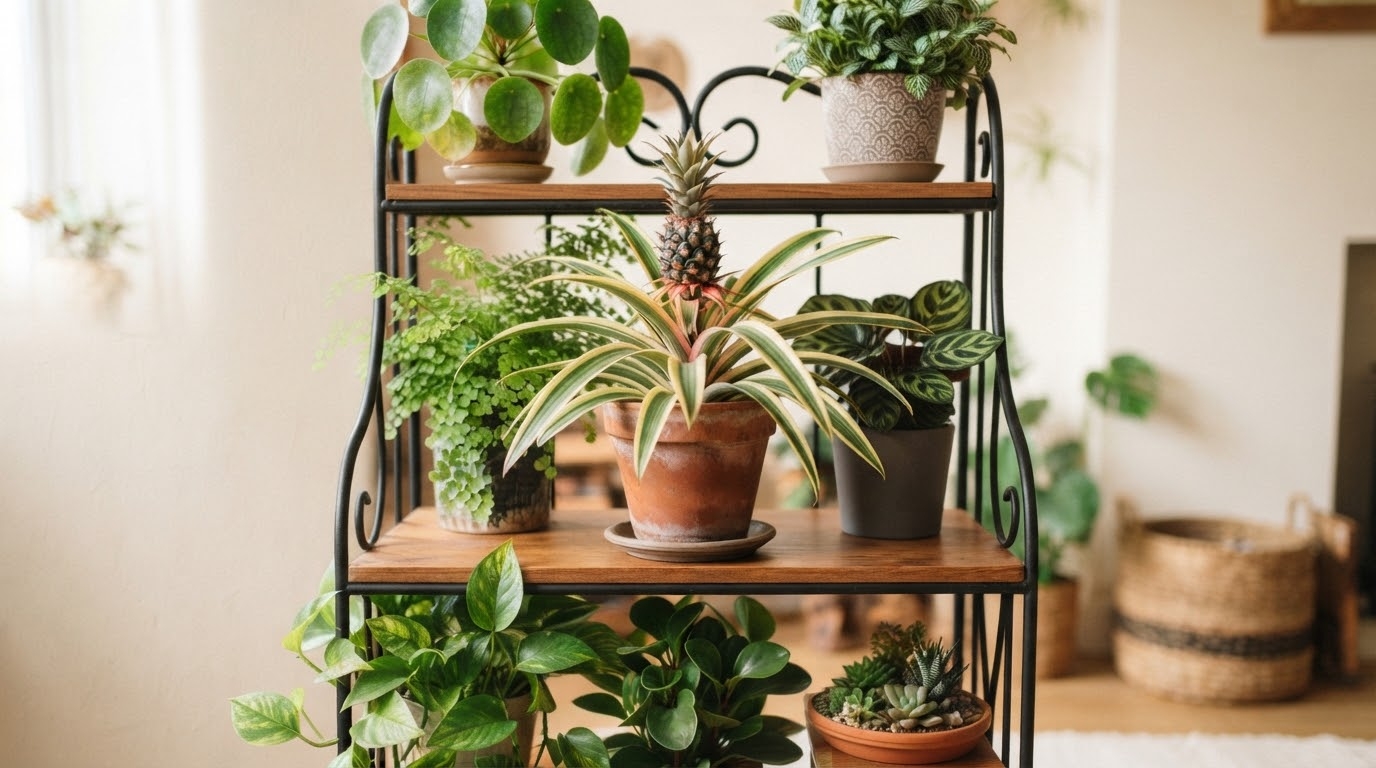
Sold as Ananas comosus var. variegatus (the RHS name; NC State files it under var. comosus, which botanically is the ordinary fruiting pineapple), the Ivory or Variegated Pineapple, carrying “grayish-green leaves variegated lengthwise along the margins with yellowish-white stripes” and reaching “2 to 3 ft. tall, 3 to 4 ft. wide” (NC State). Grown for foliage; the fruit is incidental.
The actual fruiting species
Standard Ananas comosus, reaching 3–4 feet in both directions. This is what you get if you root a supermarket pineapple top, and it needs floor space rather than shelf space.
If you are trying to identify yours: a plant under a foot tall with a fist-sized fruit is an ornamental dwarf. A plant with no fruit and leaves over two feet long is a full-size pineapple that has not fruited yet. If you want a plant that may eventually give you fruit, I would skip the ornamental with fruit attached and root a supermarket top instead: it costs nothing and gives you the full-size plant from the start.
Does the Pineapple Plant Die After Fruiting?
Yes, and this catches out nearly everyone who buys one with fruit attached.
NC State Extension states it without hedging: “A single fruit is produced, and then the plant will decline.” Pineapple is monocarpic in the same way as the rest of the family: the rosette flowers once, fruits once, and is finished. The Bromeliad Society International’s general rule holds here: “with rare exceptions, bromeliads only flower a single time.”
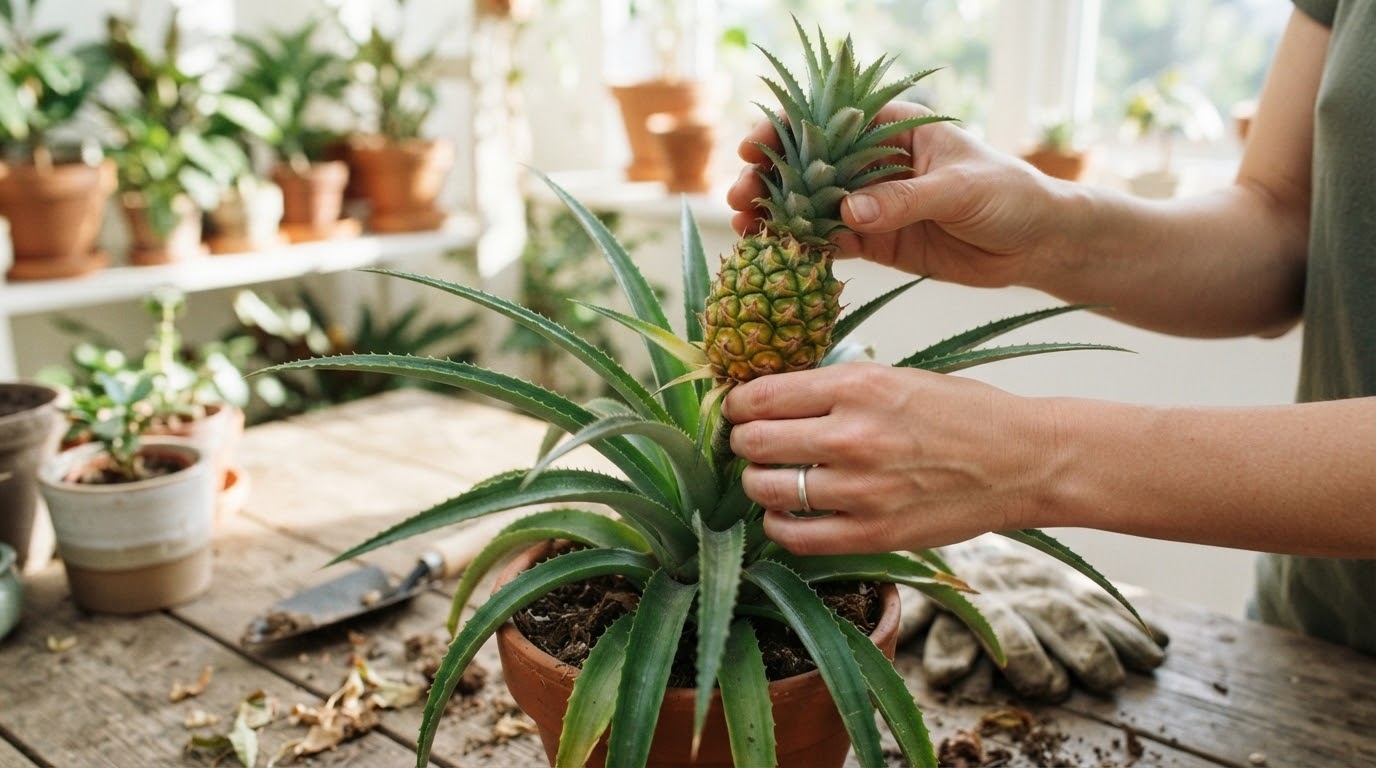
So the ornamental pineapple you bought with a decorative fruit on top has already completed its life cycle in the store. It is not going to fruit again. What it will do, like every other bromeliad, is produce offsets while it slowly declines.
Pineapple offsets come in three forms, and NC State names all of them: the plant “is propagated asexually from the fruit crown, suckers produced at the base of the plant or plantlets produced on the inflorescence.”
- Suckers: shoots from the base, the fastest route to the next fruit
- Slips: plantlets on the stalk just below the fruit
- The crown: the leafy top of the fruit itself
Commercial growers rely on exactly this. After the first harvest, subsequent fruitings called ratoon crops come from suckers, not from replanting. The mother is spent; the suckers carry on.
How Do You Grow a Pineapple From the Top?
This is the part with genuinely reliable instructions, because Iowa State University Extension published a step-by-step method.
- Cut. “Cut off the top of the pineapple about 1 inch below the cluster of leaves.” Trim away the outer fruit flesh and strip off the lowest leaves.
- Dry. Let the cut surface “dry for several days.” Skipping this invites rot: a wet, sugary cut face in damp medium can rot before roots form. I would wait the full several days rather than plant early.
- Root. Plant it in perlite, vermiculite or coarse sand up to the base of its leaves, kept moist but not wet, in bright indirect light. “Rooting should occur in 6 to 8 weeks.”
- Pot on. Move to “a light, well-drained potting mix,” keep in indirect light for “2 to 3 weeks,” then shift to a sunny window.
- Feed. “Using a dilute fertilizer solution, fertilize the pineapple once or twice a month in spring and summer.”
Note what that fertilizer instruction does and does not say. It still calls for a dilute solution, so pineapple is not a heavy feeder. The difference from a tank bromeliad is the route: a pineapple, being terrestrial, is fed through the soil and its roots, not through a central cup.
How Long Until a Pineapple Plant Fruits?
Longer than almost any blog admits, and the honest range matters if you are deciding whether to start one.
| Source | Timeline | Context |
|---|---|---|
| NC State Extension | At least 24 months to flower | From crown propagation |
| K-State Research and Extension | 2 to 3 years | “plan on two to three years before fruit production” |
| Commercial growing | 18–24 months | Field conditions, first “plant crop” |
Two years to first flower is a realistic floor indoors, under good light. Indoors in a northern US winter, three is more realistic, and a plant in mediocre light may simply never get there. Commercial figures come from Hawaii and the tropics with full sun and consistent warmth, so treat 18 months as a best-case benchmark you are unlikely to match on a windowsill. My advice is to start one only if you have a bright south- or west-facing window, and to treat any fruit as a bonus rather than the goal.
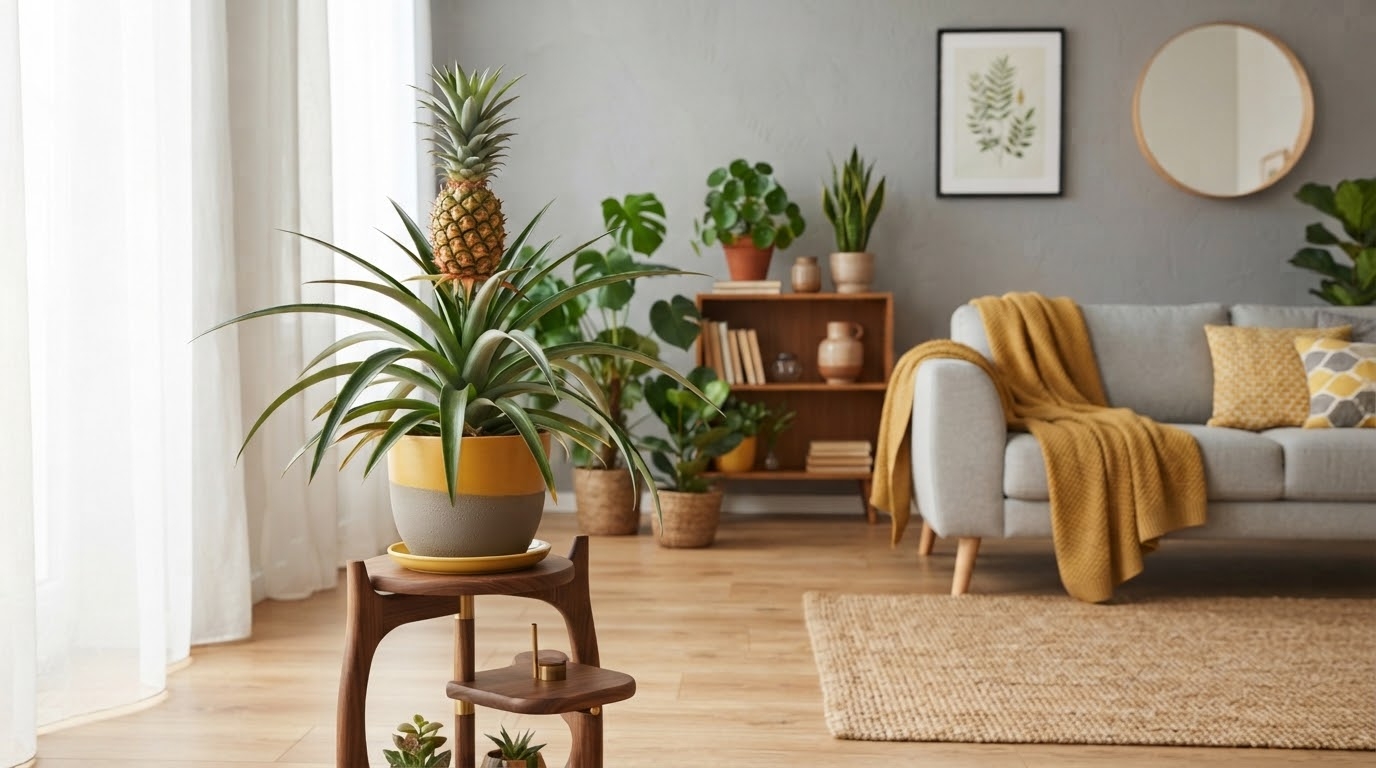
And once fruit does set, add several more months for it to ripen.
Can You Force a Pineapple to Fruit?
Yes, with the same ethylene trick used on other bromeliads. K-State Research and Extension gives the specifics: “placing the plant in a clear plastic bag with an apple for three to four days.” The ripening apple releases ethylene gas, which triggers flowering, and “Flowering should occur within two to three months after the apple treatment.”
Two caveats that most write-ups omit.
The plant must be mature. UF/IFAS says a pineapple “can be forced to flower out of season once it is at least 16 months old.” Research on ethylene-forced bromeliads (Lei et al., 2016, on Aechmea fasciata) reports the same kind of age gate: adult plants flowered under ethylene treatment, juvenile plants did not. I would not spend an apple on a plant younger than those 16 months; bagging a one-year-old plant is unlikely to do anything.
The fruit will be small. UF/IFAS notes that “the larger the container, the larger the plant (and the fruit),” and a windowsill pot is a small container. A forced indoor pineapple is a novelty, not groceries.
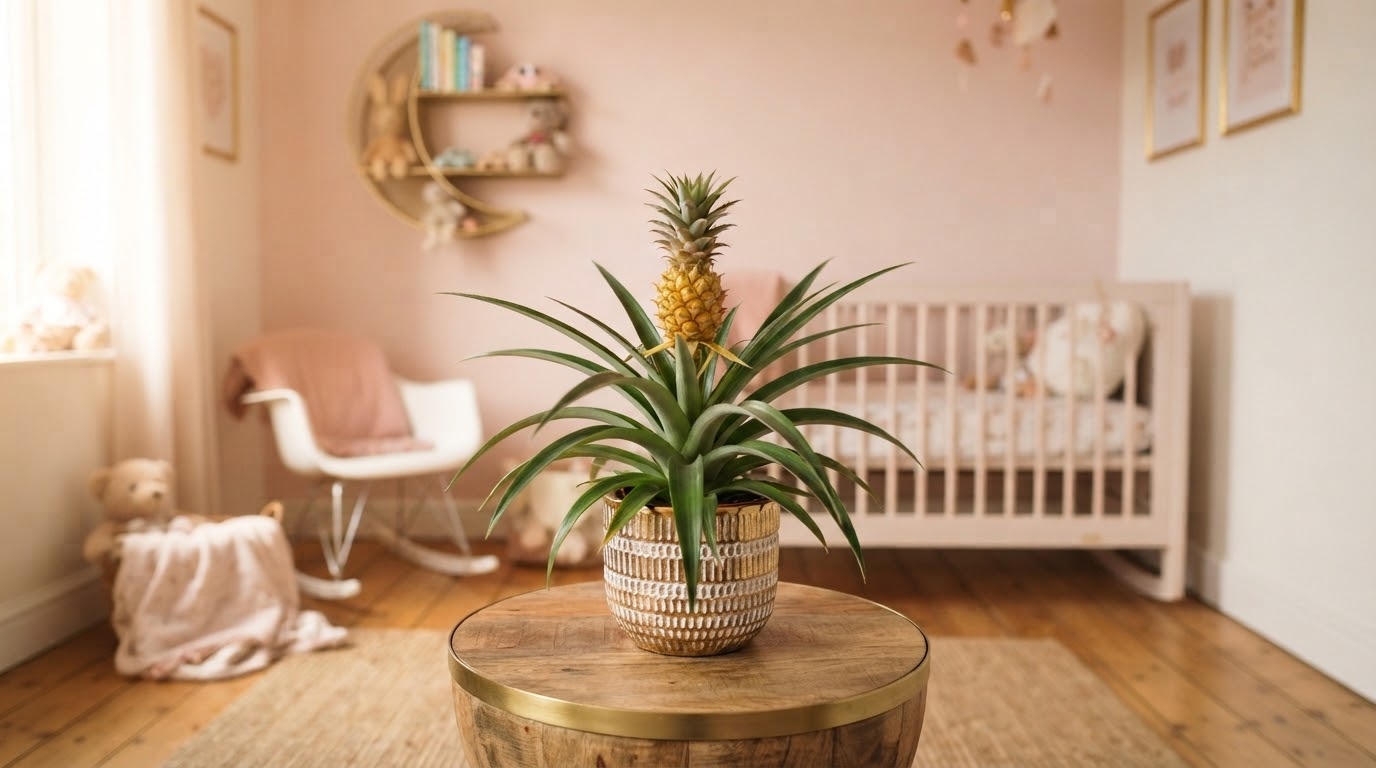
Pineapple Bromeliad Care Indoors
Light
Higher than the common tank bromeliads. NC State lists bright, indirect light, noting direct sun can scorch leaves, but pineapple tolerates and wants far more light than a Guzmania. A south or west window is the realistic minimum, and light is the main factor in whether an indoor plant ever reaches fruiting size.
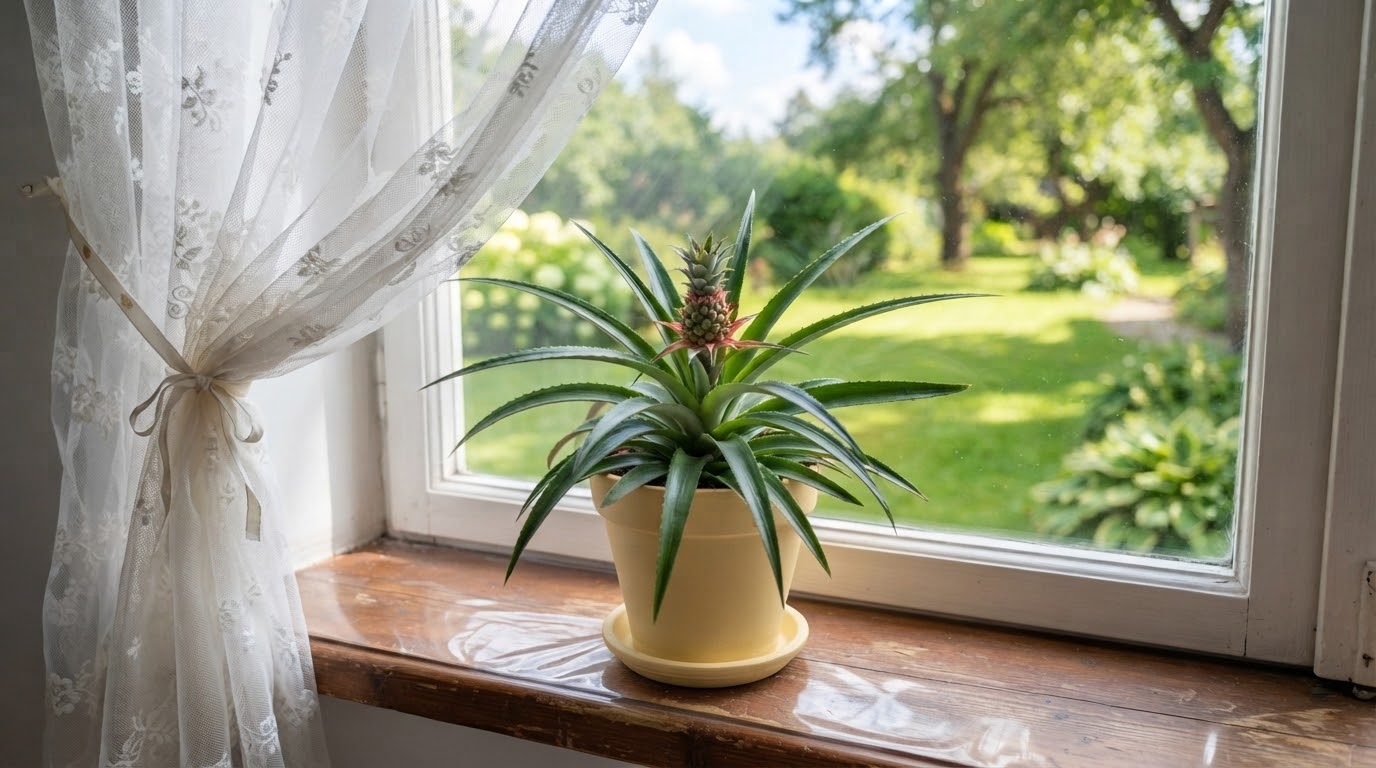
Water
Soil-based, not tank-based. NC State calls for “consistently moist, slightly acidic, well-drained sand or organically rich soil,” allowing the soil to dry between waterings. Do not attempt to keep water pooled in the center of the rosette: pineapple has no tank adapted to hold it, and NC State lists heart rot, black rot and base rot among the problems caused by overwatering.
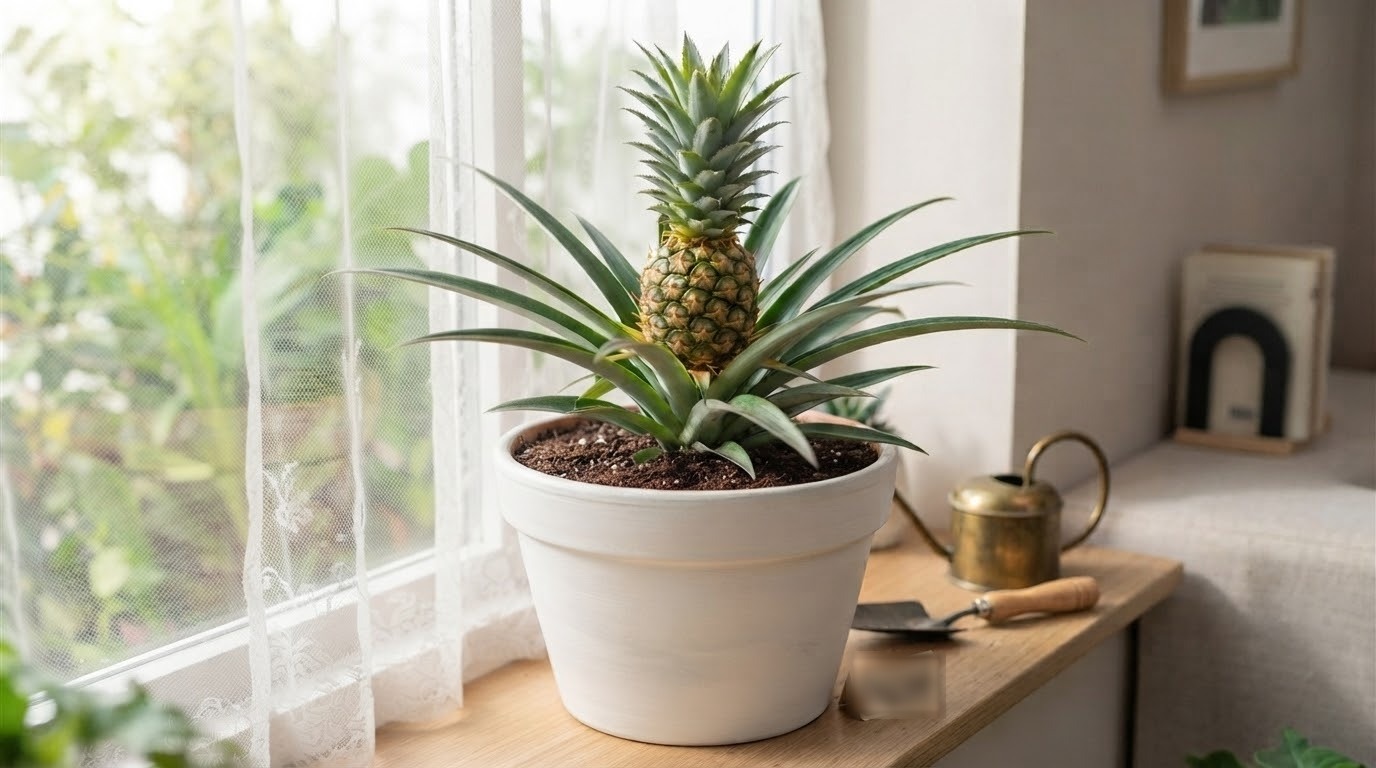
Temperature
Optimal 68–86°F, USDA zones 10a–12b, and “not frost-tolerant; bring indoors before temperatures drop below 50°F” (NC State). Iowa State allows summering outdoors after late May, back inside before first frost.
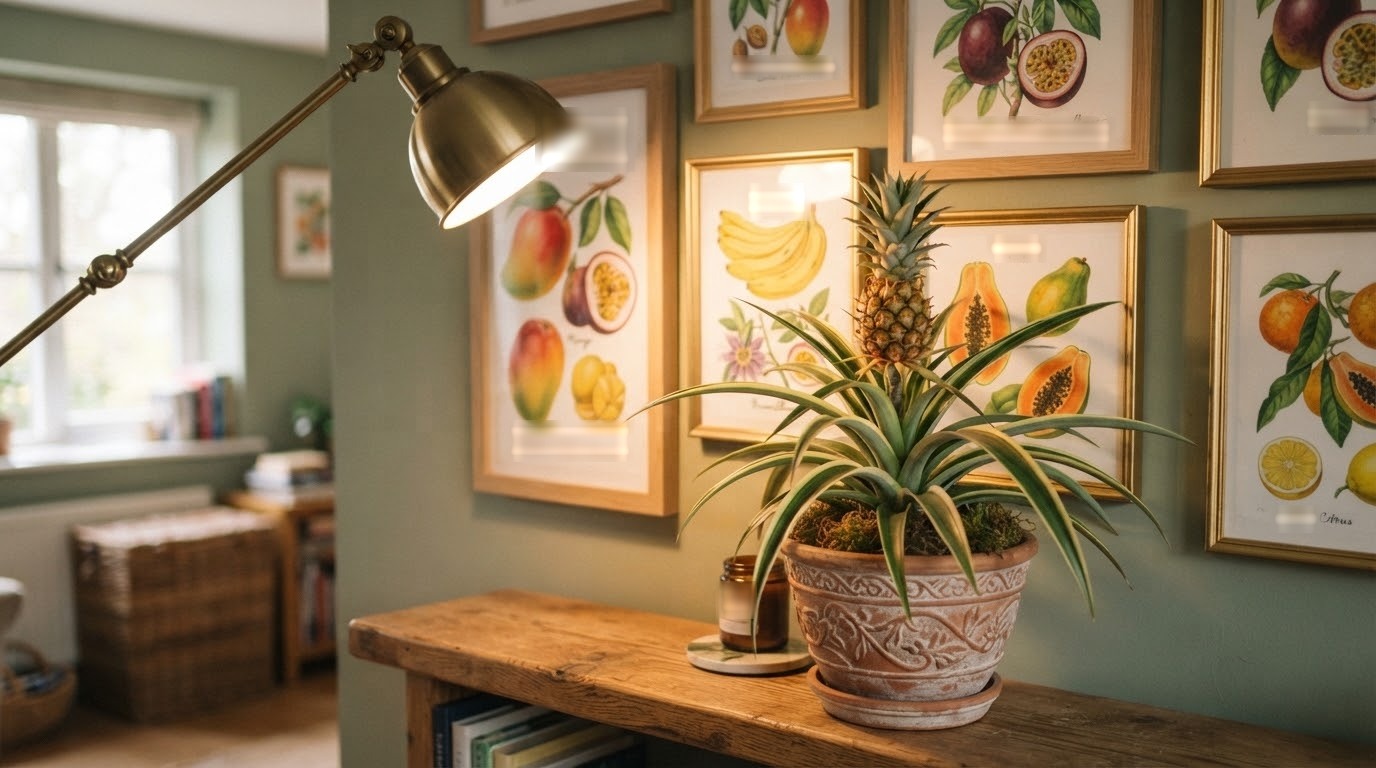
Fertilizer
Once or twice monthly through spring and summer, using a dilute fertilizer solution applied to the soil (Iowa State). The quarter-strength rule that protects tank bromeliads is built around a central cup and leaf feeding; pineapple takes its feed through the roots instead.
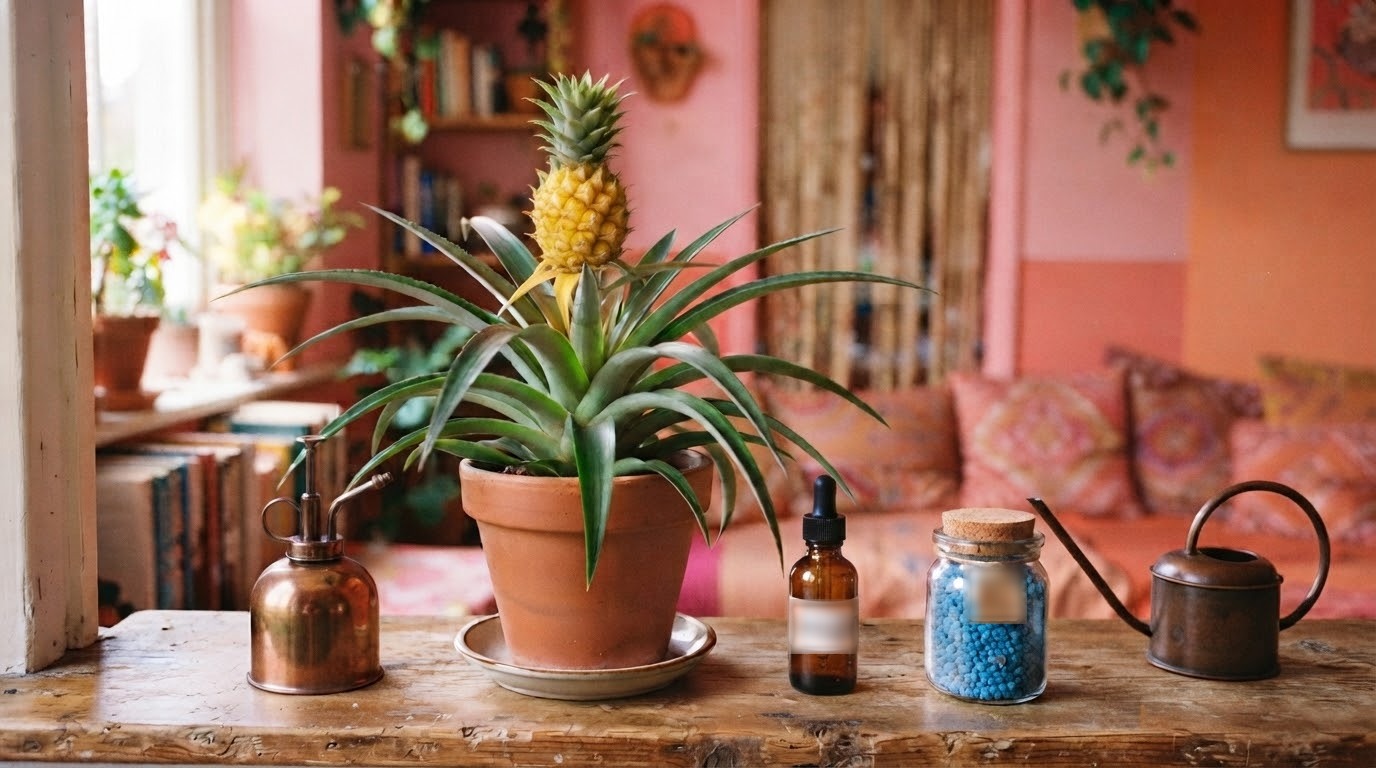
Is the Pineapple Plant Toxic to Cats and Dogs?
This deserves a more careful answer than the usual blanket “bromeliads are pet-safe.”
The bromeliads with ASPCA database entries (Guzmania, Neoregelia, Cryptanthus) are listed non-toxic to dogs and cats. Pineapple is a different case. NC State Extension classifies Ananas comosus as a low-severity poison, naming “bromelin, ethyl acrylate, and calcium oxalate crystals” as the toxic principles, present in the fruits, leaves and sap.
The documented effects are irritation rather than systemic poisoning:
- “Mild skin irritation in sensitive people from contact with juice”
- “Irritation of mouth, lips, and tongue” from the fruit, due to bromelain
- “Throat irritation and strong laxative effect” if large quantities are eaten
- Contact dermatitis: NC State lists this explicitly
The more immediate hazard is physical. NC State describes “stiff, sword-shaped, spiky, narrow, long leaves” with margins that are “sharp or saw-toothed,” and lists “mechanical damage from sharp-pointed, spiny leaves” as a symptom in its own right. A cat brushing past a mature pineapple is at more risk from the leaf edges than from any compound in the plant.
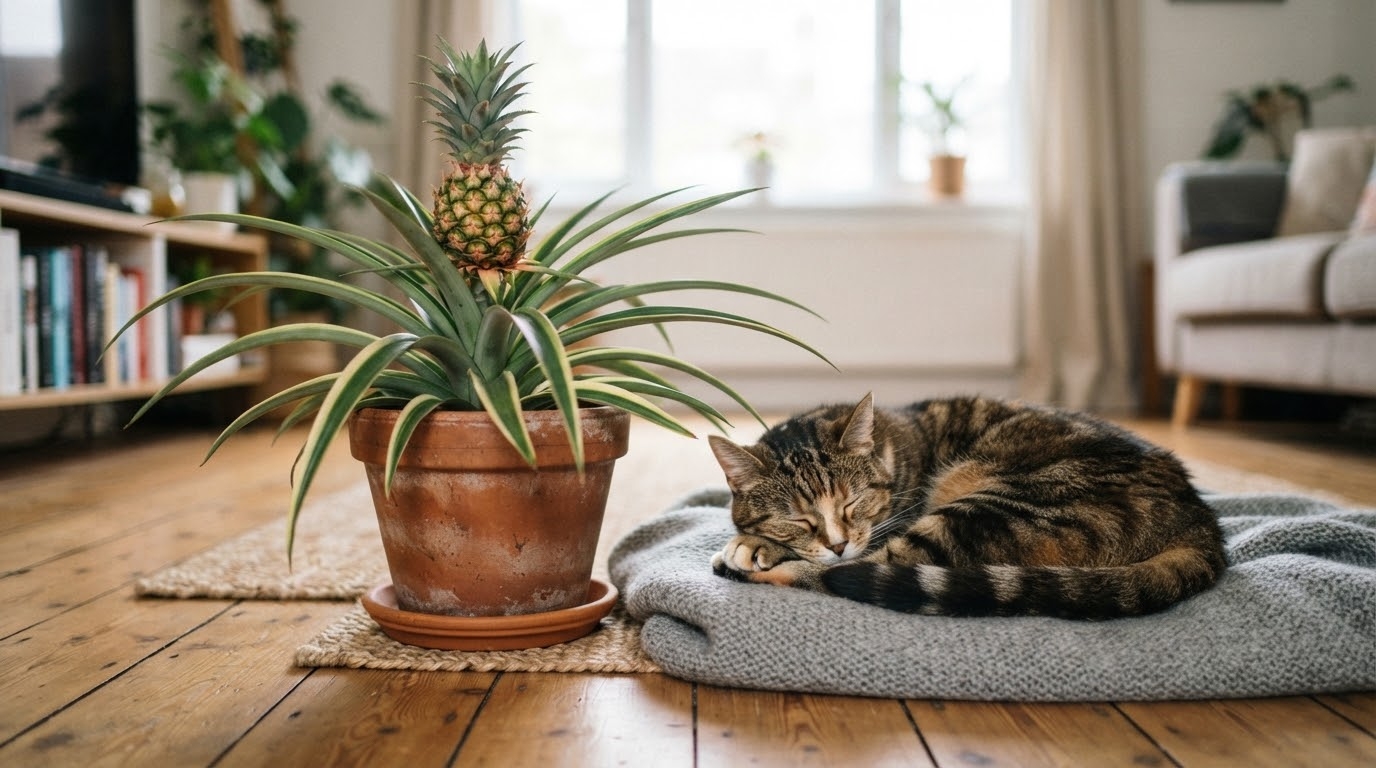
Practical reading: a pineapple plant is not going to poison a pet, but it is not in the same safety category as a Guzmania either, and its leaves can cut. If I had a cat that chews plants, I would put a Guzmania or an earth star on the low shelf and keep the pineapple where the cat does not sit.
What Doesn’t Work
Treating it like a tank bromeliad. Pineapple is terrestrial. Filling the center with water, flushing a cup that does not exist: all of it is advice for a different part of the family, and the water-in-the-center habit actively causes crown rot.
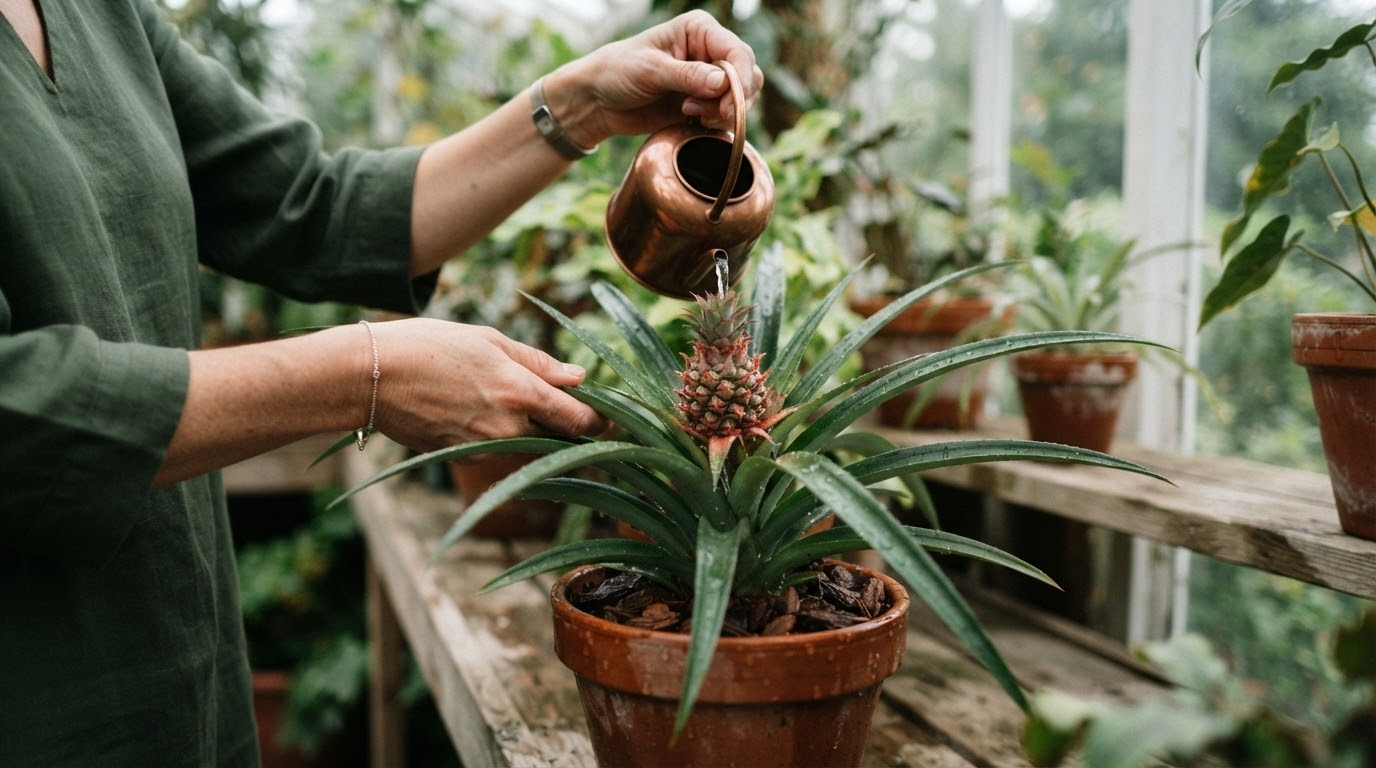
Waiting for the ornamental dwarf to fruit again. The decorative fruit it came with was the end of its cycle. It will not repeat. Watch for suckers at the base instead.
Expecting supermarket-sized fruit indoors. UF/IFAS notes that container size limits fruit size. Commercial pineapples come from full tropical sun over 18–24 months; a windowsill cannot reproduce that.
Forcing a young plant with the apple trick. The maturity requirement is not a suggestion: in the bromeliad research, juvenile plants did not flower under ethylene, and UF/IFAS sets 16 months as the minimum age for forcing a pineapple. Give the plant time to build a full rosette first.
Assuming pet-safe because it’s a bromeliad. NC State lists pineapple as a low-severity poison with contact dermatitis risk. That is a different classification from the ASPCA non-toxic listings the ornamental genera carry.
Frequently Asked Questions
Is a pineapple a bromeliad?
Yes. Ananas comosus belongs to Bromeliaceae, the same family as Guzmania and Aechmea. It differs in being terrestrial rather than epiphytic: it grows in soil and has no water-holding central tank.
Can you grow a pineapple from the top of a store-bought one?
Yes. Cut about an inch below the leaves, strip the lower leaves, let the cut surface dry for several days, then root it in perlite, vermiculite or coarse sand. Iowa State Extension reports rooting in 6 to 8 weeks.
How long does it take a pineapple plant to fruit indoors?
Flowering takes at least 24 months from a crown (NC State), and K-State Research and Extension says to plan on 2 to 3 years before fruit. Commercial 18-month figures come from full tropical sun and are not achievable on a windowsill. Light is the limiting factor.
Does a pineapple plant die after fruiting?
Yes. NC State Extension states that “a single fruit is produced, and then the plant will decline.” The plant continues through suckers at the base, slips below the fruit, and the fruit’s own crown.
Will the ornamental pineapple fruit again?
No. The small decorative fruit it was sold with completed its cycle. Look for offsets at the base; those are the next generation.
Are pineapple plants safe for cats?
Not in the same way as ornamental bromeliads. NC State classifies Ananas comosus as a low-severity poison containing bromelin, ethyl acrylate and calcium oxalate crystals, causing oral and skin irritation rather than serious poisoning. The saw-toothed leaves are a genuine physical hazard.
How much light does a pineapple plant need?
More than the common tank bromeliads such as Guzmania. A south- or west-facing window is the practical minimum indoors. Insufficient light is the usual reason an indoor pineapple never fruits.