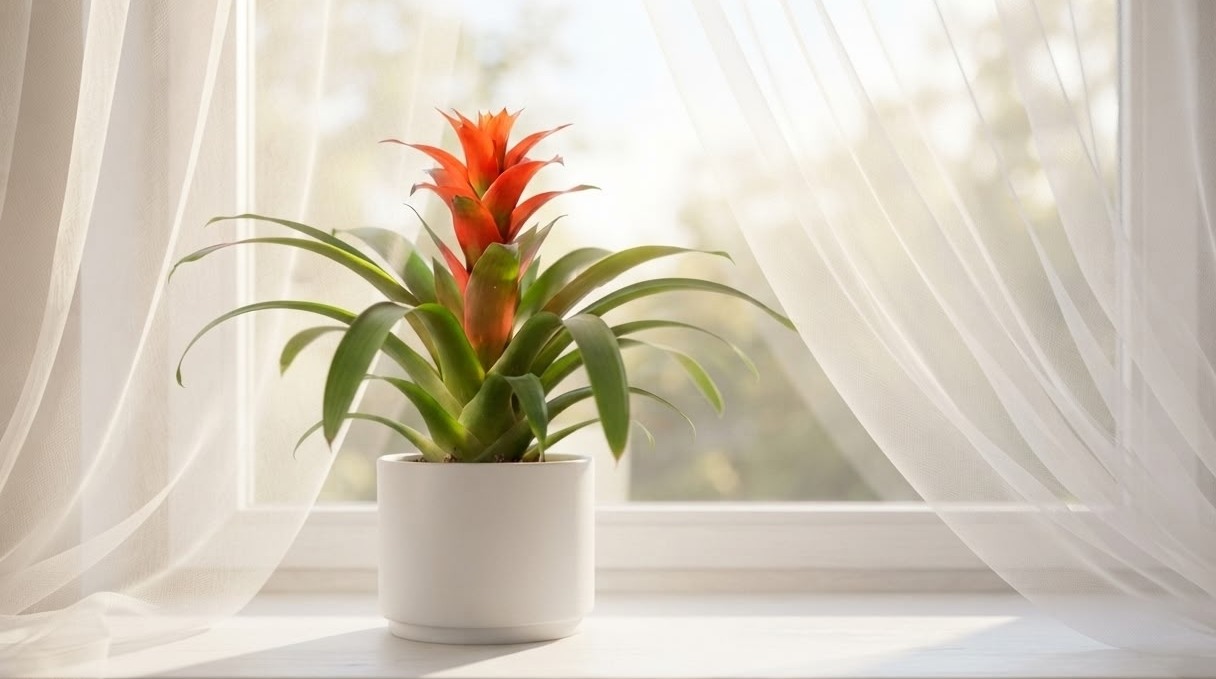
Most bromeliad advice fails at the first step: it treats the family as one plant. A Neoregelia wants strong light and almost no fertilizer. A Guzmania tolerates lower light than most. A Tillandsia has no soil and no cup at all. A pineapple grows in the ground like an ordinary houseplant. Care instructions written for “bromeliads” as a single category will be wrong for several of the plants sold under that name.
This guide covers what the genus on your tag actually changes, how the central cup works and how often to flush it, why the plant dies after flowering and what to do about it, and the numbers that university extension sources actually publish, which are narrower and more specific than most care articles suggest.
| Bromeliad Care at a Glance | |
|---|---|
| Light | 2,000 footcandles minimum; 3,000–4,000 for best color (UW–Madison) |
| Water | Keep cup filled; let the medium dry between waterings |
| Flush the cup | Weekly on hard tap water |
| Humidity | 50–75% preferred; thick-leaved genera tolerate less |
| Temperature | 60–85°F; 10°F day/night swing is beneficial |
| Fertilizer | Quarter strength, monthly, growing season only |
| Lifespan | Each rosette flowers once, then declines over 1–2 years |
| Toxicity | Guzmania, Neoregelia, Cryptanthus non-toxic (ASPCA); leaf spines are the real hazard |
Which Bromeliad Do You Actually Have?
The family is enormous: the Bromeliad Society International counts “over 3000 described species in approximately 56 genera,” though sources differ on the species figure (UW–Madison says about 2,500, Missouri Botanical Garden 2,800). Taxonomy here is actively revised, so treat any precise count with suspicion.
Six genera cover nearly everything sold as a houseplant, and the differences between them are not cosmetic. My advice is to find the genus on the tag before following any care routine, this one included.
| Genus | Identify it by | What’s different |
|---|---|---|
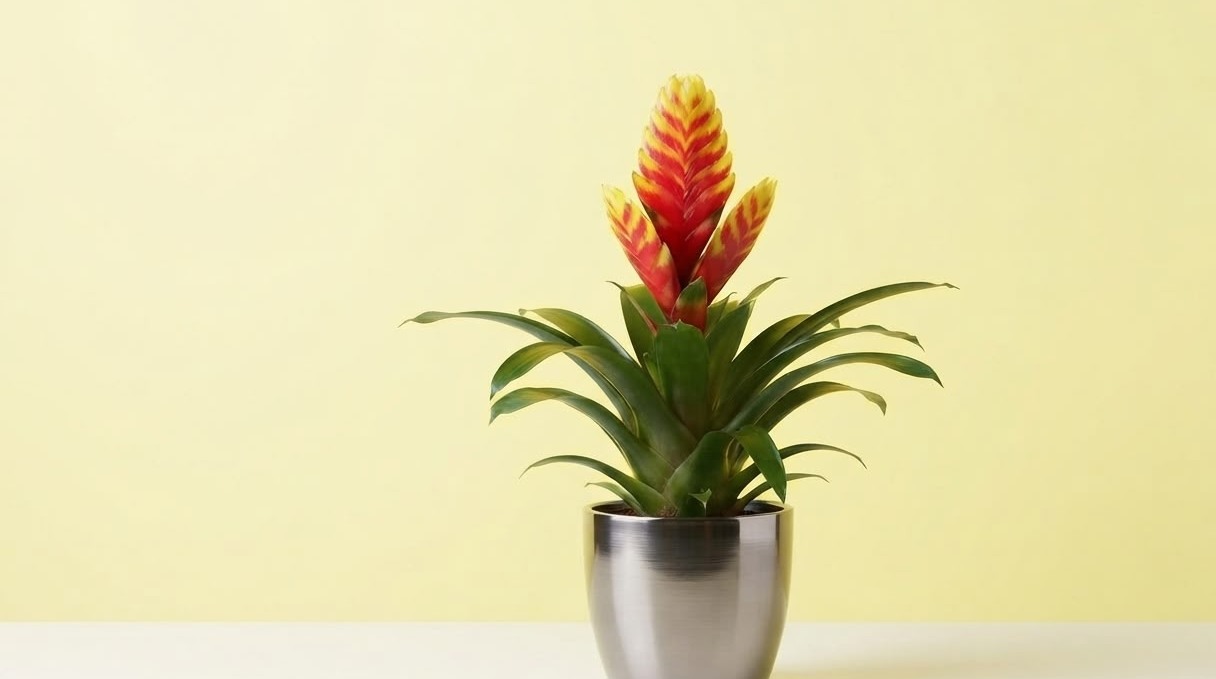
| Guzmania | Soft green leaves, tall central spike of red/orange bracts | Tolerates lower light than most; struggles in dry air |
| Aechmea | Stiff grey-green leaves, toothed edges, pink bract | Toughest; tolerates dry air and dry roots |
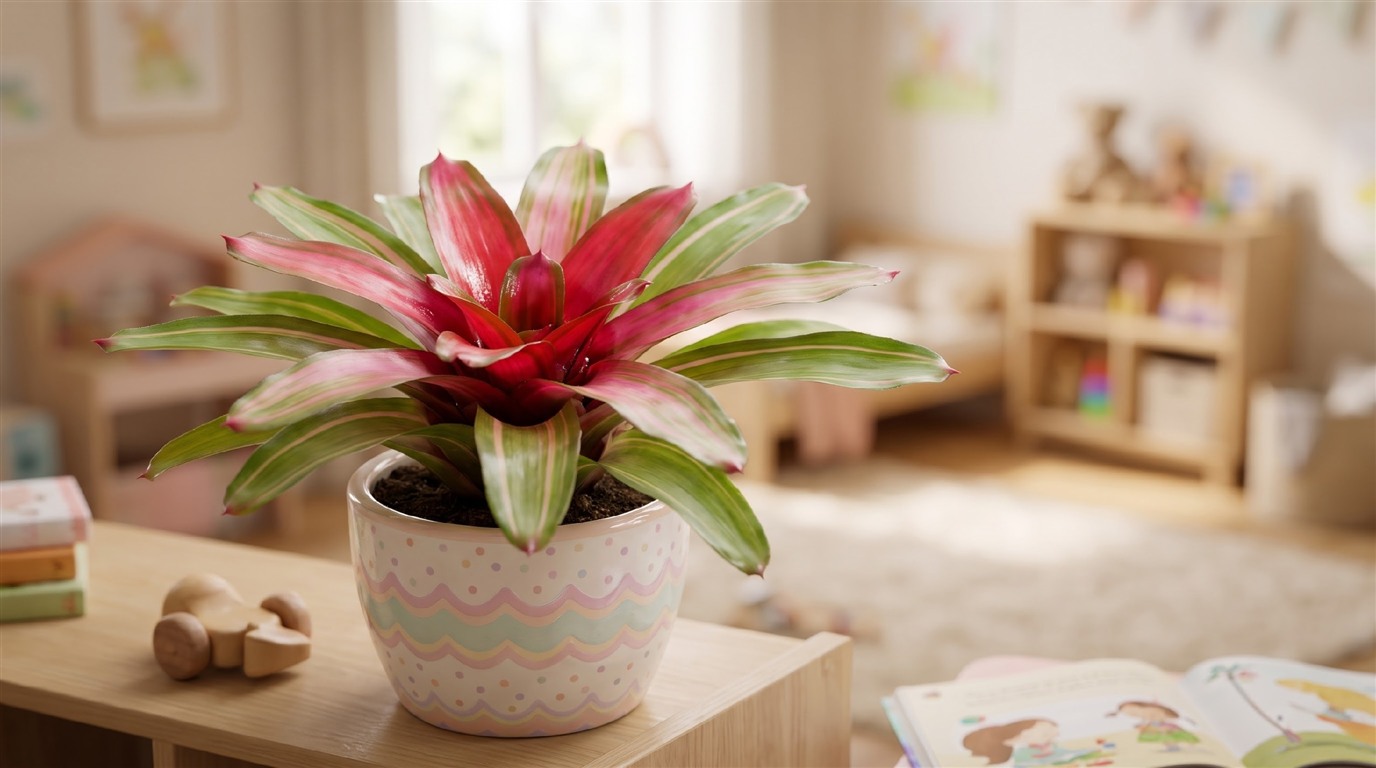
| Neoregelia | Flat rosette, inner leaves flushed red/pink, no tall spike | Highest light, least fertilizer; feeding ruins the color |
| Vriesea | Soft leaves, flat sword-shaped bract | Pups may appear inside the rosette, not at the base |
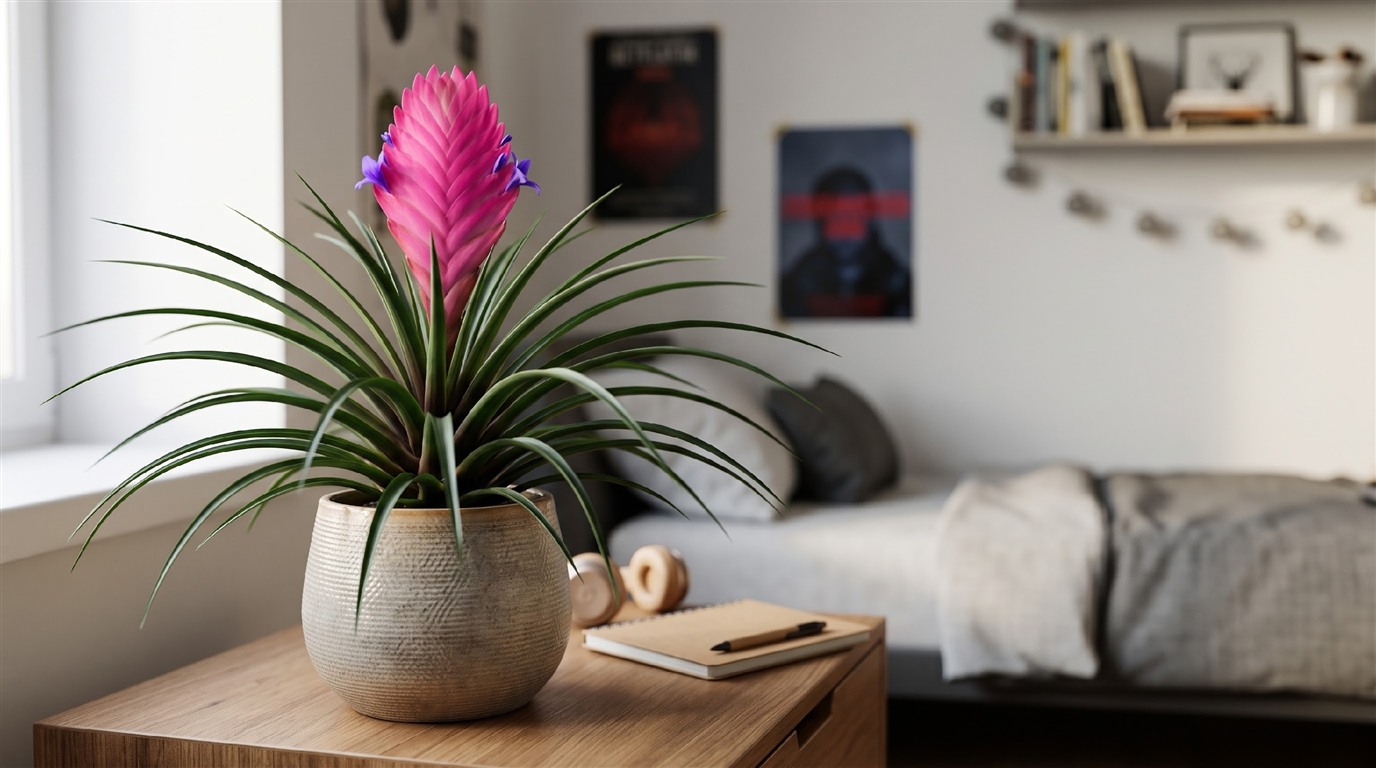
| Tillandsia | No pot or soil, sold loose | No cup; watered by misting or soaking |
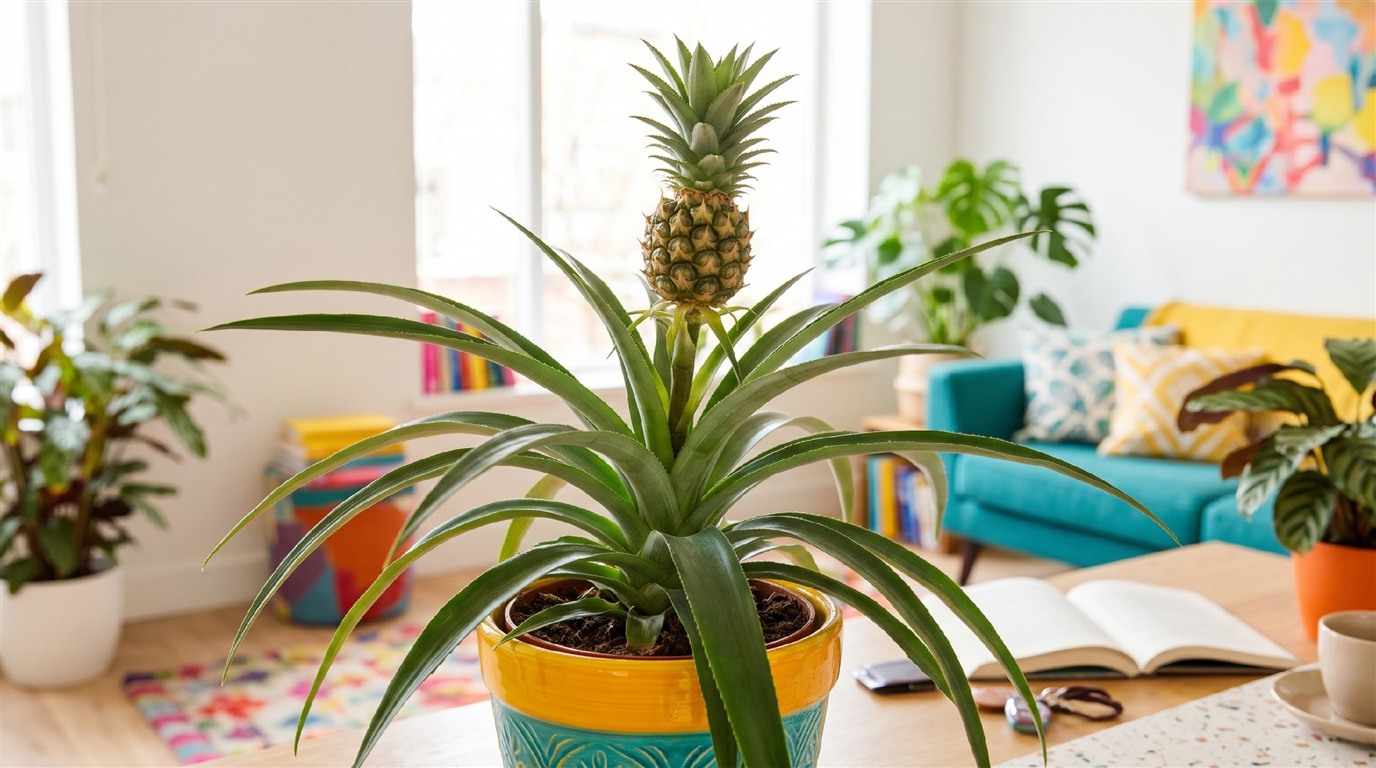
| Ananas | Spiny rosette, sometimes with a small pineapple | Terrestrial: grows in soil, no functional tank |
Two of those genera break the standard rules outright. Tillandsias have no tank to fill and no medium to water. Pineapple bromeliads are terrestrial rather than epiphytic, so they are watered at the soil, not through a cup. If you have either, most of what follows needs adjusting.
Why Bromeliad Care Rules Are Different
The reason cup-watering exists at all sits in how these plants evolved. Most bromeliads sold as houseplants are epiphytes: in the wild they grow anchored to tree branches, not in soil. Missouri Botanical Garden puts the consequence plainly: “in the rainforest, bromeliad roots function mainly to anchor the plant to a branch.”
Water and nutrients arrive differently. BSI notes that all bromeliads share “tiny scales on their leaves called trichomes” that “serve as a very efficient absorption system.” The plant drinks through its leaves and through the reservoir at their base. UF/IFAS confirms bromeliads “absorb water and nutrients mainly through their leaves and through the cups at the base of their leaves.”
This explains the two instructions that seem contradictory on every care tag: keep the cup full, keep the soil dry. The roots were never the primary drinking apparatus. Potting medium that stays wet is nothing like a breezy tree branch, and it rots them.
How Much Light Does a Bromeliad Need?
More than most people give them, and this is the single most common reason a bromeliad underperforms indoors.
UW–Madison Extension is the one extension source we found that publishes measured figures: bromeliads need “12 to 16 hours daily of relatively bright light,” and “most species need 2000 footcandles but will have more compact growth and better leaf and inflorescence color at 3000–4000 footcandles.”
For context, 2,000 footcandles is roughly 21,500 lux and 3,000–4,000 is around 32,000–43,000 lux. That is a bright windowsill, not a corner across the room. The University of Missouri IPM program states it without softening: “There are no bromeliad species that perform well indoors under poor light conditions.”
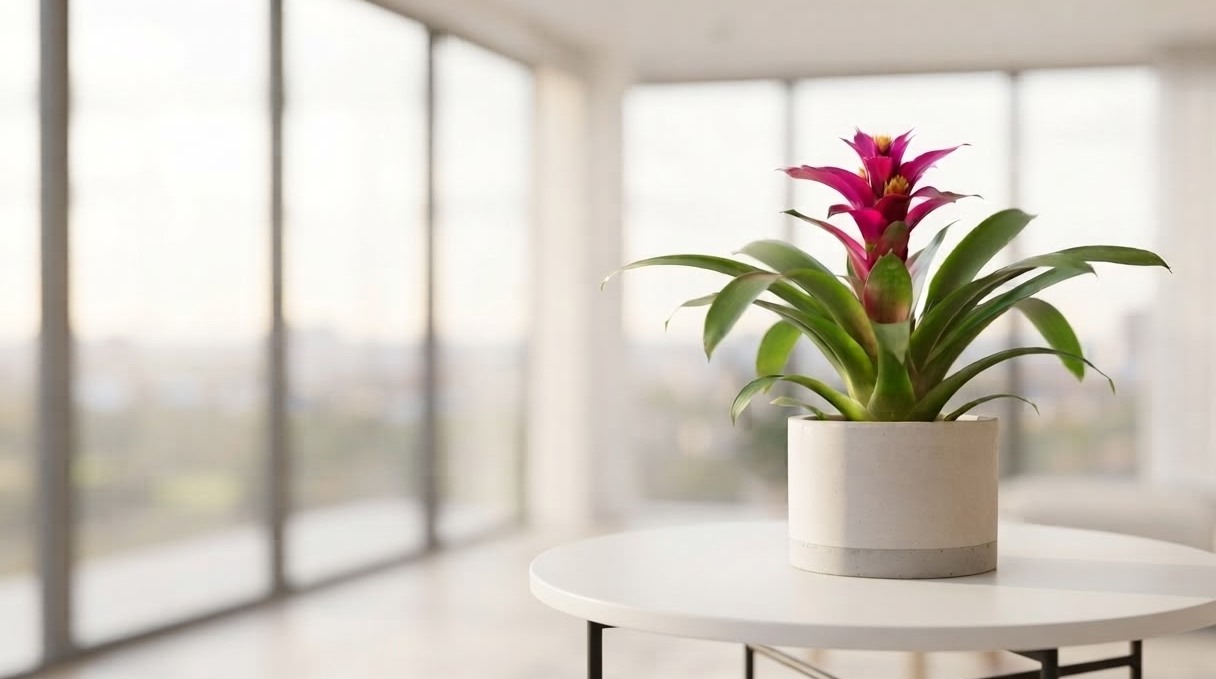
BSI offers a rule of thumb worth memorizing: “Soft leaf – soft light, hard leaf – hard light.” A soft-leaved Guzmania handles lower light. A stiff, thick-leaved Neoregelia or Aechmea wants the bright spot.
UF/IFAS gives a diagnostic that reads the plant rather than the room. Too little light produces leaves that are “long, thin, and greener in color.” Too much makes them “shorter, thicker, and lighter in color.” Stretched and green means move it brighter; stunted and bleached means pull it back. If I had one change to make for a dull, stretched bromeliad, I would move it to a brighter window before touching water or fertilizer.
How Do You Water a Bromeliad?
Two separate operations, and conflating them is how people kill these plants.
The cup
Clemson Extension: “the tank should be kept filled with water at all times.” UW–Madison notes the reservoir on large specimens can hold “up to two gallons.” Water poured into the tank should be allowed to overflow and “trickle down to the root zone” (NC State).
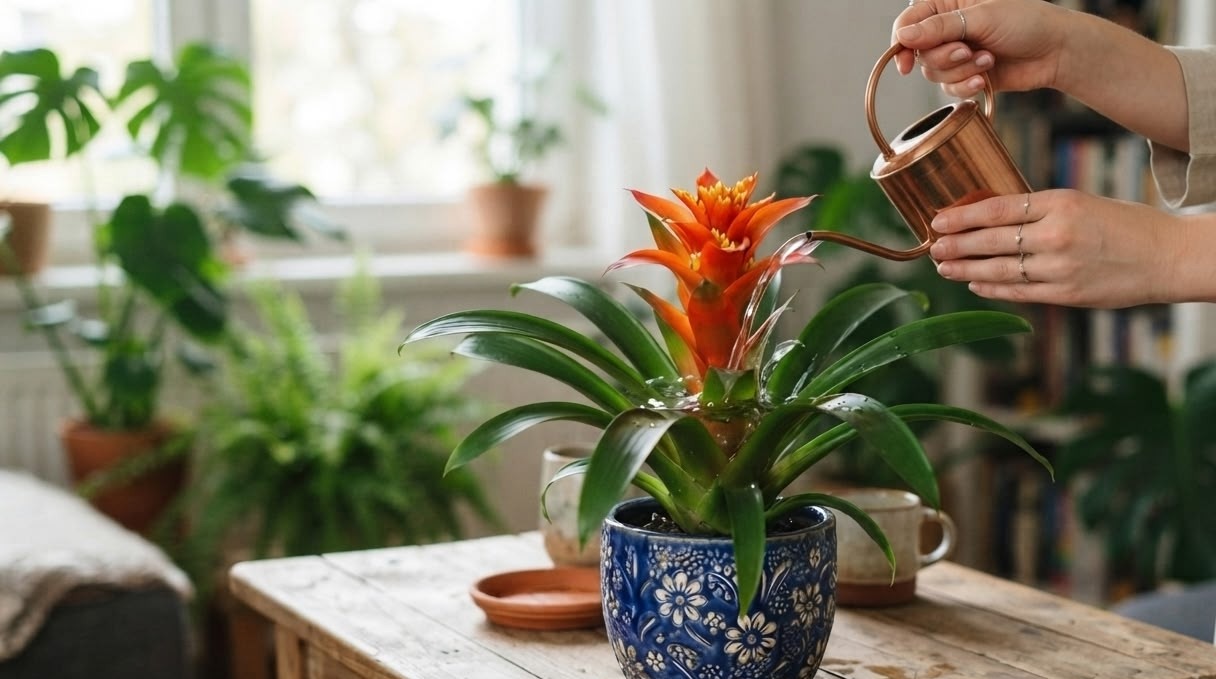
One caveat that flat care guides omit: this is not unconditional year-round. The usual guidance for Guzmania lingulata is to keep water in the cup during summer and keep the plant drier in cool winter months. A cup kept brimming through a cold winter in a cool room invites crown rot.
Clemson also warns to “be careful when you fill the tank, not to let the water soak the soil.”
The medium
Let it dry between waterings. NC State’s instruction for Neoregelia is to let the potting medium dry completely. The University of Missouri IPM program frames the tension exactly: bromeliads need “constant moisture around their roots,” but “excessive moisture encourages root rot.” UF/IFAS puts it more bluntly: bromeliads “don’t like wet feet.”
How Often Should You Flush the Bromeliad Cup?
Sources disagree substantially here, and the disagreement is worth understanding because they are measuring different risks.
| Frequency | Source | Targets |
|---|---|---|
| Weekly | UW–Madison Extension | Mineral concentration from hard water |
| Periodically | Clemson Extension | Stagnation and mineral salts |
| Every couple of months | Bromeliad Society Intl. | General freshening |
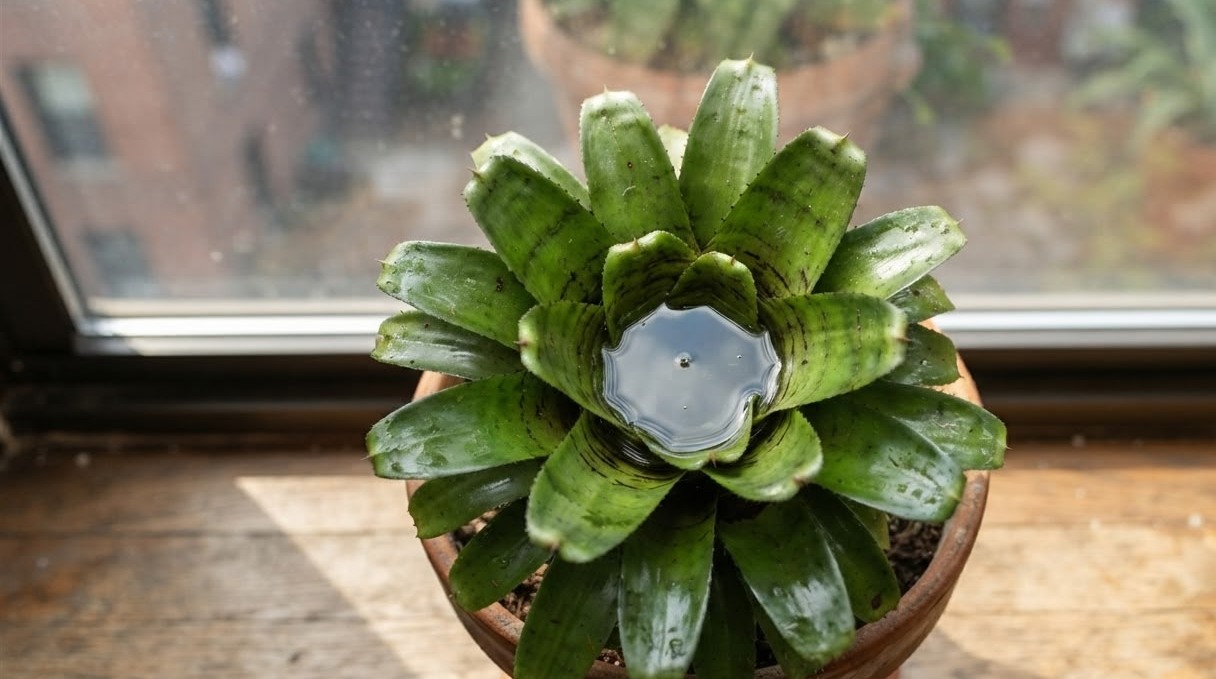
For an indoor plant on hard tap water, weekly is the defensible standard. UW–Madison ties it directly to preventing “the concentration of minerals that can cause leaf tip dieback.”
Clemson gives the technique, and the inversion is the part people skip: “flush the tank periodically by pouring fresh water into it, inverting, and filling again.” Topping up dilutes. Tipping out removes.
What water should you use?
Softened water is the one genuine prohibition: UW–Madison says to avoid alkaline or softened water, which “contains sodium.” Beyond that, bromeliads “prefer water that is acidic to neutral (pH 4.0 to 7.0), but many can tolerate water up to at least pH 8.0.”
Rainwater or distilled is preferable, and BSI notes it is “generally better than tap water (especially if you have hard water)”. Note the hedge. No extension source calls ordinary tap water unacceptable. Missouri Botanical Garden’s middle path: tap water “that has been allowed to sit for a day or two to remove chlorine.” I’d use rainwater or distilled water when it is easy to collect, let tap water stand otherwise, and never fill the cup from a water softener. Carnivorous plants are the opposite case: Nepenthes pitcher plants need distilled, rain or reverse-osmosis water.
One widely repeated claim does not survive checking. The idea that fluoride in tap water causes brown bromeliad leaf tips appears throughout commercial plant blogs but in no university extension source. Fluoride sensitivity is well documented in dracaena, spider plants and cordyline; the claim appears to have been generalized to bromeliads without support.
What Temperature and Humidity Do Bromeliads Need?
Clemson gives a working range of “60F to 85F to survive and grow well.” Missouri Botanical Garden advises bringing plants in when night temperatures fall below 55°F. The University of Missouri IPM program is reassuring: “temperatures maintained in the average home for human comfort will also suit most bromeliads.”
UW–Madison adds a detail worth acting on: the optimal range is “70 to 90 °F days and 50 to 65 °F nights,” and day and night temperatures should “differ by at least 10 degrees.” A spot near a window that cools overnight serves them better than a room held at a constant temperature.
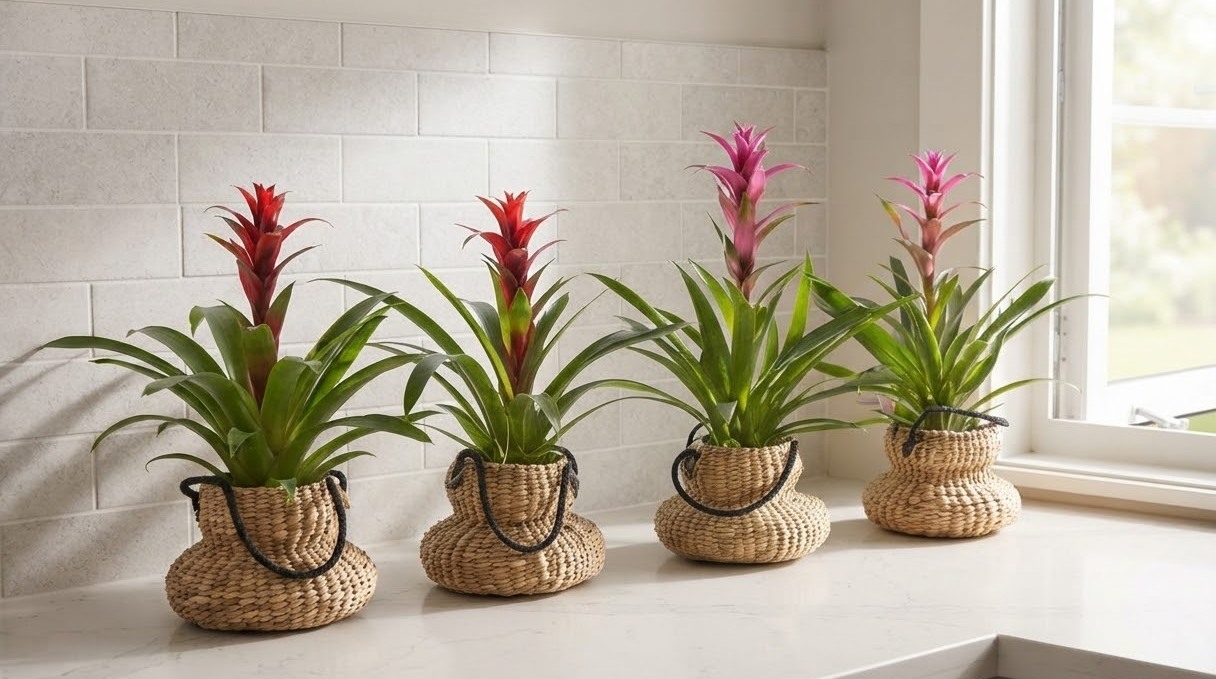
On humidity, UW–Madison specifies 50–75% relative humidity. That is above what many US homes run in winter, when heating dries the air. The practical consequence is a genus choice: thick-leaved Aechmea is “tolerant of dry air” as a houseplant (NC State), while soft-leaved Guzmania and Vriesea will struggle in a dry heated room.
What Soil Do Bromeliads Need?
Fast-draining and loose. NC State recommends “a bark-based potting medium (the kind made for orchids) to provide a well-drained root environment,” or “houseplant mix with added bark and perlite.”
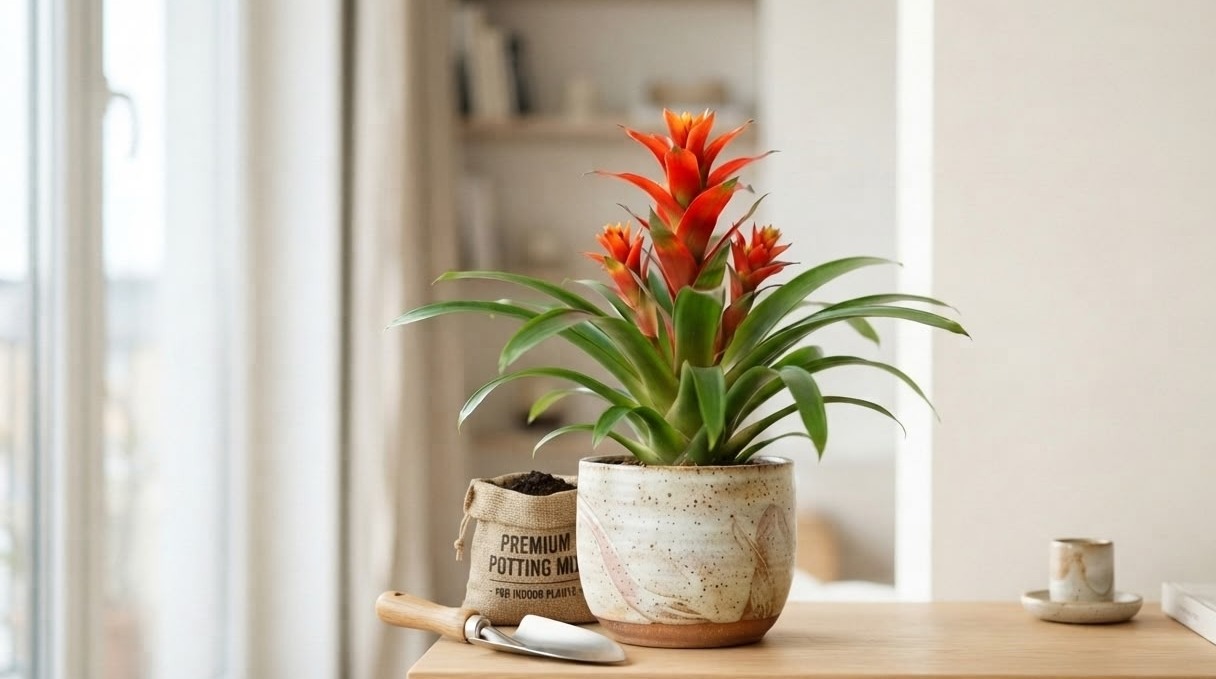
The University of Missouri IPM program lists usable components: “shredded bark, leaf mold or peat moss combined with bark, perlite, coarse sand or clay pot shards.”
Two refinements worth applying. A porous terracotta pot lets the mix dry and breathe faster than plastic, which helps avoid rot. And Clemson notes that Neoregelia do best underpotted and underfed: a small pot, on purpose.
How Should You Fertilize a Bromeliad?
Sparingly, and the strength matters more than the product. UW–Madison calls for fertilizer “diluted to 1/4 to 1/8 strength.” Clemson says “half strength or less during the summer months.” The University of Missouri IPM program specifies “light fertilization at monthly intervals when the plants are actively growing.”
Quarter strength, monthly, spring through summer only, satisfies every source. Stop in winter: unused salts concentrate in a cup that has no drainage. My advice is to err on the side of less: with Neoregelia in particular, I would rather underfeed than risk losing the leaf color.
Whether fertilizer belongs in the cup is genuinely disputed. NC State and UW–Madison say diluted liquid in the tank is fine; BSI says “never place fertilizer grains directly in the cup,” warning it will “probably burn the foliage.” The conflict largely dissolves on close reading: BSI’s prohibition names grains, not diluted liquid. Our guide to bromeliad fertilizer works through the disagreement and the safe practice in full.
The cost of over-feeding is specific. Clemson on Neoregelia: “frequent fertilization or too little light will cause the leaves to turn green.” Feeding generously converts the exact coloration you bought the plant for into plain green foliage.
Why Does a Bromeliad Die After Flowering?
Because the flower spike ends the plant’s ability to grow, and this is the fact that causes more bromeliads to be thrown away than any disease.
BSI states the rule: “with rare exceptions, bromeliads only flower a single time: once the plant stops producing leaves and produces its flower, it will not start making leaves again.” Elsewhere BSI quantifies it: “99% of all bromeliads bloom only once.”
The mechanism is the part most articles miss. A bromeliad rosette grows by adding leaves from its center. The inflorescence emerges from that same growing point and terminates it. The plant has not been exhausted by the effort of flowering. It has structurally closed off its own growth. Energy then redirects to vegetative buds at the leaf bases. For bloom timing, bracts versus true flowers, and how to coax a mature plant into blooming, see our bromeliad flower guide.
One precision worth keeping: the dying applies to the rosette, not the plant as a whole. Each flowering rosette blooms once and then slowly dies, while the clump continues through pups. UW–Madison points out that in some genera, such as Dyckia, the rosette survives flowering. A more accurate description than “monocarpic” is that these are clonal plants made of monocarpic rosettes.
How long does the bloom last?
| Genus | Display duration |
|---|---|
| Guzmania | 2 to 4 months |
| Aechmea | Weeks to several months |
| Billbergia | Only a couple of weeks |
| Tillandsia | A couple of weeks to a full year |
Here is the distinction almost no consumer article makes: what lasts for months are the colored bracts, not the flowers. The true flowers are small, often insignificant, and short-lived. The ornamental display is modified leaves. Both UW–Madison and MoBot make this distinction; most care tags do not.
How long does the mother take to die?
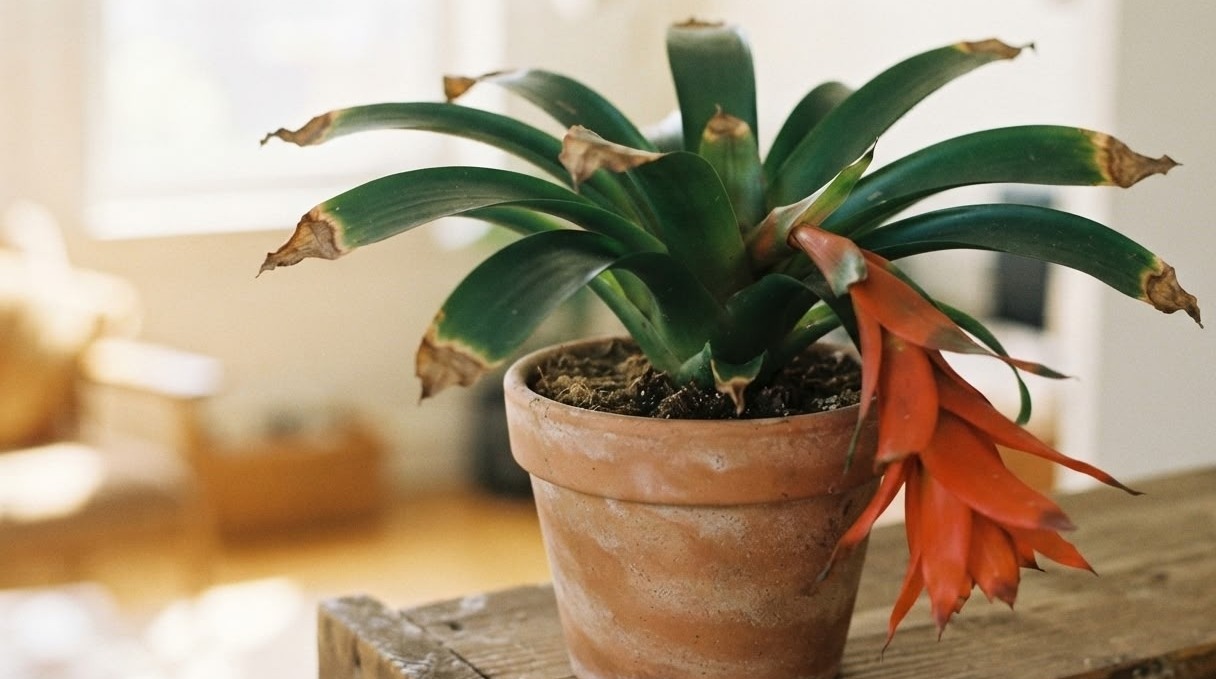
UF/IFAS Extension in Nassau County: “bromeliads slowly die over a period of a year or two after flowering.” And this is the part that matters: “the mother plant, especially if helped along with a small amount of dilute fertilizer, will continue to produce pups until it dies.”
That is the correction to the biggest misconception in bromeliad ownership. The bracts fade after a few months, the plant looks finished, and it goes in the bin, while it still had one to two years of pup production ahead of it. MoBot’s practical step: once the flowers are spent, the bract can be removed, and new growth usually appears around the outside of the original rosette. If it were my plant, I would cut off the spent bract and leave the mother in the pot until the pups reach at least one-third of her size.
How Do You Propagate Bromeliad Pups?
Wait longer than feels natural. The size threshold is one of the best-supported numbers in bromeliad growing: BSI, UW–Madison and NC State (across three separate genus pages) all converge on the same answer.
Separate a pup when it reaches one-third to one-half the size of the mother plant. One-third is the commonly cited minimum.
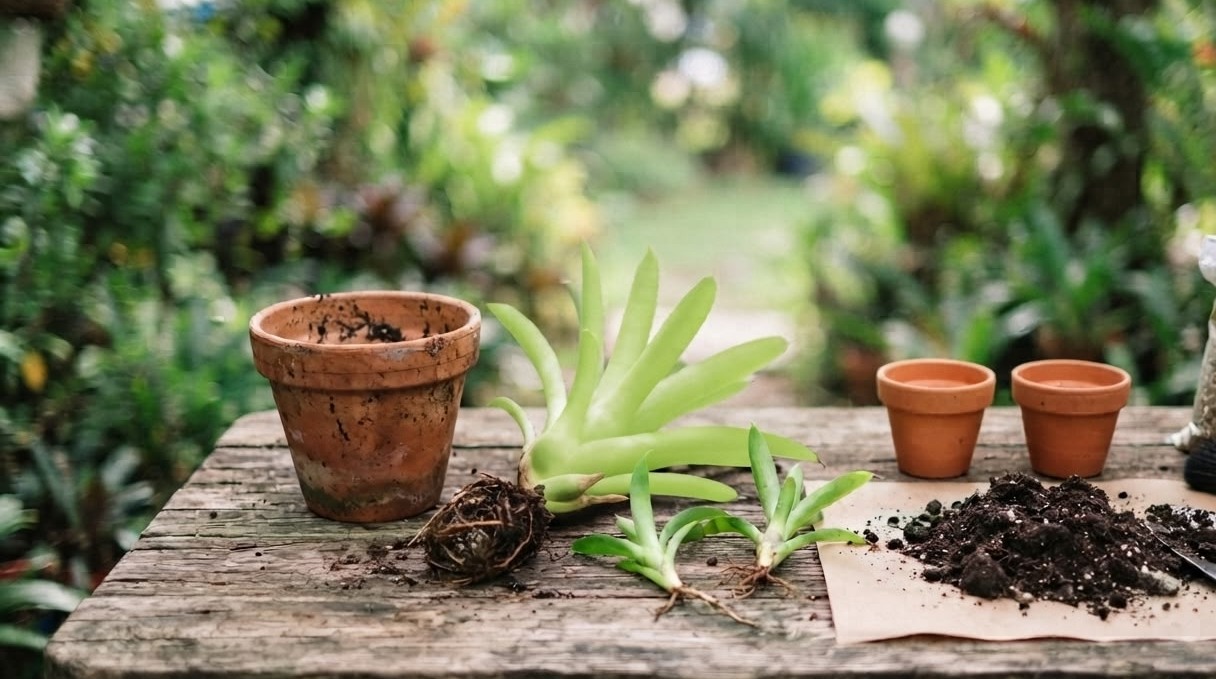
BSI explains why rushing fails: pups draw nourishment from the mother while they grow, roots are the sign a pup can survive on its own, and pups root poorly in cold conditions. A pup cut off too small has little to live on until it roots.
Roots are a helpful signal but not a requirement. BSI: “if the pup is starting to form roots, that’s a good indication that the plant can survive on its own.” UF/IFAS is more relaxed: the pup “may or may not have developed a root system of its own, but there is no need to worry, the roots will come later.”
After separation, UW–Madison advises keeping new plants “in a shadier, more humid site until new roots begin to grow,” with the medium relatively dry “to discourage rot.” UF/IFAS names the failure mode directly: “it is very important to not overwater as this is the most common mistake when propagating bromeliads.”
In cold climates, wait for spring. BSI notes pups “don’t usually root well when it’s cold.” And separating is optional: MoBot suggests you “can simply remove the faded rosette and repot the pups, altogether, in a larger pot for a specimen plant.”
When will a pup flower?
UF/IFAS: “these plants will normally flower in 1 to 3 years.” MoBot cautions that it varies enormously by species: “there are species that bloom annually and some that can take four years or more.” Light is the governing factor.
Can You Force a Bromeliad to Bloom?
Yes, and unusually for a houseplant trick, this one is backed by commercial practice and peer-reviewed research. Growers use ethylene gas industrially; at home, a ripe apple supplies it.
Clemson: “place the plant inside a clear, airtight plastic bag with a ripe apple for two to three days. Depending on the type of plant you have, flowering will begin in six to fourteen weeks.” UF/IFAS gives the identical figures. BSI suggests leaving the bag about a week.
The limitation almost every article omits: only mature plants respond. Research on Aechmea fasciata found that “adult plants can successfully bolt, whereas juvenile plants cannot” (Lei et al., 2016). A young pup will not flower no matter how many apples you use. The same paper is candid that “the precise mechanism by which ethylene induces flowering in bromeliads remains unknown.”
Are Bromeliads Toxic to Cats and Dogs?
The ornamental genera the ASPCA has assessed are listed as non-toxic, with an important gap in the record worth knowing about.
The ASPCA database lists these bromeliads as non-toxic to dogs and cats: Blushing Bromeliad and Neoregelia (Neoregelia spp.), Orange Star (Guzmania lingulata minor), Mosaic Vase (Guzmania musaica), Earth Star (Cryptanthus bivattus minor) and Silver Star (Cryptanthus lacerdae). NC State Extension independently lists Neoregelia as non-toxic to cats, dogs and horses.
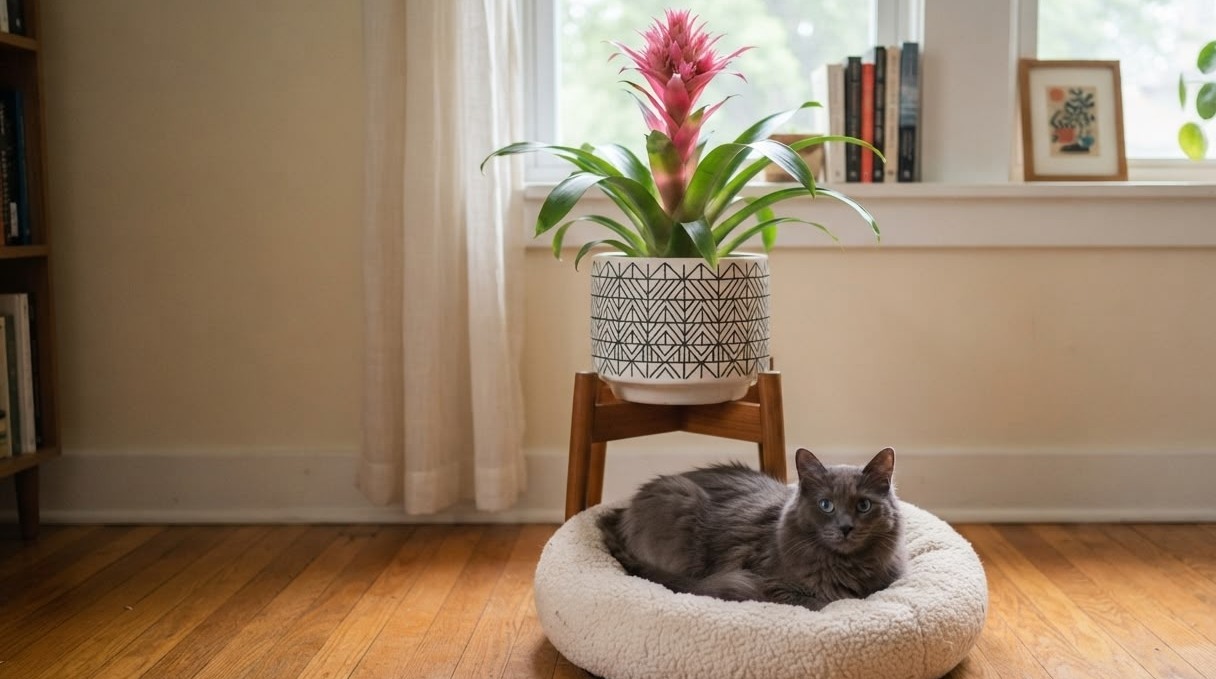
What is often stated too broadly: Aechmea, Vriesea and Tillandsia do not have their own ASPCA entries. The common claim that “the ASPCA lists bromeliads as non-toxic” is verified for Guzmania, Neoregelia and Cryptanthus and is an extrapolation for the rest, though no bromeliad appears on the ASPCA’s toxic list either. The genus-by-genus breakdown, including pineapple, is in are bromeliads toxic to cats and dogs.
Pineapple is the genuine exception. NC State classifies Ananas comosus as a low-severity poison containing “bromelin, ethyl acrylate, and calcium oxalate crystals,” causing oral and skin irritation.
The hazard people underestimate is mechanical. Many bromeliads (Aechmea, Billbergia, Neoregelia, Ananas) carry spiny, serrated leaf margins. NC State describes Aechmea leaves as “usually toothed.” They can cut a hand or a pet’s mouth. A second overlooked point: the cup is standing water a pet may drink from, which is another argument for flushing it.
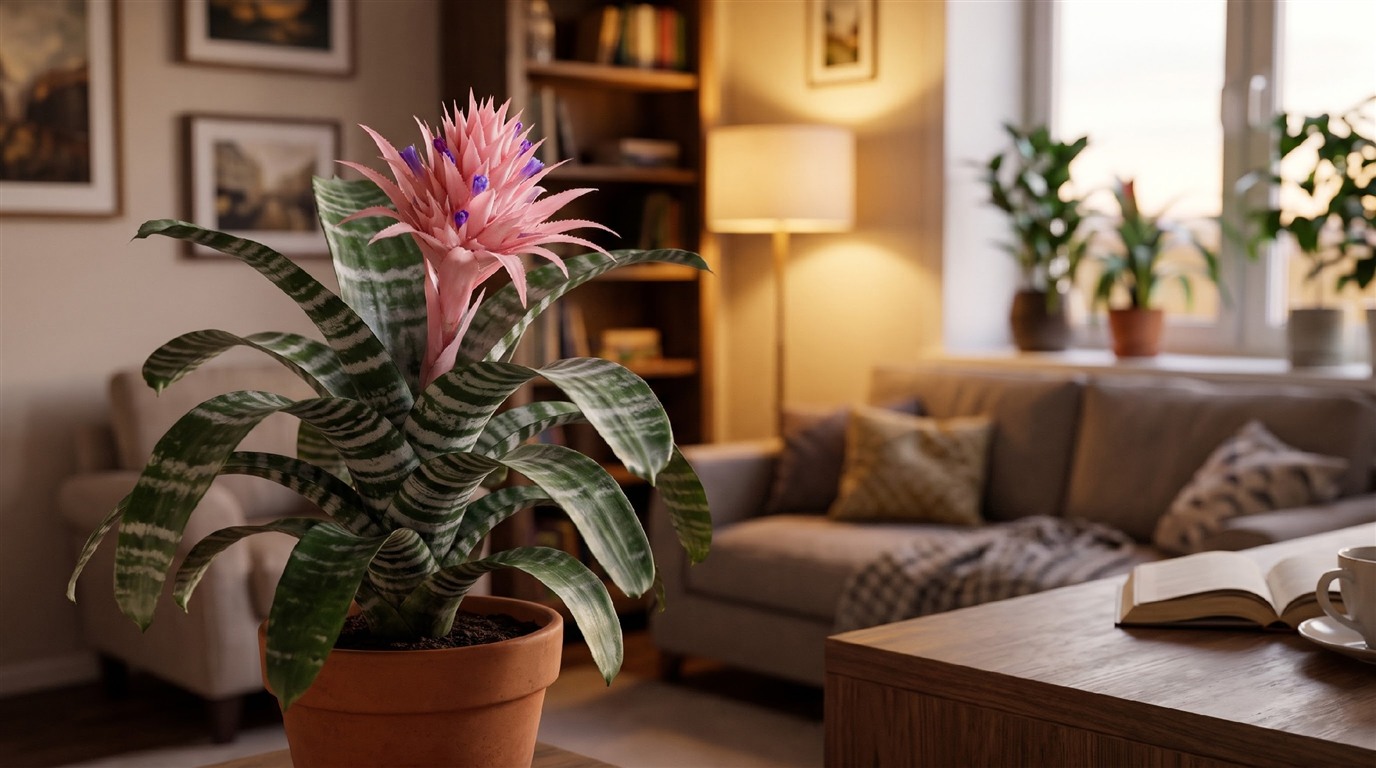
Common Bromeliad Problems
Rot
The leading killer. Clemson: “root rot usually results from a soil mix that does not drain quickly or overly frequent watering.” NC State lists crown rot separately: that is the cup-related failure, from water sitting in a cool rosette. Guzmania are specifically “prone to root rots if the soil is kept wet” (MoBot).
Brown leaf tips
Two supported causes. Underwatering and low humidity. Clemson, writing on air plants, notes “the leaves will curl or roll, the foliage will turn a dull color, and the tips will turn brown.” And mineral or salt accumulation in the cup, which is precisely what weekly flushing prevents (UW–Madison). Fluoride is not a supported cause, despite its popularity online.
It won’t bloom
Three real reasons. The plant is not mature enough: from a pup, expect one to three years. The light is too low, and no species performs well indoors in poor light. Or it has already bloomed, in which case that rosette never will again and the pups are the only path forward.
Pests
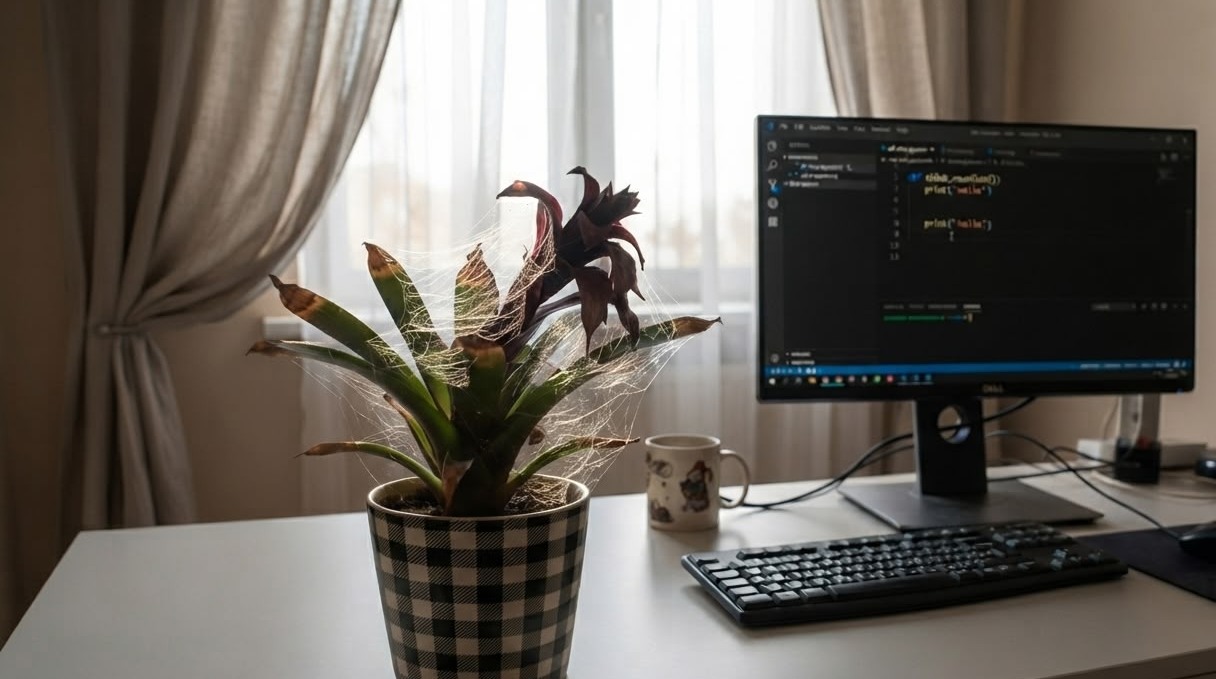
Clemson notes that “scale and mealybugs are the most frequent insect pests of bromeliads.” NC State adds spider mites and leaf spot, noting leaf spot “may spread rapidly in humid conditions.” BSI’s treatment for scale and mealybugs is “wiping over them with a cotton swab dipped in rubbing alcohol.”
What Doesn’t Work
One care routine for every bromeliad. Neoregelia wants strong light and minimal feed; Guzmania tolerates lower light; Tillandsia has no soil or cup; pineapple is terrestrial. Generic bromeliad instructions are wrong for at least two of the genera on any garden center bench.
Waiting for the original plant to rebloom. It will not. The growing point is terminated. Feeding, forcing and repotting all fail to change this. The pups are the only route to another flower.
Topping up the cup instead of flushing it. Adding water dilutes accumulated minerals; it does not remove them. The cup must be tipped out and refilled.
Misting as a substitute for light. Humidity and light solve different problems. A bromeliad in a dim corner stays green and stretched no matter how often it is misted.
Blaming fluoride for brown tips. No extension source supports it for bromeliads. Check watering, humidity and salt buildup in the cup instead, and avoid softened water, which is a documented problem.
Frequently Asked Questions
How often should you water a bromeliad?
Keep the central cup filled at all times and let the potting medium dry between waterings. Flush the cup weekly if you have hard tap water. In cool winter conditions, keep the plant drier overall.
Do you water a bromeliad in the cup or the soil?
Both, but differently. The cup stays filled; the medium is watered only as it dries. The exceptions are Tillandsias, which have no cup and are misted or soaked, and pineapple bromeliads, which are terrestrial and watered at the soil.
Why is my bromeliad turning green?
Either too little light or too much fertilizer: both drain the color from Neoregelia and other colored-foliage types. If the leaves are also long and stretched, light is the likelier cause.
How long do bromeliads live?
Each rosette flowers once and then declines over one to two years, producing pups the whole time. The clump itself continues indefinitely as long as you keep the offsets.
Should I cut off the dead bromeliad flower?
Yes. Missouri Botanical Garden advises removing the spent bract, after which new growth usually appears around the outside of the original rosette. Removing it directs energy to pups.
Are bromeliads safe for cats?
The ASPCA lists Guzmania, Neoregelia and Cryptanthus as non-toxic to cats and dogs. The greater risk is physical: many bromeliads have saw-toothed leaf margins. Pineapple is a separate case, classified by NC State as a low-severity poison.
Can a bromeliad rebloom?
No individual rosette reblooms. The flower spike terminates the growing point permanently. The pups it produces will bloom, typically one to three years after separation, and can be forced with ethylene once mature.
What is the easiest bromeliad for beginners?
Aechmea. NC State notes they are “tolerant of dry air and occasionally dry roots as long as the central tank is kept full of water,” which forgives the two mistakes beginners make most. Handle with care: the leaf margins are toothed.