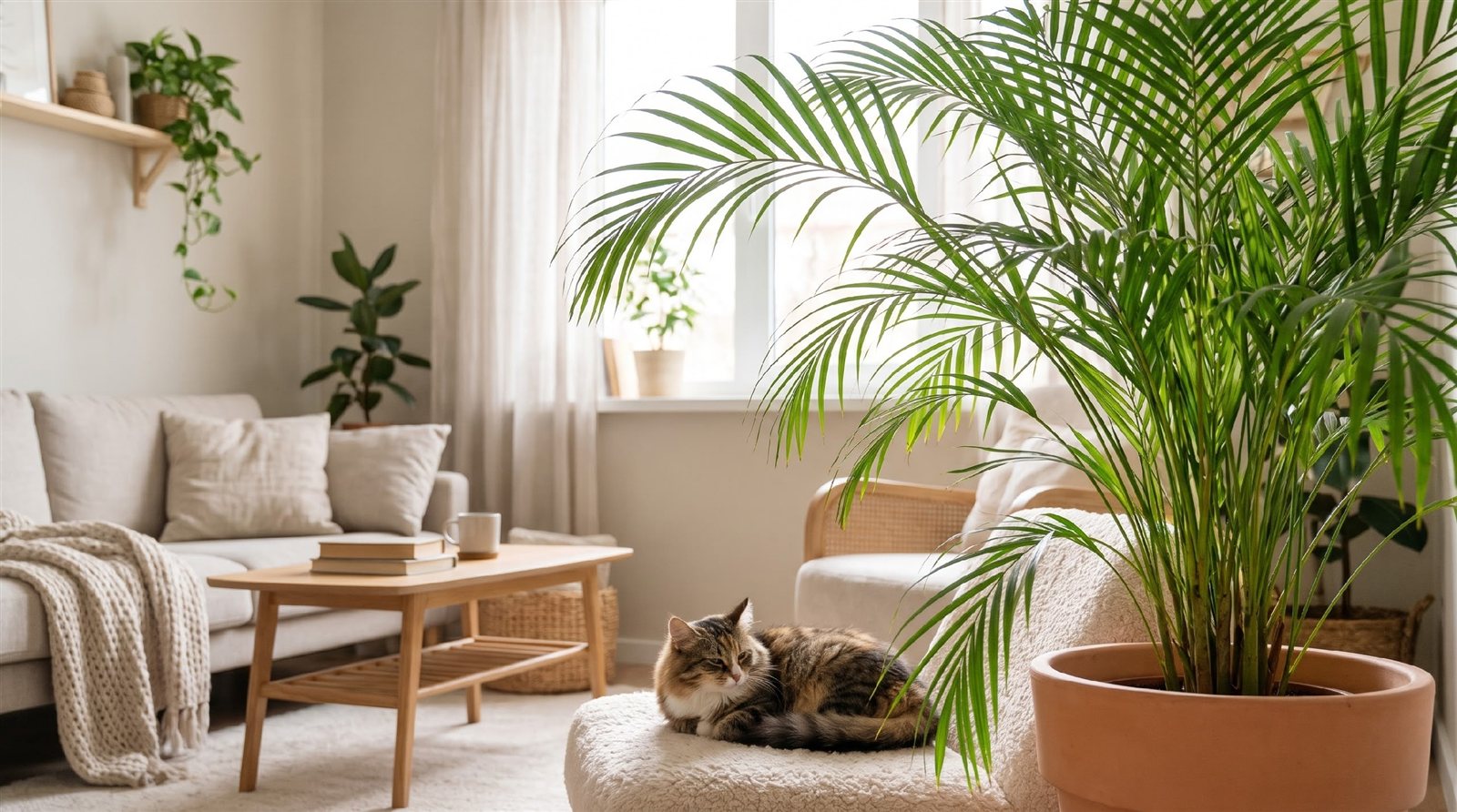
Is areca palm toxic to cats? No. The ASPCA lists the areca palm (Dypsis lutescens) as “Non-Toxic to Dogs, Non-Toxic to Cats, Non-Toxic to Horses,” and Pet Poison Helpline names it among its pet-safe houseplants. That answer is solid, but it comes with three conditions that most pages skip: the plant has to actually be an areca, anything sprayed on or mixed into the pot can be toxic even when the plant is not, and any leaf eaten in quantity can make a cat vomit.
This guide covers all three, plus what to do if your cat has already chewed the plant and how to stop it. If you are here for growing advice rather than pet safety, our areca palm care guide covers light, water and feeding.
| Areca Palm and Pets at a Glance | |
|---|---|
| Cats | Non-toxic (ASPCA) |
| Dogs | Non-toxic (ASPCA) |
| Horses | Non-toxic on the main ASPCA entry |
| Possible effect | Mild vomiting or stomach upset if a lot is eaten, as with any plant |
| Real risks | Misidentified sago palm; fertilizer or pesticide on the plant |
| Emergency numbers | ASPCA (888) 426-4435; Pet Poison Helpline (855) 764-7661 |
Is Areca Palm Toxic to Cats?
No. The ASPCA’s areca palm entry lists it as non-toxic and gives no toxic principle and no clinical signs. The same plant appears in the database under its other common names, “Cane Palm” and “Yellow Palm,” with the older scientific name Chrysalidocarpus lutescens, and the status is the same: non-toxic to cats and dogs.
Pet Poison Helpline agrees. Its guide to pet-safe plants names “Pony tail, Parlor and Areca palms” as safe choices.
One source muddies the picture, and you may run into it. NC State Extension’s Plant Toolbox tags the plant as non-toxic for cats and dogs, but its poison section lists “low” severity and cyanogenic glycosides in the leaves and stems, mainly as a warning not to eat the heart of the palm. The two parts of the same page contradict each other, and neither the ASPCA nor Pet Poison Helpline lists any toxin. I would go with the two veterinary poison services here: they handle the actual cases.
Is Areca Palm Toxic to Dogs?
No. The ASPCA lists it as non-toxic to dogs as well, and the main entry adds horses.
Dog owners are more likely to find a wrong answer online, though. Some dog-health sites publish “areca palm” pages that actually describe the betel nut palm (Areca catechu), a different plant whose seed contains the alkaloid arecoline. If a page warns that areca palm is toxic to dogs and mentions arecoline or betel nut, it has confused the two species.
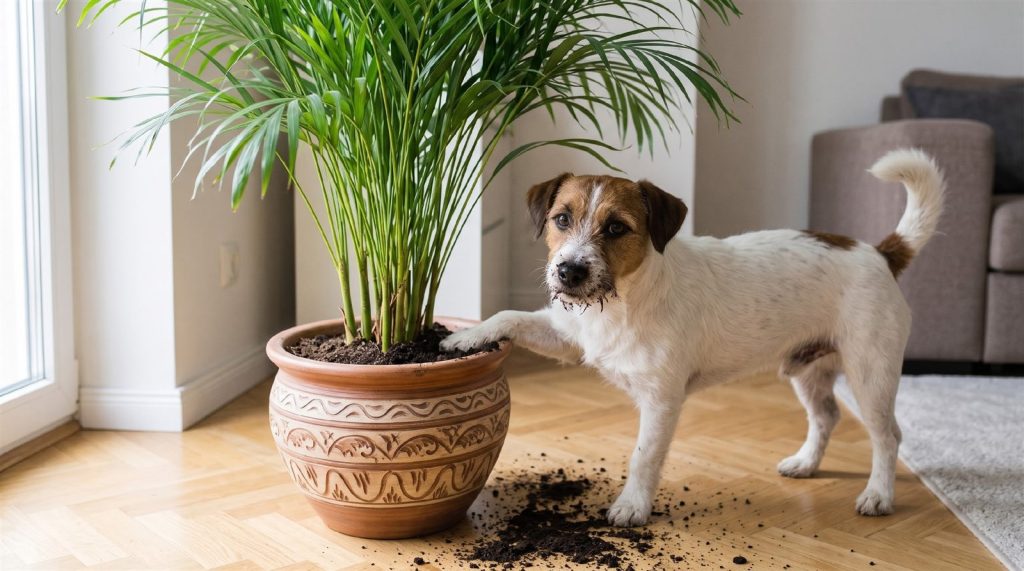
Dogs bring one risk that cats usually don’t: digging. A dog that excavates the pot can swallow potting mix and fertilizer in quantity, which matters more than the leaves themselves (see below).
First, Make Sure It Really Is an Areca Palm
This is the step that decides whether you have a problem. “Palm” is sold as a label for several plants that aren’t palms at all, and one of them is among the most dangerous houseplants for pets.
| Plant | How to recognize it | Pet status |
|---|---|---|
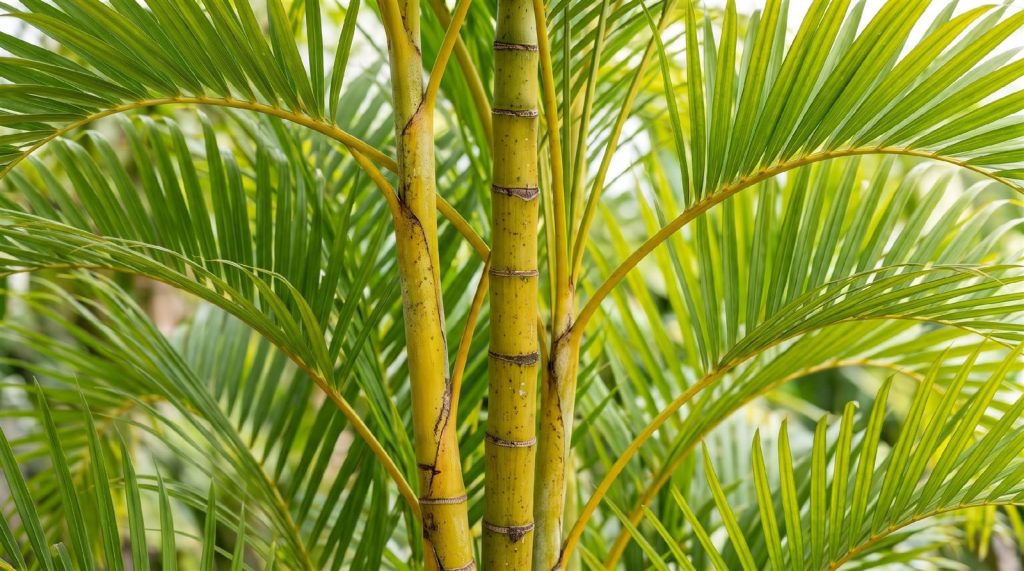
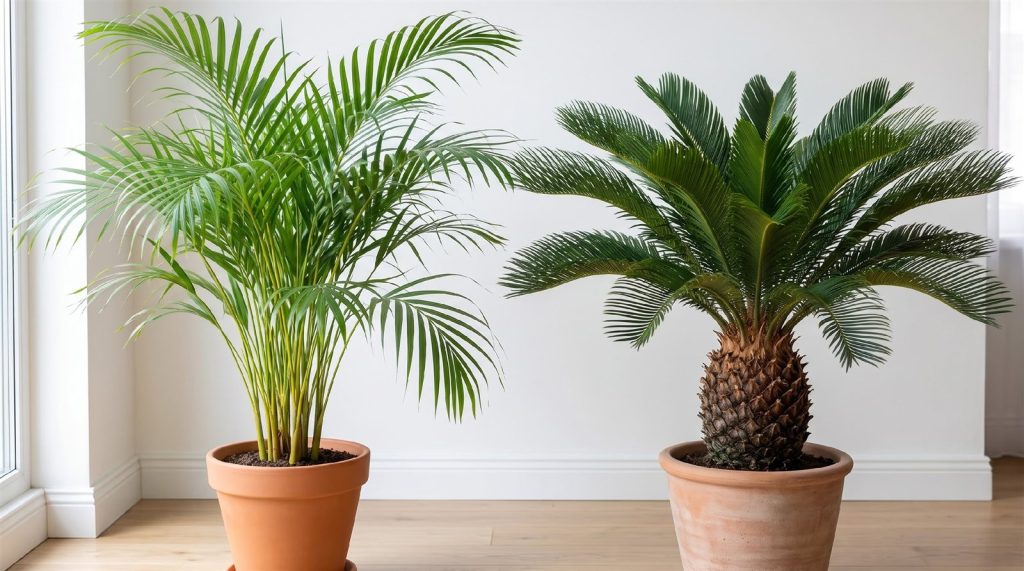
| Areca palm (Dypsis lutescens) | Clumps of slim, yellowish, bamboo-like canes; soft, arching feathery fronds | Non-toxic (ASPCA) |
| Sago palm (Cycas revoluta), a cycad | Stiff, glossy, dark green fronds with needle-like leaflets, rising from a short, shaggy trunk | Toxic to dogs, cats and horses; can cause liver failure (ASPCA) |
| Cardboard palm (Zamia), a cycad | Thick, leathery, oval leaflets that feel like cardboard | Toxic; covered by the ASPCA sago palm entry |
| Betel nut palm (Areca catechu) | A single tall trunk; rarely sold as a houseplant | No veterinary data; seed contains arecoline, toxic to people |
| Fishtail palm (Caryota) | Leaflets shaped like jagged fish tails | No ASPCA entry; poison centers note irritant calcium oxalate crystals |
| Ponytail palm (Beaucarnea), not a palm | Swollen, bulb-like trunk base and long, thin curling leaves | Non-toxic (ASPCA) |
The fastest check is the plant tag. If it says Dypsis lutescens or Chrysalidocarpus lutescens, you have an areca. If it says Cycas or Zamia, treat the plant as dangerous and move it out of reach today. Without a tag, the texture tells you: areca fronds are soft and flexible, while sago fronds are rigid enough to prick your hand.
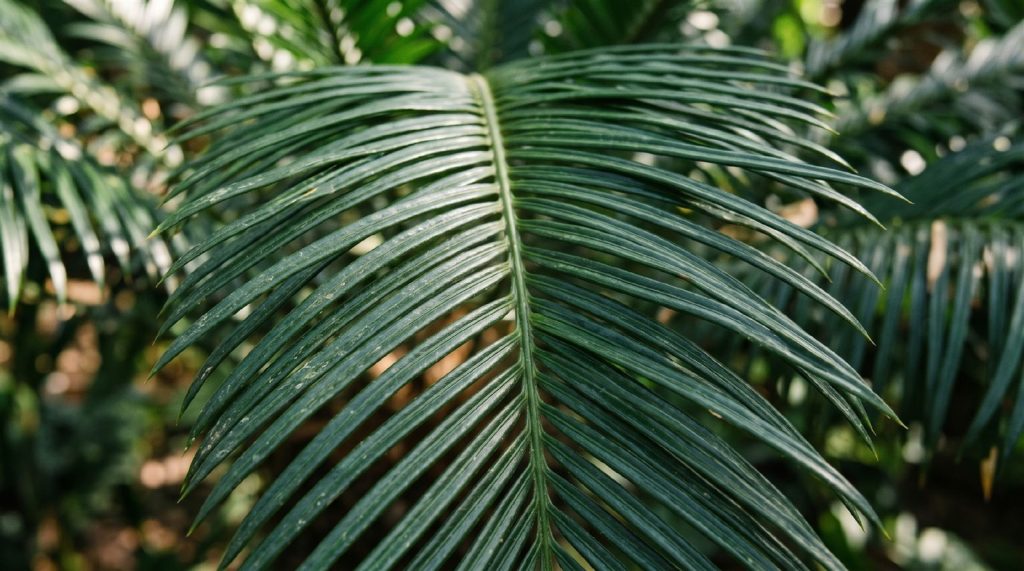
Be careful with plant-ID apps. At least one popular app serves its Areca catechu page for the search “areca palm,” and that page warns that the seeds are moderately toxic to cats. The warning is about the betel nut palm, not the plant on your windowsill. Our areca care guide explains how the common name got attached to the wrong genus.
A smaller naming problem: “bamboo palm” means different plants depending on who uses it. The ASPCA uses it for the parlor palm (Chamaedorea elegans), NC State lists it as a name for the areca, and garden centers usually mean Chamaedorea seifrizii, which has no ASPCA entry of its own. If you search by common name, check that the scientific name matches your plant.
Non-Toxic Doesn’t Mean Harmless
The ASPCA attaches a caveat to every plant in its database: “the consumption of any plant material may cause vomiting and gastrointestinal upset for dogs and cats.” Pet Poison Helpline puts it from the other side: pets can vomit after eating any plant “regardless of its toxicity,” and “vomiting is not always a sign of poisoning.”
So a cat that eats a few strips of areca frond and throws up once has not been poisoned. Cats also vomit plant material for reasons of their own. In a University of California, Davis survey of 1,021 cat owners, 27% said their cat vomited after eating plants.
What’s on the plant matters more than the plant
The more realistic hazard sits in the pot, not in the leaves:
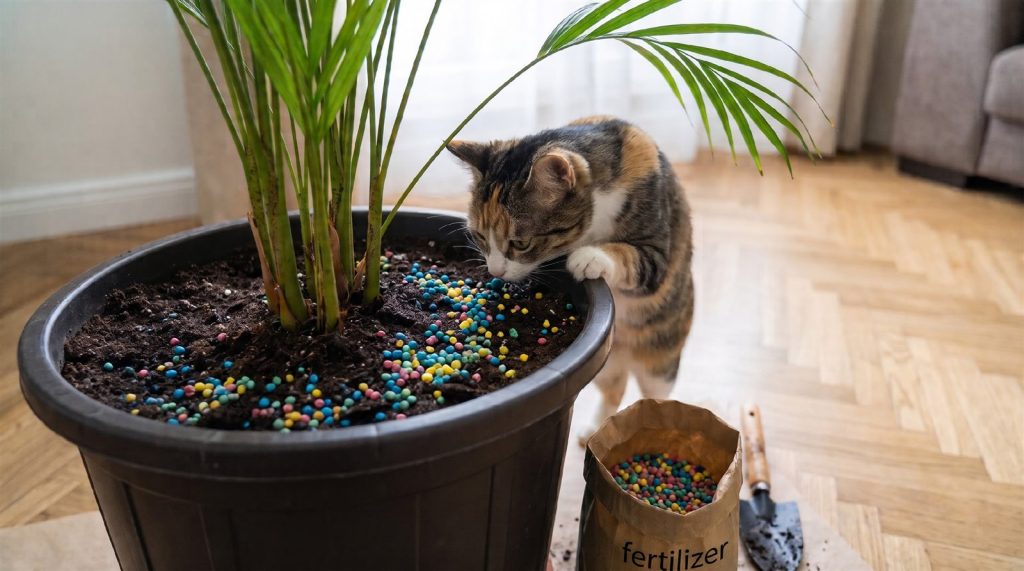
- Fertilizer. Pet Poison Helpline: “small ingestions of fertilizer may only result in mild stomach upset,” but “larger ingestions can result in severe poisoning from the iron, nitrogen and other chemicals.” It warns that fertilizers “may also contain herbicides, pesticides, and fungicides,” and that meal-based products (blood, bone or feather meal) “may be especially tasty” to pets. Granules sitting on the soil surface are the main temptation.
- Systemic insecticides. Some nursery plants are treated with products such as imidacloprid, which, according to the National Pesticide Information Center, “spreads throughout the plant’s stems, leaves, fruit, and flowers.” Washing the leaves won’t remove a systemic product. NPIC notes that “animals have vomited or drooled a lot after oral exposure.” No veterinary source has documented this from a houseplant, but it is a reason to ask the seller what the plant was treated with.
- Pest sprays you apply. Areca palms attract spider mites, and many treatments are not meant to be eaten. Cats groom whatever lands on their fur, so keep the cat out of the room until a spray has dried and follow the label.
My advice for a home with a plant-chewing cat: use liquid fertilizer watered into the soil rather than granules or spikes on the surface, and skip the leaf-shine products entirely.
Why Do Cats Chew Areca Palms?
Because most cats eat plants, and an areca’s long, narrow leaflets look and feel like grass. The UC Davis survey found that “seventy-one per cent of cats were seen eating plant matter at least six times,” and 91% of owners said their cat “almost always appeared normal before eating plants.” In other words, plant chewing is normal behavior, not a sign of illness.
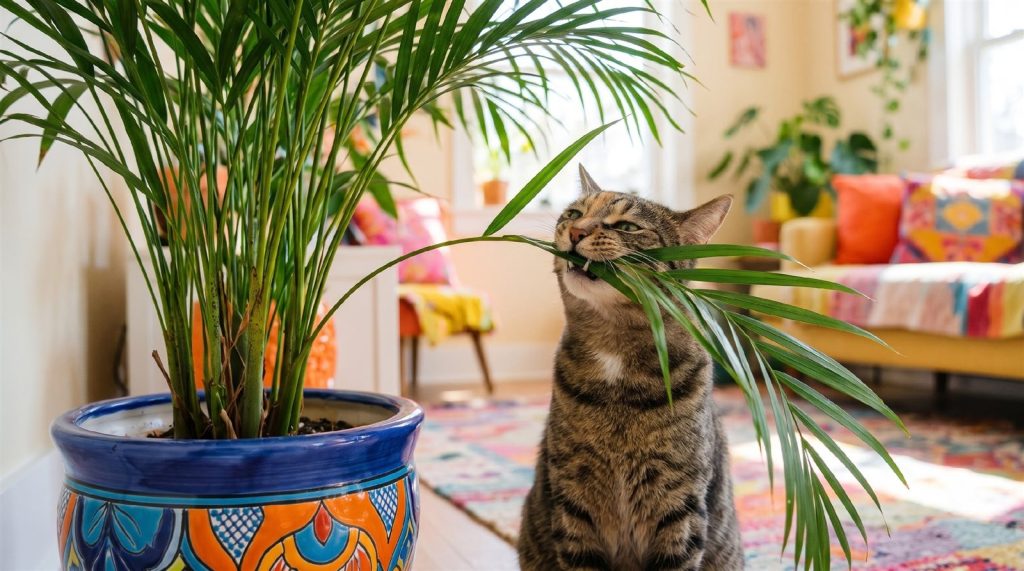
Indoor cats do it most. The Cornell Feline Health Center: “Cats that chew on houseplants are usually indoor cats with little access to grass or other greens.” The UC Davis researchers suggest plant eating may help cats manage intestinal parasites, a habit inherited from wild ancestors, though that is a hypothesis rather than a tested finding. The study also argues against the hairball explanation, because short-haired cats ate plants as often as long-haired ones.
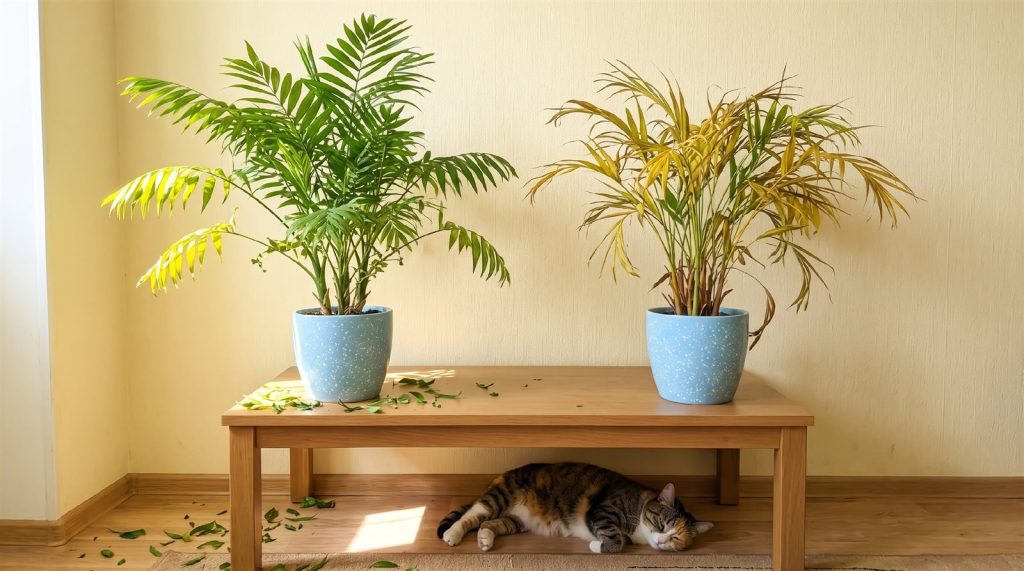
Chewed fronds leave ragged, torn tips, which are easy to tell from the yellowing or browning caused by care problems. If your areca’s leaves are discoloring rather than shredded, our guide to areca palm yellow leaves walks through the other causes.
My Cat Ate Areca Palm: What to Do
If you are certain the plant is an areca, you usually only need to watch your cat. Work through these steps:
- Confirm the plant. Check the tag or compare it with the table above. If there is any chance it is a sago or cardboard palm, skip to the emergency section below.
- Check the pot. Was there fertilizer on the soil surface, or was the plant recently sprayed? If so, have the product label ready.
- Don’t try to make your cat vomit. Pet Poison Helpline: “There is simply no safe way to induce vomiting at home with cats.” Hydrogen peroxide “is never safe to give to cats” and can ulcerate the stomach and esophagus.
- Don’t give milk unless a veterinary professional tells you to (Pet Poison Helpline).
- Watch for 24 hours. One episode of vomiting followed by normal eating and behavior is the expected outcome.
| What you see | What it likely means |
|---|---|
| Vomits once, then eats and acts normally | Ordinary plant-related stomach upset; keep watching |
| Repeated vomiting, or vomiting continues into the next day | Call your vet |
| Drooling, diarrhea, lethargy or refusing food | Call your vet or a poison hotline |
| Blood in vomit or stool, collapse, or seizures | Emergency vet now |
| Ate fertilizer, pesticide, or a plant that might be a sago palm | Call a poison hotline or vet now, even without symptoms |
The two US poison hotlines both answer around the clock and both charge a fee. The ASPCA Animal Poison Control Center is (888) 426-4435; its site says only that “a consultation fee may apply,” and recent reports put it at $95. Pet Poison Helpline is (855) 764-7661 and currently charges $99 per incident, follow-up calls included. If cost is a concern, your own vet’s office is the first call.
If It Might Be a Sago Palm, Act Now
Sago palm poisoning is a genuine emergency, and it does not wait for symptoms. The ASPCA lists sago and other cycads as toxic to dogs, cats and horses, with signs including vomiting, black stool, jaundice, bruising and liver failure. All parts are toxic, and the seeds are the most dangerous.
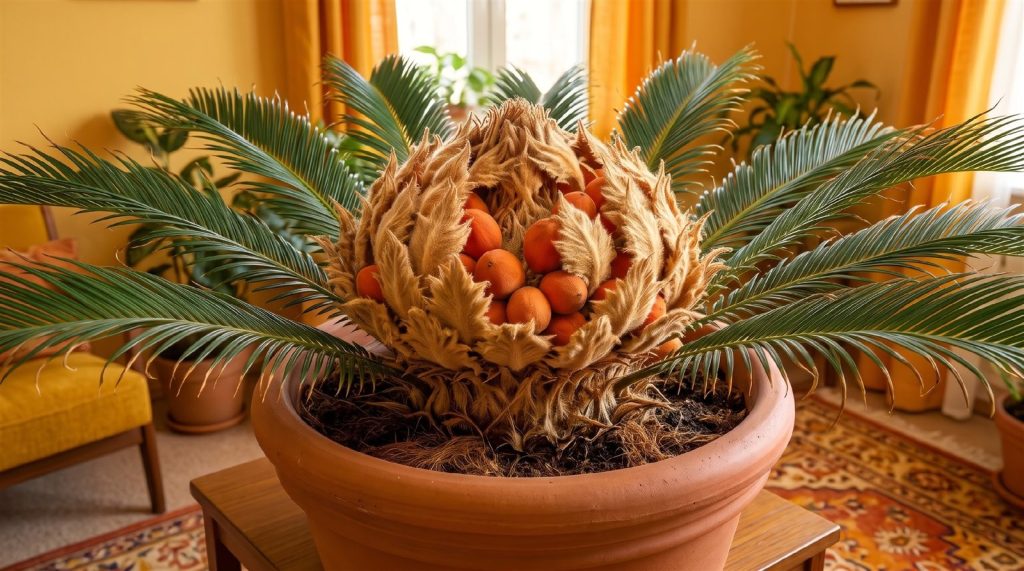
Timing is what makes it dangerous. VCA notes signs can appear “within 15 minutes to several hours,” and the Merck Veterinary Manual warns that cases can “progress to liver failure within 48–72 hours.” A pet that seems fine the morning after may still be in trouble.
Most published outcome data are from dogs, and the numbers vary widely by study:
| Study | Dogs | Died or euthanized |
|---|---|---|
| Albretsen et al., JAVMA, 1998 | 60 | 32% |
| Ferguson et al., J Vet Intern Med, 2011 | 34 | 50% |
| Texas case series, JAAHA, 2017 | 14 | 64% |
| Australian Veterinary Journal, 2020 | 130 | 12% |
The consistent finding is that early veterinary treatment helps. In the 2020 study, activated charcoal given by a vet cut the odds of death by 82%. If you suspect sago palm, call your vet or a hotline immediately and bring a piece of the plant or a photo.
How to Stop Your Cat Chewing Your Areca
Cornell is blunt: “The only way to guarantee protection for both your houseplants and your cat is to block access to the plants.” With a large floor palm, that usually means a room the cat doesn’t use. Everything else reduces chewing rather than stopping it.
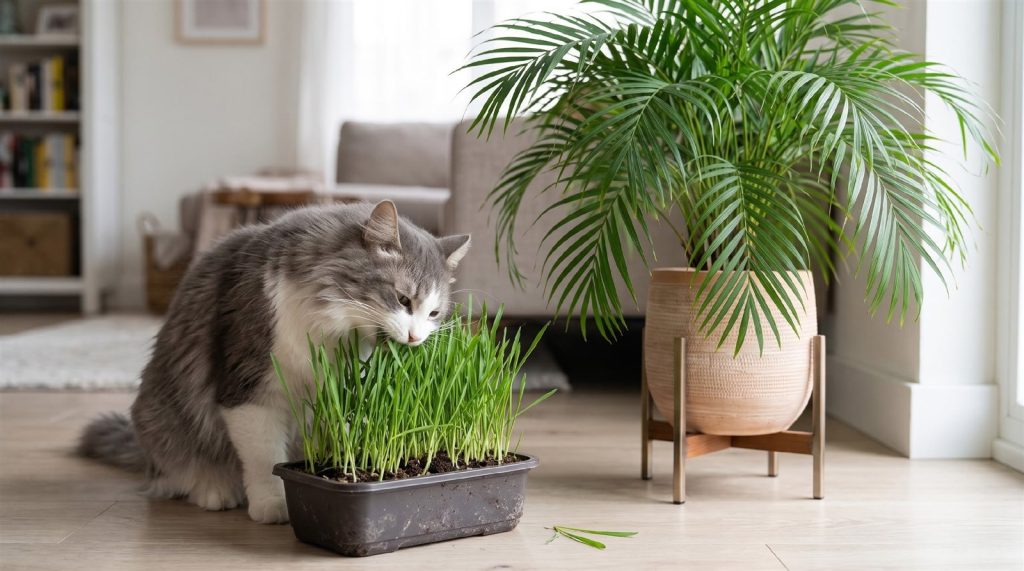
- Give the cat its own greens. Cornell suggests oat grass, catnip or catmint, and International Cat Care recommends a pot of cat grass. This is the option I would try first, because it works with the behavior instead of against it. Put it in a spot the cat already likes, away from the palm.
- Bitter deterrent sprays. The ASPCA recommends bitter sprays for cord chewing; using them on plants is a reasonable extension rather than a tested method. Spray a frond, wait, and see whether the cat avoids it before relying on it.
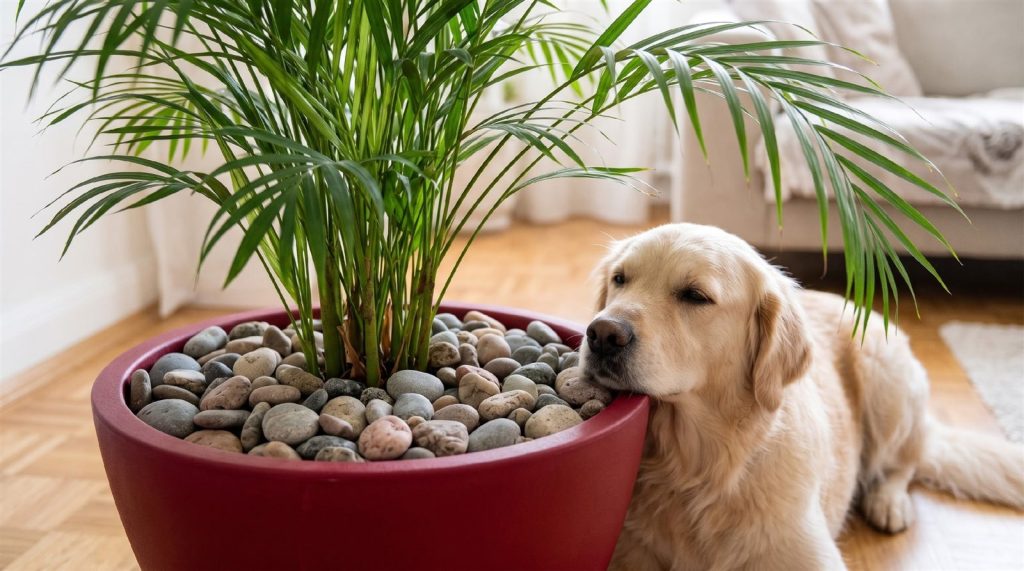
- Physical barriers. Foil or double-sided tape around the pot and large pebbles over the soil are popular. No study has tested them for plant chewing, but they are harmless and the pebbles also keep cats from digging.
Two common pieces of advice are actively dangerous. Citrus or essential-oil sprays: Pet Poison Helpline lists citrus oil (d-limonene) among oils known to poison cats, which “lack an essential enzyme in their liver,” and cats swallow whatever settles on their fur when they groom. And mothballs in the soil, which still appear in some deterrent advice: Pet Poison Helpline lists mothballs among household poisons for pets. I would never use either around a cat.
Other Pet-Safe Palms
If you want another palm in a home with cats or dogs, these are listed as non-toxic to both in the ASPCA database:
| Plant | Scientific name in the ASPCA entry | Good for |
|---|---|---|
| Parlor palm | Chamaedorea elegans | Small spaces and lower light |
| Kentia palm | Howea forsteriana | A tall, slow-growing floor palm |
| Majesty palm | Ravenea rivularis | Bright rooms (also non-toxic to horses) |
| Lady palm | Rhapis (listed under an old synonym) | Fan-shaped leaves, tolerant of indoor conditions |
| Ponytail palm (not a true palm) | Beaucarnea recurvata | Sunny windows, infrequent watering |
Cat palm (Chamaedorea cataractarum) and foxtail palm have no entry in the ASPCA, Pet Poison Helpline or NC State databases, so I would not call them pet-safe yet. For pet-safe trees beyond palms, see our guide on whether ficus is toxic to cats.
What Doesn’t Help
Trusting a plant-ID app’s toxicity warning without checking the species. Apps that match “areca palm” to Areca catechu show betel nut warnings for a plant that isn’t toxic.
Inducing vomiting at home. It is unnecessary for an areca and unsafe in cats under any circumstances.
Waiting for symptoms after a possible sago palm bite. Liver damage can develop over 48–72 hours, and early treatment is what improves survival.
Washing the leaves to remove pesticides. Systemic insecticides are inside the plant tissue. Ask the seller instead.
Citrus sprays, essential oils and mothballs as deterrents. They are more dangerous to the cat than the palm is.
Frequently Asked Questions
Is areca palm safe for cats?
Yes. The ASPCA lists the areca palm as non-toxic to cats, dogs and horses, and Pet Poison Helpline names it among pet-safe plants. A cat that eats a lot of it may vomit, as with any plant.
My cat threw up after eating my areca palm. Should I worry?
Usually not, if it happened once and your cat is eating and acting normally afterward. Call your vet if vomiting repeats, continues into the next day, or comes with lethargy, diarrhea or refusing food.
Is areca palm toxic to dogs?
No. The ASPCA lists it as non-toxic to dogs. Pages claiming otherwise usually describe the betel nut palm (Areca catechu), a different species.
Are areca palm seeds or berries toxic to cats?
The ASPCA does not list any toxic part of the areca palm. Warnings about toxic seeds refer to the betel nut palm, whose seed contains arecoline.
How can I tell an areca palm from a sago palm?
Areca palms grow as clumps of slender canes with soft, arching fronds. Sago palms have stiff, glossy, needle-like leaflets on a short, thick trunk, and the fronds feel rigid and sharp. Check the tag for Dypsis (areca) or Cycas (sago).
Is a cat palm the same as an areca palm?
No. The cat palm is Chamaedorea cataractarum, a different genus. It has no entry in the ASPCA database, so its pet safety is not officially established.
Can a cat get sick from fertilizer in an areca palm pot?
Yes. Pet Poison Helpline warns that small amounts of fertilizer cause mild stomach upset, while larger amounts can cause severe poisoning, and some products also contain pesticides. Use liquid fertilizer watered into the soil, and keep granules off the surface.