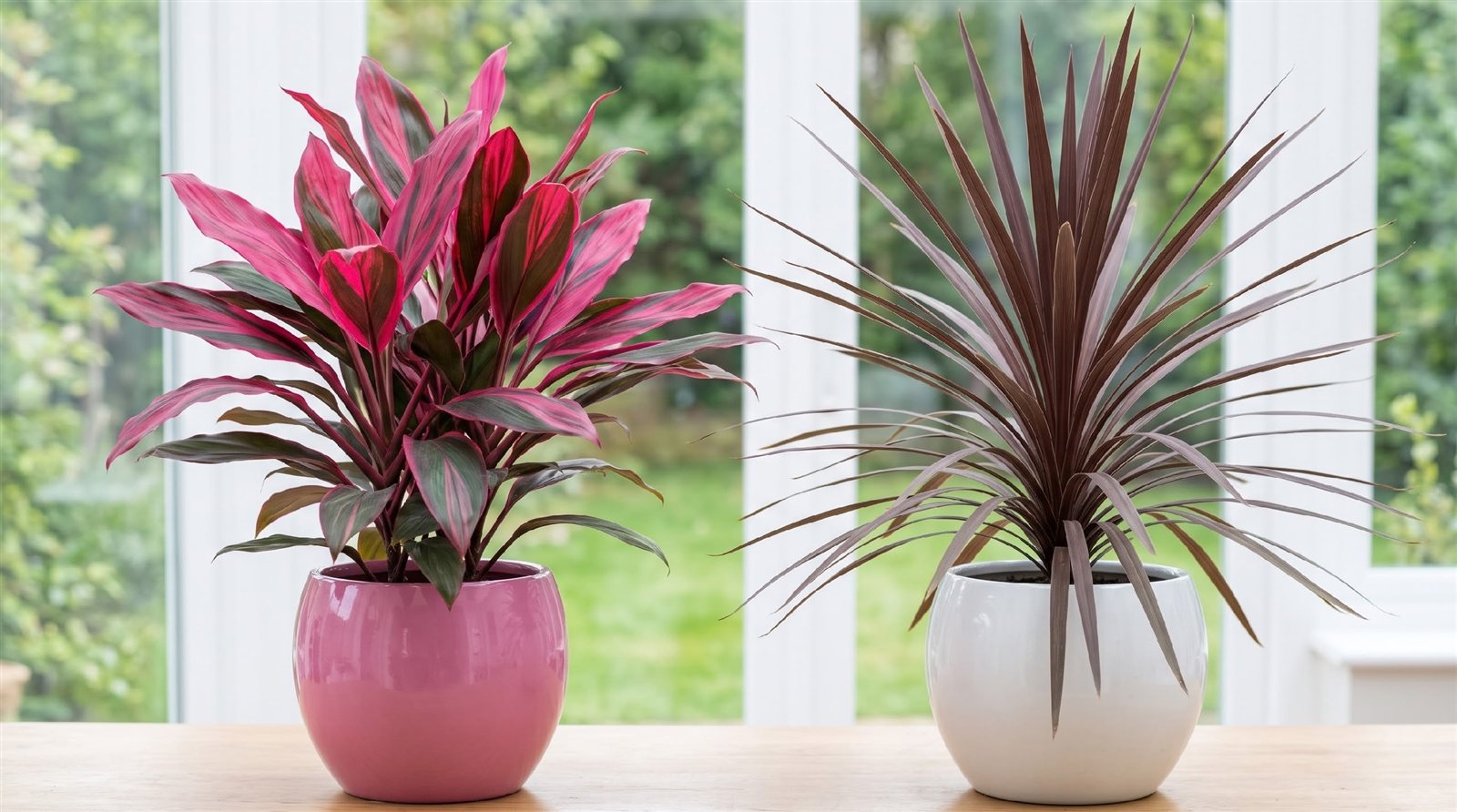
“Cordyline” on a plant tag usually means one of two very different plants. The ti plant (Cordyline fruticosa) is a tropical houseplant with broad red, pink or striped leaves that suffers below 50°F. The cabbage tree (Cordyline australis, sold as ‘Red Star’ and similar) has narrow, spiky leaves and survives a few degrees of frost outdoors. Care advice that ignores the difference will be wrong for one of them.
This guide starts with telling them apart, including from Dracaena, which they are constantly confused with. It then covers care for each, why cordyline leaf tips brown (fluoride is a measured cause here, not a myth), and what the toxicity databases actually say. Most of the figures come from the University of Hawaii’s CTAHR, which publishes production guidance for ti as a commercial crop, with measured numbers where other sources only say “bright light.”
| Cordyline at a Glance | Ti plant (C. fruticosa) | Cabbage tree (C. australis) |
|---|---|---|
| Grown as | Houseplant; outdoors in zones 10–12 | Outdoor or patio plant; zones 9–11 |
| Leaves | Broad, on grooved stalks; red, pink, green, striped | Narrow, stiff, sword-like; green, bronze or purple |
| Light | Bright indirect; 4–8 ft from a large window (CTAHR) | Full sun for green forms; light shade for colored ones (RHS) |
| Cold limit | Keep above 50°F (NC State); damaged near 32°F | About 23°F; RHS hardiness H3 |
| Water | Evenly moist, never wet; drying out causes tip burn | Drought tolerant in the ground; regular watering in pots |
| Humidity | 40–60% (CTAHR) | Not a concern outdoors |
| Main problem | Brown tips from fluoride, salts or dry soil | Frost damage to the crown |
| Pets | Toxic to cats and dogs (ASPCA) | Toxic to cats and dogs (ASPCA) |
Which Cordyline Do You Have?
Look at the leaves. A ti plant has wide, soft leaves on distinct stalks: CTAHR describes “deeply channeled petioles 2–6 inches long.” A cabbage tree has narrow, leathery leaves that sprout directly from the trunk in a spiky fountain, with no stalk to speak of.
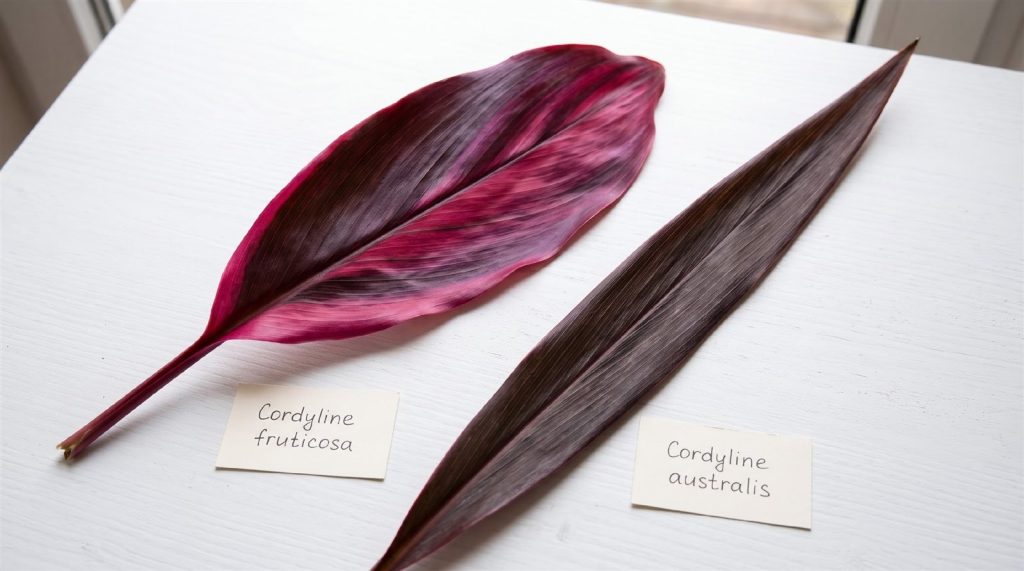
| C. fruticosa | C. australis | |
|---|---|---|
| Common names | Ti plant, Hawaiian ti, good luck plant | Cabbage tree, cabbage palm, grass palm |
| Old name on tags | Cordyline terminalis | Often sold simply as “Cordyline” or by cultivar |
| Typical cultivars | ‘Red Sister’, ‘Kiwi’, ‘Black Magic’, ‘Baby Doll’ | ‘Red Star’, ‘Torbay Dazzler’, ‘Purpurea’ |
| Native to | Tropical Asia and the Pacific (exact range debated) | New Zealand |
| Mature size | 3–10 ft (UF/IFAS); much smaller in a pot | 13–26 ft in the ground (RHS); far less in a container |
The names cause most of the confusion. NC State lists “cabbage palm” for both species, so that name alone tells you nothing. ‘Electric Pink’, often grouped with the Red Star types, is filed by NC State under a third species, C. banksii. And “good luck plant” is also used for Oxalis, which matters when you look up toxicity (see below).
Neither plant is a palm. Cordylines belong to the asparagus family (Asparagaceae), the same family as yucca. If yours has a thick cane topped with a leaf tuft and you aren’t sure which it is, our yucca cane care guide covers the third plant that gets mixed up with both.
Is It a Cordyline or a Dracaena?
Garden centers and even reference books mix the two up. CTAHR lists “common dracaena” among the trade names for ti, and the ti plant’s own synonyms include Dracaena terminalis. Even the RHS growing guide lists “Cordyline marginata” among its tender cordylines, although NC State confirms that name belongs to Dracaena marginata.
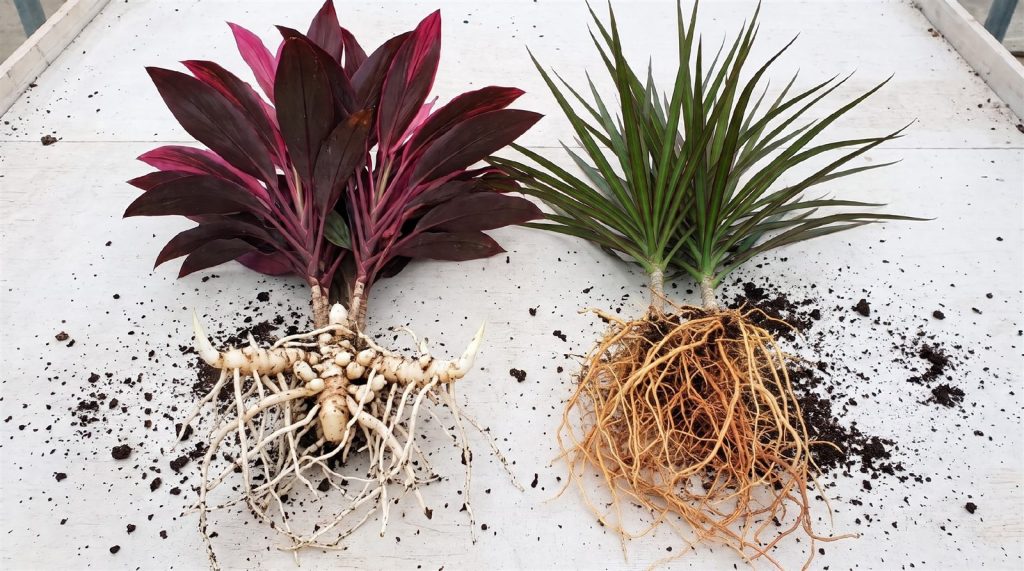
Three checks separate them:
- Leaf stalks. Cordylines have grooved petioles. NC State notes they are “often confused with Dracaena spp., which have no petioles.” Dracaena leaves attach straight to the stem.
- Roots. Cordyline roots and rhizomes are white; CTAHR calls the ti taproot “long, thick, white, and sweet.” NC State describes Dracaena roots as orange or yellow. This is the easiest check when repotting, though only one extension source states the Dracaena half of it.
- Seed count. A botanist’s test: Cordyline fruits carry several ovules per chamber, Dracaena only one. Useful if your plant ever fruits, which indoor plants rarely do.
The distinction matters for care in one respect. Both genera are sensitive to fluoride, so the brown-tip advice below applies to a misidentified Dracaena as well.
How to Care for a Ti Plant Indoors
Bright light, evenly moist soil, warmth and clean water. That covers most of it, but each has a number worth knowing.
Light
Ti plants survive in dim rooms, but they lose what you bought them for. CTAHR measured the effect: ti tolerates “light levels as low as 75–150 foot-candles. However, at those levels new growth becomes stretched and poor in color, and foliage variegation is reduced. Foliage color and quality retention improve as light increases to around 800 foot-candles.”
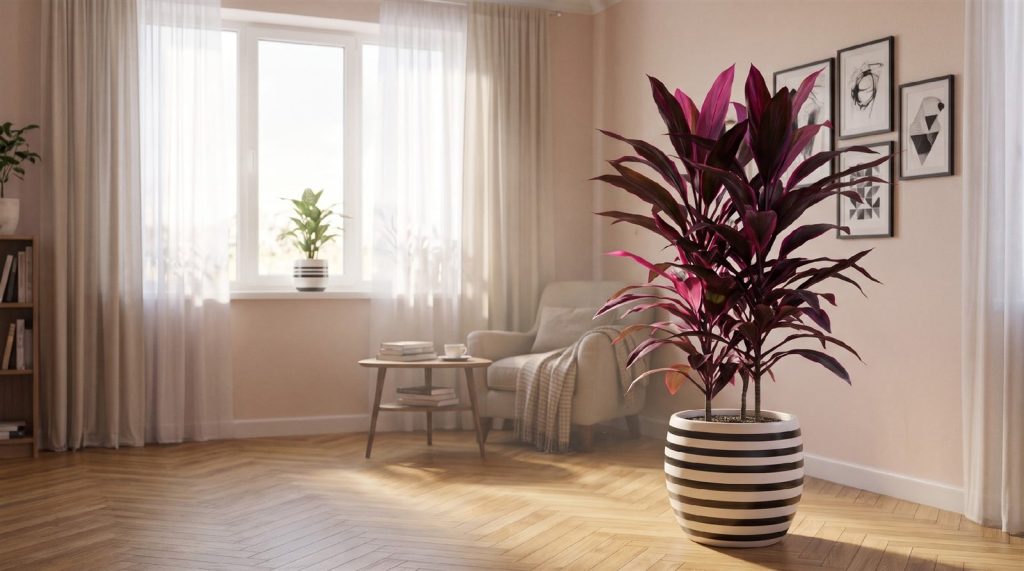
In practical terms, CTAHR recommends “4 hours of direct sunlight or bright, indirect light… within 4–8 feet of large south-facing, east-facing, or west-facing windows.” It also notes ti is “less suitable for locations where it receives only artificial light.” Clemson places ti in its high-light group (150–1,000 foot-candles). If I had a ti plant in a north-facing room, I would treat it as a temporary display plant rather than expect it to keep its color.
Full sun has a ceiling, though. CTAHR warns that the foliage of brightly colored cultivars “is easily burned when grown in full sunlight.” A few hours of morning sun is fine; an unshaded south window in summer is not.
Water and humidity
Keep the potting mix moist but not wet. CTAHR is specific about why: “Excessive drying between waterings causes tipburn and necrosis of the leaf margins.” NC State is more relaxed and says to “allow the plant to dry out a bit between watering,” with less water from late fall to late winter.
The two positions are closer than they look. Let the top inch dry, then water thoroughly and empty the saucer. What you want to avoid is a pot that swings between bone-dry and soaked. My advice is to check the pot with a finger every few days rather than water on a fixed schedule, because a ti plant’s water use drops sharply in winter.
On humidity, CTAHR is the only source that gives a figure: “Ti prefers humidity levels between 40 and 60%.” That is achievable in most homes outside the depths of winter. NC State notes a humidifier “may be required” in dry indoor air, and CTAHR lists “low light, low humidity, and hot, dry air” as causes of leaf loss. Keep the plant away from heating vents.
Temperature
Indoors, CTAHR recommends 65–85°F and advises avoiding “cold, drafty areas.” NC State says ti “does not tolerate temperatures below 50 degrees Fahrenheit.” You will also see CTAHR’s outdoor figure, “hardy to about 30˚F,” quoted on care sites. That describes brief survival in a Hawaiian landscape, not conditions a potted plant should live in. A UF/IFAS research note puts cold damage below about 32°F.
One useful detail: CTAHR notes that leaf color is “more intense during the cooler weather.” A room in the mid-60s brings out the reds better than a constant 80°F.
Soil and fertilizer
Use a well-drained, slightly acidic mix. CTAHR’s production guidance is peat at “no more than 50–60%” of the mix, with dolomite lime to bring the pH to 5.5–6.5. A standard houseplant mix with extra bark works.
Feed lightly. CTAHR’s indoor rate is “a 20-10-20 fertilizer at a rate of 1 teaspoon in a 6-inch pot every 2 months.” That is not much, and for good reason: CTAHR rates ti’s salt tolerance “poor to fair,” and UF/IFAS rates it “poor.” Over-fertilizing shows up as brown tips. CTAHR also advises rinsing liquid fertilizer off the leaves so salts don’t collect in the central whorl.
Why Do Cordyline Leaves Get Brown Tips?
In ti plants, the most specific cause is fluoride, and it is one of the few brown-tip explanations backed by research rather than repetition. CTAHR: “Ti plants are highly sensitive to fluoride exposure by air, water, media, or fertilizer.” The symptoms are “tipburn and marginal necrosis followed by mottling within the center of the leaf and death of entire leaf in severe cases.”
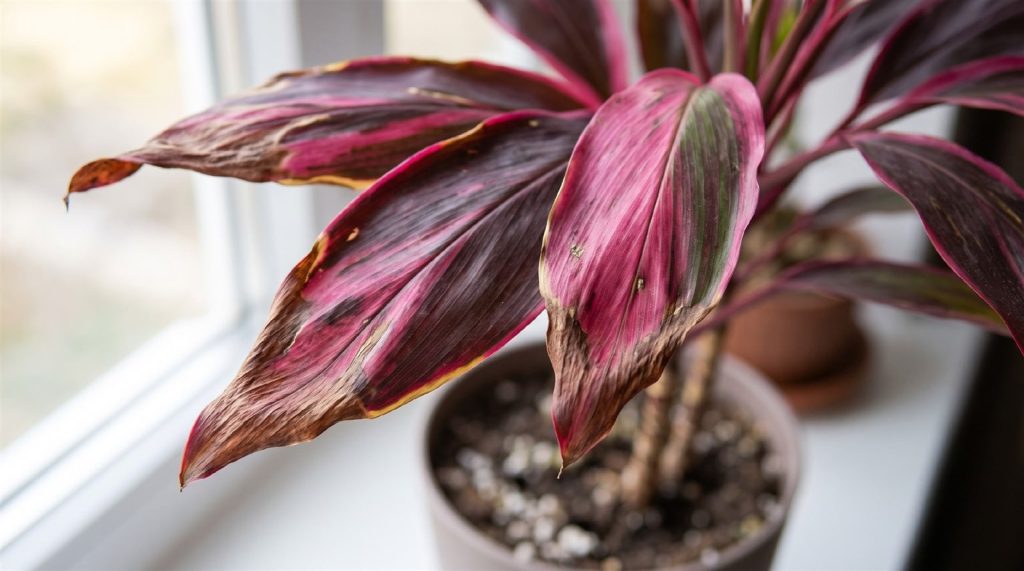
The threshold explains why so many indoor ti plants show it. CTAHR states that irrigation water “should contain less than 0.25 ppm of fluoride.” The US Public Health Service recommends fluoridating municipal water to 0.7 ppm. If your city fluoridates, your tap water likely carries close to three times what a ti plant tolerates.
How to stop fluoride damage
- Change the water. Rainwater, distilled or reverse-osmosis water removes the main source. Letting tap water stand overnight does not help: that releases chlorine, but fluoride does not evaporate.
- Keep the pH up. CTAHR and Penn State Extension both recommend a growing-medium pH of 6.0–6.5. Fluoride is less available to the roots at that pH, which is why growers add lime.
- Avoid superphosphate fertilizers. UF/IFAS foliage research notes superphosphate “contains 1 to 2% fluoride as a contaminant.” Penn State also lists perlite as a source, though a Cornell analysis argues thorough leaching largely solves that. Superphosphate is the stronger case.
The same sensitivity shows up in other common houseplants, notably spider plants and dracaenas. I would not apply fluoride advice to C. australis, though. No authoritative source documents fluoride sensitivity in the cabbage tree, and outdoors it is rarely an issue.
Other causes of brown tips
| Pattern | Likely cause | Fix |
|---|---|---|
| Tips and edges brown, then mottling spreads inward | Fluoride (CTAHR, Penn State) | Rain, distilled or RO water; pH 6.0–6.5 |
| Tips brown after the pot dried out | Irregular watering (CTAHR) | Keep the mix evenly moist |
| Tips brown in winter near a heater | Dry air (NC State, Clemson) | Move away from vents; humidity toward 40–60% |
| White crust on the soil or pot rim | Salt buildup (Clemson, UC IPM) | Flush with plenty of water; feed less |
| Tips died after you used leaf shine | Chemical damage (Penn State) | Wipe leaves with plain water only |
Brown tissue does not turn green again. Trim it with clean scissors, following the leaf’s shape, and judge your fix by the new leaves.
Why Is My Cordyline Losing Its Color?
Usually because it needs more light. NC State: ti “requires bright indirect light to maintain its bright foliage colors.” CTAHR’s outdoor trials show the same thing in reverse: in heavy shade, red cultivars “tend to produce leaves with more green color.”
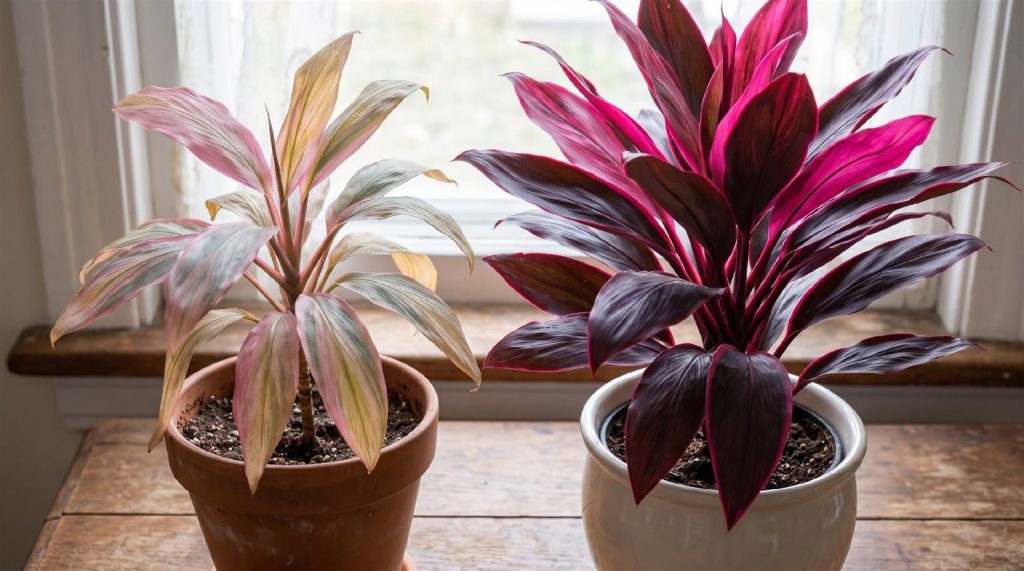
Two other factors play a part. Warm conditions mute color, since CTAHR finds it most intense in cooler weather. And Penn State lists poor color (“lack rose or pink tints”) among ti disorders, fixed by moderate fertilizer, adequate light and moderate temperatures.
There is one documented exception. CTAHR’s cultivar table notes that ‘Baby Doll’ “will begin to produce leaves with wider pink margins as the light intensity is reduced.” So if you grow ‘Baby Doll’, more light is not automatically more color. For most red and pink cultivars, though, a brighter spot is the answer.
Why Are the Lower Leaves Turning Yellow?
A few yellow leaves at the bottom of the stem are normal. Ti plants shed their oldest leaves as they grow taller, which is how they form a bare cane with a tuft on top. Remove them once they are fully yellow or brown.
It becomes a problem when several leaves yellow at once or the yellowing climbs the stem. Penn State describes Fusarium stem and root rot: “Lower leaves yellow and wilt,” with brown roots and tan spots near the soil line. NC State notes that “cold wet soils can cause rotting of the rhizomes.” Clemson adds long dry spells and nitrogen deficiency as causes. Check the roots: firm and white is healthy, brown and mushy means rot, and the plant needs fresh mix and less water.
How to Grow Cordyline australis Outdoors
This is the hardier plant, and the one sold in garden centers for patio pots and coastal gardens. In the ground it is easy. The risks are cold and wet winters.
How cold can it get?
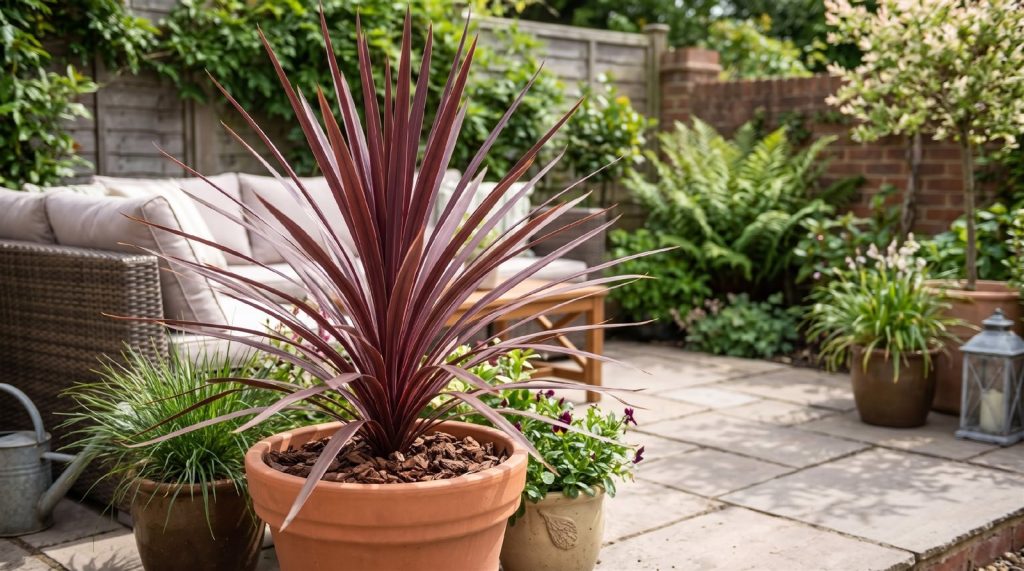
The RHS rates C. australis H3, “hardy in coastal and relatively mild parts of the UK,” which it defines as −5 to 1°C (about 23–34°F). US sources put it in zones 9–11. The RHS adds that young plants and colored cultivars are less hardy than the green species. A small purple ‘Red Star’ in a pot is far more vulnerable than an established green tree in the ground.
I would treat any cordyline in a container as frost-tender, whatever the label says. Roots in a pot are exposed to cold from all sides, and container plants are usually young.
Light, water and soil
The RHS says “full sun is ideal for green-leaved cordylines,” while “light shade is preferable for those with colourful or variegated leaves.” Established plants in the ground are drought tolerant; containers need “regular watering during the growing season” and should be kept fairly dry in winter.
In containers, the RHS recommends a soil-based mix with added grit and a “balanced, liquid fertiliser from spring to late summer.” Plants in the ground shouldn’t need feeding. MoBot notes the taproot needs “a large and deep container,” so a wide, shallow bowl is a poor choice.
Winter protection
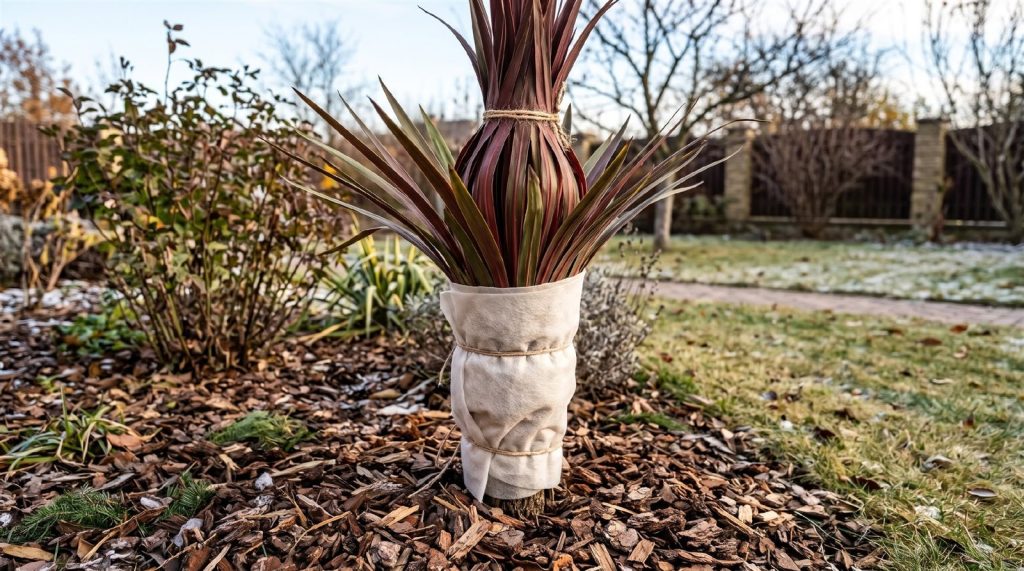
Where frost is likely, the RHS method is to “tie the foliage together in a bunch,” wrap the stem in fleece and mulch the base about 6 inches deep. Tying the leaves protects the growing point in the center, which is the part that matters. Container plants can come indoors: the RHS says to “grow indoors in bright light,” and MoBot recommends overwintering “in bright sunny spots.”
What to do after frost damage
The first sign of a frost-damaged crown is that the leaves “initially appear to ‘wilt’ or flop” (RHS). Bacteria then enter the damaged tissue and cause slime flux, a foul-smelling ooze. The RHS says this “is not usually fatal,” and there is no control beyond pruning.
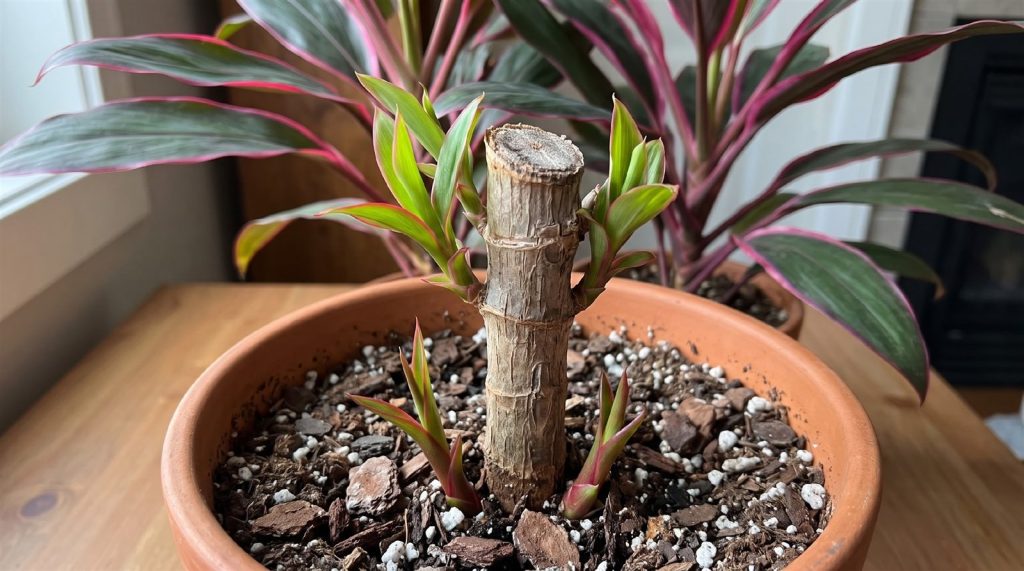
Don’t dig the plant up too early. The RHS advises cutting frost-damaged cordylines “back to living tissue with a saw or secateurs.” A stem cut back “will sprout just below the cut,” and even if the whole top is dead, “it is still possible for shoots to appear from ground level in June-September.” My advice is to wait until late summer before giving up on a cordyline that looks dead after a hard winter.
How to Fix a Leggy Cordyline
Cut it back. A ti plant that has grown into a tall bare cane will resprout below the cut. CTAHR’s indoor advice: plants “may be rejuvenated by cutting the stems back to 6 inches above the level of the soil… so that new shoots will arise at a lower location on the stem.” Outdoors, CTAHR suggests cutting a foot above the soil to encourage branching and leaving three new shoots.
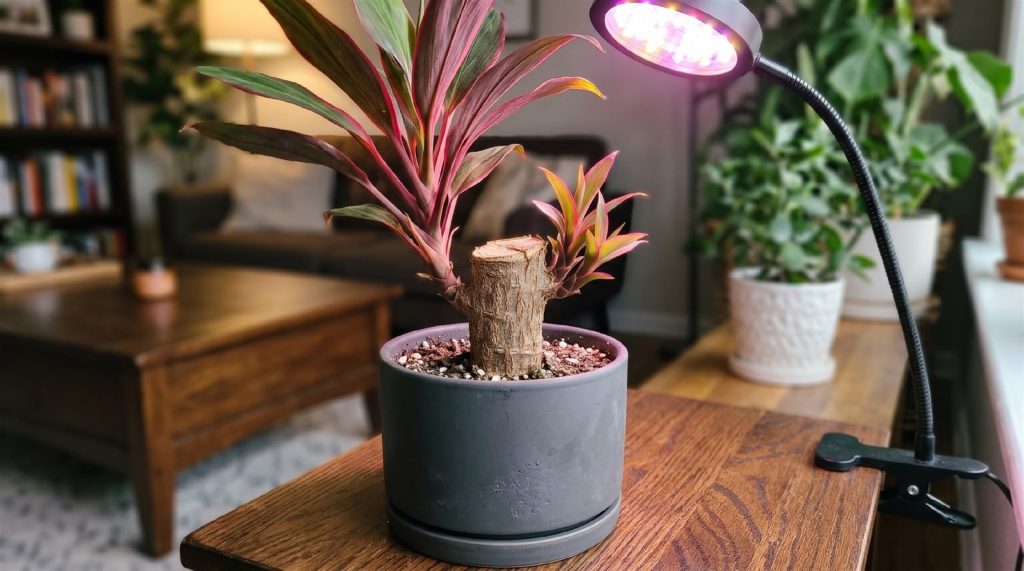
It feels drastic, but it is how commercial growers manage the plant. The cut top and cane sections become new plants (see below), so nothing is wasted. For C. australis, the RHS says to cut “just above a sideshoot or basal shoot, or down at ground level,” in mid-spring.
How to Propagate Cordyline
Ti plants are among the easiest houseplants to propagate, because almost any piece of cane will root. CTAHR lists stem sections, tip cuttings, seed and air layering.
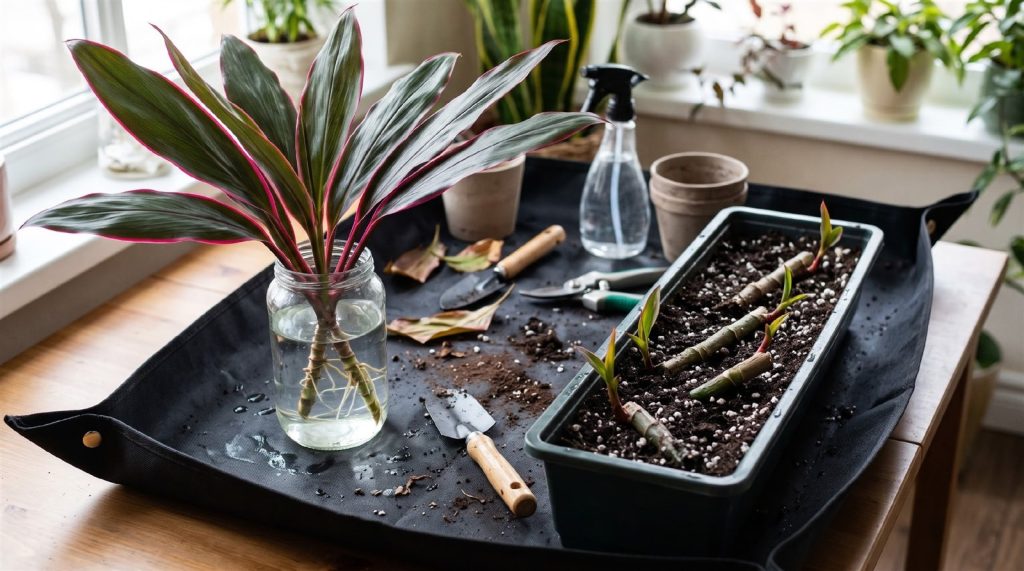
- Tip cuttings. CTAHR: “A terminal cluster of leaves with 6 inches of stem will root quickly and make a well-shaped plant in 4–6 months.” This is the method I would choose for a single good-looking plant.
- Cane sections (“ti logs”). Cut the bare cane into pieces “1 inch or more long.” CTAHR: “Cuttings inserted in a vertical position will grow into single plants. Cuttings inserted in a horizontal position may grow into several plants.” The RHS suggests laying them horizontally “with the growth bud just visible at the surface.”
- Rooting. Use a moist peat-sand or seed-starting mix. CTAHR says “a rooting hormone is not necessary” and gives a rooting time of 2–4 weeks. For rooting in water, cuttings “should be at least 6 inches long.”
- Air layering. For a tall plant you don’t want to cut blind. CTAHR: “It takes a couple of months for an air-layered branch to root.”
For C. australis, the RHS method is simpler: “sever rooted suckers from the base in spring.” Seed works for both species but produces variable plants. CTAHR notes ti seedlings show “wide variation,” so a seedling won’t match the parent’s colors.
One fluoride note: unrooted cuttings are the most vulnerable stage, so if you only have tap water for your mature plants, use rain or distilled water at least while cuttings root.
Is Cordyline Toxic to Cats and Dogs?
Yes, both species. The ASPCA lists the ti plant (Cordyline terminalis, the old name for C. fruticosa) as “Toxic to Dogs, Toxic to Cats.” The toxic principle is saponins, and the listed signs are “vomiting (occasionally with blood), depression, anorexia, hypersalivation, dilated pupils (cats).” C. australis appears under two other names, “Giant Dracaena” and “Palm Lily,” also toxic to dogs and cats.
NC State rates the poison severity as “low” for both species, with saponins as the toxin. For C. fruticosa, it also lists contact dermatitis from the sap, so wear gloves if your skin is sensitive when taking cuttings.
Two details trip up pet owners searching the database:
- “Good luck plant” is a different entry. The ASPCA’s “Good Luck Plant” page is Oxalis, toxic for a different reason (soluble calcium oxalates). Search by “ti plant” or the scientific name instead.
- Horses are inconsistent. Some ASPCA entries for the same species include horses and some don’t. Treat cordyline as toxic to horses as well.
Hawaiians traditionally ate cooked ti root, which sometimes leads to claims that the plant is safe. Cooked root eaten by people says nothing about a cat chewing raw leaves. None of the veterinary sources exempt any part of the plant. If a pet has eaten cordyline and shows symptoms, call your vet or the ASPCA Animal Poison Control Center.
Cordyline Pests and Leaf Spots
NC State lists “aphids, scale insects, spider mites, fungus gnats, thrips, and mealybugs” on ti plants. Spider mites are the ones to watch indoors, especially in dry winter air. UC IPM’s advice for mites is to “frequently wash leaf surfaces”; for mealybugs, wipe or scrape them off, remove badly infested parts, then use horticultural oil or insecticidal soap.
Leaf spots on ti plants are usually fungal. Penn State describes Fusarium leaf spot as “tan to red-brown, oval spots… on the tips of young leaves,” and Phyllosticta as small spots with purple borders on older leaves. Both spread with water on the foliage, so Penn State’s first control is to “avoid overhead watering.” A soft, slimy, foul-smelling stem points to bacterial rot (Erwinia); Penn State’s advice is to discard the plant, and that is one case where cuttings from healthy tissue are the only rescue.
Outdoors, the RHS notes that “few pests and diseases affect cordylines.” Most leaf spotting on C. australis comes from “physical damage or stress, such as cold wind, hail and winter wet.”
What Doesn’t Work
One set of care rules for every cordyline. A ti plant on a cold patio dies at temperatures a cabbage tree barely notices. A cabbage tree in a dim living room stretches and declines. Identify the species first.
Letting tap water stand overnight to fix brown tips. That removes chlorine. Fluoride, the documented cause in ti plants, stays in the water.
Fertilizing a faded plant. Color depends mainly on light. Ti plants have poor salt tolerance, so extra fertilizer is more likely to add brown tips than restore color.
Leaf shine products. Penn State lists them as a cause of leaf tip damage. Plain water on a soft cloth is enough.
Throwing out a frost-damaged cabbage tree in spring. The RHS documents regrowth from below the damage and from ground level as late as September.
Assuming “cabbage palm” or “good luck plant” identifies the plant. Both names cover more than one species. Use the scientific name when buying or checking toxicity.
Frequently Asked Questions
Is cordyline an indoor or outdoor plant?
It depends on the species. Cordyline fruticosa (ti plant) is a houseplant anywhere colder than zone 10. Cordyline australis is an outdoor plant in zones 9–11 and a patio container plant elsewhere, brought indoors for winter.
Is cordyline a palm?
No. Despite names like “cabbage palm,” cordylines belong to the asparagus family (Asparagaceae), the same family as yucca and dracaena.
How often should I water a cordyline?
Water a potted ti plant when the top inch of mix is dry, thoroughly, and never leave it standing in water. CTAHR warns that letting it dry out too far causes tip burn. C. australis in the ground is drought tolerant once established.
Can I put my ti plant outside for the summer?
Yes, once nights stay above 50°F. Start it in shade and move it to light shade over a week or two. CTAHR notes brightly colored cultivars burn easily in full sun. Bring it in before nights cool again in fall.
Can I cut the top off my cordyline?
Yes. CTAHR recommends cutting leggy ti plants back to about 6 inches above the soil; new shoots form below the cut. The top can be rooted as a new plant.
Does cordyline flower indoors?
Rarely. NC State notes “potted indoor plants rarely flower or fruit.” Outdoors in warm climates, both species produce sprays of small, fragrant flowers.
Why are the leaves on my cordyline turning brown?
Brown tips on a ti plant usually mean fluoride in tap water, salt buildup, irregular watering or dry air. Brown, flopping leaves on an outdoor cabbage tree after a cold spell mean frost damage to the crown.
Is cordyline safe for cats?
No. The ASPCA lists both the ti plant and C. australis as toxic to cats and dogs because of saponins. Signs include vomiting, drooling, loss of appetite and, in cats, dilated pupils.