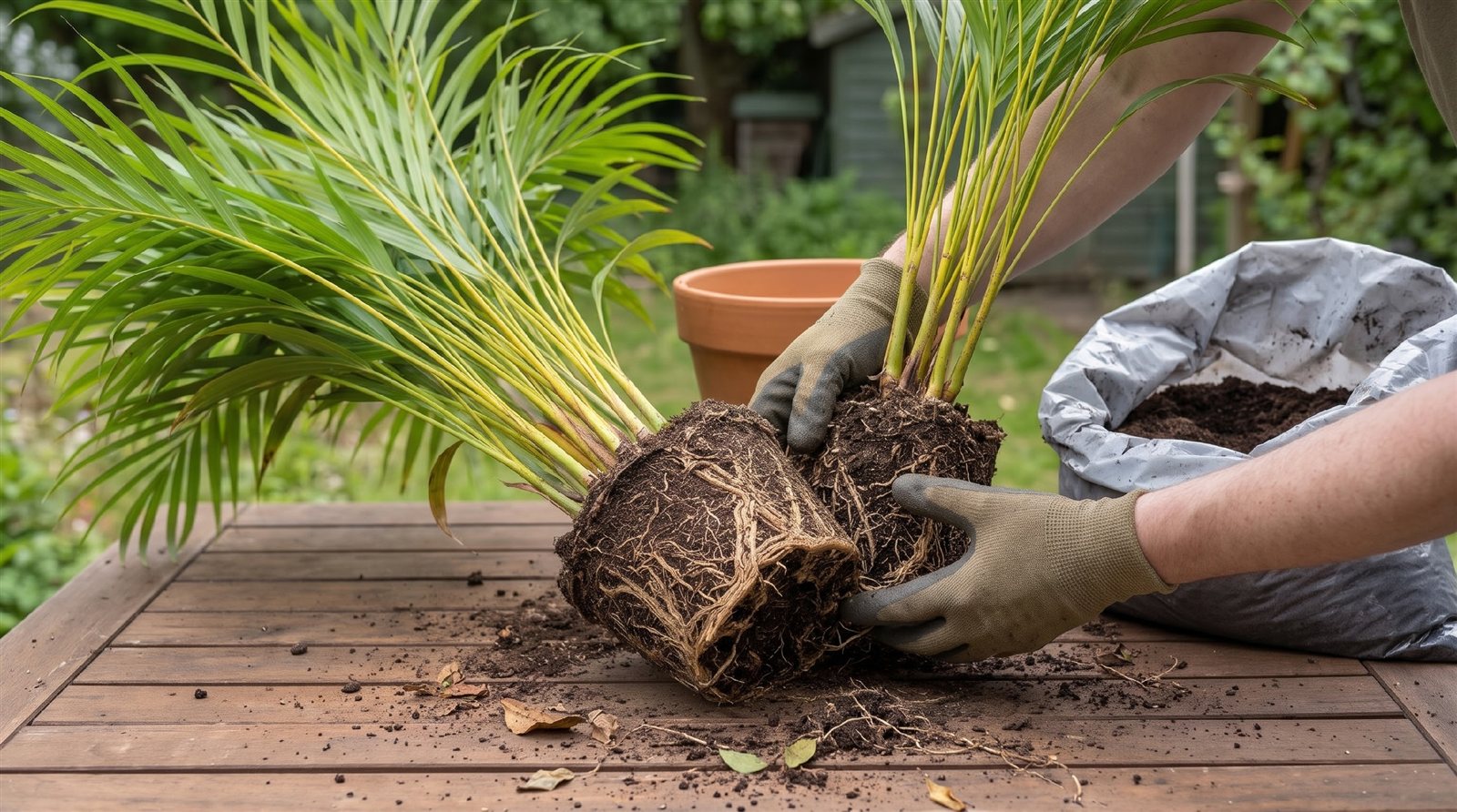
How to divide an areca palm comes down to one fact most guides skip: the plant you bought is usually not one plant. Growers sow areca seeds thickly and pot the seedlings together, so the clump is several separate palms sharing one pot. Dividing it means easing those palms apart into a few large groups, each with plenty of stems and roots. You cannot root a cut stem or a frond; palms do not grow from cuttings.
This guide covers when to divide, how to split the root ball with the least damage, how big each division should be, what the first months look like, and how to grow areca from seed if you want to start from scratch. For everyday care (light, water and feeding), see our areca palm care guide.
| Areca Propagation at a Glance | |
|---|---|
| Methods that work | Division of the clump; seed |
| Methods that don’t | Stem or leaf cuttings, rooting a cane in water |
| Best time to divide | Spring or early summer |
| Division size | Large: a thick group of stems with its own root mass, not single stems |
| Recovery | Months; UF/IFAS allows 4 to 6 months for divided palms to establish |
| Seed germination | Starts in 3 to 4 weeks at 85–95°F (UF/IFAS) |
Can You Propagate an Areca Palm From Cuttings?
No. A palm stem grows from a single bud at its tip. UF/IFAS explains that “palm stems are characterized by having a single apical meristem or growing point” and that “palms have no lateral meristems.” A cut cane has no way to make new roots or new shoots, so it simply dies.
That is why UF/IFAS states that “with relatively few exceptions, palm species can only be propagated from seed.” Areca is one of the exceptions only because it grows in clumps: each cane in the clump is a complete palm with its own roots, and the clump can be separated. NC State and UF/IFAS both list the same two methods for areca: seed or division.
You will find pages promising areca “cuttings in water.” Read closely and they describe rooted offshoots that were already separate plants, not cuttings. A cane without roots will not root in water either.
Your Areca Is Probably Several Plants Already
This changes how you should divide. UF/IFAS describes how nurseries grow areca: seeds are sown densely, and “the germinated seedlings will be transplanted together to make a dense specimen plant.” The full, bushy look of a store-bought areca comes from many young palms planted in one pot.
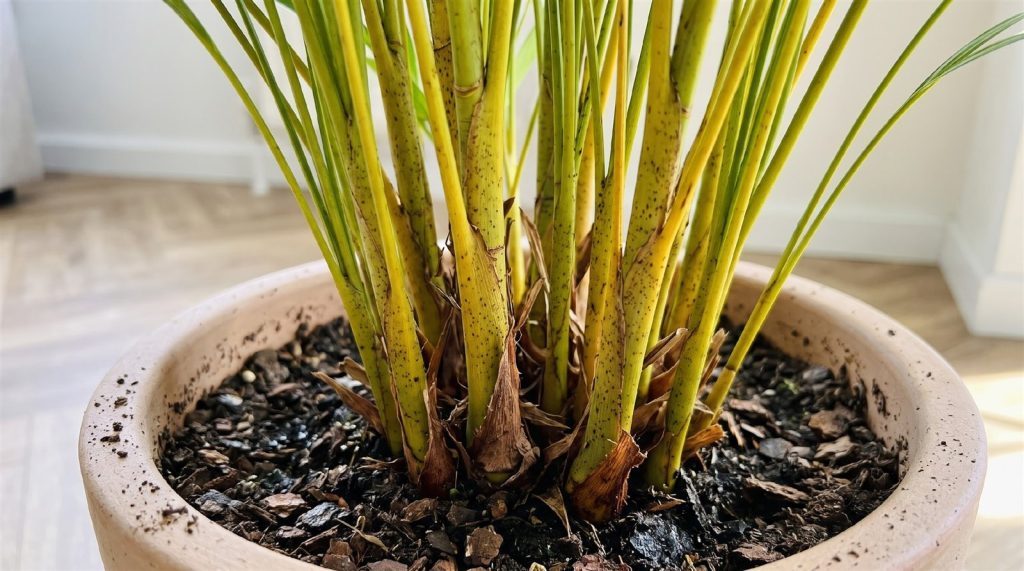
Over a few years, those palms tangle their roots together, and each one may also produce suckers from its base. But the original seedlings remain separate plants. When you look at the base of the clump, you can often see distinct groups of canes, each rising from its own point. Those natural seams are where the clump comes apart most easily.
My advice before you pick up a knife: lift the plant, look at the base and find those seams first. Following them damages far fewer roots than slicing straight through the middle.
When Should You Divide an Areca Palm?
Spring or early summer, when the plant is entering its main growing season. Clemson recommends repotting palms “in spring or early summer,” and Iowa State Extension calls early spring “the ideal time” for dividing palms such as Dypsis lutescens. A division made in late fall sits in cool, dim conditions for months before it can grow new roots.
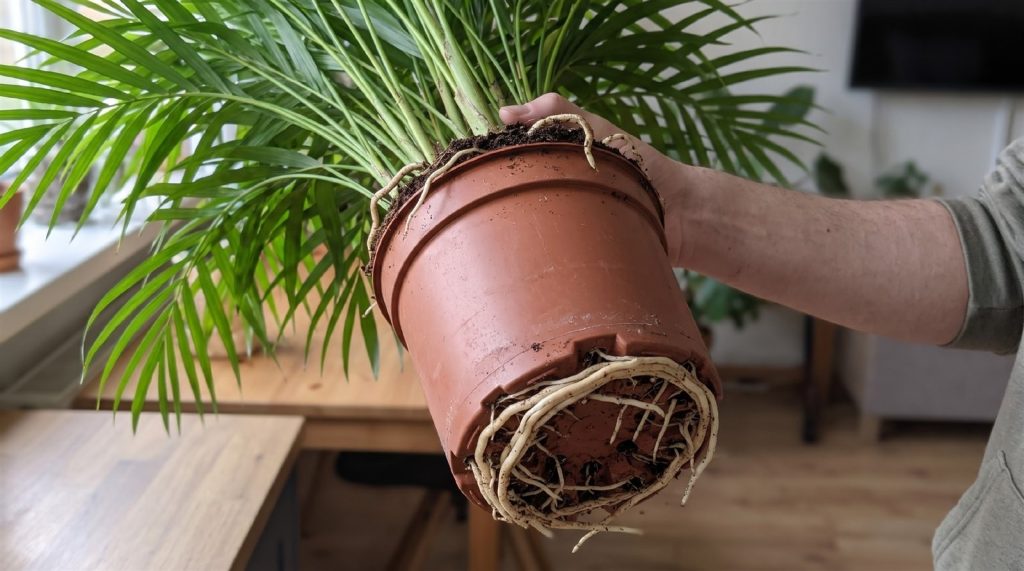
Signs that a clump is ready:
- Roots growing out of the drainage holes or circling the top of the soil
- Water running straight through the pot because roots have replaced the soil
- The clump has become too wide or crowded for its spot, with inner canes shaded out
- Repotting is due anyway: Clemson and NC State suggest every 2 to 3 years
Don’t divide a palm that is already struggling. A plant with rotting roots, heavy pest damage or widespread yellowing should recover first. Division is a setback even for a healthy plant, and I would rather wait a full season than divide a weak one.
What You Need to Divide an Areca Palm
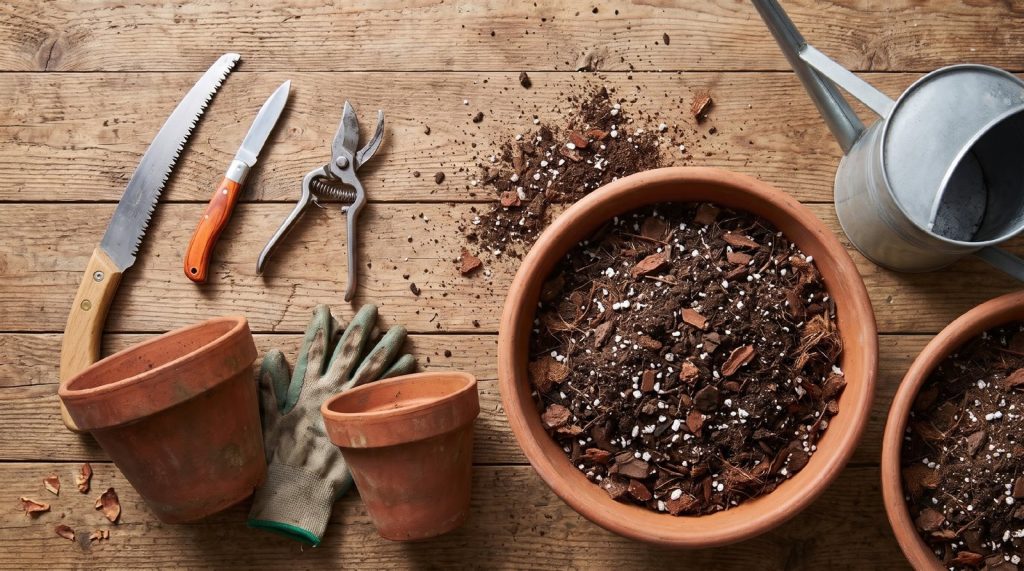
- A sharp, clean knife or a small pruning saw for roots that will not come apart by hand. UF/IFAS uses “a sharp spade” for nursery-scale divisions.
- Pots for each division, only slightly larger than each root mass. An oversized pot holds wet soil around a small root system.
- A fast-draining palm mix. UF/IFAS nurseries use peat, pine bark and wood shavings; a quality potting mix with added bark and perlite works at home.
- Gloves and a tarp or old sheet to work on.
How to Divide an Areca Palm, Step by Step
Work in shade, and keep exposed roots moist throughout. Don’t rush: slow hands tear fewer roots.
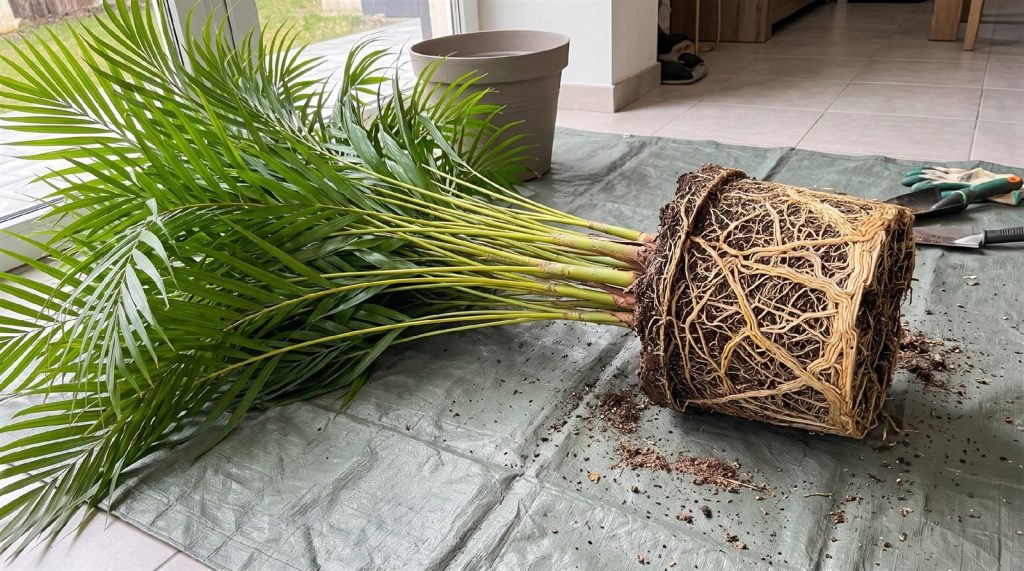
- Water the day before. Moist roots slide apart more easily and suffer less tearing.
- Remove the plant from the pot. Lay the pot on its side and slide the root ball out. If it is stuck, cut the plastic pot away rather than pulling on the canes.
- Find the natural seams. Loosen the outer soil with your fingers and look for the groups of canes that rise from separate bases.
- Tease the root ball apart along the seams. Work slowly with your fingers from the bottom up. Aim for two or three large sections rather than many small ones.
- Cut only where roots will not separate. Use the knife or saw to slice through the tangle, keeping as much of the root ball with each section as you can. UF/IFAS advises lifting divisions “with as much of the root ball as can be managed.”
- Pot each division at its original depth. UF/IFAS warns that palms “are very intolerant of being planted too deeply, regardless of age or size.” Keep the soil line exactly where it was on the canes.
- Water thoroughly and let the pot drain completely.
Should you tease the roots apart or cut them?
Tease wherever you can, and cut only what you must. Palm roots do not respond to pruning the way most houseplant roots do. UF/IFAS notes that root pruning “usually results in growth setbacks or even death” in palms. Every root you sever is a root the division has to replace before it can grow.
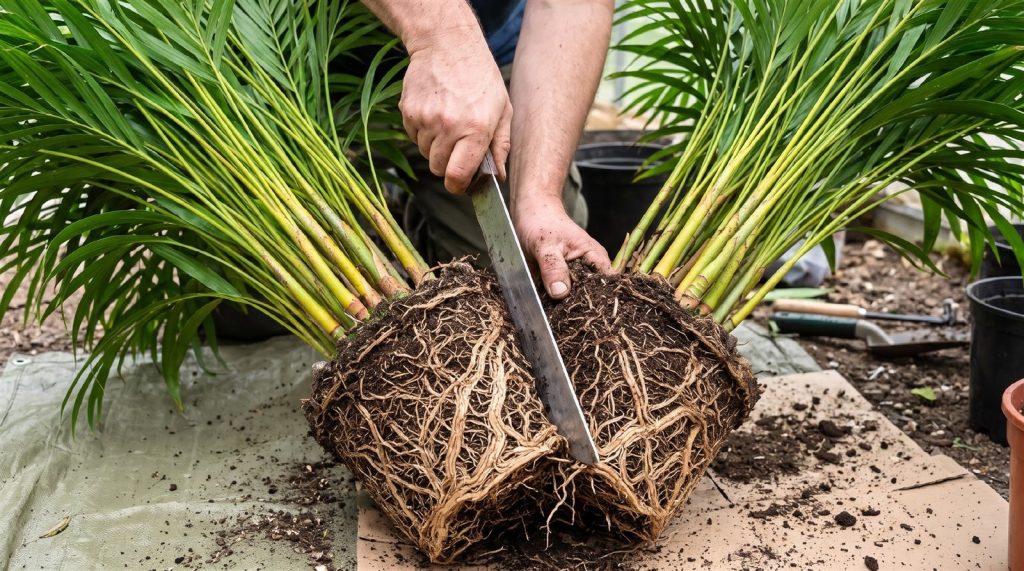
On an old, solidly matted clump, some cutting is unavoidable. In that case, make a few clean cuts with a sharp blade rather than tearing, and accept a slower recovery. My rule of thumb: if a section won’t come free after a few minutes of gentle work, make one clean cut there instead of pulling harder.
How Big Should Each Division Be?
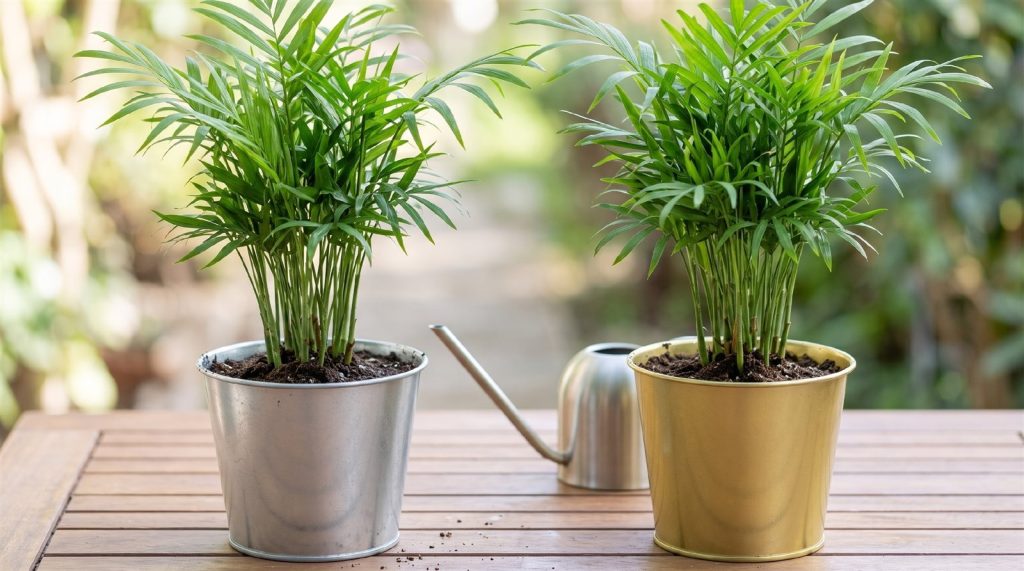
As large as your goal allows. Iowa State Extension puts it simply: “The larger the piece, the more quickly the plant recovers.” A big division has enough roots to keep its fronds supplied while it re-establishes. A single cane with a few roots often does not.
| Division | What to expect |
|---|---|
| Clump split in half, each part with many canes and a full root mass | Best recovery; the quickest to look full again |
| Groups of roughly 5 to 10 canes with their own roots | Usually recovers; expect browning and a slow first few months |
| One or two canes with a small piece of root | High risk of failure; even if it survives, it stays thin for a long time |
The table reflects the general rule from extension sources and the biology of palm roots, not a measured trial; I could not find areca-specific survival data. Popular guides suggest a minimum of 3 to 5 stems per division. I would treat that as the bare minimum and aim higher: splitting a clump in two is the safest division there is.
The same logic applies to the parent plant. Taking one large section off the side and leaving the rest intact is far gentler than breaking the whole clump into pieces.
How to Care for an Areca Palm After Dividing
Treat new divisions like patients: steady, gentle conditions and no extra stress.
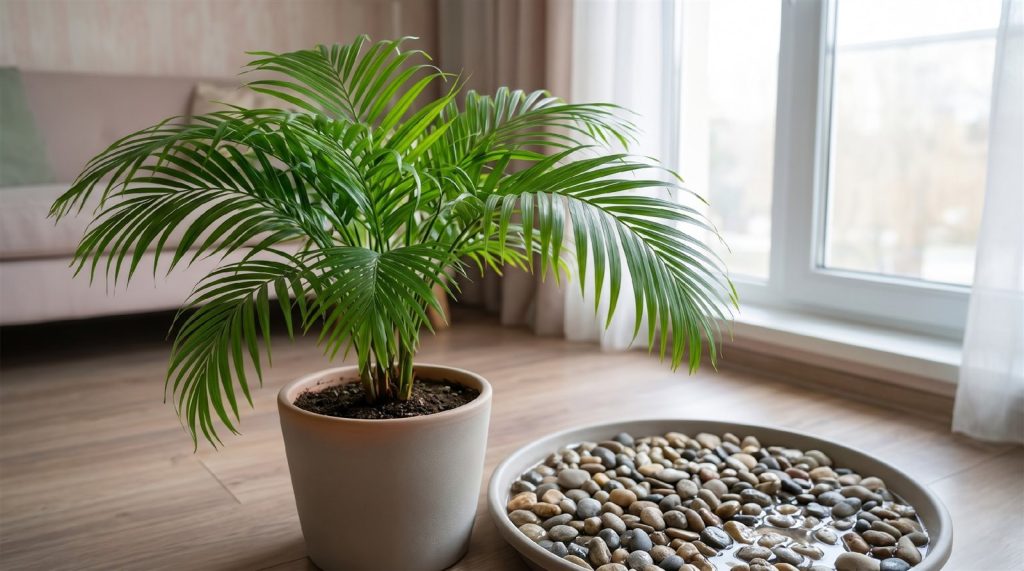
- Light: bright, indirect light only. UF/IFAS keeps freshly potted palms under shade until new growth appears; at home, that means no direct sun through the window for the first few weeks.
- Water: keep the soil evenly moist but never soggy. A reduced root system cannot use as much water, so check the soil with a finger before every watering.
- Fertilizer: none for now. The RHS advises waiting 6 to 8 weeks after potting before feeding palms. Fertilizer salts burn damaged roots.
- Humidity: helpful but not essential. A pebble tray or grouping with other plants reduces leaf browning while roots recover.
Be patient about timing. UF/IFAS allows divided palms “4 to 6 months” to become established (its worked example is lady palm, another clustering palm, rather than areca). Don’t judge success in the first few weeks: a new spear emerging from the center is the sign that roots have caught up.
I would leave a new division alone during that time: no moving it around the house, no repotting into a bigger pot, no feeding. Every change is one more stress on a plant that is short of roots.
Why Is My Divided Areca Turning Brown?
Some browning after division is normal. The plant has lost roots, and it cannot supply all of its fronds until new roots grow. Expect brown tips, and possibly a few older fronds dying back, in the first weeks.
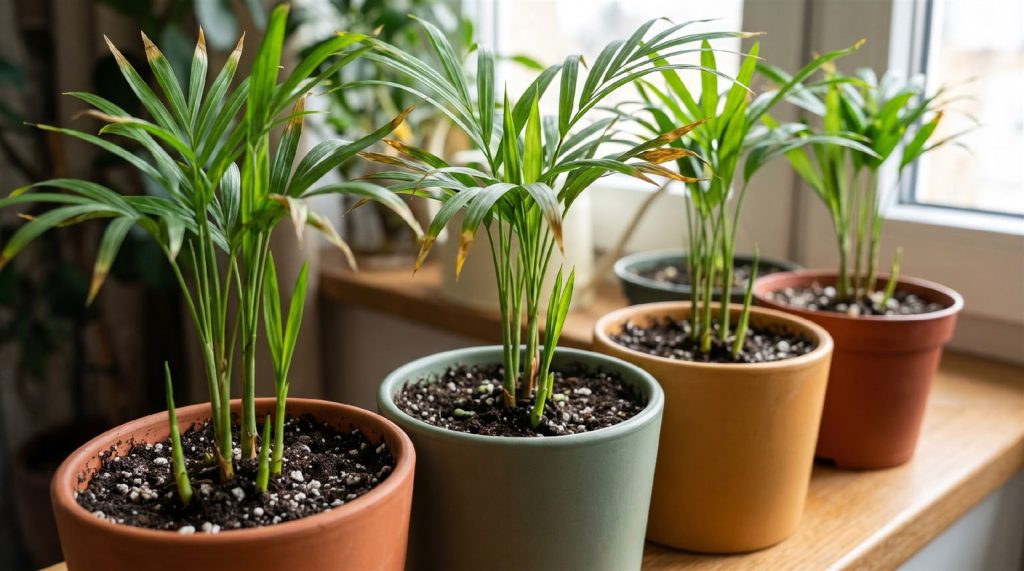
It is a problem when:
- The newest spear turns brown or pulls out easily. That means the growing point of that cane has died, often from rot in wet soil. Check that the pot drains and that the cane was not planted deeper than before.
- Browning spreads through the whole division after several weeks. The division was probably too small for its root system, or the soil is staying wet. Cut back on watering and move it out of any direct sun.
- Fronds turn yellow rather than brown. That points to a nutrient or root problem rather than division stress. Our guide to areca palm yellow leaves explains how to read the pattern.
Cut off fronds only when they are fully brown. A half-green frond is still feeding the plant, which is exactly what a recovering division needs.
How to Grow Areca Palm From Seed
Seed is how every commercial areca starts, and it works at home if you can get fresh seed and keep it warm. UF/IFAS reports that areca seed begins to germinate “in 3–4 weeks” under good conditions.
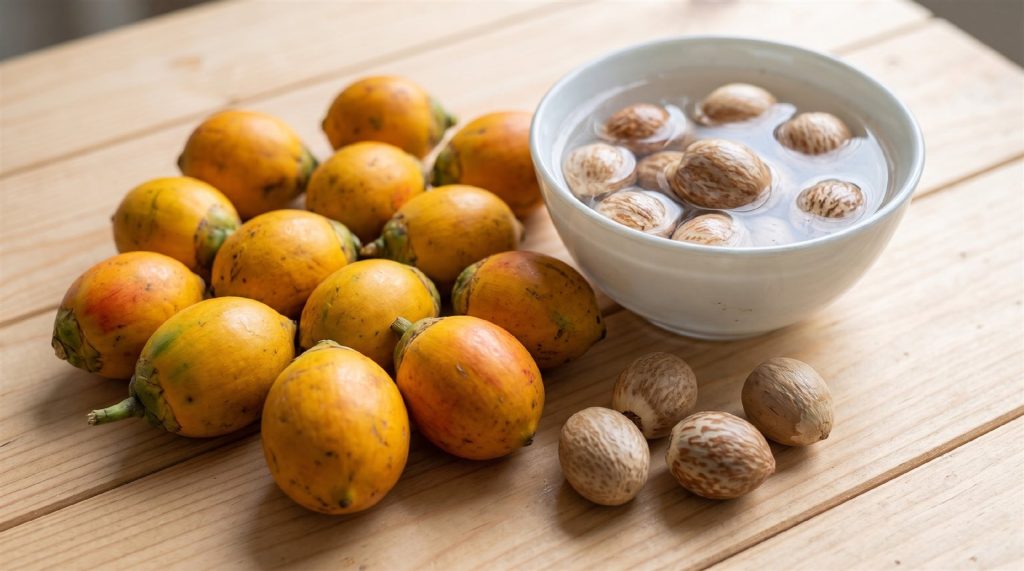
| Step | What to do | Source |
|---|---|---|
| Fruit | Use fully ripe fruit; it turns from yellow-orange toward dark purple or black as it matures (sources describe the final color differently) | UF/IFAS, MBG, NC State |
| Cleaning | Rub off the thin fruit flesh by hand in a bucket of water | UF/IFAS |
| Soaking | 1 to 7 days in water, changed daily | UF/IFAS |
| Mix | 1:1 peat moss and perlite | UF/IFAS |
| Depth | Shallow; cover the seed lightly, about its own depth | UF/IFAS, RHS |
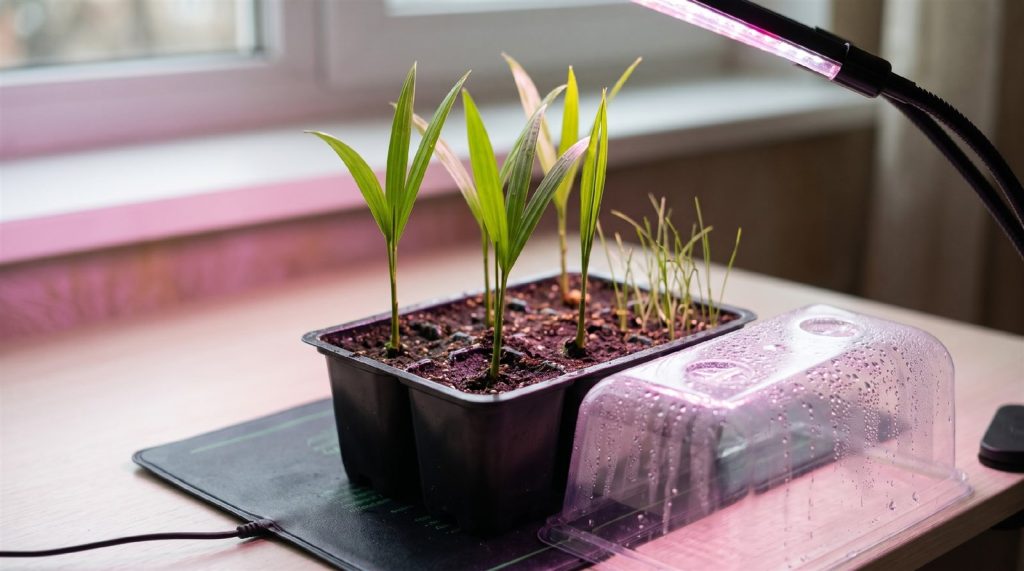
| Temperature | 70–100°F works; 85–95°F gives the best results. Use bottom heat | UF/IFAS |
| Germination | Begins in 3 to 4 weeks; in a University of Hawaii trial, half the seeds had sprouted by 5 to 6.5 weeks and final germination reached 89–97% | UF/IFAS, CTAHR |
| Feeding | No fertilizer for the first two months after germination | UF/IFAS |
Freshness matters most. UF/IFAS found that cleaned areca seed stored at 73°F kept its viability for over a year, but that it “may be killed after storage for 24 hours at 40°F.” Seed that has sat in a cold mailbox or a refrigerator may never sprout. In the University of Hawaii trial, soaking and bottom heat sped germination up but did not increase the final percentage. I would only order areca seed in the warm months, from a seller who states when it was harvested.
UF/IFAS advises against the gibberellic acid treatments sometimes sold for palm seed: they speed germination but can produce elongated, distorted seedlings.
Seedlings look nothing like a palm at first. The first leaves are narrow and undivided, like blades of grass; feathery fronds come later. UF/IFAS estimates a nursery can grow a sellable 8 to 10 inch pot of areca “in 1.5 years from seed,” under ideal greenhouse conditions with many seedlings per pot. At home, expect a full-looking plant to take longer. If you want the bushy store look, do what growers do and plant several seedlings together in one pot.
What Doesn’t Work
Rooting a cut cane or a frond. Palms have no buds along the stem to make new roots or shoots. A cut cane dies, whether in water or soil.
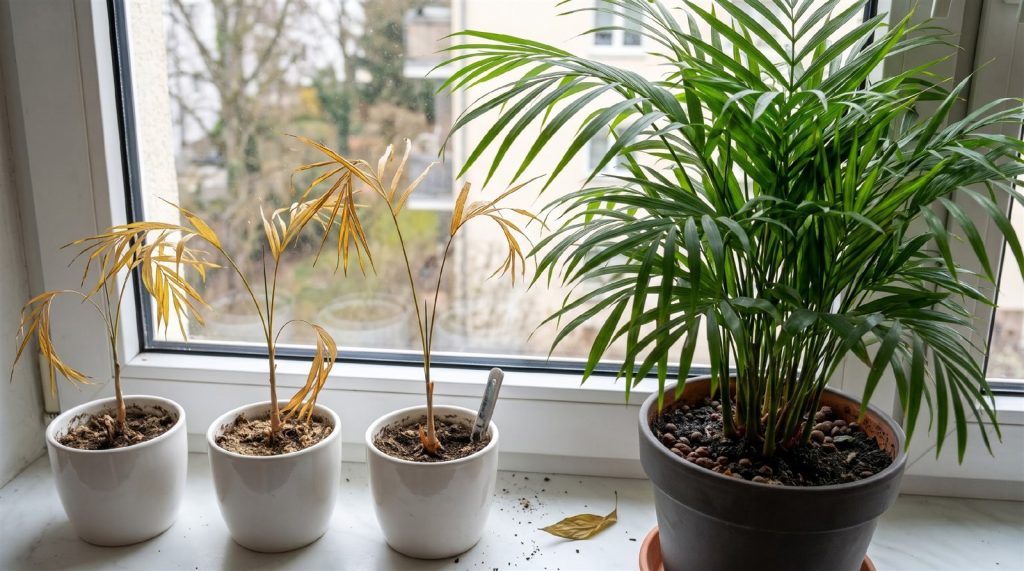
Splitting the clump into single stems. It looks efficient, but each piece has too little root to support itself. You end up with several thin, struggling plants instead of two healthy ones.
Planting divisions deeper to “stabilize” them. Palms tolerate deep planting very poorly. Stake a wobbly division if needed, but keep the soil line where it was.
Fertilizing to speed recovery. Damaged roots cannot use the extra nutrients, and the salts add stress. Wait until new growth appears.
Dividing in fall or winter. Cool temperatures and short days slow root growth just when the division needs it most.
Frequently Asked Questions
Can you propagate an areca palm in water?
Not from a cutting. A cut cane has no way to grow roots. The only way to get a new plant from an existing areca is to divide the clump into sections that already have roots, and those belong in soil.
How many stems should each areca division have?
As many as possible. Popular guides suggest at least 3 to 5 stems, but larger divisions recover faster; splitting a clump in half is the safest option.
When is the best time to divide an areca palm?
Spring or early summer, at the start of the growing season. Avoid fall and winter, when root growth slows.
How long does a divided areca take to recover?
Expect a slow few months. UF/IFAS allows 4 to 6 months for divided palms to establish; a new spear from the center is the sign it has.
Is it normal for an areca to turn brown after dividing?
Some brown tips and a few dying older fronds are normal while roots regrow. Browning of the newest spear, or spreading across the whole plant, points to rot or a division that was too small.
How long does areca seed take to germinate?
Usually 3 to 6 weeks at 85–95°F with fresh seed. Old or chilled seed may take longer or not sprout at all.
Should I separate a store-bought areca into individual plants?
Not into single stems. The pot holds several seedlings planted together, but separating them one by one leaves each with too few roots. Divide into two or three large groups instead.