Podocarpus macrophyllus is sold under a confusing pile of common names — Buddhist pine, Japanese yew pine, fern pine, southern yew — and is frequently overlooked in favor of flashier tropical plants.

This is a mistake. Podocarpus is one of the best long-term indoor trees available: extremely slow-growing (which keeps it manageable), adaptable to a wide range of indoor conditions, shapeable into almost any form, and capable of lasting decades. This guide covers what it needs, how to shape it, and a toxicity warning that most sellers do not mention.
| Podocarpus Quick Care Summary | |
|---|---|
| Light | Bright indirect to some direct morning sun |
| Water | Every 7–10 days; let top inch dry |
| Humidity | 40–60% |
| Temperature | 55–75°F (13–24°C); tolerates cooler winters |
| Fertilizer | Monthly spring–summer, balanced slow-release |
Why Podocarpus Makes an Unusual but Excellent Indoor Tree

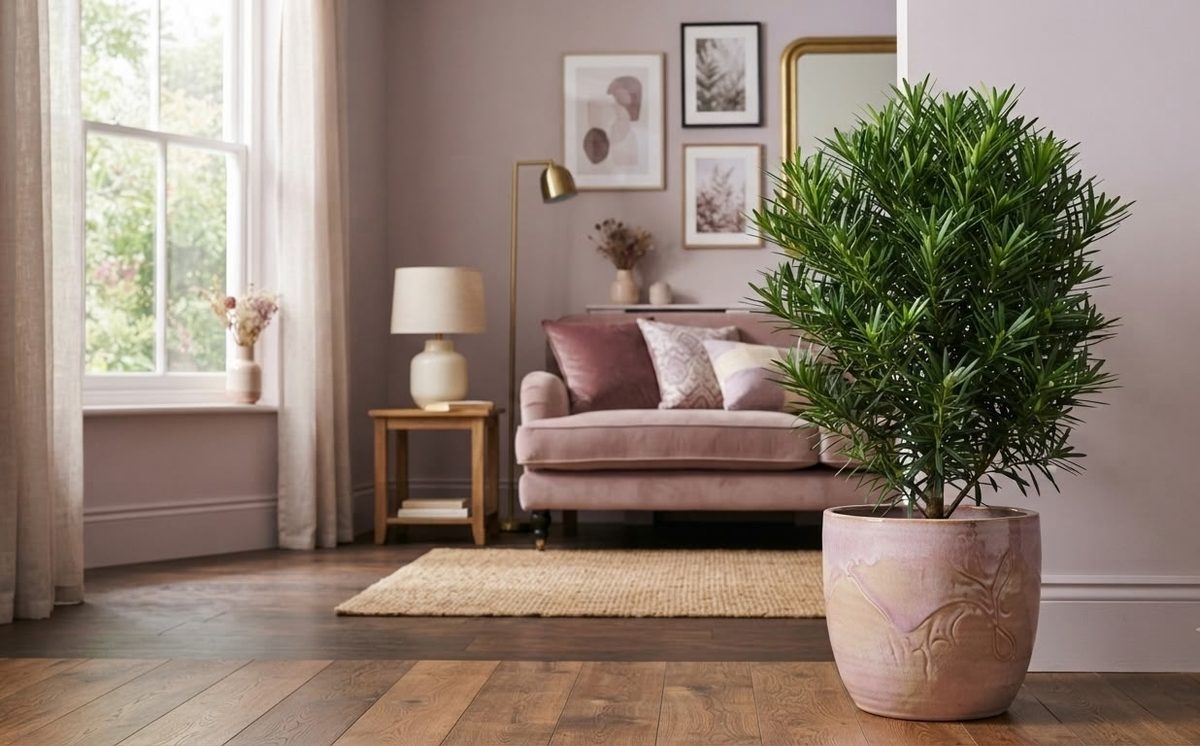
Podocarpus macrophyllus has a needle-like (but soft) foliage and an upright, elegant growth habit that reads as more architectural than most tropical houseplants. It can be trained as a formal upright tree, shaped into a tight topiary, or grown as a bonsai. Because it grows so slowly — typically less than 6 inches per year indoors — it stays at a manageable size for years without constant intervention.
Indoors, it typically reaches 3-6 feet given adequate light and several years. It is hardy for a houseplant: it tolerates drier air than most tropical plants, is not prone to dramatic leaf drop, and survives occasional neglect far better than ficus or other indoor trees.
Is Podocarpus Toxic to Cats and Dogs?
Yes. The ASPCA lists Podocarpus macrophyllus as toxic to cats, dogs, and horses, with the specific toxic principle listed as unknown and clinical signs of vomiting and diarrhea (more severe symptoms reported in horses). The ASPCA listing does not break down which plant part is responsible.

Podocarpus fruit is unusual: what looks like a berry is actually a fleshy, swollen stalk (the aril) with a hard seed attached. NC State Extension notes that in humans, the fleshy aril itself is edible — it’s the hard seed that carries the toxic risk. The ASPCA’s pet listing does not make this same distinction, so treat the whole fruit as off-limits for cats and dogs regardless.
This is important because Podocarpus is widely planted outdoors in warm climates and often sold without any toxicity warning. If you have cats or dogs with access to the plant, keep the berries swept up if the plant produces them, and keep pets from chewing the foliage. Contact your vet if ingestion is confirmed.
What Light Does Podocarpus Need Indoors?
Bright indirect light to full direct sun. Podocarpus is among the more light-tolerant indoor trees — it can grow reasonably well in a bright room without direct sun, but grows faster and maintains denser, more attractive foliage with direct sun for several hours daily. A south or west-facing window is ideal. In low light (below 200 foot-candles), growth nearly stops and the plant becomes sparse and leggy.
Unlike many tropical houseplants, Podocarpus adapts well to outdoor conditions if moved outside for summer. It can handle full outdoor sun without leaf burn if the transition is gradual (move to shade first, then increase sun exposure over 2 weeks).
How Often Should You Water Indoor Podocarpus?
Water when the top 1-2 inches of soil feel dry — roughly every 7-10 days in the growing season. Podocarpus is moderately drought tolerant; an occasional missed watering will not harm an established plant. What it does not tolerate is consistently wet roots: overwatering causes yellowing foliage and root rot faster than underwatering causes visible damage. Use a well-draining pot and never allow it to sit in standing water.
In winter, reduce watering to every 2-3 weeks. The plant’s growth slows substantially in low winter light, and the reduced water use means soil stays wet much longer than in summer.
What Soil Does Podocarpus Need?
Well-draining potting mix — a standard potting soil with 20-25% perlite added provides adequate drainage. Podocarpus prefers slightly acidic soil (pH 5.5-6.5). Avoid lime-amended mixes designed for vegetables or herbs, which raise soil pH above the ideal range and cause interveinal yellowing (iron deficiency) over time.
Does Podocarpus Need High Humidity?
No — this is one of its advantages over most indoor trees. Podocarpus tolerates standard household humidity (40-50%) without the brown leaf tips and constant misting requirements of ficus, ficuses, or calatheas. If the air is very dry (below 30% in winter with heating running), occasional misting helps, but it is not necessary in normal household conditions.
What Temperature Does Podocarpus Prefer?
50-80°F (10-27°C). Podocarpus macrophyllus is hardier than most houseplants — it can tolerate temperatures down to about 25°F (-4°C) for brief periods outdoors, and handles cool indoor temperatures (down to 50°F/10°C) without damage. It does not need the consistently warm conditions required by tropical plants, making it suitable for cooler rooms and unheated sunrooms in mild climates.
How Often Should You Fertilize Indoor Podocarpus?
Once monthly during spring and summer with a balanced, acidic liquid fertilizer (formulated for acid-loving plants). Because the plant is a slow grower, it does not need heavy feeding — over-fertilizing produces soft, weak new growth and salt buildup in the soil without meaningfully increasing growth rate. Do not fertilize in winter.
How to Shape and Prune Podocarpus Indoors

Podocarpus tolerates pruning extremely well — this is one of its best qualities for indoor use. It can be shaped into: Its tolerance for pruning is one reason podocarpus, like portulacaria afra, is a popular bonsai subject.
- Formal upright tree: Prune lower branches to expose the trunk, maintain a rounded or pyramidal canopy. The classic nursery form.
- Topiary: Shear to spheres, columns, or layered cloud forms. The dense foliage holds shape well between pruning sessions.
- Bonsai: Can be trained as juniper-style bonsai using wire and regular pinching. The slow growth rate makes Podocarpus ideal for bonsai — it holds its shape for years between refinement sessions.
Prune in spring before new growth begins, and again lightly in summer if needed to maintain shape. Remove interior branches that cross or rub. Do not remove more than one-third of foliage in a single session.
What Pests Attack Podocarpus Indoors?

Scale Insects
By far the most common pest problem on indoor Podocarpus. Brown, dome-shaped scale insects attach to stems and branches; their waxy coating makes them resistant to sprays. Scrape off manually with a soft brush or toothpick, then apply neem oil or horticultural oil weekly for 3-4 rounds. Systemic insecticide applied to the soil handles persistent infestations. Inspect regularly — scale spreads slowly but is much easier to control when caught early.
Sooty Mold

Not a pest itself — sooty mold is a fungus that grows on the honeydew excreted by scale insects. Black, powdery coating on leaves indicates scale infestation above. Treat the scale; the mold resolves once the honeydew source is removed.
Spider Mites

Less common than scale, but possible in very dry conditions. Fine stippling on foliage, sometimes with webbing. Raise humidity, rinse the plant, and treat with insecticidal soap or neem oil weekly.
How to Propagate Podocarpus

Podocarpus is a conifer, so it roots more slowly than typical broadleaf houseplants — patience matters more than technique here. Take semi-hardwood cuttings in spring to early summer, when the plant is actively producing new growth. A study on Podocarpus propagation found apical cuttings around 4 inches long, with about 4 leaves retained, rooted best.

Rooting hormone isn’t strictly required, but it measurably improves success — the same study found a quick 10-second dip in IBA rooting hormone far outperformed a slow soak, which caused the cut end to oxidize and rot instead. Use a fast-draining mix, keep it warm and consistently moist (not soggy), and expect this to take far longer than a typical houseplant cutting: the study measured root development at 100 days (roughly 3 months), not the 4-6 weeks common for softer-stemmed plants. New top growth or gentle resistance when tugged are the signs it has rooted.
Common Mistakes With Indoor Podocarpus
Overwatering. The most damaging mistake. Podocarpus foliage yellows slowly in response to root rot, and by the time yellowing is widespread, significant root damage has occurred. Check soil moisture before every watering — if the top inch is still moist, wait.
Insufficient light. A common error because Podocarpus looks healthy in medium light for months before showing problems. In inadequate light, the new growth becomes pale, stretched, and widely spaced. Move to a brighter spot before growth deteriorates significantly.
Assuming it’s pet-safe because it’s not tropical. The “Buddhist pine” and “fern pine” names give the impression of a benign ornamental. The ASPCA toxicity listing is real — keep out of reach of pets.
Frequently Asked Questions
How fast does Podocarpus grow indoors?
Very slowly — typically 3-6 inches per year in good conditions, less in low light. This is an advantage for managing size indoors, but means a small plant stays small for years. Buy at a size you are happy with.
Can I grow Podocarpus as a bonsai indoors?
Yes — Podocarpus macrophyllus is an excellent bonsai subject. It tolerates pruning and wiring well, has naturally small leaves relative to its growth habit, and develops attractive bark texture with age. Its slow growth rate means refinement work holds for long periods between sessions.
Is Podocarpus the same as a yew tree?
No. Podocarpus (family Podocarpaceae) and Taxus yews (family Taxaceae) are different plant families, despite sharing the “yew” name in Podocarpus’s common names. Both produce fleshy arils around their seeds and are both toxic to pets, but they are not closely related. Taxus yews are significantly more toxic than Podocarpus.
Why are my Podocarpus leaves turning yellow?
Yellow leaves are usually caused by overwatering (check soil moisture), soil pH that is too high (over 7.0, causing iron deficiency — interveinal chlorosis), or insufficient light. Occasional lower leaf drop is normal aging. If yellowing is affecting new growth and the top of the plant, low light or pH imbalance is the likely cause.