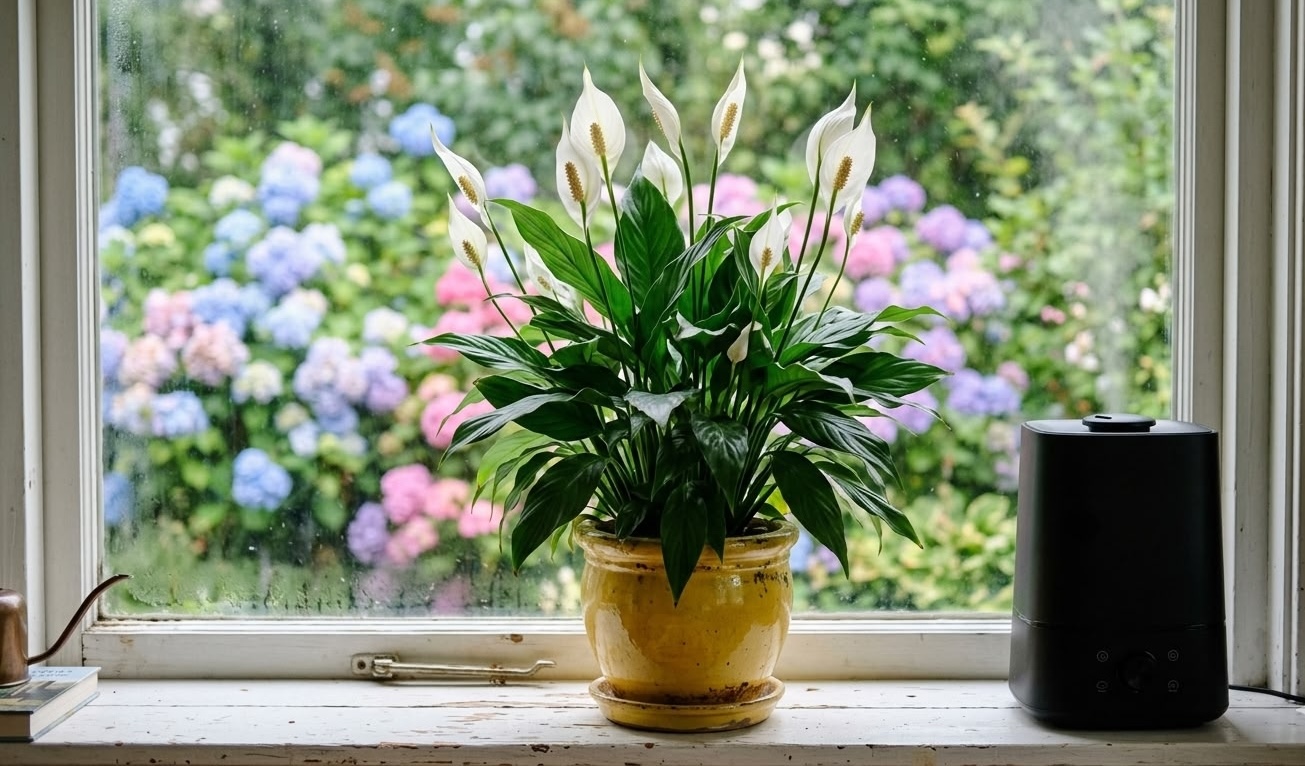
Peace lilies need 50–65% relative humidity — higher than the average home, which runs at 30–50% and drops to 20–30% in winter when heating is on. A humidifier is the most reliable way to maintain this, but the type you choose, how close you place it, what water you use, and when you run it all affect whether it actually helps the plant or creates new problems. This guide covers everything specifically for peace lily — not just generic humidifier advice.
Do Peace Lilies Need a Humidifier?
Not strictly — peace lilies survive at normal household humidity. But survive and thrive are different things. At 30–40% humidity (typical of most heated or air-conditioned homes), peace lilies develop brown leaf tips, lose their glossy appearance, and grow more slowly. At 50–65%, the foliage stays cleaner, growth is more vigorous, and the plant blooms more reliably.
A humidifier isn’t mandatory, but it’s the most effective way to reach and maintain the humidity a peace lily actually needs. The alternatives — misting, pebble trays, bathroom placement — help but don’t reliably maintain 50%+ across a whole room.
I have a hygrometer in the room with my peace lilies. In January, with the heating on, it reads 28% even with the windows closed. Without intervention, that’s the environment my plants are in for four to five months of the year. That reading alone convinced me a humidifier was worth it.
How Much Humidity Does a Peace Lily Need?
The target range is 50–65% relative humidity. Most sources give a broad range (40–80%), but the practical threshold is:
- Below 40%: Brown leaf tips appear within weeks. Leaves lose gloss. Growth slows.
- 40–50%: Marginal. The plant survives but isn’t thriving. Brown tips slow but don’t stop.
- 50–65%: Optimal range. Foliage stays clean, growth is healthy, blooming is more reliable.
- Above 70%: No additional benefit. At sustained very high humidity with poor airflow, fungal issues become a risk.
The 50% floor is where the practical difference begins. A hygrometer costs $10–15 and takes the guesswork out — you can see exactly what your room runs at before and after adding a humidifier.
What Type of Humidifier Is Best for Peace Lilies?
Three types are commonly recommended for houseplants. They work differently and each has tradeoffs specific to peace lily use.
Ultrasonic Cool Mist Humidifiers
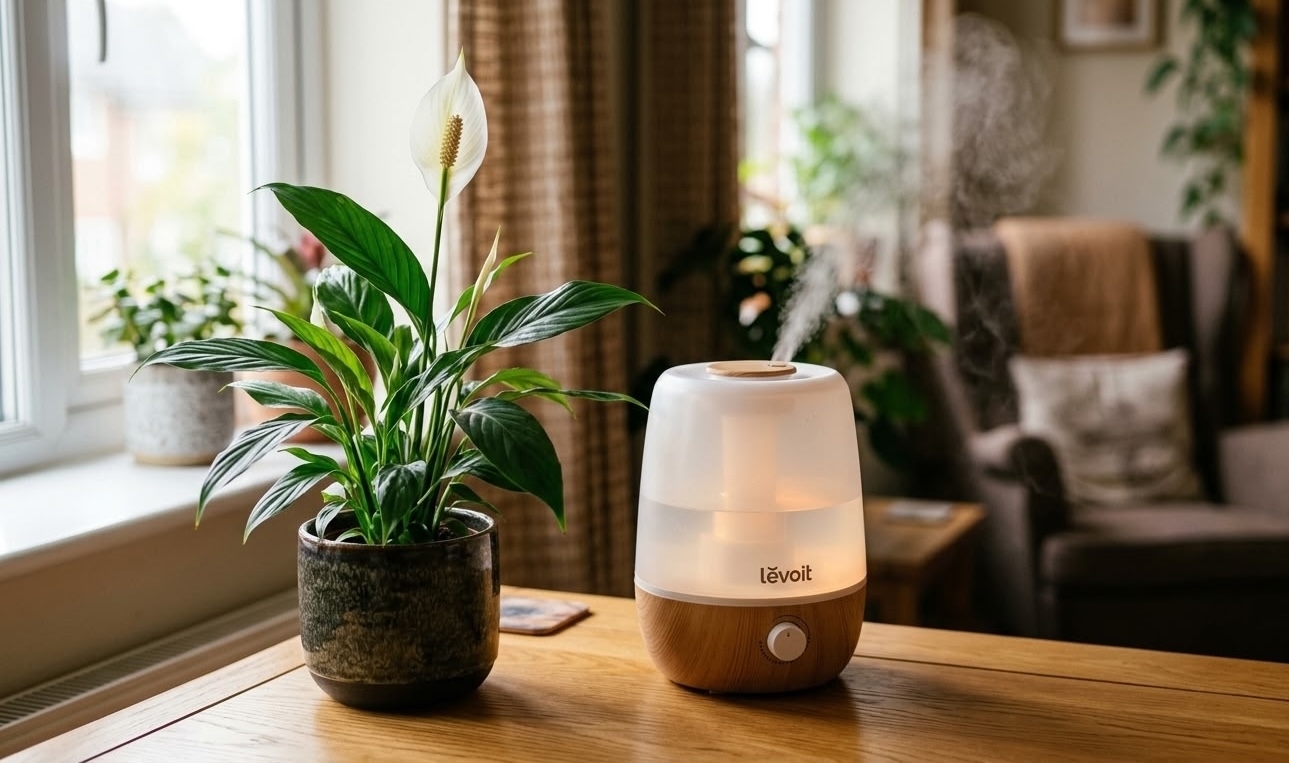
The most popular choice. Ultrasonic units use high-frequency vibration to aerosolize water into a fine mist without heating it. They’re quiet, energy-efficient, and produce visible output that feels like it’s “doing something.”
Peace lily-specific issue: Ultrasonic humidifiers aerosolize everything in the water — including dissolved minerals, fluoride, and chlorine from tap water. This produces a fine white mineral dust that settles on leaves. Over time this buildup can clog leaf stomata and cause the same brown-tip symptom as fluoride in soil water. Use distilled water in an ultrasonic humidifier. This is the single most important setup decision for peace lily owners — see the next section.
Evaporative Humidifiers
Evaporative units pull air through a wet wick or filter, allowing water to evaporate naturally without producing visible mist. The key advantage: they self-regulate. As the room reaches a higher humidity level, evaporation slows naturally — so they won’t over-humidify. Quieter at low speeds than ultrasonic units and don’t produce white mineral dust because evaporation leaves minerals behind in the filter.
Tradeoff: evaporative units are slightly larger, require regular filter replacement, and the output isn’t as immediately visible. For peace lilies, they’re arguably the better long-term choice if you’re using tap water.
Warm Mist Humidifiers
Warm mist units boil water before releasing steam. This sterilizes the output and leaves minerals behind, so white dust isn’t an issue. However, the warm output raises the local temperature slightly — not ideal for a peace lily directly next to it. Better suited for a room you’re trying to warm and humidify simultaneously. Generally less recommended for plant-specific use than cool mist options.
The Distilled Water Problem with Ultrasonic Humidifiers
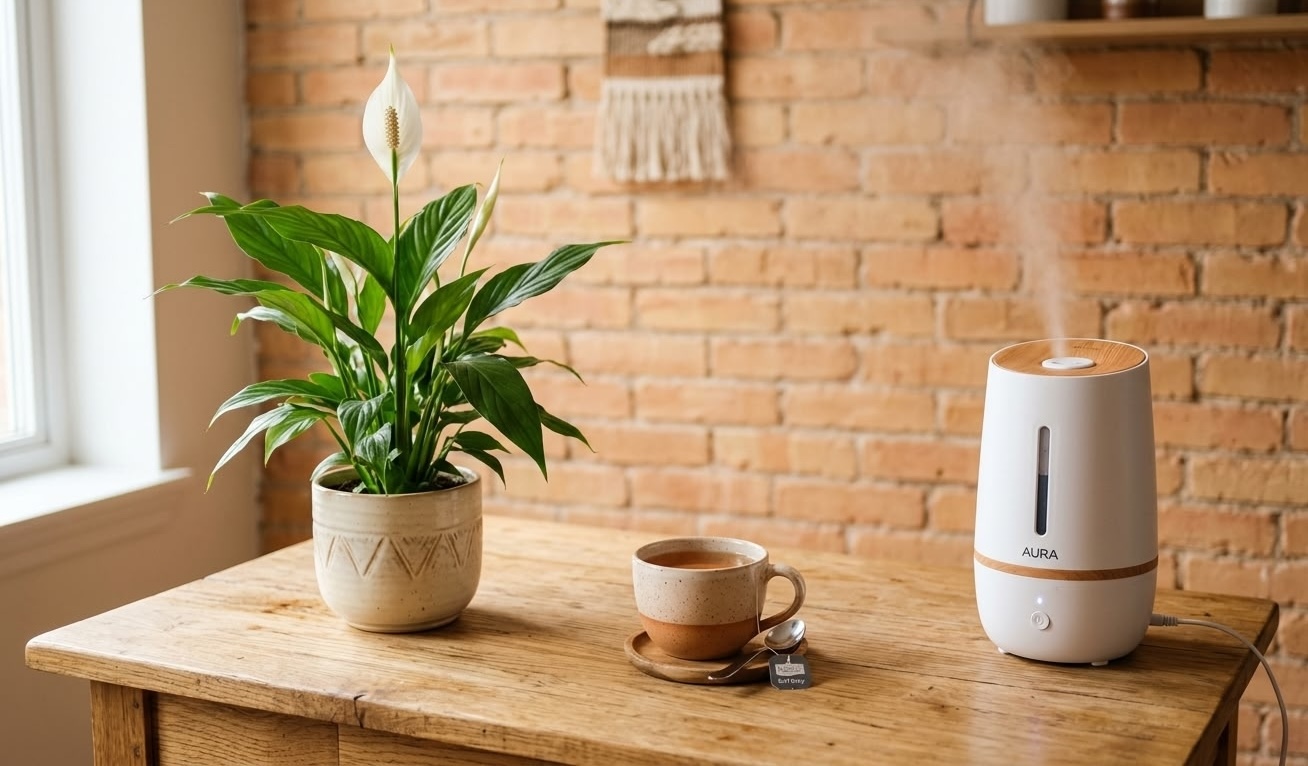
This is the most overlooked practical issue in peace lily humidity advice. Ultrasonic humidifiers work by vibrating water at high frequency until it breaks into fine droplets. Those droplets carry everything dissolved in the water — including fluoride, chlorine, calcium, magnesium, and any other minerals in your tap water.
The result: a fine white powder that settles on every surface near the humidifier, including your peace lily’s leaves. Over time this mineral layer:
- Blocks leaf stomata, reducing the plant’s ability to breathe and transpire
- Deposits fluoride directly on leaf tissue — causing the same brown-tip symptom as fluoride in watering water, but harder to diagnose
- Creates a dull, dusty appearance on otherwise healthy foliage
Solution: Use distilled water or reverse osmosis water in your ultrasonic humidifier. The mineral content is near zero, so the output is just water droplets — no residue. When I switched from tap to distilled water in my ultrasonic unit, the white dust on my peace lily leaves stopped completely within a week.
If distilled water isn’t practical, an evaporative humidifier avoids this problem entirely — minerals stay in the wick rather than becoming airborne.
How Far Should a Humidifier Be from a Peace Lily?
Placement matters more than most guides acknowledge. Both too close and too far create problems.
Too close (under 12 inches): The direct mist output can wet the plant’s leaves, creating conditions for fungal spotting and bacterial issues. Condensation on leaf surfaces is a different problem than high air humidity — it’s actively harmful. I learned this the hard way when I placed an ultrasonic unit 6 inches from my peace lily. Within two weeks, one leaf developed early fungal spotting. Moving the unit further back resolved it.
Too far (over 4–5 feet): The humidified air disperses before it consistently benefits the plant. Humidity from a small unit dissipates quickly in a large room.
Optimal placement:
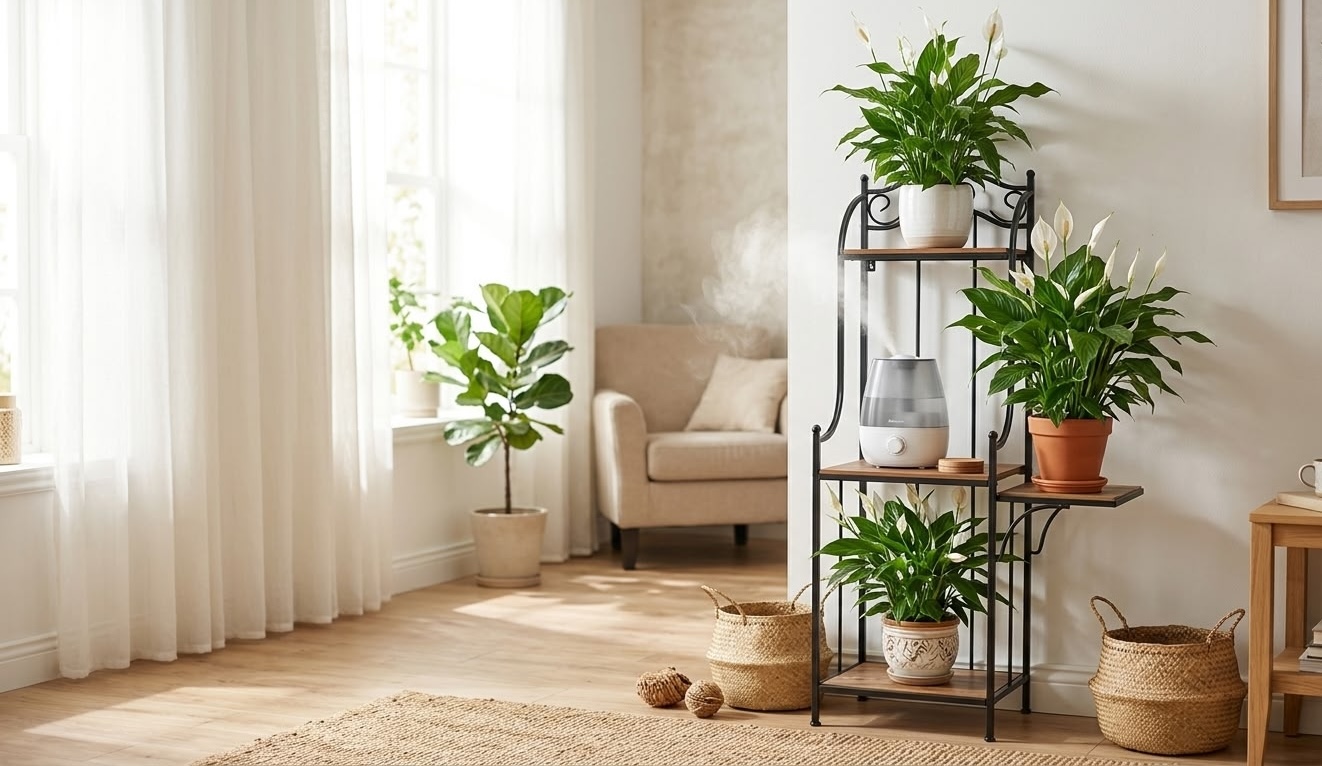
- Distance: 18–36 inches (1.5–3 feet) from the plant
- Height: Roughly the same level as the plant, or slightly above — mist falls, so placing the unit higher than the plant distributes coverage better
- Direction: Aim the mist output toward open air, not directly at the plant foliage
- Airflow: Keep a few feet clear on all sides — stagnant humid air pools, which encourages mold and pests
How Long to Run the Humidifier — and When
The answer depends on your room size, humidifier output, and target humidity — but for most home setups, 4–6 hours daily is sufficient to maintain 50–65% in a normal bedroom or living room.
Best timing: morning hours. Running the humidifier from early morning through midday means:
- Leaves stay drier at night — reducing fungal disease risk (plants are less active, humidity on leaves at night is more problematic than during the day)
- Plants are actively transpiring and growing during daylight hours — humidity is most beneficial when the plant is processing it
- The humidifier runs while you’re awake — you can notice and respond to condensation or other issues
Running the humidifier overnight seemed more efficient, but I noticed condensation on my windowsill and early mold in a corner within a few weeks. Switching to a morning-only schedule solved both problems with no measurable difference in plant health.
Use a smart plug or a humidifier with a built-in timer to automate this schedule. A humidifier with a built-in hygrostat is even better — it runs only until the target humidity is reached, then stops automatically.
Seasonal Adjustment: Winter Heating vs. Summer AC
Peace lily humidity needs change seasonally — not because the plant changes, but because the indoor environment does.
Winter (heating season): Central heating dries indoor air significantly. A heated room that was at 50% humidity in autumn can drop to 20–30% in January. This is when peace lilies suffer most. Run the humidifier daily, extend the schedule to 5–8 hours if your room is large or your humidifier is small, and monitor with a hygrometer.
Summer (AC season): Air conditioning also removes moisture from the air. In a heavily air-conditioned home, summer can be nearly as dry as winter. If your home runs AC aggressively, the humidifier may need to run in summer as well — not just winter.
Spring and fall: Natural outdoor humidity tends to be higher, and neither heating nor heavy AC is typically running. These are the shoulder seasons where many plants need the least support. You may be able to reduce or eliminate humidifier use.
Signs Your Peace Lily Needs More Humidity
The plant shows clear signals when ambient humidity is too low:
- Brown leaf tips: The earliest and most common signal. Often misdiagnosed as underwatering or fluoride — but if it persists after switching to filtered water and adjusting watering, low humidity is likely the cause.
- Curling or drooping leaves despite adequate soil moisture: Low humidity increases transpiration demand. If the plant is losing moisture through its leaves faster than it can absorb through its roots, it wilts even in moist soil.
- Dull, matte leaf surface: Healthy peace lilies have a glossy sheen. Low humidity causes a dulled appearance as the leaf surface dehydrates.
- Yellowing that doesn’t respond to watering changes: Persistent mild humidity stress can manifest as overall yellowing distinct from the typical overwatering pattern.
- Slow growth despite adequate light and fertilizer: High humidity is required for photosynthesis to run efficiently. Chronically low humidity stunts growth even when other conditions are right.
My peace lily had brown tips for months before I diagnosed it as a humidity issue. I tried everything — filtered water, adjusting the watering schedule, changing fertilizer. Nothing worked. A hygrometer showed my apartment was running at 35% year-round. Two weeks after adding a humidifier, the brown tips on new growth stopped. Old damaged leaves stayed brown — those you trim — but new growth came in clean.
Humidifier vs. Misting vs. Pebble Tray: Which Actually Works?
All three raise humidity — but by very different amounts, for very different durations.
| Method | Humidity increase | Duration | Risk | Verdict |
|---|---|---|---|---|
| Humidifier (running) | 15–30%+ above baseline | Continuous while running | Condensation if too close | Most effective ✅ |
| Misting (fine spray) | 5–10% for 15–30 minutes | Dissipates quickly | Fungal spotting if overdone | Temporary relief only |
| Pebble tray with water | 5–10% locally | Until water evaporates | Root rot if pot sits in water | Mild improvement |
| Bathroom placement | Significant during shower/bath | Only during use + 1–2h after | Too dark for most peace lily spots | Good if light allows |
| Grouping plants together | 5–10% locally from transpiration | Continuous while plants are healthy | Pest spread between plants | Useful supplement |
Misting is the most commonly recommended alternative, but it’s the least effective at actually raising ambient humidity. It wets the leaf surface briefly — which can help in a heat wave — but the effect dissipates within 30 minutes. In high humidity climates it can encourage fungal leaf spots. It’s not a substitute for a humidifier if your home runs consistently below 50%.
Other Ways to Increase Humidity Without a Humidifier
If a humidifier isn’t practical, these methods help:
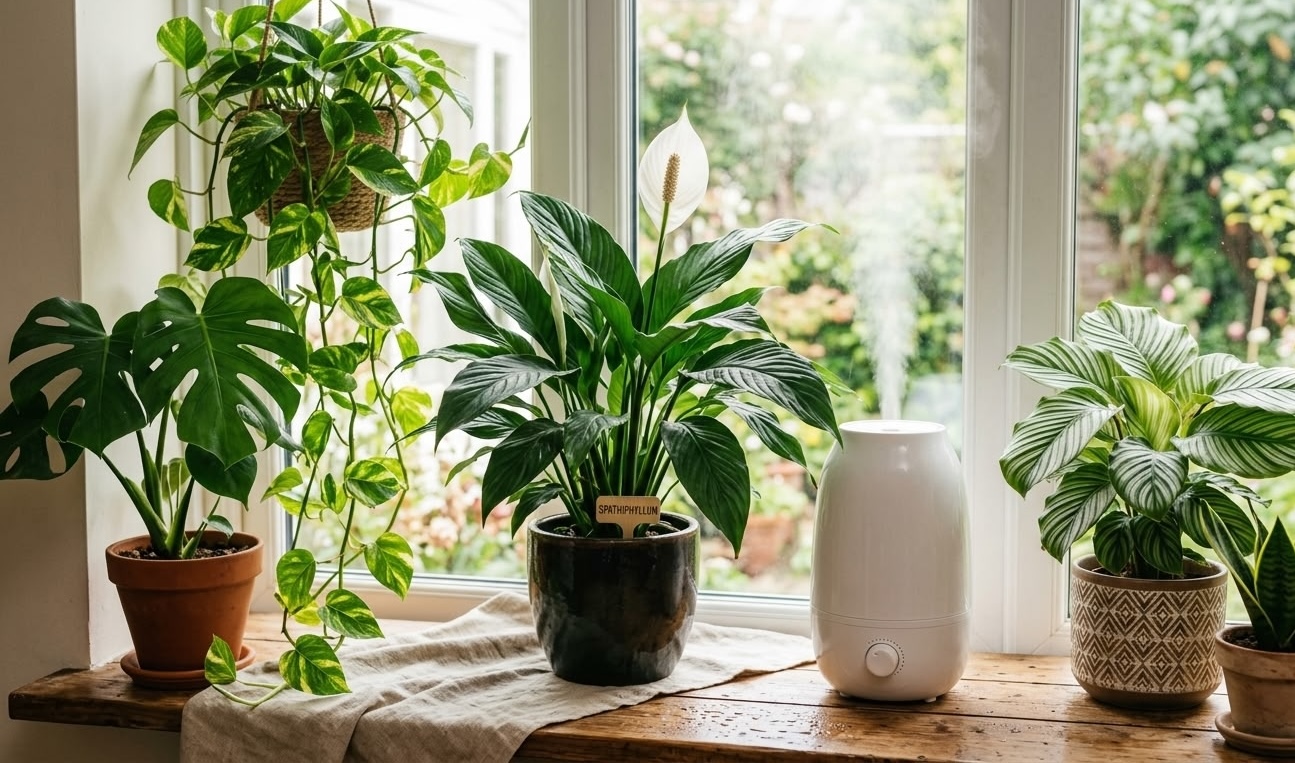
- Group with other humidity-loving plants. Plants transpire moisture into the air around them. A cluster of tropical plants — peace lily, calathea, pothos — creates a microclimate with measurably higher local humidity. I grouped my peace lily with a calathea and a bird of paradise. Even without a humidifier, the combined transpiration slowed new brown tips noticeably. Not as good as a humidifier, but measurably better.
- Pebble tray with water. Place the pot on a tray of pebbles with water below the pot surface (not touching the drainage holes). Evaporation raises local humidity by 5–10%. Simple and passive.
- Bathroom or kitchen placement. Naturally higher humidity from showering and cooking. Works well if the light levels are adequate — many bathrooms are too dark for regular peace lily growth.
- Open water containers nearby. A bowl of water placed near the plant evaporates slowly and adds modest humidity. Effective in small, enclosed spaces.
For full care guidance including watering, soil, and fertilizing, see our complete peace lily care guide. For pet safety information, see our guide on whether peace lilies are toxic to cats and dogs.
Frequently Asked Questions
Do peace lilies need a humidifier?
Not strictly — peace lilies survive at normal household humidity. But most homes run at 30–50%, and peace lilies thrive at 50–65%. Without intervention, plants develop brown tips, lose their gloss, and grow slowly. A humidifier is the most reliable way to bridge the gap, though a pebble tray, plant grouping, or bathroom placement can help.
What humidity level does a peace lily need?
50–65% is the optimal range. Below 40%, brown leaf tips appear consistently. At 40–50% the plant survives but isn’t thriving. Above 70% offers no additional benefit and increases fungal risk with poor airflow. A hygrometer lets you measure your actual room humidity and confirm whether it’s in the right range.
How far should a humidifier be from a peace lily?
18–36 inches (1.5–3 feet) is the practical range. Too close (under 12 inches) causes wet leaves, which creates fungal and bacterial risk. Too far (over 4–5 feet) and the humidified air disperses before consistently benefiting the plant. Aim the mist output toward open air rather than directly at the foliage.
Is misting enough for peace lilies?
Not reliably. Misting raises local humidity by about 5–10% for 15–30 minutes, then dissipates. If your home runs consistently below 50% humidity, misting provides temporary relief but can’t maintain the 50–65% range a peace lily needs. A humidifier is significantly more effective for sustained humidity. In high-humidity climates, overdoing misting can encourage fungal leaf spots.
Should I use distilled water in my humidifier for a peace lily?
Yes, if using an ultrasonic humidifier. Ultrasonic units aerosolize everything dissolved in the water — including fluoride and minerals from tap water — creating a fine white dust that settles on leaves, clogs stomata, and causes brown tips. Distilled or reverse osmosis water eliminates this issue. Evaporative humidifiers leave minerals in their wick and don’t produce white dust, so tap water is acceptable with those.
Why are my peace lily tips turning brown despite proper watering?
Low humidity is the most likely cause when brown tips persist after switching to filtered water and adjusting watering. Check your room humidity with a hygrometer — if it reads below 45%, that’s your answer. Adding a humidifier and maintaining 50–65% typically stops new brown tips within one growing cycle. Already-damaged tips won’t recover; trim those cleanly and watch new growth.
What type of humidifier is best for peace lilies?
An evaporative humidifier is arguably the best long-term choice — it self-regulates, doesn’t produce white mineral dust, and works with tap water. Ultrasonic cool mist humidifiers are more popular and work well if you use distilled water. Warm mist humidifiers sterilize the output (no white dust) but the warm air isn’t ideal directly next to a peace lily.
How do I know if my peace lily needs more humidity?
The clearest signals are persistent brown leaf tips that don’t improve with better watering, curling or drooping leaves despite adequate soil moisture, and a dull or matte leaf surface rather than a glossy sheen. A hygrometer confirms it: if your room reads below 45%, the plant needs more humidity. These symptoms often respond within 4–6 weeks of adding a humidifier.