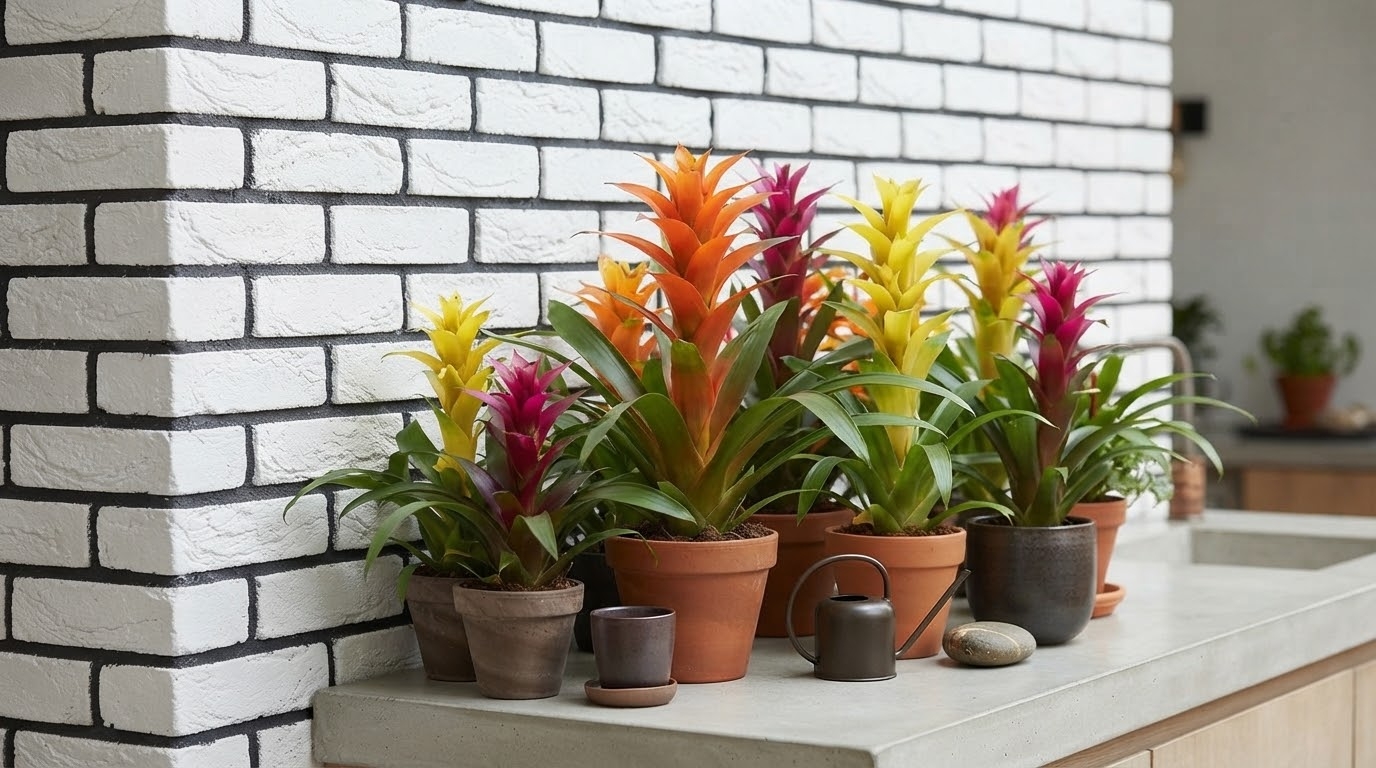
Guzmania is the bromeliad most people own without knowing it: the glossy green rosette with a torch of red, orange or yellow rising from the center, sold everywhere from garden centers to supermarket checkouts. It is also one of the easier bromeliads for indoor light levels, because it comes from shadier habitats than most of the family.
That shade tolerance is the reason Guzmania survives in homes where an Aechmea or Neoregelia would sulk. It also sets up the two problems owners actually run into: a plant that browns at the tips, and a plant that never flowers again after the bract fades.
| Guzmania at a Glance | |
|---|---|
| Light | Bright indirect; tolerates lower light than most bromeliads |
| Water | Keep cup filled in summer, drier in winter; let medium dry |
| Bloom duration | 2 to 4 months |
| Minimum night temp | 60°F (MoBot) |
| Fertilizer | Half-strength liquid in the tank during growth (NC State) |
| Pups | Separate at one-third to one-half the size of the mother |
| Toxicity | Non-toxic to cats, dogs and horses (ASPCA) |
What Makes Guzmania Different From Other Bromeliads?
Habitat. Missouri Botanical Garden’s bromeliad fact sheet describes the genus as “over 180 stem-less, evergreen, mainly epiphytic perennials” native to South Florida, Central America, the West Indies and northern and western South America, growing mainly in Andean rainforests up to 11,500 feet. UW–Madison Extension draws the practical conclusion: “These species come from shadier habitats than most other bromeliads, so they do well in lower light conditions.”
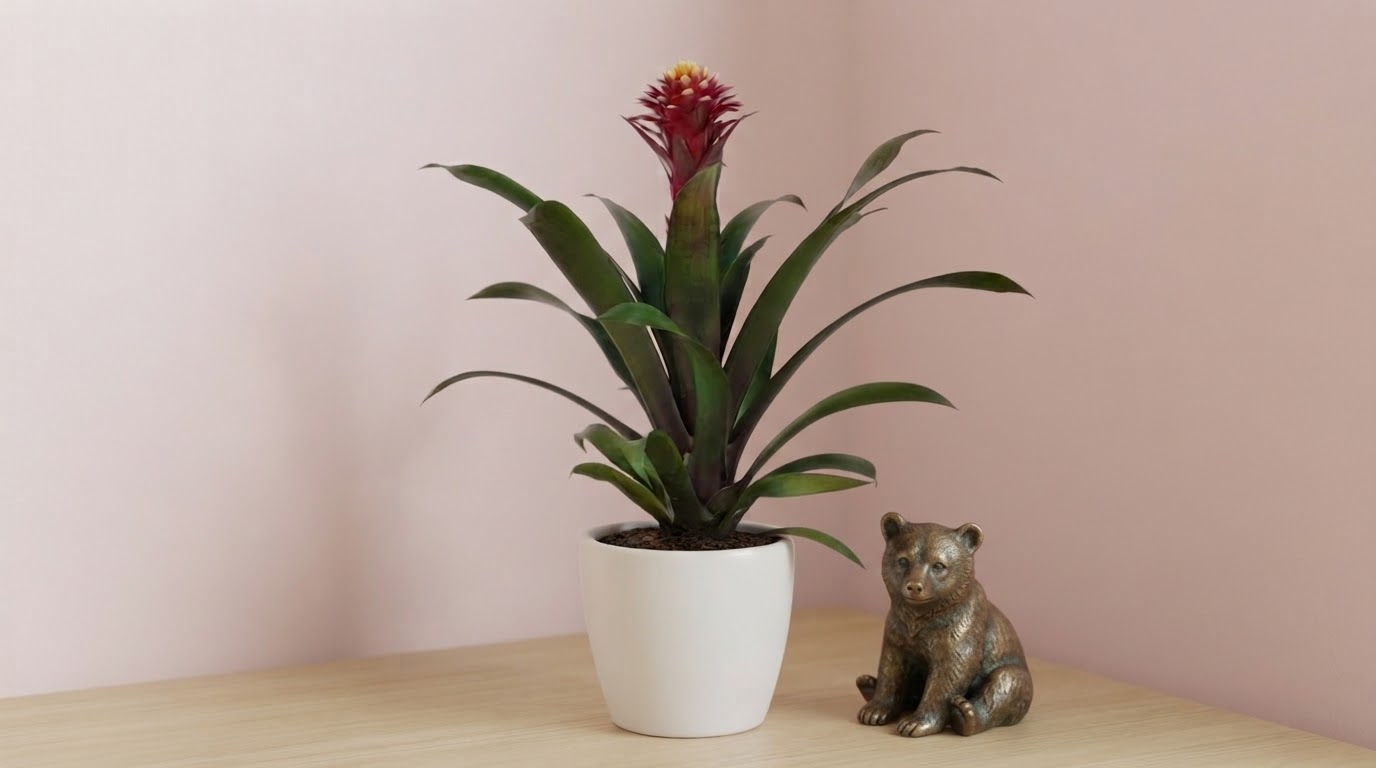
That single trait separates Guzmania care from the standard bromeliad routine in three ways:
- It tolerates less light. Where a Neoregelia needs strong light to hold its color, Guzmania performs in an east window or a few feet back from a brighter one.
- It responds to feeding. BSI’s culture brochure notes “a consensus that guzmanias and vrieseas require fertilization to obtain large colorful bloom spikes.” Neoregelia is the opposite case: BSI warns that excess fertilizer turns its colorful foliage green.
- It wants more humidity. BSI’s rule of thumb, “Soft leaf – soft light, hard leaf – hard light,” names Guzmania as a soft-leaved genus, and its culture brochure adds that soft-leaved plants “require more water and humidity than stiff leafed ones.”
Guzmania is also among the bromeliads with a confirmed ASPCA listing: Orange Star (Guzmania lingulata minor) and Mosaic Vase (Guzmania musaica) are both recorded as non-toxic to dogs, cats and horses. Its leaf margins are smooth, unlike the toothed edges on Aechmea, which makes it a sensible choice for a home with pets.
How Much Light Does Guzmania Need?
Bright indirect light: more than people assume from its shade-tolerant reputation, less than most of the family demands.
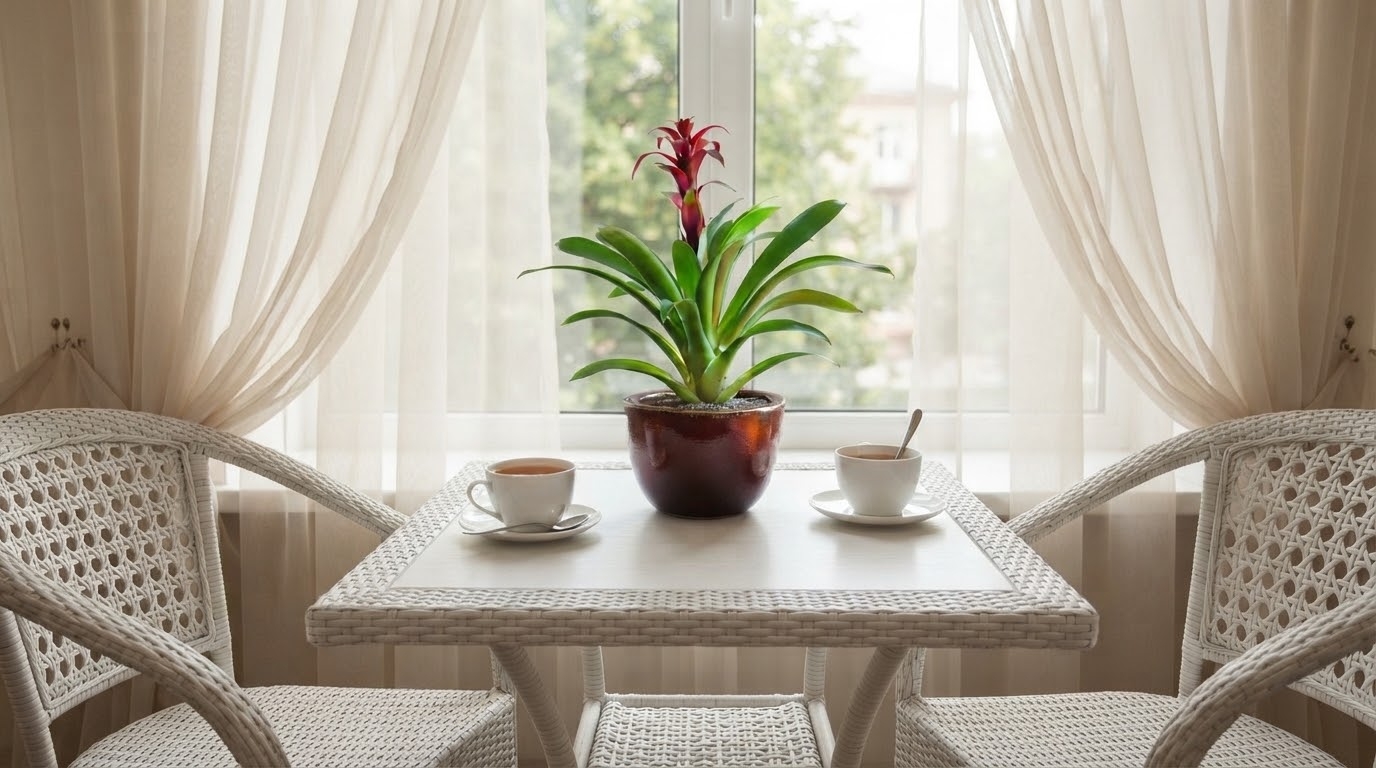
MoBot specifies “bright, but indirect light” for G. lingulata. NC State’s Guzmania entry says bromeliads need “full sun to shade, depending on the species,” which is unusually broad and reflects how variable the family is.
The benchmark worth working from comes from UW–Madison Extension, which applies to bromeliads generally: most species need 2,000 footcandles, with more compact growth and better leaf and flower color at 3,000–4,000. Guzmania sits at the lower end of that range rather than outside it. Shade-tolerant does not mean shade-loving: the University of Missouri IPM program is blunt that “there are no bromeliad species that perform well indoors under poor light conditions.”
Read the plant rather than the room. UF/IFAS gives the diagnostic: too little light produces leaves that are “long, thin, and greener in color”; too much makes them “shorter, thicker, and lighter in color.” A Guzmania stretching and darkening wants a brighter spot; one bleaching out wants to move back.
How Do You Water a Guzmania?
Cup and medium are separate operations, and the seasonal adjustment matters more for this genus than most guides admit.
The cup
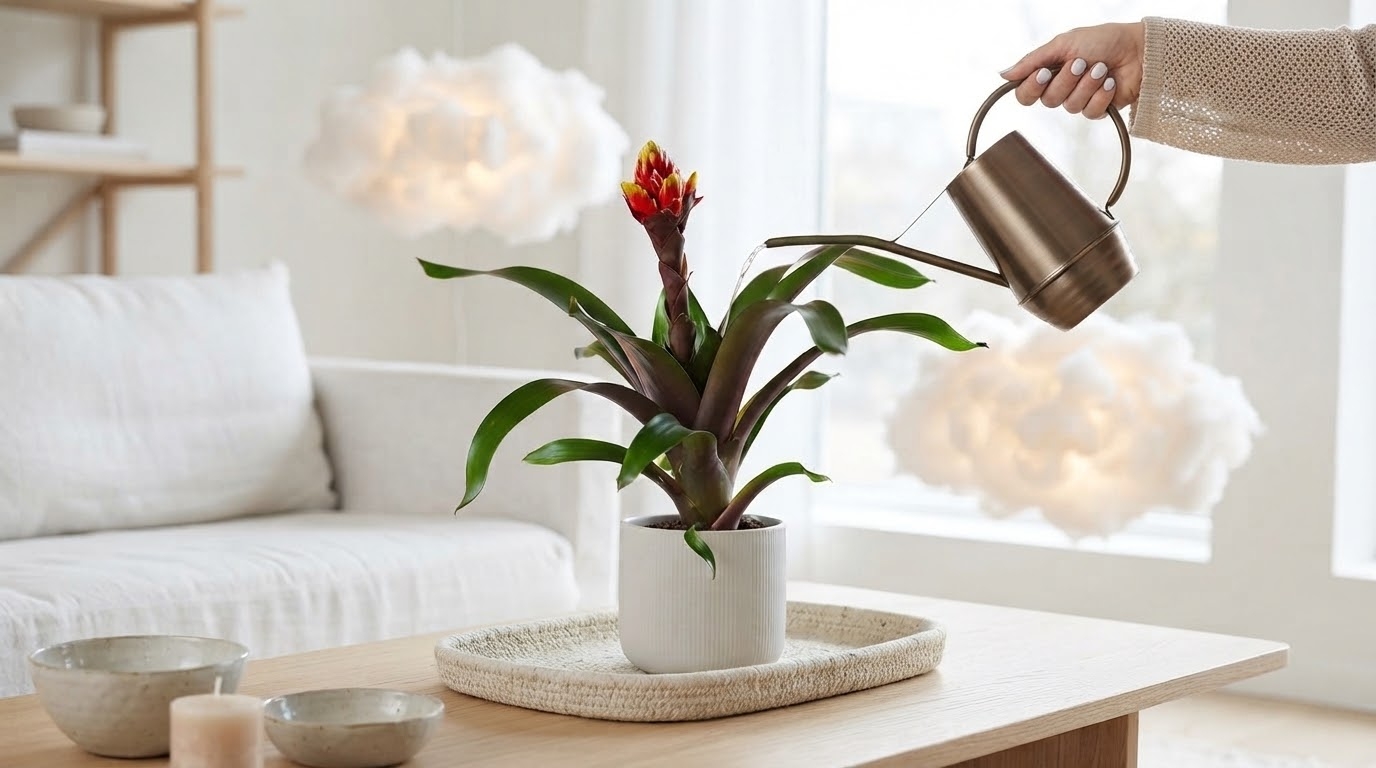
NC State: “the central tank should be kept full of water and should be replaced periodically, allowing overflow water to trickle down to the root zone.”
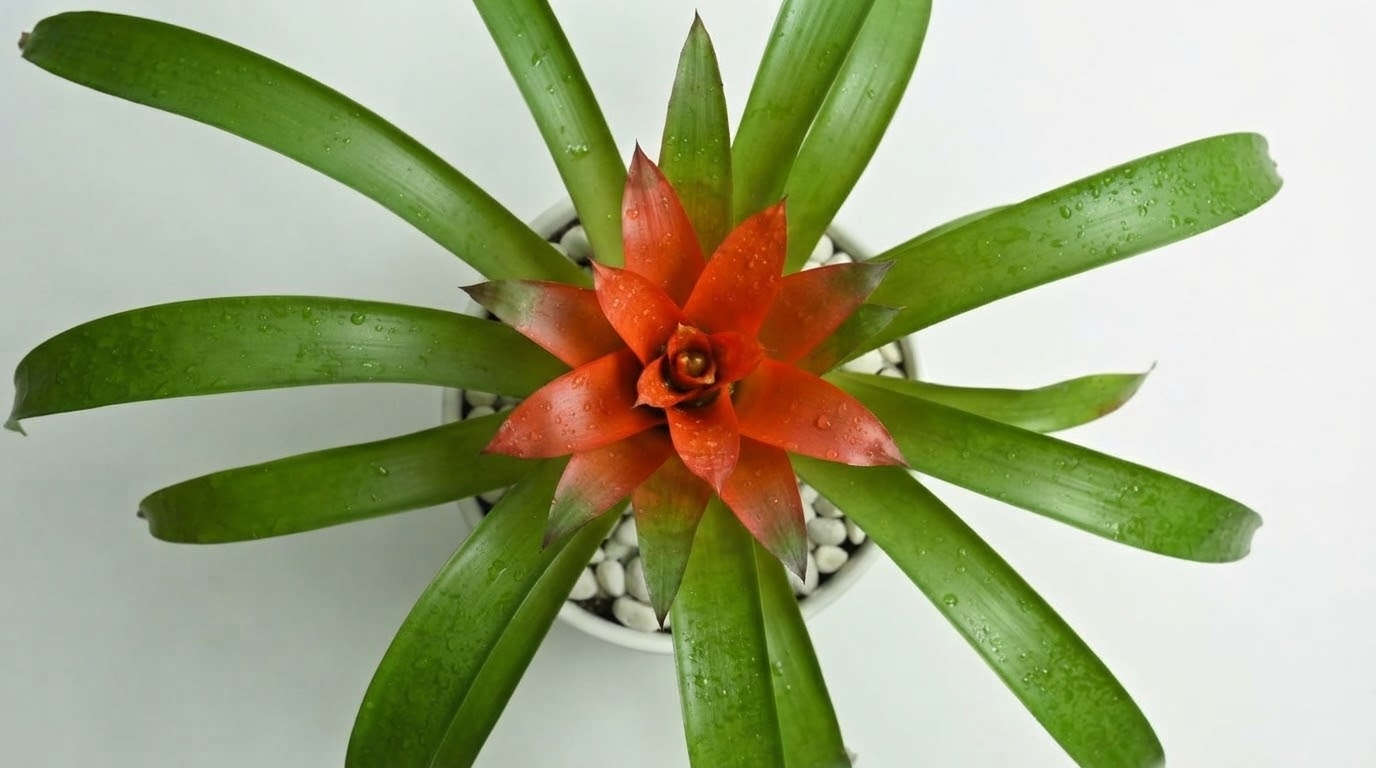
But MoBot’s entry for G. lingulata adds the qualification that almost every care tag omits: keep water in the cup during summer months, while the plant “should be kept drier during the cooler or winter months.” A cup kept brimming through a cold winter in a cool room is how Guzmania crown rot starts. In a room that drops toward 60°F at night, I would keep only a little water in the cup until spring.
The medium
Let it dry between waterings. MoBot warns that “Guzmania are prone to root rots if the soil is kept wet,” and BSI’s brochure gives the general bromeliad rule: roots should be “moist, but never soggy.”
Flushing
Tip the cup out and refill rather than topping it up. Clemson gives the method: “pouring fresh water into it, inverting, and filling again.” UW–Madison recommends weekly on hard tap water, tying it directly to preventing “the concentration of minerals that can cause leaf tip dieback.” My advice is to fill the cup with rainwater if your tap water is hard; Missouri Botanical Garden’s bromeliad fact sheet suggests rainwater for the cup.
Why Is My Guzmania Turning Brown?
Browning shows up in three distinct patterns, and they have different causes. Identifying which one you have is most of the diagnosis.
Are the Tips Brown and Crispy?
The most common complaint. Two supported explanations:
Mineral or salt buildup in the cup. Water evaporates from the tank and leaves dissolved solids behind. UW–Madison explicitly links unflushed cups on hard water to “leaf tip dieback.” If you have not tipped the cup out in a month, start there.
Low humidity. UW–Madison puts the bromeliad preference at 50–75% relative humidity. Heated homes in winter often run well below that range, and Guzmania, as a soft-leaved genus, feels dry air more than stiff-leaved genera do (BSI).
One cause you can discount: fluoride in tap water. That claim circulates widely on plant blogs, but we found no university extension source that links it to bromeliads. Fluoride sensitivity is documented in dracaena and spider plants, and the claim seems to have migrated across without evidence. Softened water is the genuine water problem: UW–Madison says to avoid “alkaline or softened water (which contains sodium).”
Is the Whole Bract Browning?
Usually not a problem at all. Guzmania bracts hold color for two to four months and then fade and brown as the display ends. That is the normal cycle, not a care failure.
Is the Base or Center Soft and Brown?
This one is serious. Soft brown tissue at the base of the rosette or in the center of the cup indicates rot, typically from water sitting in a cool plant or a medium that never dries. MoBot’s G. lingulata entry warns that Guzmania are prone to root rots in wet soil, so treat soft tissue as urgent.
Why Won’t My Guzmania Flower Again?
Because it cannot. This is the single biggest source of disappointment with this plant, and it is not a care problem.
Guzmania, like nearly every bromeliad, flowers once. BSI: “once the plant stops producing leaves and produces its flower, it will not start making leaves again.” The inflorescence emerges from the rosette’s central growing point and terminates it permanently.
Most Guzmanias in stores are sold in bloom, and growers often force them into flower for sale (University of Missouri IPM). That colored torch is what makes people buy it, which means the rosette you brought home had already used its one bloom before you owned it.
What happens next is the useful part. NC State: “offsets will appear at the base after the bloom fades and can be removed when they are about one-third as large as the flowering plant.” UF/IFAS notes the mother “will continue to produce pups until it dies,” a process taking one to two years.
So the answer to “why won’t it flower again” is: it will, but as a different plant. Keep the mother, let her make pups, and expect the next bloom in one to three years from an offset. If a mature pup still has not bloomed after that, I would try the ripe-apple method BSI describes before buying any bloom booster: enclose the plant in a plastic bag with a ripe apple and keep it out of direct sun for a week.
How Do You Propagate Guzmania Pups?
Wait longer than seems necessary, then separate cleanly.
NC State gives the threshold for this genus specifically: pups “can be removed when they are about one-third as large as the flowering plant.” BSI puts the general range at one-third to one-half. If the mother still looks healthy, I’d wait closer to one-half, because BSI notes that the longer pups stay attached, “the quicker they will reach maturity.”
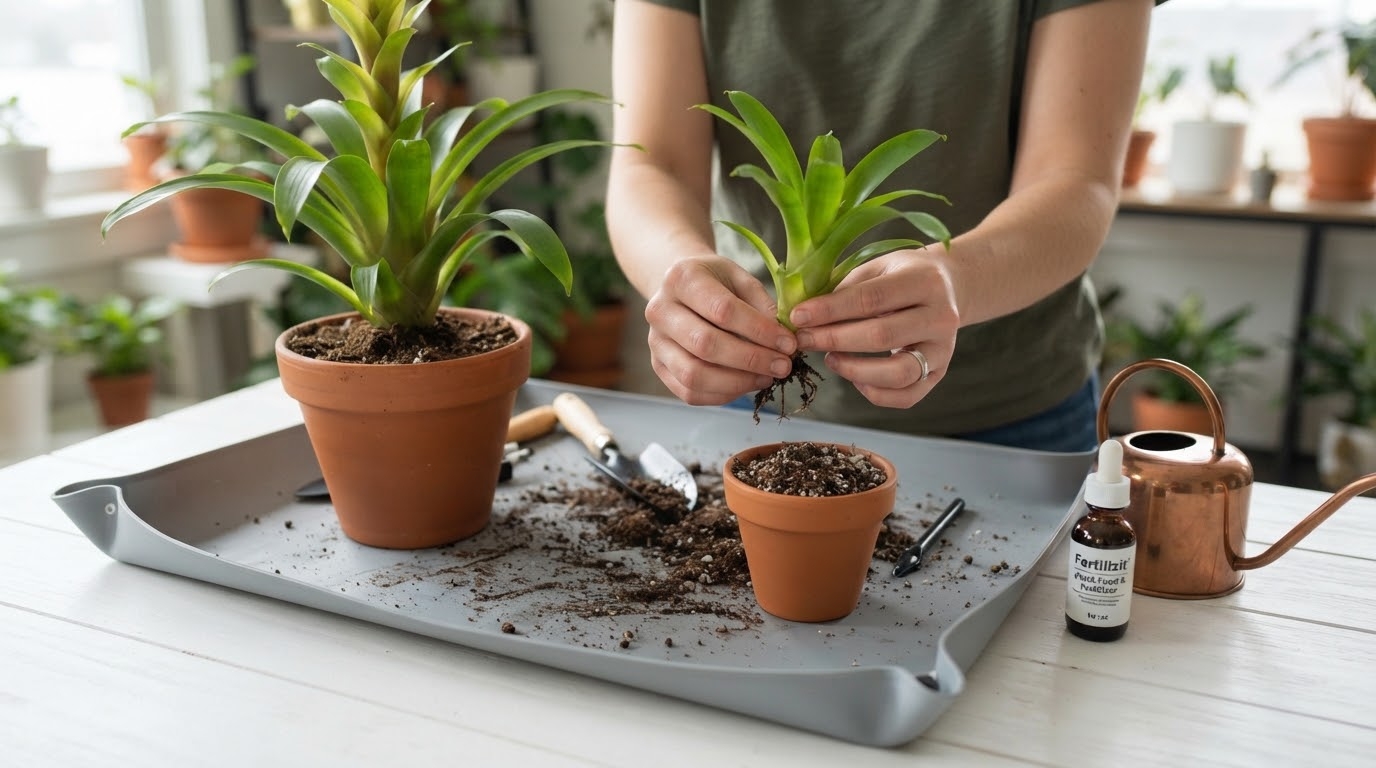
Why not sooner: BSI explains that pups feed off the mother plant until they are large enough to set roots of their own. A pup removed at a quarter of the mother’s size is being cut off from its food supply before it can support itself.
Roots help but are not required. BSI treats visible roots as “a good indication that the plant can survive on its own,” while UF/IFAS is more relaxed: the pup “may or may not have developed a root system of its own, but there is no need to worry, the roots will come later.”
After separating, UW–Madison advises keeping new plants “in a shadier, more humid site until new roots begin to grow,” with the medium relatively dry “to discourage rot.” UF/IFAS names the common failure: “it is very important to not overwater as this is the most common mistake when propagating bromeliads.”
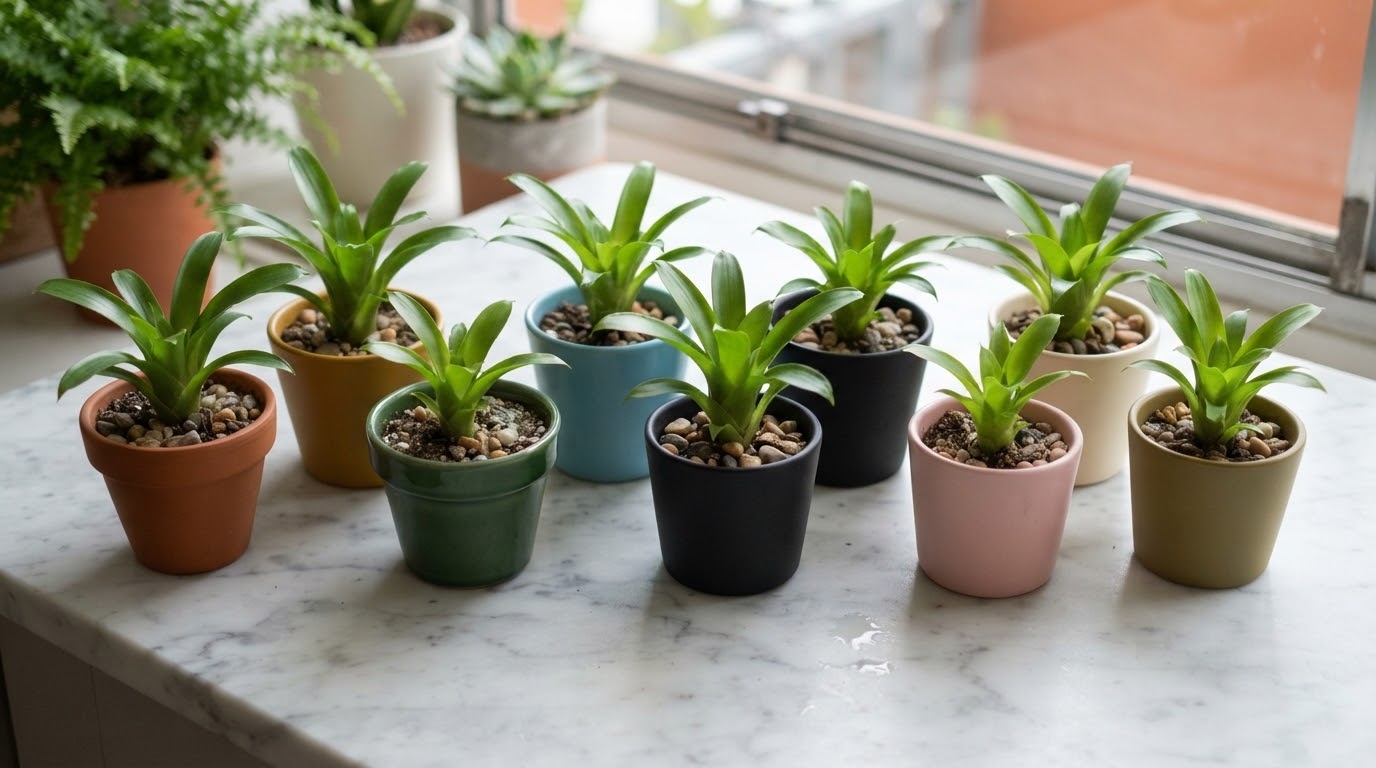
You can also leave them attached. MoBot suggests removing “the faded rosette and repot the pups, altogether, in a larger pot for a specimen plant,” which gives a fuller display than single pots.
How Should You Feed and Pot a Guzmania?
Fertilizer
NC State: “liquid fertilizer (diluted to half-strength) should be applied in the tank periodically when the plant is in active growth.” UW–Madison is more conservative at 1/4 to 1/8 strength. Either works; quarter strength monthly through spring and summer sits safely inside both recommendations, and inside BSI’s limit of 1/4 to 1/3 strength for monthly feeding. I’d skip feeding entirely in winter, when BSI notes most growers stop because growth slows.
Never put granular or slow-release fertilizer in the cup. BSI warns that doing this “will probably burn the foliage and might foster the growth of algae or invite rot.” Our bromeliad fertilizer guide works through the conflicting advice on cup feeding in full.
Potting
Bark-based and fast-draining. NC State recommends “a bark-based potting mix made for orchids, or houseplant mix with added bark and perlite.” Missouri Botanical Garden’s fact sheet suggests a porous terracotta pot, which “allows oxygen to the roots” and helps avoid rot.
Temperature
MoBot sets a minimum of 60°F at night for G. lingulata. NC State lists USDA zones 10a–12b. Ordinary indoor temperatures suit it; cold drafts and unheated winter rooms do not. BSI also lists guzmanias among the bromeliads least tolerant of hot temperatures, so keep it away from radiators.
What Doesn’t Work
Waiting for the original plant to rebloom. The growing point is gone. No amount of light, fertilizer or patience brings it back; the pups are the only route.
Keeping the cup full year-round without adjustment. MoBot specifically advises keeping Guzmania drier in cool and winter months. Brimming cups plus cold rooms produce crown rot.
Blaming fluoride for brown tips. We found no extension source supporting it for bromeliads. Check cup flushing, humidity, and whether you are using softened water. That last one is a documented problem.
Treating shade tolerance as shade preference. Guzmania handles lower light better than most bromeliads. It still needs bright indirect light, and a dim corner produces stretched, dull leaves and no future flowering.
Removing pups early to “give them room.” They feed on the declining mother. One-third of her size is the usual minimum, and smaller pups are less likely to root.
Frequently Asked Questions
How long does a Guzmania bloom last?
Two to four months. What lasts is the colored bract, a modified leaf, rather than the true flowers, which are small and short-lived.
Will my Guzmania flower again?
Not the same rosette. Each rosette flowers once and then declines over a year or two, producing pups along the way. An offset usually flowers one to three years later.
Why are my Guzmania’s leaf tips turning brown?
Most often mineral buildup in an unflushed cup, or low household humidity. Flush the tank weekly by tipping it out and refilling, and avoid softened water, which is high in sodium.
Is Guzmania toxic to cats?
No. The ASPCA lists both Orange Star (Guzmania lingulata minor) and Mosaic Vase (Guzmania musaica) as non-toxic to dogs, cats and horses. Its leaf margins are smooth, unlike the toothed edges on some other bromeliads.
How often should I water a Guzmania?
Keep the central cup filled during the growing season and let the potting medium dry between waterings. In cool or winter conditions, keep the plant drier overall; Missouri Botanical Garden advises this specifically for G. lingulata.
Can Guzmania grow in low light?
Better than most bromeliads, but not in genuine shade. It comes from shadier habitats than most of the family, yet bright indirect light is still the target, and BSI notes that no bromeliad likes a dark environment.
When should I remove Guzmania pups?
When they reach about one-third the size of the mother plant, according to NC State Extension. BSI gives a range of one-third to one-half. Earlier separation is riskier, because the pups are still drawing nourishment from the parent.