The first time I came across a curly spider plant, I spent about ten minutes trying to figure out what was wrong with it. Those spiraling, corkscrewing leaves didn’t look intentional—they looked stressed. I was wrong. The curly spider plant, sold under the cultivar name ‘Bonnie,’ is a plant that’s designed to look exactly the way it does, and once you understand that, everything about caring for it starts to make sense.
Bonnie is a compact, curly-leaved form of Chlorophytum comosum—the same species as the common spider plant, but with leaves that spiral and twist rather than arch straight outward. It stays smaller, grows fuller, and produces the same cheerful hanging babies that make spider plants so easy to propagate. If you’ve kept a regular spider plant alive, you can keep a Bonnie alive. If you’ve struggled with houseplants before, Bonnie is still a genuinely forgiving choice.
Here’s everything that actually matters for keeping one thriving.
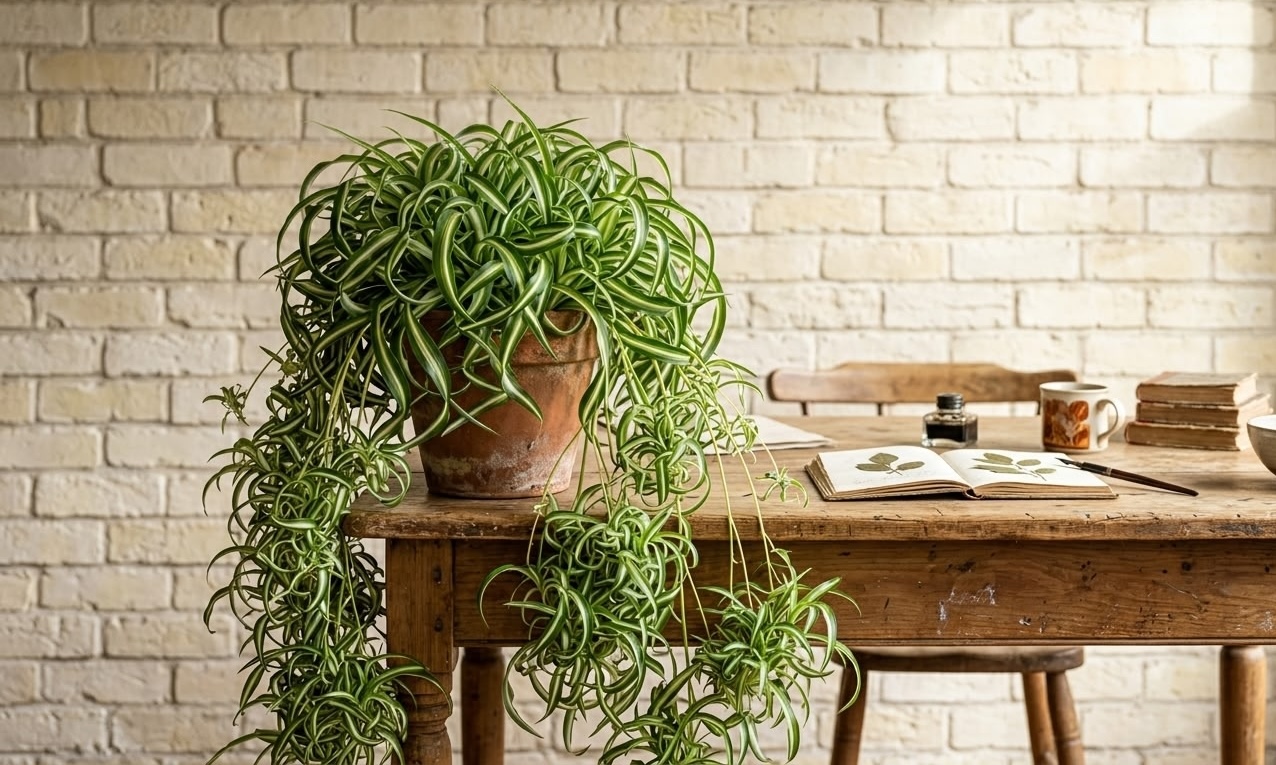
What Is the Curly Spider Plant?
The curly spider plant is a cultivar of Chlorophytum comosum, a species native to a broad stretch of sub-Saharan Africa—from Cameroon and Ethiopia in the north all the way through to southern Africa. The ‘Bonnie’ cultivar was registered with a U.S. plant patent (PP13935) after being discovered as a spontaneous whole-plant mutation. Someone found a spider plant where all the leaves were curling differently from the rest, selected it, and propagated it into the Bonnie sold in nurseries today.
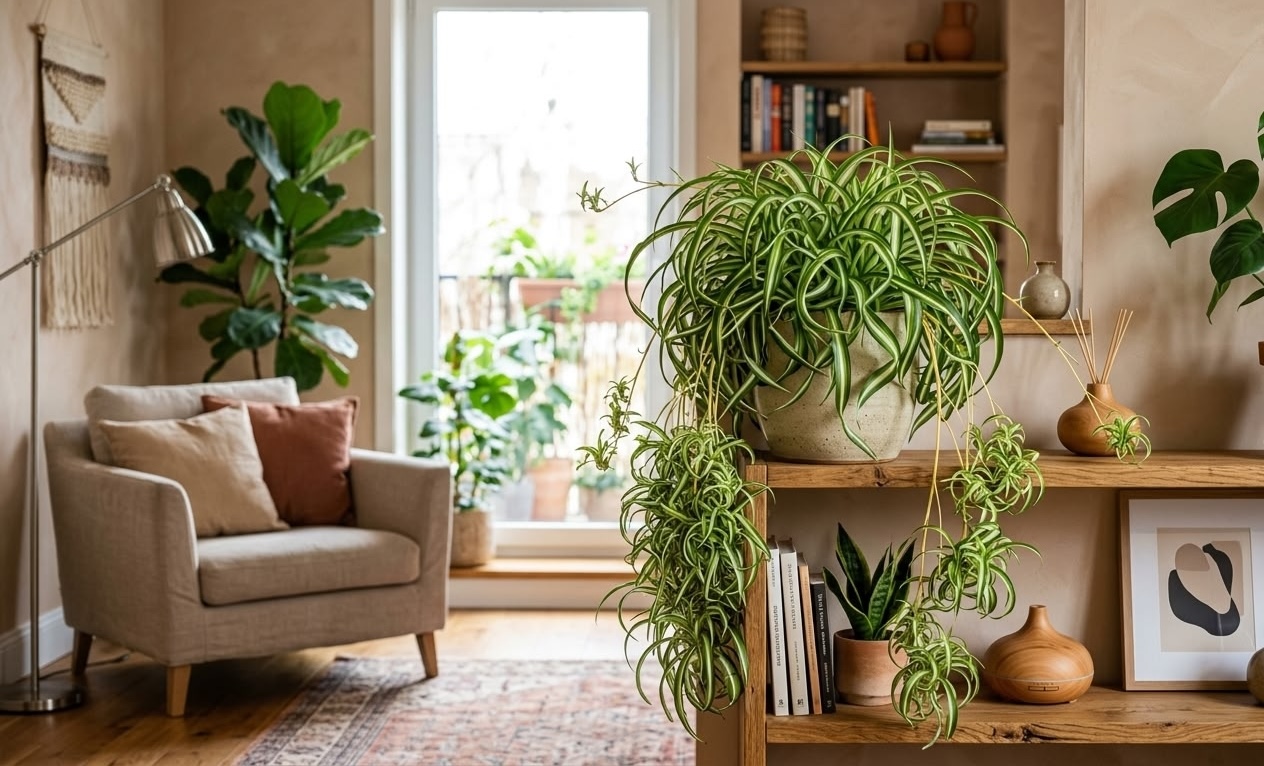
The result is a more compact plant—about 8 inches tall and 15 inches wide at maturity—compared to standard spider plants that typically reach 12–18 inches. The leaves curl and recurve on themselves, creating a dense, rounded shape that works well in hanging baskets, on shelves, and as a tabletop plant.
The most common form is variegated, with dark green leaf margins and a creamy white or pale yellow stripe down the center. A solid green version exists, but the variegated is more widely available and more popular. Both varieties share the same care requirements.
Botanically, C. comosum belongs to the family Asparagaceae—the same family as asparagus, hostas, and snake plants. Some older sources still list it under Liliaceae, but that classification has been updated across modern botanical databases.
If you’re new to spider plants entirely, our spider plant care guide covers the standard variety in depth—most of the care information overlaps closely with Bonnie.
Quick Care Overview
| Condition | What Bonnie Needs |
|---|---|
| Light | Bright indirect; tolerates low light |
| Water | When the top inch of soil feels dry |
| Soil | Well-draining potting mix with added perlite |
| Temperature | 65–75°F (day); above 50°F (night) |
| Humidity | Moderate; no misting needed |
| Fertilizer | Balanced liquid, every other month (spring–summer) |
| Mature size | 8 inches tall × 15 inches wide |
| Toxicity | Non-toxic to cats, dogs, and horses |
Light Requirements
Bonnie does best in bright indirect light—a few feet back from a window, or directly next to a north- or east-facing window. It handles lower light better than most variegated plants, which is one of the things that makes it versatile for interior spaces. In low light, growth slows and the creamy stripe may narrow as the plant produces more chlorophyll, but it survives without dramatic deterioration.
Avoid direct sun, especially from a south- or west-facing window in summer. The leaf tips scorch quickly and will bleach to a papery yellowish-cream that looks like disease but is simply sun damage. I moved a Bonnie onto a south-facing sill in July to give it “more light”—within two weeks the newest leaves were pale and translucent at the edges. Moved it back to a bright spot without direct sun and new growth came in clean within a month.
A practical test: if you can comfortably read without turning on a lamp, there’s likely enough light for Bonnie to grow at a reasonable rate.
How to Water Curly Spider Plant
Water when the top inch of soil feels dry. Stick your finger in—if there’s any dampness an inch below the surface, wait another day or two. Bonnie has thick, tuberous roots that store water, so it handles short dry spells without showing much stress.
Over-watering is the bigger risk. I kept a Bonnie too wet through one cool, dark November—the kind of stretch where you stick to a schedule rather than actually checking the soil. The roots had been rotting for weeks before I noticed any change in the foliage. By the time the leaves started yellowing, the damage was already significant. Check the soil, not just the leaves.
Use distilled or filtered water if you can, or let tap water sit out overnight before using it. Chlorine and fluoride in tap water are linked to brown leaf tips in spider plants—it’s one of the most common causes of that crispy-edge look and one of the easiest to fix. If you’re already doing everything else right and still getting brown tips, the water is often the culprit.
Reduce watering in fall and winter. Growth slows, the plant uses less water, and soil takes longer to dry. The same schedule that worked in June will over-water in December.
Soil
Use a well-draining potting mix. Standard houseplant mix works well with a handful of perlite added to improve drainage and aeration—Bonnie’s tuberous roots need oxygen at the root zone, and dense, waterlogged soil suffocates them and sets up conditions for rot.
Drainage holes are non-negotiable. Terracotta pots work particularly well because the porous material wicks away excess moisture passively. Plastic holds water longer, which means you’ll water less often but need to watch more carefully to avoid over-watering. Whichever material you use, the pot needs drainage.
Temperature and Humidity
Keep Bonnie between 65–75°F during the day. It tolerates nighttime temperatures down to around 50°F, but prolonged exposure below 45°F damages the leaves and stresses the root system. Keep it away from air conditioning vents, cold drafts near windows in winter, and spots that drop sharply in temperature at night.
Humidity needs are moderate and easy to meet in most homes—you don’t need a humidifier or a regular misting routine. What you’ll notice is that very dry air, especially in winter with central heating running, causes brown leaf tips. If you’re seeing browning at the tips despite correct watering and filtered water, low humidity is a likely contributor. Moving the plant away from heating vents, or grouping it with other houseplants, usually helps without any extra equipment.
Fertilizing
Feed Bonnie with a balanced liquid fertilizer every other month during spring and summer. Skip fall and winter entirely—the plant isn’t actively growing and won’t use the nutrients, while excess fertilizer salts build up in the soil and contribute to brown tips.
One counterintuitive thing worth knowing: over-fertilizing reduces baby production. Too much nitrogen pushes leafy growth at the expense of spiderette formation. One summer I fertilized monthly thinking more was better, and Bonnie produced almost no plantlets all season. Cut back when you want babies.
Pruning
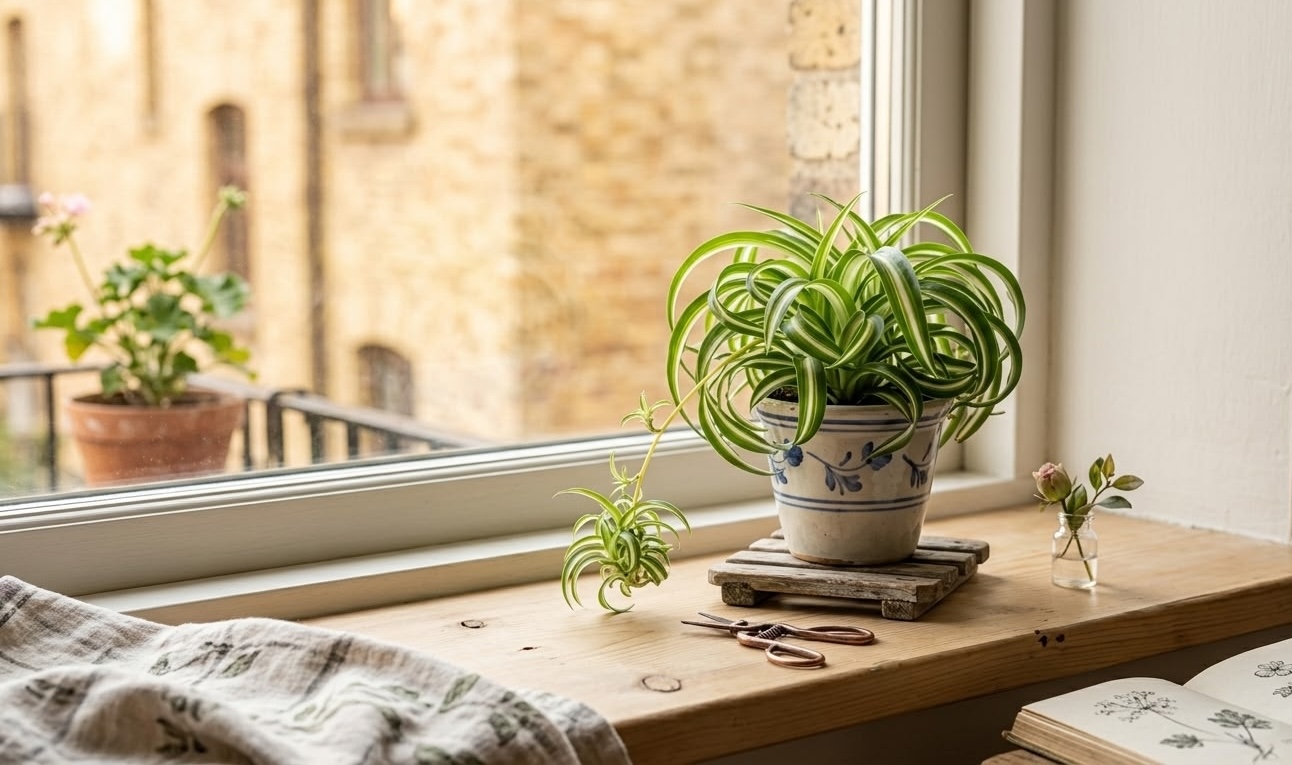
Pruning Bonnie is optional maintenance rather than essential care. Trim brown or damaged leaf tips with clean scissors—cut at a slight angle to match the natural leaf shape, and it’ll be less conspicuous than a blunt straight cut. Remove entirely any leaves that have gone fully brown or yellow at the base.
If a runner (the long arching stem that carries plantlets) dries up after you’ve harvested the babies from it, snip it off at the base. Leaving dead runners doesn’t harm the plant, but removing them keeps the shape tidy and redirects energy toward new growth.
Repotting
Repot every 2–3 years, or when roots are visibly circling the bottom of the pot or pushing through the drainage holes. Spring is the best time. A slightly root-bound Bonnie actually produces more spiderettes, so don’t rush to size up—wait until growth slows noticeably or roots are obviously cramped.
When you do repot: shake off old soil, inspect the roots, and cut off any soft, dark, or mushy sections with clean scissors. Go up one pot size—not two. Too much extra soil volume holds water the plant can’t yet use, which creates waterlogging problems even with good drainage.
How to Propagate Curly Spider Plant
Propagation is genuinely easy—Bonnie does most of the work. The plant sends out long arching runners with small plantlets (called spiderettes or babies) at the tips, and those plantlets root readily in water or soil.
When to harvest: Wait until the plantlet has visible root nubs—small white bumps or short roots at its base. You can propagate without them, but success rates are much higher when root tissue is already present. I used to cut babies the moment they looked like a separate plant, before any roots formed, and lost several to rot before I started waiting for the root nubs to appear first.
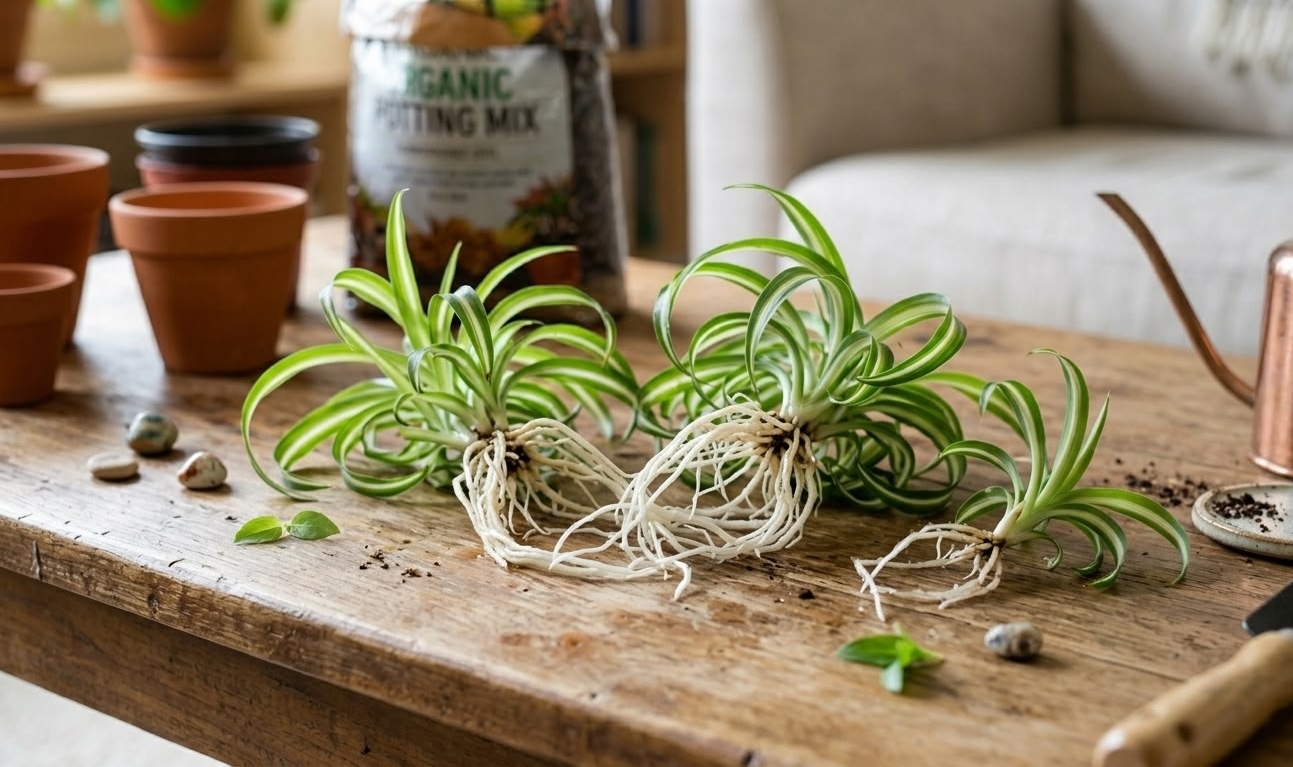
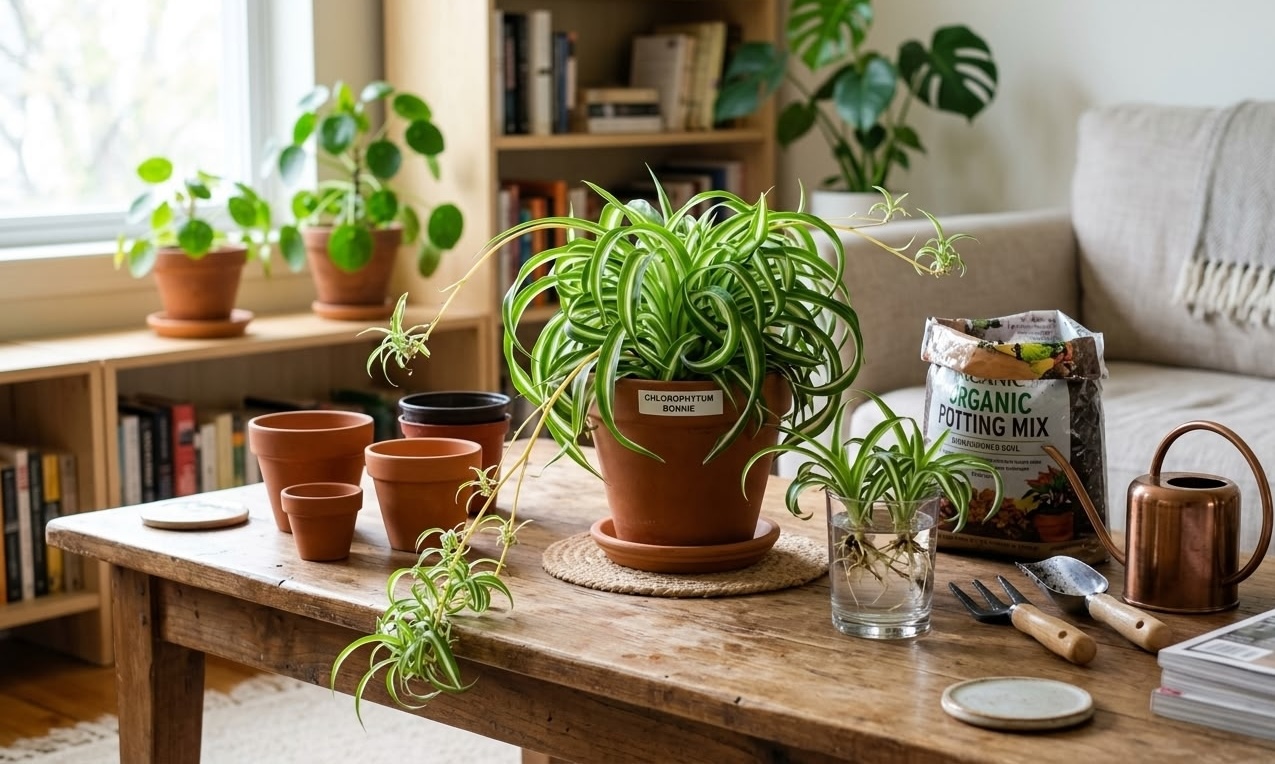
Method 1: Water rooting. Snip the plantlet from the runner and set it in a glass of water with the roots or base submerged and the leaves above the waterline. Place in bright indirect light. Roots develop and lengthen over several weeks. Once they’re an inch or longer, move the plantlet to potting mix and water consistently while it adjusts to soil.
Method 2: Soil rooting. Fill a small pot with moist potting mix. Nestle the base of the plantlet into the surface—or pin it in place with a bent wire or hairpin. Keep the soil consistently moist (not soggy) until you feel gentle resistance when you tug. That resistance means roots have taken hold.
Method 3: Leave it attached. Set a small pot of moist soil next to the mother plant and pin the plantlet—still connected to the runner—into the new pot. Let it root while still receiving nutrients from the mother. Sever the runner after the plantlet is established. This is the most reliable method, especially for beginners.
Getting Bonnie to produce more babies: Spiderette production is triggered by short days—specifically, fewer than 12 hours of light per day for at least three consecutive weeks. This is a photoperiod response: shorter days signal the plant to reproduce. If your Bonnie isn’t producing babies, it’s often because it’s getting too much light for too many hours, especially in summer or under grow lights. Move it somewhere with a natural light cycle in fall, reduce fertilizer, and let the roots get slightly crowded. The babies usually follow.
Curly Spider Plant vs. Regular Spider Plant
The two varieties come up together constantly, and the comparison is worth making directly:
| Curly (Bonnie) | Regular Spider Plant | |
|---|---|---|
| Leaf shape | Curling, spiraling, recurved | Straight to gently arching |
| Mature height | ~8 inches | 12–18 inches |
| Mature width | ~15 inches | 12–24 inches |
| Growth habit | Compact, rounded | Spreading, fountain-like |
| Spiderettes | Yes; babies also curl | Yes |
| Care requirements | Nearly identical | Nearly identical |
The main practical differences are size and leaf form. Bonnie’s compact shape makes it better for shelves, small tables, and spots where a spreading plant would feel crowded. Standard spider plant has more dramatic trailing spread and works particularly well in hanging baskets where the long runners have room to cascade. Care-wise, you can treat them interchangeably.
Why Is My Curly Spider Plant Not Curling?
This is one of the most common questions about Bonnie, and it has several distinct causes:
Too much light. Strong or direct light tends to flatten the curl. The curling in Bonnie’s leaves is related to differential growth rates between the two leaf margins—strong light can speed up growth overall and reduce that differential. Move the plant to bright but indirect light and watch whether new growth comes in with more curl.
Temperature extremes. Sustained temperatures above 85°F can temporarily straighten the leaves. Once conditions moderate, new growth typically curls normally.
Over-fertilizing. Excess nitrogen promotes fast, upright growth. The mechanism that creates curling—uneven growth between the inner and outer leaf margins—gets disrupted when the plant grows too quickly. Ease off on feeding and give the plant time to produce new leaves.
Normal leaf maturation. Older leaves at the base of the plant often lose curl as they age. This is completely normal. Focus on the newest growth—if fresh leaves are curling, the plant is healthy. You can trim older, straighter basal leaves if the appearance bothers you.
The wrong plant. Plants sold as Bonnie or “curly spider plant” are occasionally mislabeled, or may be individuals where the cultivar traits are less strongly expressed. If the plant was never particularly curly and nothing in its care has changed, you may simply have a plant where the curl is genetically less pronounced.
Common Problems
Brown Leaf Tips
The most universal spider plant complaint. Three main causes: fluoride or chlorine in tap water, dry air from heating vents, and salt buildup from over-fertilizing. Switch to distilled or filtered water, move the plant away from vents, and flush the soil thoroughly every few months by running plenty of water through until it drains freely—this clears accumulated fertilizer salts. Once brown, leaf tips don’t recover; trim them off at an angle to match the leaf shape.
Yellow Leaves
Usually a watering issue—most often overwatering, less often prolonged drought. Check the roots: healthy roots are white or tan and firm. Mushy, dark, or slimy roots are rotting. For root rot, remove the plant from the pot, cut away all rotted tissue with clean scissors, let the remaining roots air for an hour, and replant in fresh dry mix. Water sparingly for the next few weeks while new roots establish.
No Babies
Two main causes: too much light and too much fertilizer. Bonnie produces spiderettes in response to shorter days—fewer than 12 hours of light per day for several weeks. In fall, reduce feeding, let the pot get slightly root-bound, and give the plant a natural light cycle without supplemental grow lights. Most owners who report no babies have been keeping the plant in long days with generous fertilizing. The fix usually means doing less, not more.
Pests
Spider plants are relatively pest-resistant, but spider mites and mealybugs appear occasionally, especially when the plant is stressed or in dry conditions. Spider mites show up as fine webbing with tiny dots on leaf undersides; mealybugs appear as white cottony clumps at leaf joints or where leaves meet the stem. For both: isolate the plant immediately, wipe all visible pests and webbing off with a damp cloth, and treat with neem oil or insecticidal soap every 5–7 days until the infestation clears completely.
Is Curly Spider Plant Safe for Cats and Dogs?
Yes. The ASPCA lists spider plants as non-toxic to cats and dogs. NC State Extension also confirms it as safe for horses. For the full breakdown on what compounds spider plants contain and what to do if your pet chews one, see our dedicated guide: are spider plants toxic to cats and dogs?
You may have read that spider plants have a mild hallucinogenic effect on cats. This is loosely true: the leaves contain compounds that produce a weak euphoric reaction similar to catnip, which is why some cats chew on spider plants with enthusiasm. The effect isn’t harmful, but eating a significant quantity of leaves can cause mild gastrointestinal upset—vomiting or loose stools. If your cat is a dedicated chewer, hanging Bonnie in a basket out of reach is the simplest solution.
Frequently Asked Questions
Is the curly spider plant the same as the Bonnie spider plant?
Yes. ‘Bonnie’ is the registered cultivar name for the curly-leaved form of Chlorophytum comosum. “Curly spider plant” and “Bonnie spider plant” refer to the same plant.
How big does a curly spider plant get?
Bonnie grows to approximately 8 inches tall and 15 inches wide at maturity—noticeably more compact than standard spider plants, which typically reach 12–18 inches tall and 12–24 inches wide.
Why are my curly spider plant leaves going straight?
Most often caused by too much direct light, sustained heat above 85°F, or over-fertilizing. The curl can also naturally fade in older basal leaves as they age—check whether newer growth is still curling normally.
Do Bonnie spider plant babies also curl?
Yes. Spiderettes from a Bonnie will develop the same curly leaves as the mother plant as they mature. The curl becomes more pronounced once the plant is established in its own pot.
How do I get my Bonnie to produce more spiderettes?
Reduce fertilizer, allow the plant to become slightly root-bound, and give it fewer than 12 hours of light per day for several consecutive weeks. This mimics the shorter days of fall and triggers the photoperiod response that produces babies.
Why does my curly spider plant have brown tips?
The most common causes are fluoride or chlorine in tap water, very dry air from heating or air conditioning, and salt buildup from excess fertilizer. Switch to filtered water, move the plant away from vents, and flush the soil periodically to clear salt accumulation.
Recommended Products
As an Amazon Associate, Two Leaf Garden earns from qualifying purchases.