Banana trees are heavy feeders, and without the right fertilizer, you’ll notice it fast — leaves that stay small, slow growth, and a plant that just looks tired no matter how much you water it. The good news is that fertilizing banana trees isn’t complicated once you understand what they’re actually hungry for.
This guide covers the best banana tree fertilizer options, when and how often to apply them, and what works specifically for container plants — which have different needs than in-ground ones.
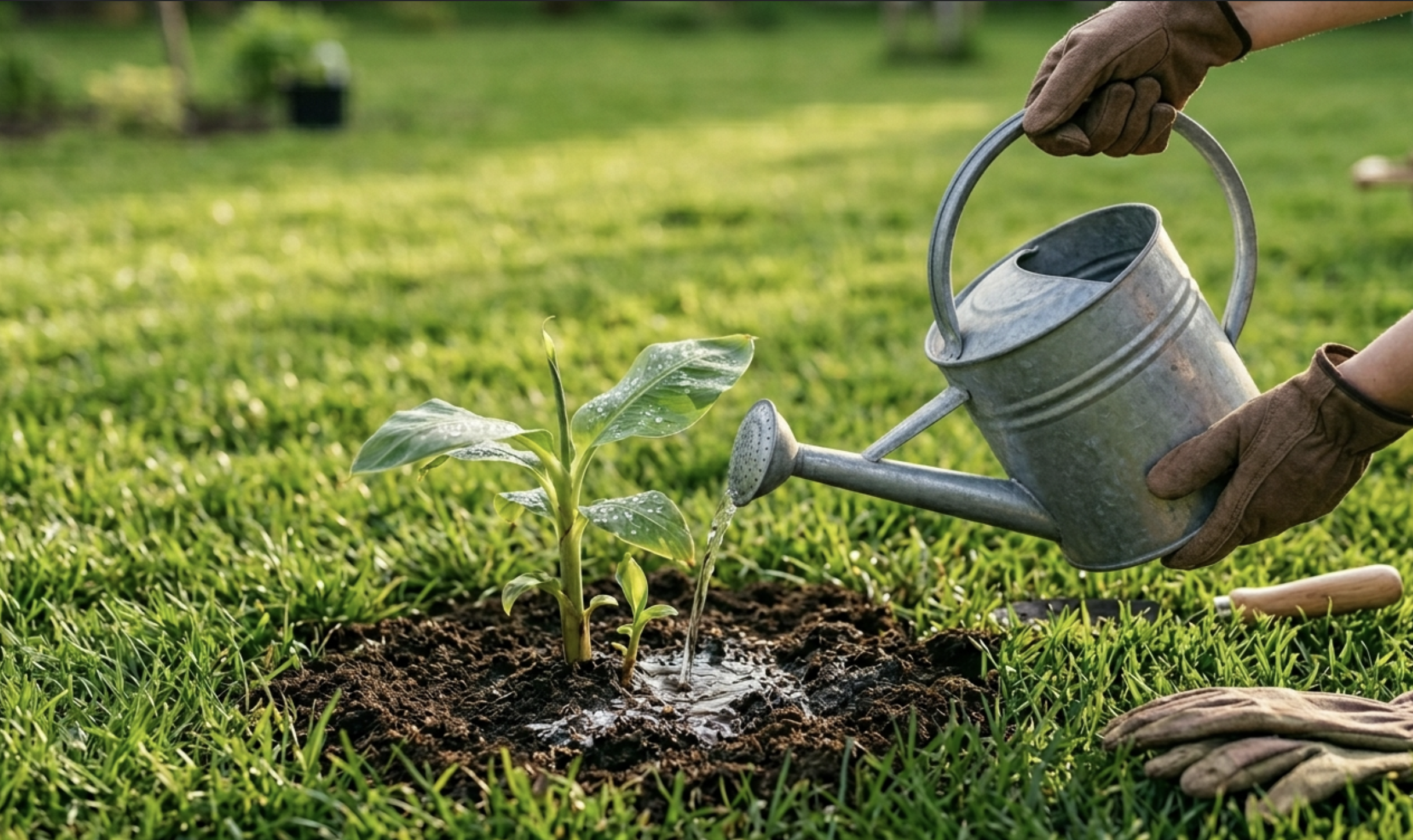
What Banana Trees Need From Fertilizer
Banana trees have an unusual nutrient profile compared to most garden plants. They need plenty of nitrogen to push out those big tropical leaves, but their highest demand is for potassium — more than almost any other common landscape plant.
Why Does Potassium Matter More Than Nitrogen?
A mature banana plant pulls more potassium from the soil than any other nutrient. Potassium drives fruit quality, stem strength, and disease resistance. When potassium runs low, you’ll see it in the plant before you see it in a soil test — stems lean, older leaves develop brown scorched edges, and the whole plant looks like it’s struggling in a way that more water won’t fix.
Potassium also helps the plant regulate water, which is why high-potassium fertilizers matter especially in hot weather when banana trees are actively pumping moisture through their massive leaves.
Which NPK Ratio Works Best for Banana Trees?
The most widely recommended NPK ratio for banana trees — based on University of Florida/IFAS and University of Hawaii CTAHR research — is a 3:1:6 nitrogen-to-phosphorus-to-potassium ratio, commonly sold as a 6-2-12 formula. That means high potassium, moderate nitrogen, and low phosphorus. Popular gardening sites often cite 8-10-10, but that formula has too much phosphorus relative to what banana trees actually need. Here’s how that changes across growth stages:
| Growth Stage | Recommended NPK | Why |
|---|---|---|
| Spring / vegetative | 6-2-12 or 8-2-12 | High K, moderate N, low P — the profile banana trees need |
| Pre-flowering | Increase K further (e.g. 6-10-20) | Shift toward higher K for fruit and stem strength |
| Container plants | Liquid 3-1-6 at half strength | Lower N, easier to control dose and prevent salt buildup |
Two ratios to skip: high-nitrogen 21-0-0 ammonium sulfate pushes leafy growth at the expense of fruit and drops soil pH over time. And despite what many gardening sites say, 10-10-10 or 8-10-10 are not ideal — the elevated phosphorus relative to potassium doesn’t match banana trees’ actual needs. Stick to a high-K formula like 6-2-12 or an equivalent palm fertilizer.
Best Fertilizer for Banana Trees
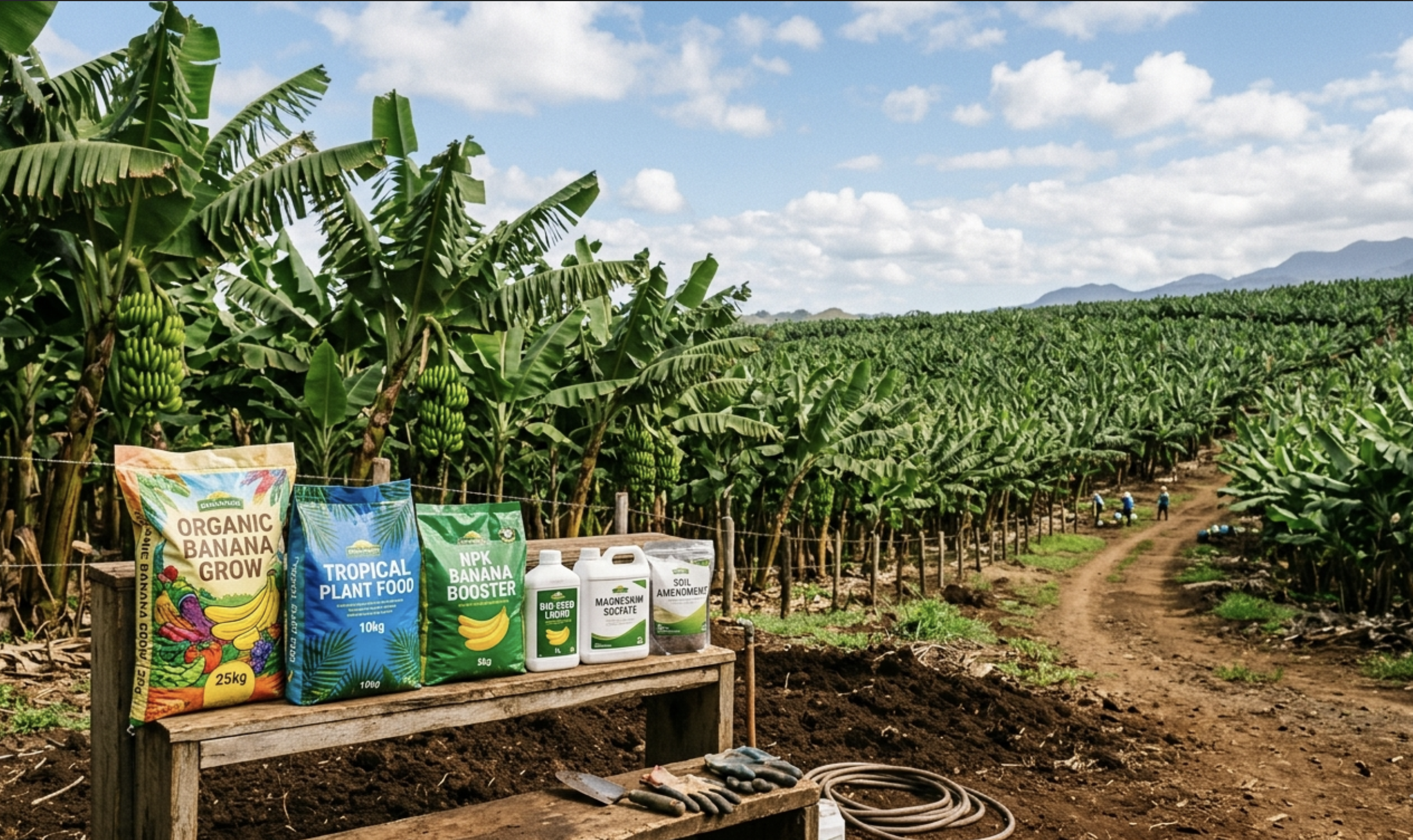
Best Granular Option
For outdoor in-ground banana trees, a slow-release granular fertilizer with a 6-2-12 or 8-2-12 NPK ratio applied monthly from spring through early fall is the most reliable approach. It dissolves slowly, feeds consistently, and doesn’t require you to remember to reapply every couple of weeks.
Espoma Citrus-tone (5-2-6) is worth considering for its potassium content and organic inputs — it breaks down steadily and won’t burn roots if you apply it correctly. For a more conventional option, any granular fertilizer labeled for tropical fruit trees in the 8-10-10 range will do the job.
Best Organic Option
If you prefer going organic, worm castings combined with a kelp meal amendment are hard to beat. Worm castings provide a steady slow release without any burn risk — NPK varies significantly by brand and feedstock, but expect low numbers across all three macronutrients, and they improve soil structure at the same time. Adding a handful of kelp meal bumps the potassium. The downside: you’ll need larger volumes than with synthetic fertilizers, and nutrient content varies by brand.
Can You Use Palm Fertilizer for Banana Trees?
Yes — and it’s actually a solid match. Palms have high potassium needs just like banana trees, so palm fertilizers are typically formulated with ratios like 8-2-12 or similar. Many gardeners use Fertilome Palm Tree Food (8-2-12) with good results on banana trees.
Some palm fertilizers include chelated micronutrients (manganese, iron, zinc) matched specifically to palms. This isn’t harmful to banana trees, but it’s not essential either — don’t pay a premium for it specifically.
How Often Should You Fertilize a Banana Tree?
Once a month during the growing season is the standard schedule for outdoor banana trees. The timing depends on your climate: in zones 8–9 where plants go semi-dormant, that’s roughly March through September. In Florida, Hawaii, and other warm climates where bananas grow year-round, the University of Florida/IFAS recommends fertilizing every two months throughout the year — reducing but not stopping in winter. In colder zones, hold off entirely during dormancy, since fertilizing a dormant plant wastes nutrients and can push soft new growth vulnerable to cold damage.
Fertilizing Schedule by Season
| Month | What to Do |
|---|---|
| March | First application of the season — granular, full dose |
| April – August | Monthly granular application at full strength |
| Early September | Last full-strength application before slowdown |
| October – February | No fertilizer (zones 8–9, dormant plants); reduce to half-strength in warm climates |
Young Plants vs. Established Trees: Does the Dose Change?
Yes — young banana plants under six months in the ground need much lighter applications — university extension research suggests starting at roughly one-quarter to one-sixth of the mature tree dose and scaling up over the first year. Too much fertilizer on a new planting stresses the roots before they’re established enough to handle it.
For mature trees (over a year in the ground, at least five to six feet tall), you can apply one to one and a half pounds of granular 6-2-12 per month during the growing season. Start on the low end and increase if growth seems consistently slow.
How to Apply Fertilizer to a Banana Tree
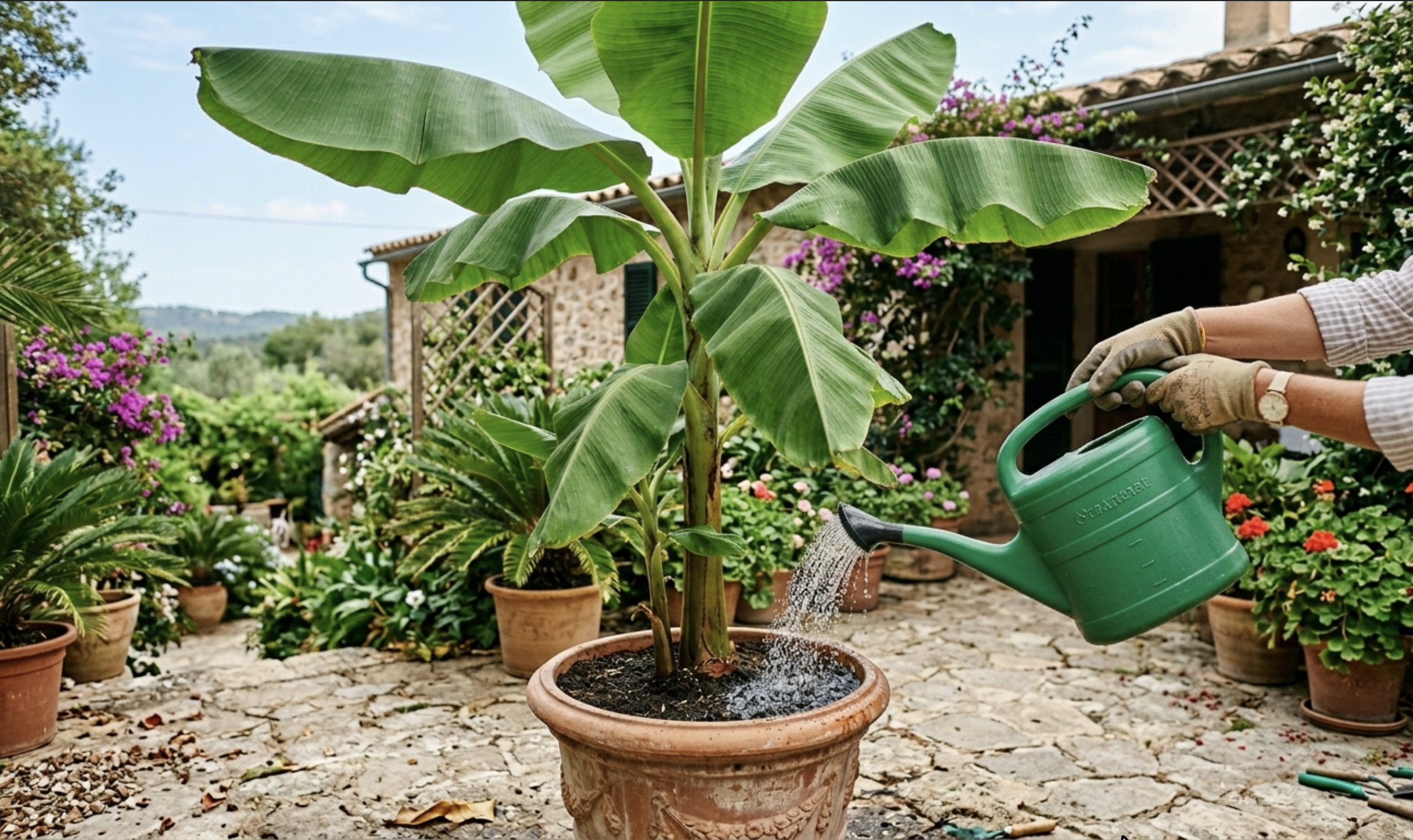
Broadcast granular fertilizer in a ring around the base of the plant, starting about six inches from the pseudostem and extending out to at least the drip line — or further. Banana roots are wide and relatively shallow, spreading well beyond the visible canopy, so covering a broad area matters more than piling fertilizer close to the trunk.
Avoid pushing fertilizer directly against the pseudostem. It won’t cause immediate damage, but sustained contact can create soft spots that let rot in over time.
After applying, water thoroughly so granules dissolve into the soil and reach the root zone. If you’re using a liquid fertilizer, apply it the same day you water — don’t let liquid fertilizer sit on completely dry soil.
Fertilizing Banana Trees in Containers
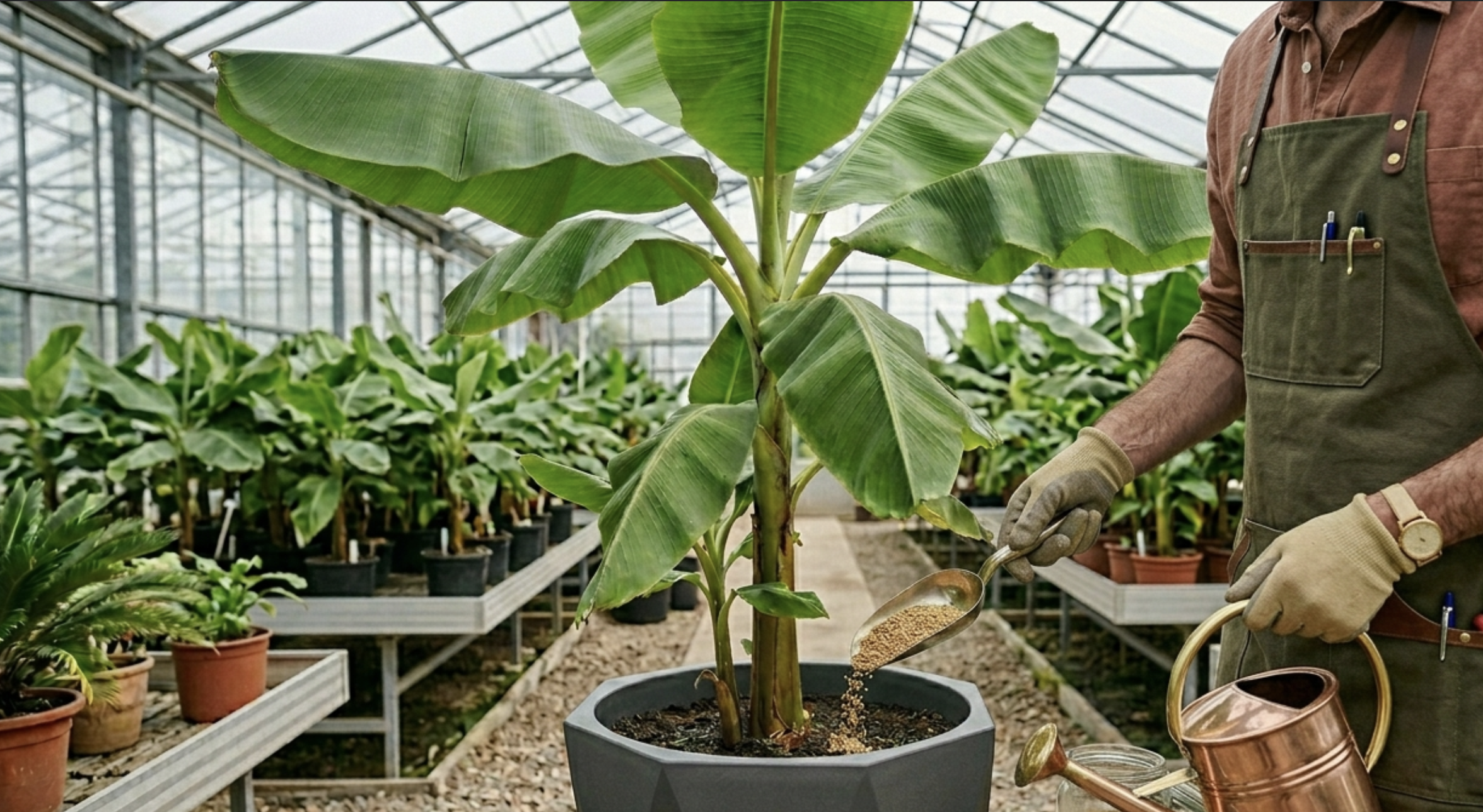
Container banana trees actually need more frequent fertilizing than in-ground plants — but each application should be lighter. The reason: potted plants don’t have access to nutrients in the surrounding soil, and regular watering flushes nutrients out of the pot faster than rain does in a garden bed.
For container bananas, apply at half-strength every two to three weeks during the growing season instead of full-strength monthly. A water-soluble liquid fertilizer works well here because you can dial the dose precisely and mix it into your regular watering routine.
A few things to watch specifically with container plants:
- Salt buildup: Fertilizer salts accumulate in potted soil over time. Every six to eight weeks, water the pot heavily until water runs freely from the bottom drainage holes to flush salts out.
- Soil pH drift: Container soil pH shifts more than in-ground soil. Check pH once a season — banana trees prefer 5.5 to 7.0. A drift below 5.5 locks out nutrients even if you’re fertilizing regularly.
- Dwarf varieties: Smaller types like Dwarf Cavendish need proportionally less fertilizer than full-size species. Start at quarter-strength and work up based on how the plant responds.
Organic Fertilizer Options That Actually Work
If you’d rather skip synthetic fertilizers, several organic amendments deliver real results for banana trees — some better than their reputation suggests, and a few that are more myth than reality.
Do Coffee Grounds Help Banana Trees?
Yes, but not for the reason most people think. Coffee grounds are often pitched as an acidifying amendment, but spent grounds are nearly neutral — pH around 6.5 to 6.8. Most of the acid is extracted during brewing. What grounds actually contribute is nitrogen and organic matter, both useful. The best approach is adding them to your compost pile rather than spreading them directly on the soil surface, where they can compact into a water-repellent layer.
Does Epsom Salt Help Banana Trees Grow?
Epsom salt (magnesium sulfate) helps specifically if your banana tree has a magnesium deficiency, which shows up as yellowing between leaf veins while the veins themselves stay green. If you see that pattern, a diluted Epsom salt drench — one tablespoon per gallon of water, applied monthly — can correct it quickly.
One caveat: interveinal chlorosis can also be caused by iron or manganese deficiency, which Epsom salt won’t fix. If a soil drench doesn’t improve the yellowing after a few weeks, get a soil test before continuing. And if your plant looks fine, adding Epsom salt won’t boost growth — it’s not a general fertilizer.
Fish Emulsion
Fish emulsion (typically 5-1-1 NPK) is a high-nitrogen liquid organic fertilizer that banana trees respond well to during the vegetative phase in spring. It’s fast-acting, which makes it useful when you want to push growth quickly after a slow winter. The smell is noticeable on application day but fades within a few hours.
Are Banana Peels Good Fertilizer for Banana Trees?
Banana peels do contain meaningful potassium — though the “42% potassium” figure that circulates online is inflated and not supported by lab analysis (actual elemental potassium is closer to 8–12% on a dry weight basis). Composted banana peels are still worth adding to your pile, and they work better than raw peels buried near the root zone. Raw peels decompose slowly in soil and can attract pests. If you have a compost pile, throwing peels in regularly is genuinely worth doing.
Signs Your Banana Tree Needs More Fertilizer — and Signs You’ve Added Too Much
It’s worth knowing both directions, because over-fertilizing is easier to do than most people realize, and the symptoms can look similar to deficiency if you’re not paying attention.
Signs of nutrient deficiency:
| What You See | Likely Cause |
|---|---|
| Small leaves, slow overall growth | Nitrogen deficiency |
| Brown leaf edges, leaning stems | Potassium deficiency |
| Yellowing between veins, veins stay green | Magnesium deficiency |
| Purple undersides on young leaves | Phosphorus deficiency |
Signs of over-fertilization:
- Tips and edges of leaves turn brown and crispy (fertilizer burn)
- White crust forming on the soil surface in containers (salt buildup)
- Rapid, soft new growth that wilts easily — excess nitrogen makes plants more vulnerable to cold and pests
If you suspect over-fertilization in a container, flush the pot with several gallons of water until it runs clear from the drainage holes. For in-ground plants, reduce application frequency and let rainfall work through the soil naturally over a few weeks.
Frequently Asked Questions
How often should you fertilize a banana tree?
Once a month during the growing season. In cooler zones (8–9) that’s roughly March through September; in warm climates like Florida or Hawaii, reduce to every two months in winter rather than stopping entirely. Container plants do better with lighter applications every two to three weeks instead of one heavy monthly dose.
What is the best NPK ratio for banana trees?
An 8-10-10 ratio works well for most banana trees. During the vegetative phase in spring you can use a balanced 10-10-10; as the plant matures and approaches flowering, shift toward higher potassium — something like 5-10-15 — to support fruit development and stem strength.
Can I use 10-10-10 fertilizer on banana trees?
Yes. A balanced 10-10-10 is a perfectly reasonable choice, especially if you don’t want to track ratios closely. It won’t optimize growth the way a higher-potassium formula might, but it won’t harm the plant either.
Should I fertilize banana trees in winter?
No. In most parts of the US, banana trees slow down or go dormant in fall and winter. Fertilizing during this period wastes nutrients and can push new growth that gets damaged by cold. Resume in early spring once the plant starts showing signs of new growth.
What fertilizer makes banana trees grow faster?
Higher nitrogen during the vegetative phase — spring through midsummer — encourages faster leaf production. But pushing growth with excess nitrogen comes with trade-offs: softer stems, more pest pressure, and potential soil acidification over time. A consistent monthly 6-2-12 program produces steady, healthy growth without those downsides.
Recommended Products
As an Amazon Associate, Two Leaf Garden earns from qualifying purchases.