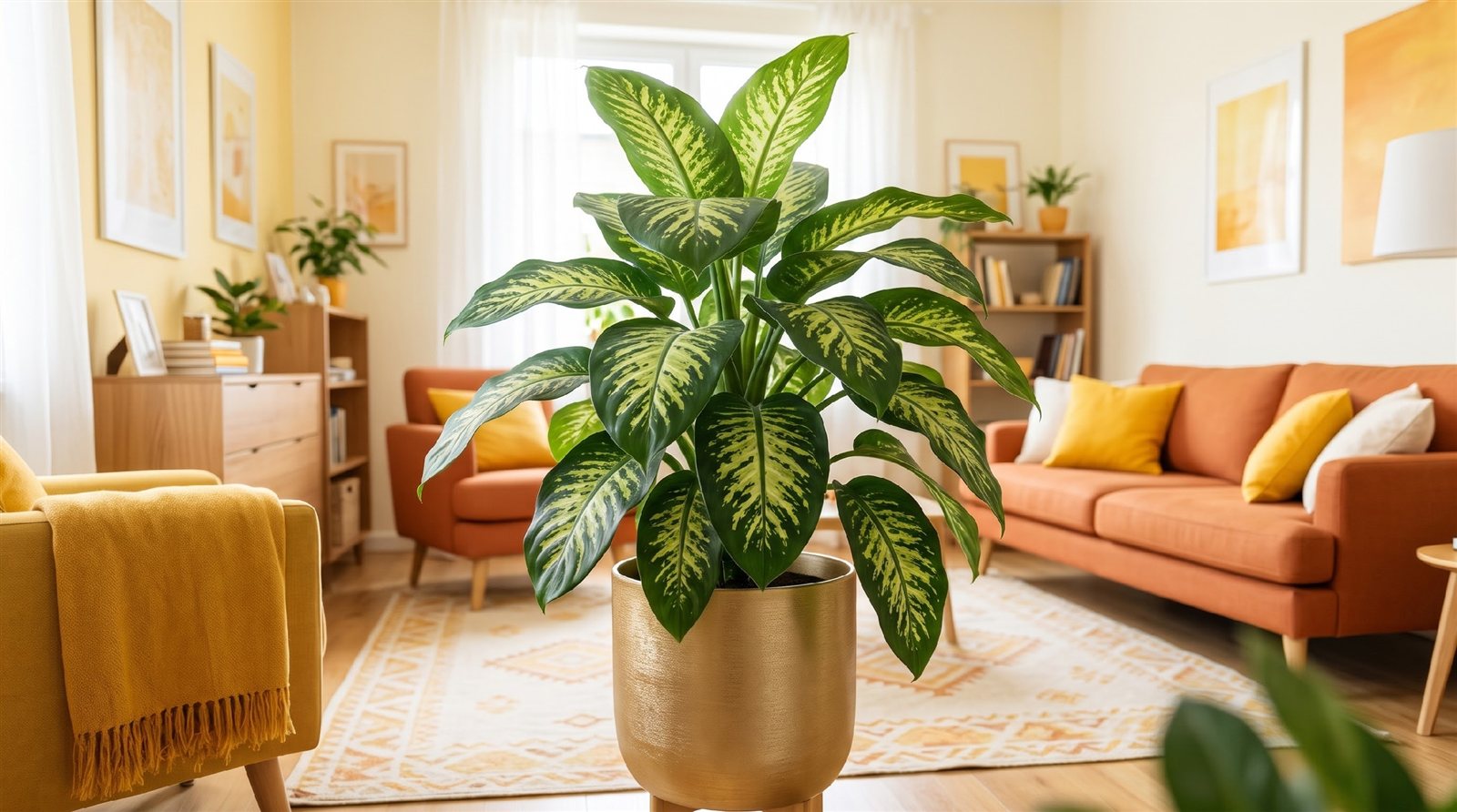
Dieffenbachia care comes down to three things most guides blur: enough light to keep the leaf pattern, steady warmth (this is one of the most cold-sensitive foliage plants sold), and a light hand with water and fertilizer. Get those right and a dumb cane will grow for years indoors. When it goes wrong, the plant tells you with yellow lower leaves, brown edges or a long bare stem, and each of those has a specific cause.
This guide uses the numbers from University of Florida and other extension research, including the light levels different varieties need and how they handle cold. It also covers the ‘Tiki’ variety in detail, because almost no one explains what it actually is.
| Dieffenbachia Care at a Glance | |
|---|---|
| Light | Bright, indirect; 50 to 250 foot-candles depending on variety; some direct sun in winter is fine |
| Water | Water thoroughly once the top inch of soil is dry |
| Temperature | 60 to 75°F for homes; keep it above 55°F |
| Fertilizer | None for 2 months after purchase, then a diluted feed in spring and summer only |
| Soil | Any well-drained potting mix; pH 6.0 to 6.5 |
| Size indoors | About 1 foot for compact types; most reach 3 to 6 feet |
| Pets | Toxic to cats and dogs (ASPCA); the sap also irritates skin and eyes |
How Much Light Does a Dieffenbachia Need?
More than its “low-light plant” reputation suggests, and the amount depends on the variety. The University of Florida’s dieffenbachia guide (EP137) gives the range: ‘Star Bright’ and ‘Snow Flake’ “will tolerate low light levels of 50 foot candles, whereas ‘Camille’ requires 150-250 foot candles to remain attractive.” For comparison, growers produce these plants under about 2,500 foot-candles, so even a bright room is a big step down for a plant fresh from the nursery.
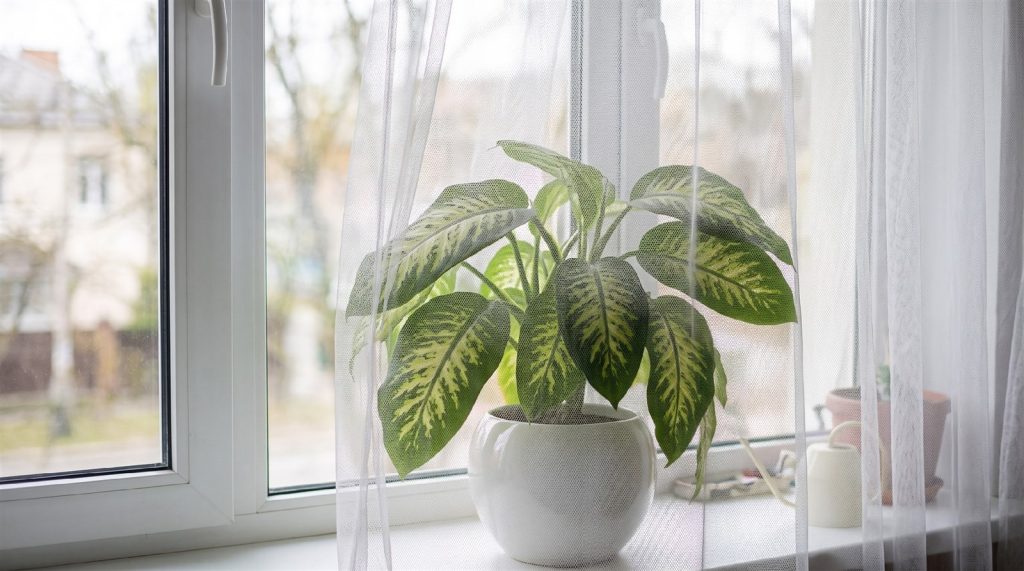
A foot-candle is a unit of light intensity, and a free light-meter app on your phone gives a rough reading. The point of the numbers is the spread: a dark corner that keeps one variety alive will make another lose its color.
What too little light looks like
The same UF guide names the symptoms: “Inappropriate low light levels cause foliar variegation reduction and excess stem elongation.” In practice, new leaves come out greener and plainer than the old ones, and the gaps between leaves on the stem get longer. That is the start of a leggy plant. Turning the pot a quarter turn every few days, as UF Gardening Solutions suggests, keeps the stem from leaning toward the window.
What too much light looks like
Leaves that look bleached or “washed-out,” in UF’s words. Strong summer sun through glass does this. Winter is different: Clemson Extension’s dieffenbachia fact sheet recommends bright filtered light in spring, summer and fall, but says “bright light, even direct sunlight, is best during winter.” I would move the plant closer to the window from November to February and pull it back in spring.
How Often to Water Dieffenbachia
Water thoroughly, then wait until the top inch of soil is dry to the touch before watering again. Clemson and NC State Extension both give that same rule, and it works better than any fixed schedule because a plant in a warm, bright room dries out far faster than one in a cool corner.
Overwatering is the common mistake. University of Illinois Extension notes that dumb cane “is often overwatered causing the roots and base of the canes to rot quickly,” and Clemson traces root rot to “a soil mix that does not drain quickly or overly frequent watering.” Use a pot with a drainage hole and empty the saucer after watering.
Any well-drained potting mix suits it. Commercial growers use peat with pine bark, perlite or vermiculite at a pH of 6.0 to 6.5 (EP137), and a standard indoor mix with a handful of perlite is close to that. Repot in early spring, when roots fill the pot.
Temperature: Why Cold Is the Real Danger
Keep a dieffenbachia between 60 and 75°F and never let it sit below 55°F. Clemson and UF Gardening Solutions both give 60 to 75°F as ideal for homes. UF’s chilling-injury study (EP530) calls dieffenbachia “one of the most sensitive foliage plant genera for chilling injury,” which means damage from temperatures well above freezing, roughly 32 to 59°F.
How sensitive depends on the variety. UF chilled eight cultivars at 35, 45 and 55°F:
| Result | Cultivars |
|---|---|
| Most cold-tolerant | ‘Panther’ (no injury in the test), then ‘Star Bright’ and ‘Camouflage’ |
| Middle | ‘Camille’, ‘Octopus’, ‘Carina’ |
| Least tolerant | ‘Sterling’, then ‘Tropic Honey’ |
| Injured at 45°F | Only ‘Tropic Honey’: 26% of leaves damaged after 6 hours |
| Killed at 35°F | All ‘Tropic Honey’ plants, even after only 6 hours |
Chilling shows up as yellowing, water-soaked patches and wilting, and in bad cases a reddish-brown stem base that collapses. On leaves, UF’s EP137 describes the areas between the main veins turning pale or light brown. The usual culprits at home are a cold window pane in January, a draft from an exterior door, and the ride home from the store in winter. My advice is to have the plant wrapped for any trip in weather below 50°F and to keep the leaves from touching the glass.
Humidity matters less than warmth. Growers keep it at 60% or more, and UConn Extension suggests a pebble tray or grouping plants indoors rather than misting.
Fertilizing: Less Than You Think
Don’t fertilize a new plant for at least two months. UF’s EP137 says “plants do not need fertilizer for at least two months after purchase,” because nursery plants arrive with nutrients in the mix. After that, feed only in the growing season. The extension sources give slightly different schedules:
- Clemson: liquid fertilizer at half strength every two to four weeks, March through September.
- UConn: a complete fertilizer such as 20-20-20 every four to six weeks in the growing season.
- UF EP137: a dilute feed once a month, with a nitrogen-heavy ratio around 3-1-2.
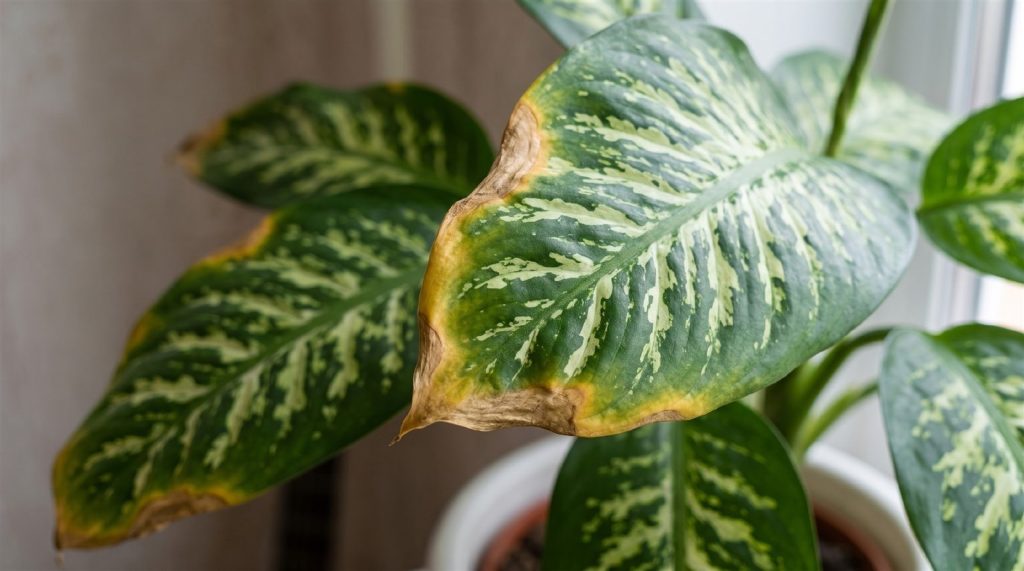
I would go with half strength once a month from spring to late summer and nothing in winter. UConn adds a useful point: plants given “a minimal amount of nutrients will grow slowly and retain a desired shape.” A lean diet keeps a dieffenbachia compact. Too much fertilizer shows up as burned leaf edges; too little as yellowing, smaller leaves and stunted growth (Clemson).
Yellow Leaves, Brown Tips and Drooping: What Each Means
Match what you see to the likely cause before changing anything. Most problems trace back to water, light or cold.
| What you see | Likely cause | What to do |
|---|---|---|
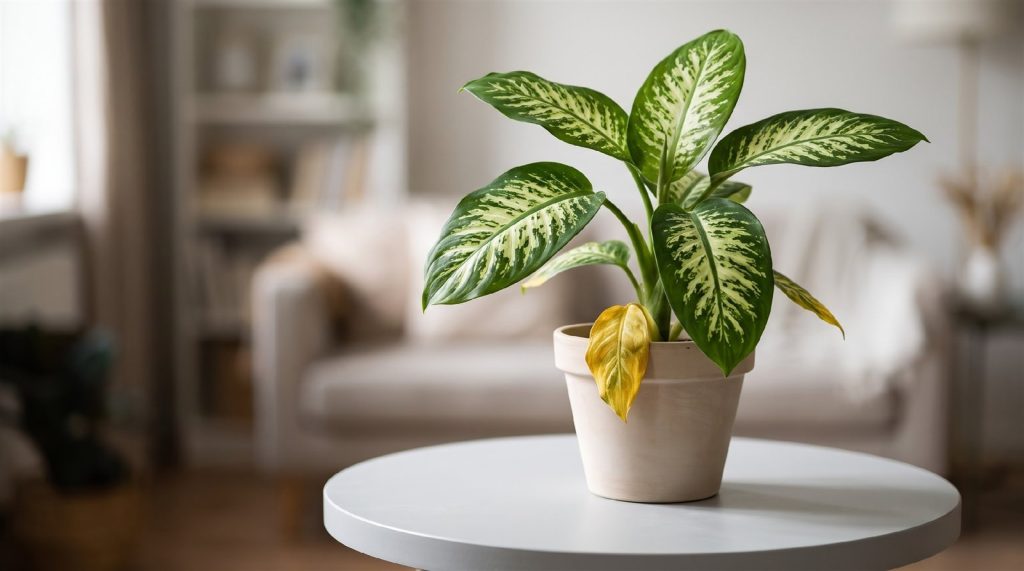
| One lower leaf yellows at a time; the rest of the plant looks healthy | Normal aging; lower leaves “naturally drop” as the stem matures (Clemson) | Remove the leaf; nothing else |
| Several yellow leaves, soil stays wet, base of the stem soft | Overwatering and root rot (UConn, Illinois) | Let the soil dry; check roots; repot in fresh mix if roots are brown and mushy |
| Yellow lower leaves, dry soil, dry room | “Excess moisture loss” (UF EP137) | Water more consistently; raise humidity with a pebble tray |
| Brown leaf tips or edges | Too much fertilizer, or soil drying out between waterings (UConn, UF) | Flush the pot with plain water; feed less; water evenly |
| New leaves small and curled down with dead edges | Wet soil plus salt buildup (UF EP137) | Flush the pot, water less often, stop feeding for a month |
| Leaves pale or washed out | Too much direct light (UF EP137) | Move back from the window or filter with a sheer curtain |
| New leaves greener, long gaps on the stem | Too little light (UF EP137) | Move closer to a window |
| Whole plant droops | Too dry or too cold (UF Gardening Solutions) | Check the soil first, then the temperature near the plant |
| Leaves drop after a move or near a door | Sudden temperature change or drafts (UConn) | Find a stable spot away from doors and vents |
| Water-soaked patches, reddish-brown stem base after a cold spell | Chilling injury (UF EP530) | Move somewhere warm; cut off damaged leaves once you see what recovers |
| Mushy spots with a rotten, fishy smell | Bacterial soft rot (UF PP286) | No chemical cure exists; root a healthy top cutting and discard the rest |
| Dark spots with a yellow halo, starting at the leaf edge | Bacterial leaf spot, spread by splashing water (UF PP286) | Remove affected leaves; water the soil, not the leaves |
| White cottony clumps on stems and leaf undersides | Mealybugs | Wipe off with a cotton ball dipped in rubbing alcohol (UConn) |
| Fine webbing, speckled pale leaves | Spider mites | Hose the plant down with a strong spray of water (UF); discard heavily infested plants |
The bacterial rots are mainly a greenhouse problem. Clemson notes that “in the home, plant diseases are very rarely a problem,” so check water and temperature before assuming disease. If your plant shares a room with an alocasia, a relative in the same aroid family, the same overwatering rules apply to both.
How to Fix a Leggy Dieffenbachia
Cut it back. Clemson and UF give the same instruction: cut the stem down to about 6 inches tall, and “the plant will regrow below the cut.” New shoots come from dormant buds on the remaining stump. Do it in spring or early summer, when the plant has light and warmth to recover.
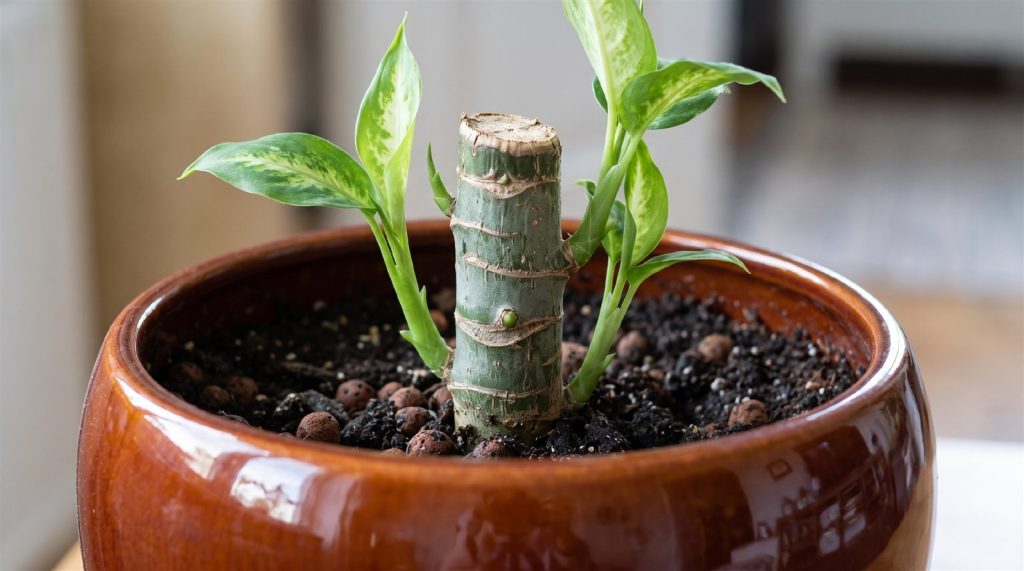
A tall plant with leaves only at the top is partly normal. Clemson points out that lower leaves drop as the plant matures “to reveal attractive, trunklike stems.” It becomes a problem when the stem leans or the plant looks like a palm tree on a stick. If only the lower third is bare and the rest looks good, I would leave it.
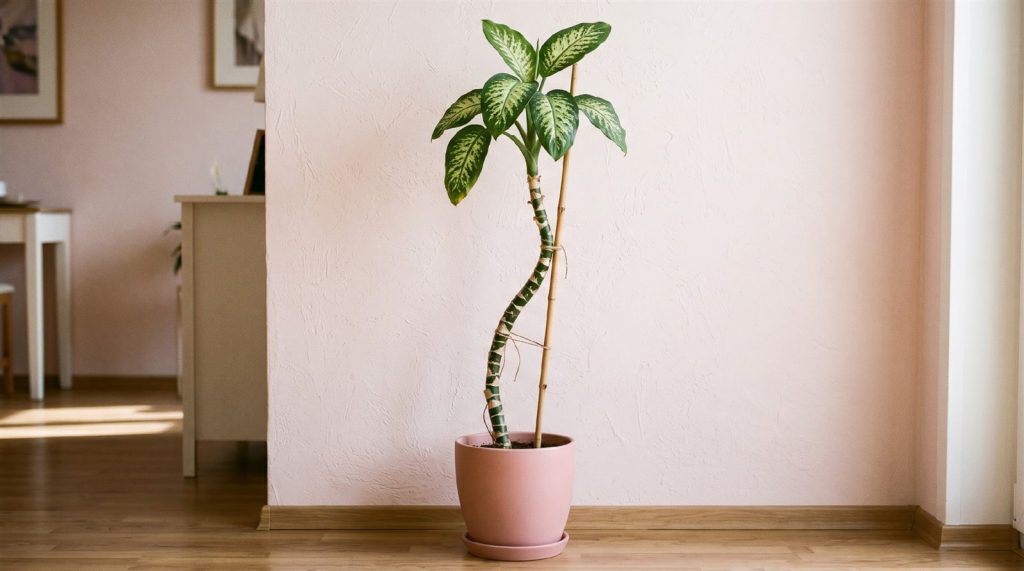
Don’t throw away the top you cut off. University of Illinois Extension notes it “can be cut off and rooted in sand or water,” which gives you a second plant. Wear gloves for this job: the sap irritates skin, and you do not want it near your eyes.
How to Propagate Dieffenbachia
Dieffenbachia roots from tip cuttings, sections of bare stem (cane), or air layering, best done in spring or early summer (Clemson).
Tip cuttings
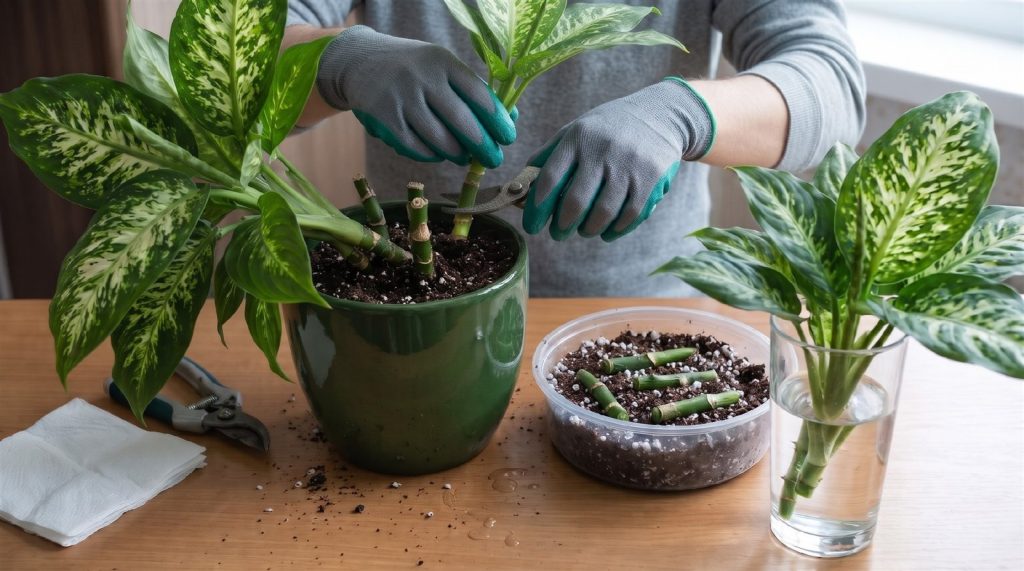
Take the top of the plant with a few leaves, strip the lowest leaf, and root it in water or moist potting mix. UConn notes tip cuttings root faster than sections from the base of the stem. Commercial growers get roots in 3 to 8 weeks with the rooting mix at 75°F or warmer (UF EP137), so a warm spot speeds things up.
Cane sections
This is how to use the bare stem left after cutting back a leggy plant:
- Cut the stem into 2- to 3-inch pieces, each with at least one bud or node (UConn, Iowa State).
- Let the cut ends dry for a day (UConn).
- Lay each piece on its side, half buried in moist peat, perlite or vermiculite, with the bud facing up.
- Keep it at 65 to 75°F. Iowa State Extension expects roots and shoots in 8 to 10 weeks.
Air layering
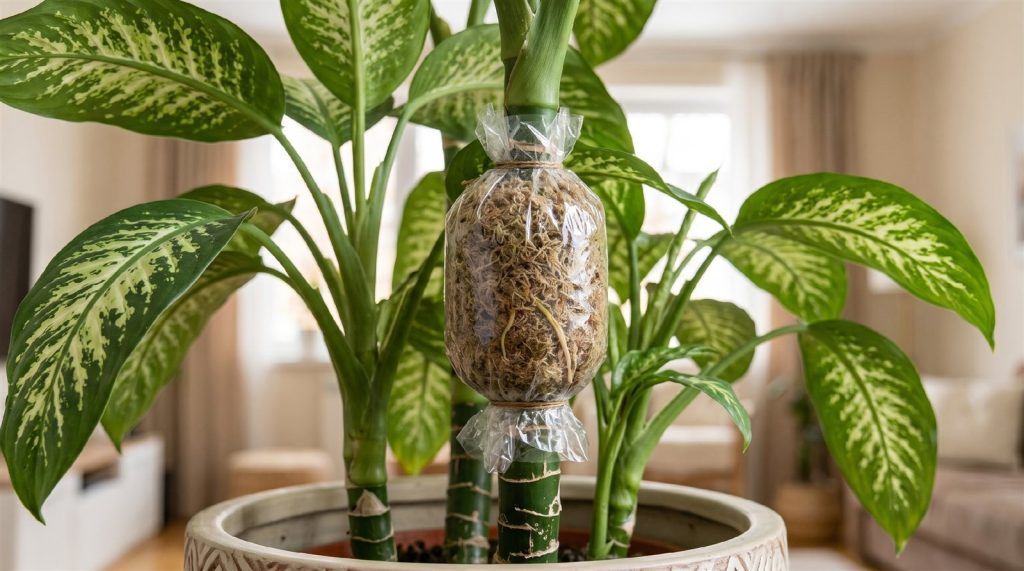
Best for a tall plant you want to shorten without leaving it unrooted. Illinois Extension describes the method: make an upward slanting cut one-third to halfway through the stem, prop it open with a toothpick, dust with rooting hormone, wrap a fist-sized ball of moist sphagnum moss around it, and cover with clear plastic. “After 3-4 months, roots should begin to appear.” Then cut below the new roots and pot the top.
Dieffenbachia ‘Tiki’: What It Actually Is
‘Tiki’ is a natural mutation (a sport) of the older cultivar ‘Memoria Corsii’, found at Vanderlaan’s Nursery in Lake Worth, Florida, and patented in 1990. The US plant patent PP7298, filed by Dan Vanderlaan and Robert Hartman of Hartman Plant Laboratories, is the most detailed description of the plant anywhere, and none of the popular care guides cite it. The patent has since expired.
How to recognize a ‘Tiki’
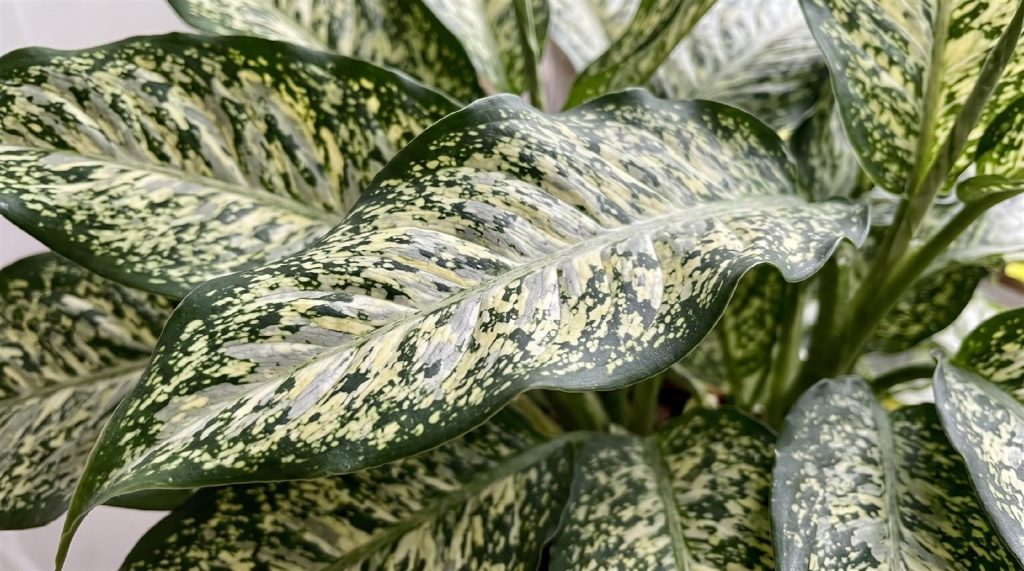
Compared with its parent, the patent describes leaves that are “narrower and wavier,” with green and gray variegation and more white spots on both surfaces. The leaf blades are “highly undulated for a Dieffenbachia,” and those rippled edges are the easiest thing to spot. Average leaves measure 22 to 26 cm long and 10 to 12 cm wide, about 9 to 10 inches by 4 to 5 inches. UF’s EP137 sums it up as “narrow and wavy leaves that have green and gray variegation with white spotting,” and Clemson describes “silver leaves mottled with green and white.”
How big does ‘Tiki’ get?
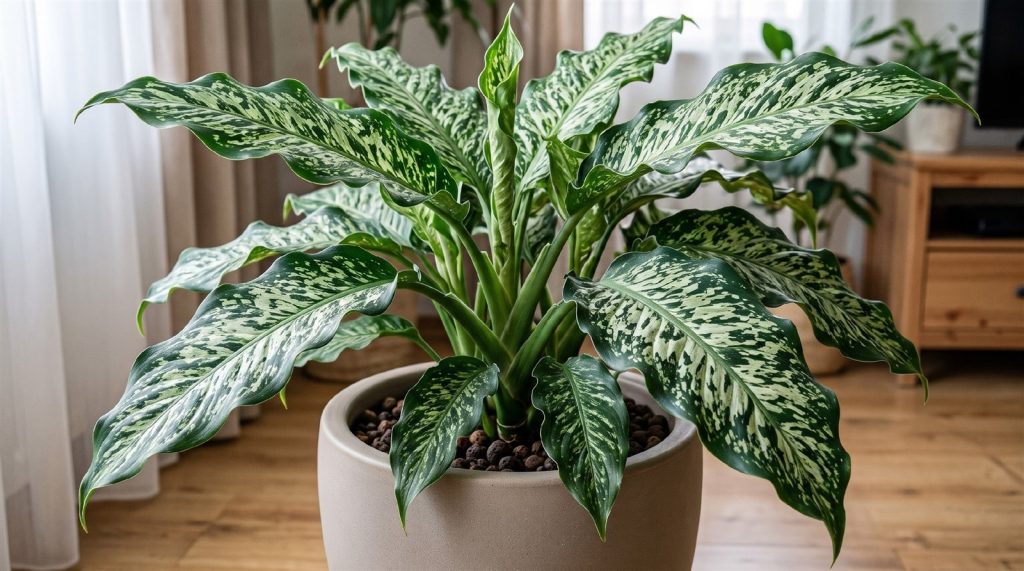
Sources disagree, and the reason is what they compare. The patent says the plant is “shorter and branches more” than ‘Memoria Corsii’, sending up 4 to 7 side shoots; in a 6-inch pot it measured 20 to 28 cm tall but 55 to 60 cm wide. Clemson calls ‘Tiki’ “one of the largest dieffenbachias at maturity.” Both can be true: it starts as a low, spreading clump in the pot and fills out into a large plant over the years. Plan for width as much as height.
‘Tiki’, ‘Tropical Tiki’ and ‘Snow Flake’
NC State Extension lists a ‘Tropical Tiki’ with “dark and light green leaves with white splatters.” No source confirms whether this is the same plant under a trade name, so go by the leaf: strong waves and gray marbling mean ‘Tiki’. ‘Snow Flake’ is a sport of ‘Tiki’ itself, “almost entirely white and gray with very little green” (UF EP137), and is one of the two varieties UF lists as tolerating 50 foot-candles.
Does ‘Tiki’ need different care?
No. No extension source or the patent gives any care rule specific to ‘Tiki’. Clemson says it tolerates low light, but in my view the gray and silver pattern is the reason to grow it, and that pattern fades first when light is short. I would give it the bright, indirect light you would give ‘Camille’, and expect it to need repotting sooner than an upright variety because of all the side shoots. Everything else in this guide applies, and it is just as toxic to pets as any other dieffenbachia.
Popular Dieffenbachia Varieties Compared
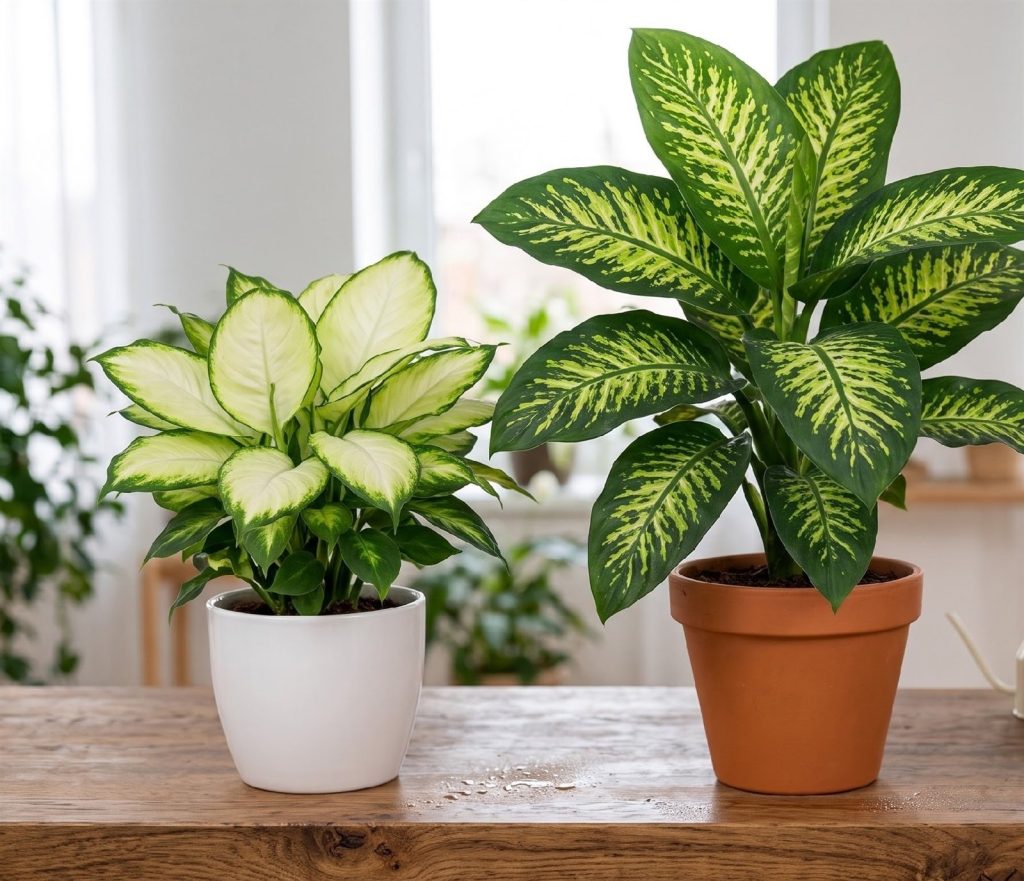
The genus has about 30 species and more than 100 cultivars, of which roughly 20 are grown commercially (UF). Most houseplants sold today are hybrids or sports, and the species names D. maculata, D. picta and D. amoena you see on older tags are now treated as Dieffenbachia seguine (NC State).
| Variety | Leaf pattern | Size and habit | Worth knowing |
|---|---|---|---|
| ‘Tiki’ | Narrow, very wavy leaves; gray and green marbling, white spots | Bushy, branches from the base | Sport of ‘Memoria Corsii’, patented 1990 |
| ‘Snow Flake’ | Almost all white and gray | Similar to ‘Tiki’ | Sport of ‘Tiki’; tolerates 50 fc (UF) |
| ‘Camille’ | Creamy ivory center, dark green border | Bushy, up to about 3 ft | Needs 150 to 250 fc to keep its color (UF) |
| ‘Tropic Snow’ | Dark green with creamy-white blotches along the veins | Large and wide-spreading | Tolerates lower light than most (Clemson) |
| ‘Star Bright’ | Narrow, arching golden-green leaves splashed dark green | Small; bred for 6- to 10-inch pots | Tolerates 50 fc; second most cold-tolerant in UF’s test |
| ‘Panther’ | Long leaves, silvery-green center, wide dark rim | Medium | Most cold-tolerant in UF’s test |
| ‘Camouflage’ | Two greens: lighter center, darker edges with dark islands | Large, clumping; leaves up to 70 cm long | Mutation of ‘Panther’ (patent PP12275) |
| ‘Sterling’ | Deep green with a bright white midrib and veins | Compact, 4 to 8 basal shoots | Bred at UF (patent PP14762); cold-sensitive |
| ‘Compacta’ | Yellow speckled with green | Compact | Good for small spaces |
| ‘Tropic Marianne’ | Yellow-green with a thin green border | Dense, upright, larger than ‘Camille’ | Patent PP8832 |
If your space is dim, pick ‘Star Bright’, ‘Snow Flake’ or ‘Tropic Snow’. If the plant will sit near a drafty window, ‘Panther’ and ‘Star Bright’ handled cold best in UF’s trials.
Is Dieffenbachia Toxic to Pets and People?
Yes. The ASPCA lists dieffenbachia as toxic to cats and dogs. Every part of the plant contains needle-like calcium oxalate crystals that cause intense mouth pain, drooling and vomiting when chewed, and the sap can injure the eye. Serious poisoning is rare, but the plant earns its “dumb cane” name: the swelling can make speaking and swallowing difficult. Our guide on whether dieffenbachia is toxic to cats and dogs covers symptoms, first aid and when to go to the vet.
For care, the practical rule is gloves whenever you cut the plant, and washing your hands before touching your face. UF/IFAS also no longer recommends planting dieffenbachia outdoors in Florida, because it is predicted to become invasive there.
What Doesn’t Work
Treating it as a plant for dark corners. Only a few varieties tolerate about 50 foot-candles. The rest lose their pattern and stretch.
Misting the leaves daily. It barely changes room humidity, and wet foliage is what bacterial leaf spot needs to spread. A pebble tray or a humidifier does more.
Fertilizing year-round. Growth slows in winter, salts build up in the pot, and leaf edges burn.
Watering a drooping plant without checking the soil. Drooping can mean too dry, too cold or rotting roots. Extra water only fixes the first.
Throwing out a leggy plant. Cut back to 6 inches, it regrows, and the top becomes a new plant.
Pruning with bare hands. The sap irritates skin and is painful in the eyes.
Frequently Asked Questions
Why does my dieffenbachia drip water from its leaves?
This is guttation: the plant pushes excess water out through leaf edges and tips, usually after a heavy watering when the air is humid. It is not a disease. UConn notes that salts left behind by the droplets can cause tip burn, so wipe them off if the tips start browning.
How often should I water a dieffenbachia?
When the top inch of soil is dry, which may be weekly in summer and every two to three weeks in a cool winter room. Water thoroughly and let the excess drain away.
Why is it called dumb cane?
Because chewing the stem or leaves releases crystals that numb and swell the mouth and throat, which can temporarily stop a person from speaking. NC State Extension links the name to these “numbing and paralyzing effects of the sap.”
Can dieffenbachia go outside in summer?
Yes, in shade, once nights stay above 60°F. Bring it in well before temperatures fall to 55°F, because chilling damage starts above freezing.
Can I root a dieffenbachia cutting in water?
Yes. University of Illinois Extension notes tops root in water or sand. Pot the cutting into soil once the roots are a few inches long.
Why are the lower leaves falling off?
Some loss is normal as the plant ages. If several leaves yellow at once, check for wet soil, cold drafts or a dark spot, the three most common causes.
Is the sap dangerous to touch?
It can irritate skin, and NC State warns that sap in the eye can damage the cornea. Wear gloves when pruning and keep your hands away from your face until you have washed them.