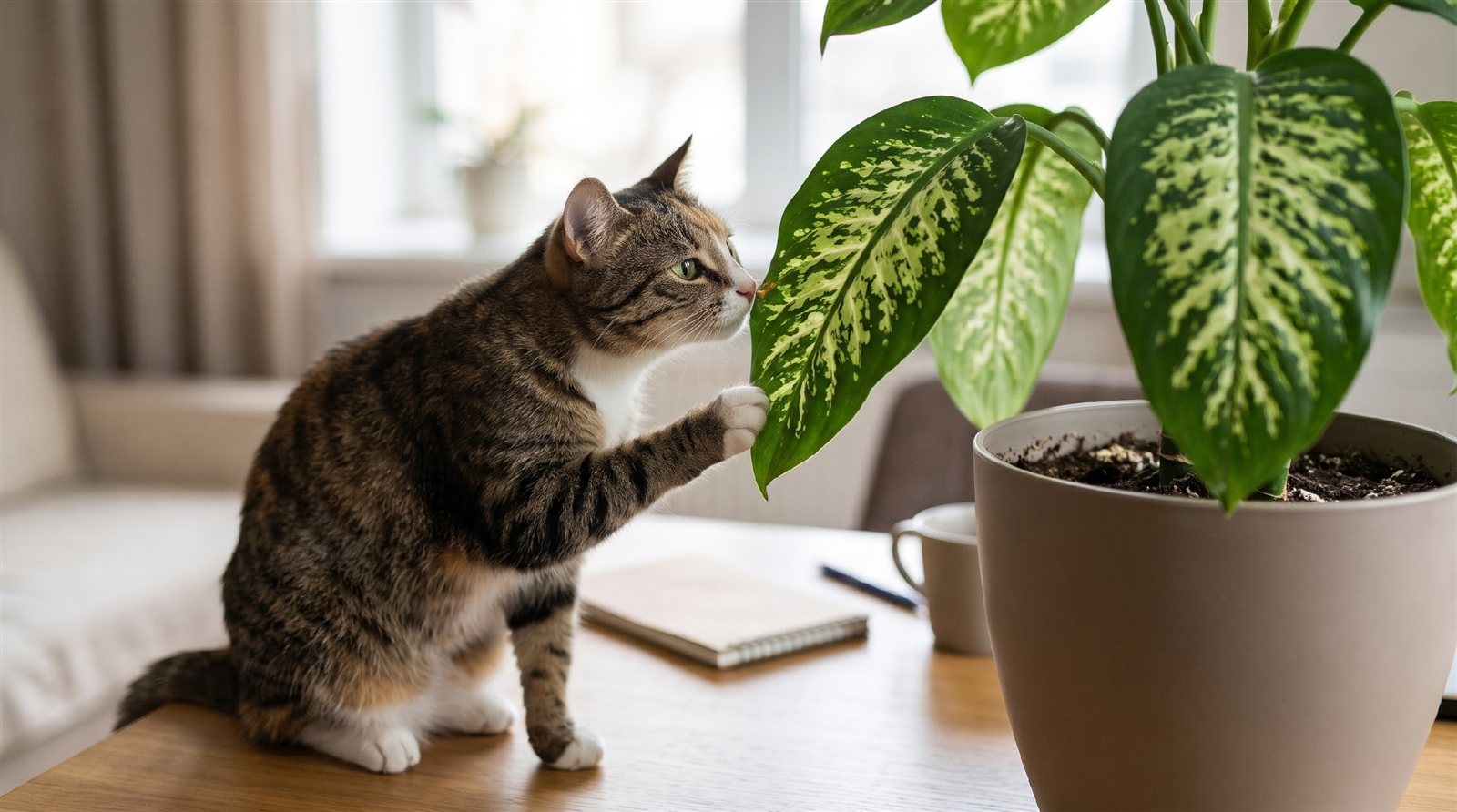
Is dieffenbachia toxic to cats and dogs? Yes. The ASPCA lists dieffenbachia (dumb cane) as toxic to both. Chewing any part of the plant releases microscopic needle-shaped crystals that cause immediate, intense pain in the mouth, drooling and often vomiting. The good news is that serious poisoning is rare: the Merck Veterinary Manual describes a good to excellent prognosis, and most pets recover fully. The one real danger is swelling in the throat, which is uncommon but needs a vet right away.
This guide explains what happens when a pet bites the plant, how symptoms differ between cats and dogs, what to do in the first few minutes, and when to go straight to the vet. If you came here for growing advice, see our dieffenbachia care guide.
| Dieffenbachia and Pets at a Glance | |
|---|---|
| Cats | Toxic (ASPCA) |
| Dogs | Toxic (ASPCA) |
| Toxic parts | All of it: leaves, stem, roots and sap |
| Cause | Insoluble calcium oxalate crystals and a protein-digesting enzyme |
| Typical signs | Mouth pain, drooling, pawing at the mouth, vomiting, trouble swallowing |
| When it starts | Immediately, as soon as the plant is chewed |
| Emergency sign | Swelling of the face or throat, noisy or difficult breathing |
| Hotlines | ASPCA (888) 426-4435; Pet Poison Helpline (855) 764-7661 |
Is Dieffenbachia Toxic to Cats?
Yes. The ASPCA’s dieffenbachia entry lists it as toxic to cats, with “insoluble calcium oxalates, proteolytic enzyme” as the toxic principles. The clinical signs it lists are “oral irritation, intense burning and irritation of mouth, tongue and lips, excessive drooling, vomiting, difficulty swallowing.”
The ASPCA database files the plant under several names, so you may find it as Dumbcane, Charming Dieffenbachia, Giant Dumb Cane, Spotted Dumb Cane, Tropic Snow, Exotica or Exotica Perfection. All of them carry the same warning.
The burning starts with the first bite, which usually limits how much a pet swallows. A 2020 veterinary review in Frontiers in Veterinary Science describes cats as especially sensitive to plants with these crystals, which is one more reason not to wait and see if your cat is struggling to swallow.
Is Dieffenbachia Toxic to Dogs?
Yes. The ASPCA lists it as toxic to dogs with the same signs. Dogs bring a risk cats usually don’t: they chew big pieces, including the thick stem. The only published pet death from dieffenbachia, a case report by Loretti and colleagues in 2003, involved a 9-year-old poodle that chewed the thick stem of a dumb cane. The dog developed severe tongue inflammation and sudden breathing difficulty, and died a few hours later from swelling that closed its airway.

That case is the exception. It is why vets take throat swelling seriously, not a sign that a dog that licked a leaf is in danger.
What Happens When a Pet Chews Dieffenbachia
The plant stores bundles of needle-like calcium oxalate crystals, called raphides, inside special cells. The Merck Veterinary Manual explains that “chewing or crushing the plant material causes these idioblasts to release the raphides into tissues.” The cells fire the crystals out like tiny darts, and the crystals embed in the lips, tongue and gums.
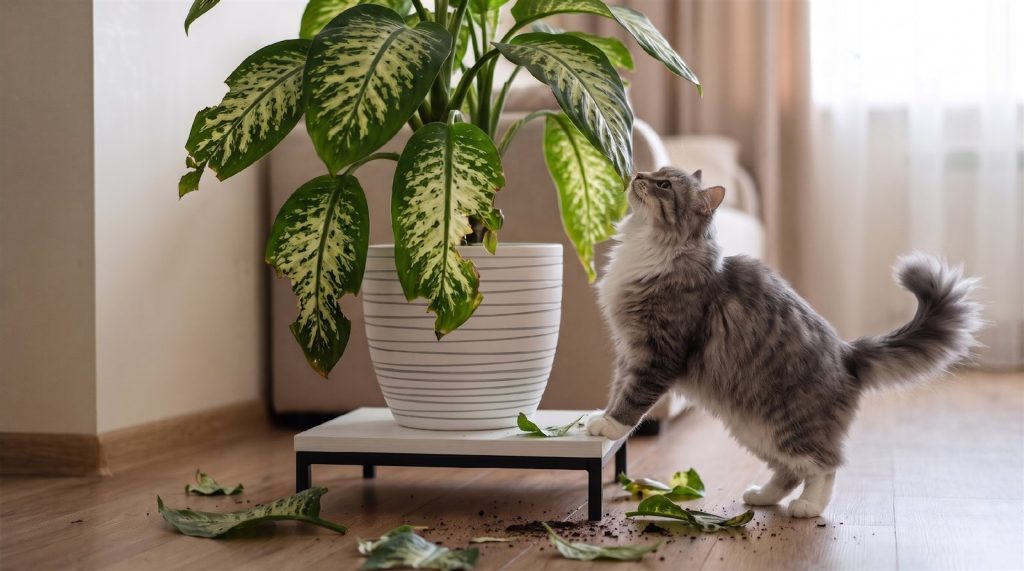
The crystals are only part of the story. The plant also contains a protein-digesting enzyme, and researchers think the combination does the damage: the needles make small wounds, and the enzyme triggers the release of histamine and other inflammatory substances. The exact mechanism is still debated in the scientific literature, but the result is the same: pain and swelling right where the plant touched.
Children’s Hospital of Philadelphia’s poison center describes biting the plant as like “biting into ground glass.” That instant pain is why most pets stop after one bite and why serious cases are uncommon.
Symptoms in Cats vs Dogs
| Cats | Dogs | |
|---|---|---|
| Typical signs | Drooling, pawing at the mouth, head shaking, vomiting, refusing food | Drooling, pawing at the mouth, retching, vomiting, refusing food |
| Amount eaten | Often a small bite of leaf | May chew larger pieces, including the stem |
| Rare serious sign | Throat swelling, trouble breathing | Throat swelling, trouble breathing (one published fatal case) |
| Making them vomit at home | Never; no home method is safe for cats | Never without instructions from a vet or hotline |
| Outlook | Good to excellent; full recovery expected (Merck Veterinary Manual) | |
The Merck manual lists “immediate pain, irritation, erythema, hypersalivation, pawing at mouth, edema, lethargy, and anorexia” for pets that chew these plants. In plain terms: redness, drooling, swelling, tiredness and not wanting to eat. The ASPCA adds retching, nausea, diarrhea and head shaking.
Watch at Home or Go to the Vet?
Breathing decides it. Use this to judge the first hour:
| What you see | What to do |
|---|---|
| Drooling, pawing at the mouth, one bout of vomiting; breathing normally and can swallow | First aid below, then call your vet or a hotline for advice; watch closely |
| Symptoms not easing after a few hours, repeated vomiting, refusing water | Call your vet today |
| Swollen face, lips or tongue; noisy breathing; gagging, can’t swallow; breathing with effort | Emergency vet now; don’t wait for a callback |
| Sap in the eye: squinting, pawing at the eye, watering | Flush the eye with lukewarm water and call your vet; eye injuries need an exam |
| Ate a large amount, especially chunks of stem | Call your vet or a hotline now, even if symptoms look mild |
The ASPCA’s advice is the same: if your pet has trouble swallowing or breathing, go directly to a veterinary hospital. My advice is to call even in a mild case. A hotline vet can tell you within minutes whether your pet’s signs fit the expected pattern, and it saves you guessing.
First Aid: What to Do and What Not to Do
- Get the plant away from your pet and take any pieces out of its mouth if you can do it safely. An animal in pain may bite.
- Rinse or wipe the mouth. The Merck manual lists removing plant material and rinsing or wiping the mouth as the first steps.
- Offer a little dairy. The ASPCA suggests a small amount of milk, yogurt or vanilla ice cream to ease the burning. Check that the product contains no xylitol, a sweetener that is dangerous to dogs. Skip this if your pet is struggling to swallow.
- Call your vet or a poison hotline. Keep the plant tag or a photo nearby so you can identify it.
- Watch breathing for the next few hours.
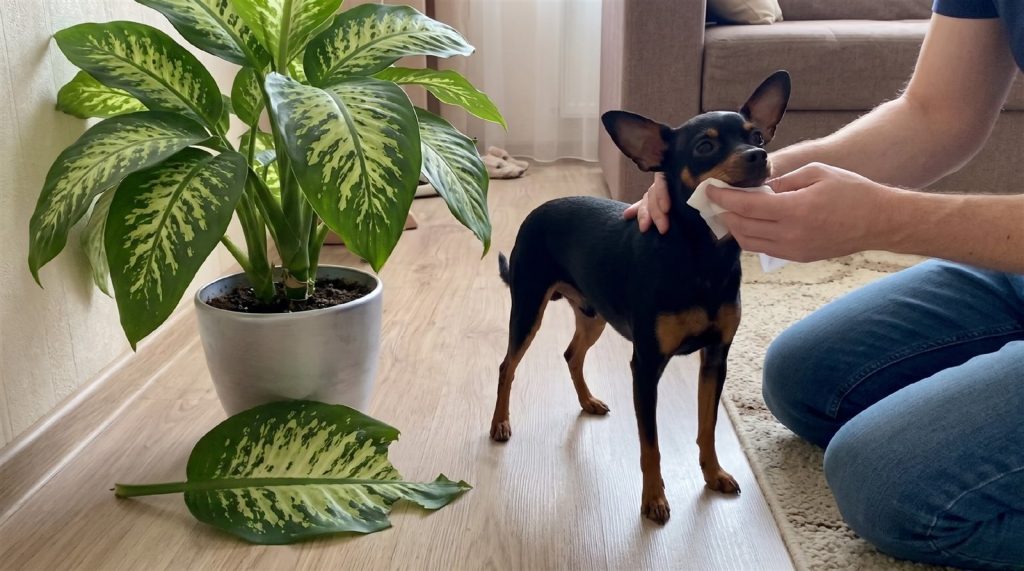
Don’t try to make your pet vomit. Pet Poison Helpline warns that “you can do more harm than good if you attempt to induce vomiting yourself,” and that hydrogen peroxide is not safe for cats and can be fatal. The ASPCA says there is “nothing that can be given at home to safely get a cat to vomit.” With a plant that burns the mouth, bringing it back up would only repeat the irritation.
A note on milk, because you will see conflicting claims: dairy soothes, it does not “neutralize” the crystals already stuck in the tissue. The Merck manual says vets “sometimes” use calcium-containing dairy products. Think of it as a cold compress for the mouth, not an antidote.
What the vet does
Treatment is supportive: removing remaining plant material, rinsing the mouth, medication for pain and vomiting, and watching for swelling in the throat. In the rare severe case, the Merck manual notes that “securing an airway and providing oxygen support may be necessary.” VCA Animal Hospitals states that toxicity beyond the mouth and stomach “is not expected.”
Is Every Part and Every Variety Toxic?
Yes to both. Clemson Extension notes that “all the plant parts contain needle-like crystals,” and NC State Extension lists the leaves, roots, sap and stems as toxic. The stem deserves extra caution: it is the part the dog in the fatal case chewed, and it is the part people handle most when pruning and propagating. Water dripping from a freshly cut stem can also irritate a pet’s mouth or eyes.
Popular varieties such as ‘Tiki’, ‘Camille’ and ‘Compacta’ do not have their own ASPCA entries, but they are all dieffenbachias with the same crystals. I would treat every variety as equally toxic. You can read more about ‘Tiki’ and other varieties in our dieffenbachia care guide.
How Dangerous Is Dieffenbachia, Really?
Painful, rarely dangerous. The ASPCA says “long-term effects are not expected,” and the Merck manual notes that “full recovery is expected, often without veterinary intervention.” Cornell’s poisonous plants database puts it plainly: the plant won’t kill a cat “unless the swelling got so bad the windpipe were closed, and that rarely happens.”
Two myths are worth clearing up:
- “Dieffenbachia is deadly to cats.” It is toxic, but the veterinary sources describe local irritation with a good outlook. The single published death involved a dog chewing the stem. Some sources, including NC State’s plant database, still rate the plant “may be fatal to pets,” which is technically true for that rare airway case, not the typical one.
- “It causes kidney failure.” That is a different kind of oxalate. Plants like rhubarb leaves and star fruit contain soluble oxalates, which can harm the kidneys. Dieffenbachia’s crystals are insoluble, and the Merck manual states they “do not pose a concern for renal injury.”
Is Dieffenbachia Dangerous to People?
For people, the same rules apply. A child who bites a leaf gets the same instant pain, and poison centers see many such cases. US poison center data from 1985 to 1994 ranked dieffenbachia second only to philodendron among plant exposures. In one study of 188 cases, mostly babies under a year old, only 2.1% developed symptoms at all, and those were minor. For any human exposure in the US, call Poison Help at 1-800-222-1222.
The eyes are the bigger risk for adults, usually from sap squirting while pruning. NC State Extension warns that “sap exposure to the eyes can result in damage to the cornea.” In published cases, the crystals cleared from the cornea within one to three months. The National Capital Poison Center advises flushing the eye with water for at least 15 minutes and washing skin with soap and water. I would wear gloves and glasses when cutting a big dumb cane, and keep pets out of the room while you do it.
Can You Keep Dieffenbachia With Cats or Dogs?
Only if they truly can’t reach it. Cornell’s Feline Health Center says “the only way to guarantee protection for both your houseplants and your cat is to block access to the plants,” and Clemson Extension goes further: dieffenbachias are “not recommended if children or pets are present.”

- A room the pet doesn’t use is the only reliable option for a floor-sized plant. A high shelf works against dogs, rarely against cats.
- Give the cat its own greens. A pot of cat grass in a favorite spot gives a plant-chewing cat a safe outlet. Of all the options here, it is the one I would try first.
- Clean up after pruning. Fallen leaves and cut stems on the floor are easy targets.
- Know your other plants. Several common houseplants carry the same crystals, including pothos, peace lily and ZZ plant, so the same first aid applies.
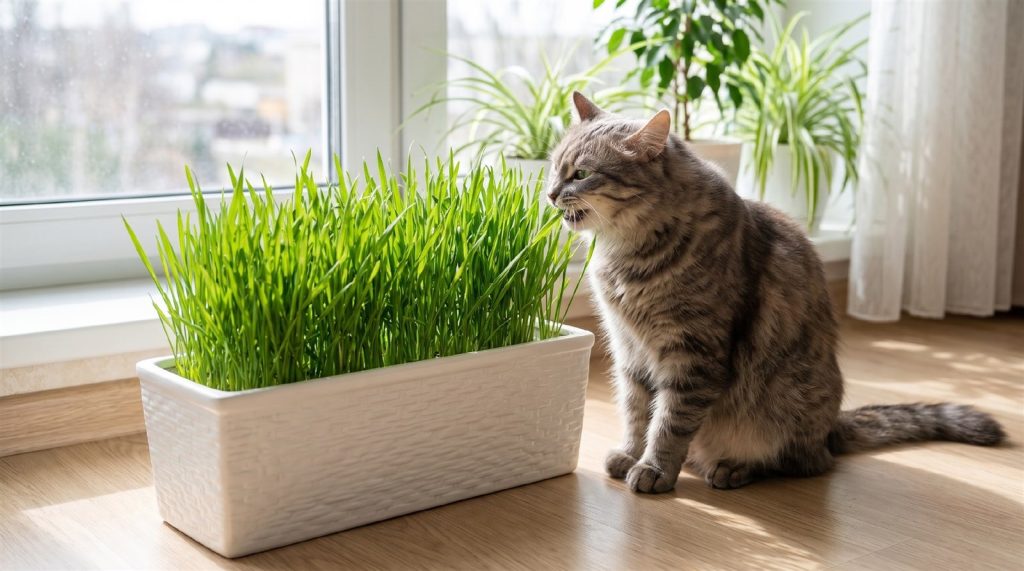
If your pet is a known plant chewer, I would give the dieffenbachia to a pet-free home rather than gamble. For patterned leaves without the risk, calathea is listed by the ASPCA as non-toxic to cats, dogs and horses (see is calathea toxic to cats). Spider plants and the areca palm are other pet-safe choices.
Pet Poison Hotlines
| Service | Phone | Cost |
|---|---|---|
| ASPCA Animal Poison Control Center | (888) 426-4435 | “A consultation fee may apply”; recent reports put it at $95 |
| Pet Poison Helpline | (855) 764-7661 | $99 per incident, follow-up calls included |
| Poison Help (people, US) | 1-800-222-1222 | Free |
Both pet hotlines answer around the clock. If cost is a concern, your own vet’s office is a good first call during opening hours.
What Doesn’t Help
Inducing vomiting. It is unsafe for cats under any circumstances and pointless for a plant that burns on contact.
Treating milk as an antidote. It eases the pain; it does not remove the crystals.
Waiting overnight when breathing changes. Throat swelling is rare, but it is the one sign that can’t wait.
Assuming a different variety is safe. ‘Tiki’, ‘Camille’ and every other dumb cane carry the same crystals.
Pruning with pets nearby. Sap and cut pieces end up on the floor, on paws and in eyes.
Frequently Asked Questions
My cat bit a dieffenbachia leaf. What should I do?
Rinse or wipe its mouth, offer a little milk or plain yogurt if it can swallow normally, and call your vet or a pet poison hotline. Go to an emergency vet if you see swelling of the face or throat or any trouble breathing.
How long do dieffenbachia symptoms last in pets?
Signs start immediately after chewing. Veterinary sources describe a good to excellent outlook with full recovery, but give no exact timeline. Call your vet if your pet still won’t eat or drink after a few hours.
Can dieffenbachia kill a dog?
Very rarely. One fatal case has been published: a dog that chewed the thick stem and died from airway swelling. Most dogs only have mouth pain, drooling and vomiting.
Is dieffenbachia toxic to touch?
The sap can irritate skin and is painful in the eyes, for people and pets. Wear gloves when pruning and wash your hands before touching your face.
Is ‘Tiki’ dieffenbachia toxic to cats?
Yes. ‘Tiki’ is a dieffenbachia variety and contains the same calcium oxalate crystals as the species the ASPCA lists as toxic.
Can the water from a dieffenbachia pot hurt my pet?
Water dripping from cut stems or leaves can carry sap, so keep pets from drinking from the saucer after pruning or propagating.
Is dieffenbachia toxic to horses?
The ASPCA’s dieffenbachia entry lists only cats and dogs. It is still an irritant plant, so keep cuttings out of paddocks.