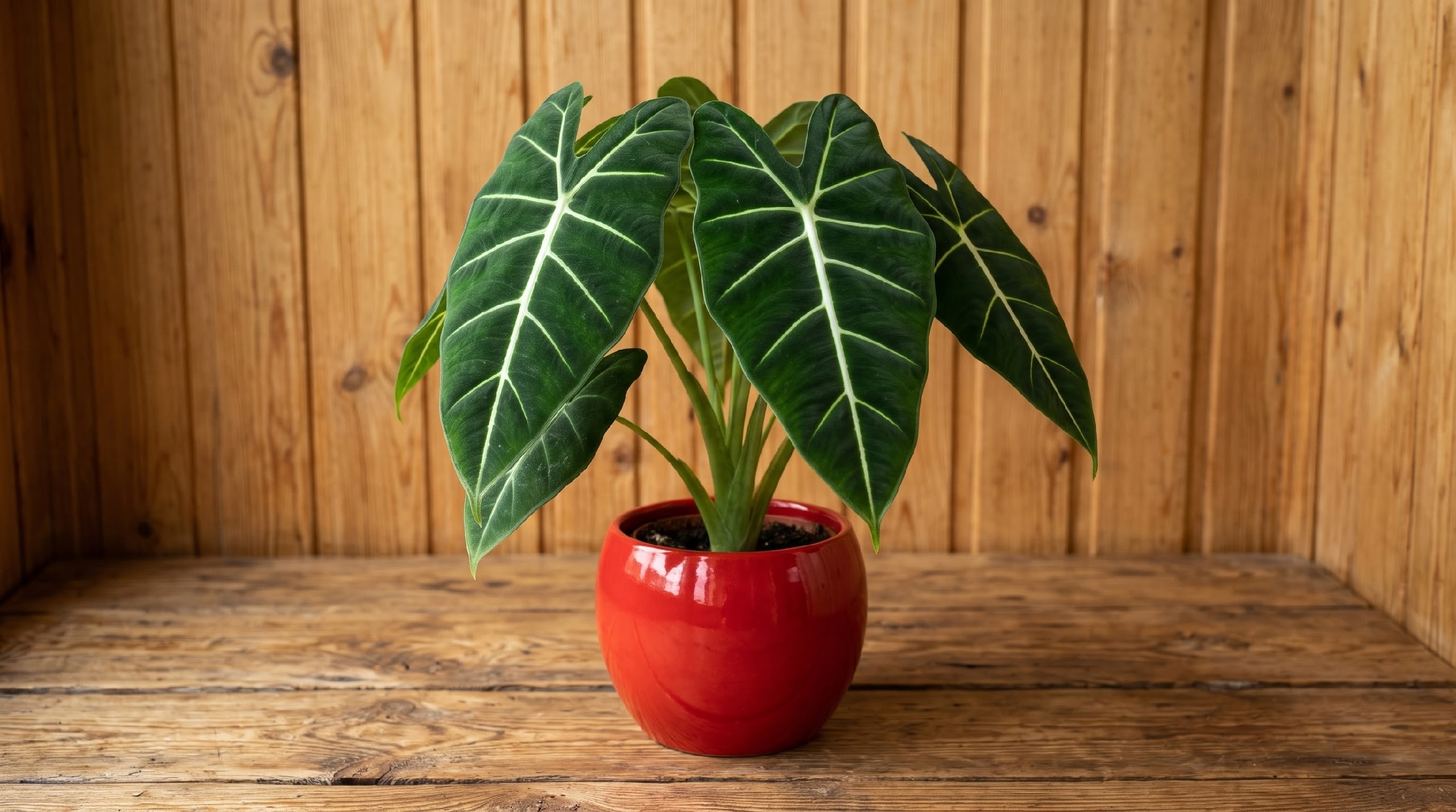
Alocasia Frydek care comes down to four conditions: bright indirect light, warmth above 60°F, soil that dries in the top 2 inches between waterings, and air that is more humid than a typical heated home. When a Frydek droops, yellows or loses leaves, one of those four has slipped, and in most homes it is cold, wet soil in winter or dry air that invites spider mites.
The plant sold as Alocasia Frydek or Green Velvet Alocasia is Alocasia micholitziana, an aroid endemic to Luzon in the Philippines. It is not difficult, but it is less forgiving than a pothos or a ZZ plant, and much of the advice online contradicts itself on light, humidity and soil. Below you will find what authoritative sources (the RHS, NC State Extension, UF/IFAS and others) actually say, where they disagree, and how to read the plant when something goes wrong. If you grow other alocasias too, our general alocasia care guide covers the genus as a whole.
| Alocasia Frydek Care at a Glance | |
|---|---|
| Light | Bright indirect; no strong direct sun (RHS) |
| Water | When the top 2 in (5 cm) is dry, spring to autumn; minimal in winter (RHS) |
| Humidity | Medium to high; 50% or more is a practical target |
| Temperature | At least 60°F (16°C) while growing; in winter keep above 50°F (RHS genus guide) or 59°F (RHS species page) |
| Soil | Free-draining: about 3 parts houseplant mix to 1 part grit (RHS) |
| Fertilizer | Liquid feed every 2–3 weeks, spring to autumn (RHS) |
| Size | 1–3 ft tall and wide (UF/IFAS); RHS gives 0.5–1 m |
| Main pests | Spider mites and mealybugs |
| Pets | Toxic to cats, dogs and horses (ASPCA) |
What Is Alocasia Frydek?
Alocasia Frydek is a cultivated form of Alocasia micholitziana, a species with arrow-shaped, velvety, deep green leaves and bright white veins. Botanist Alistair Hay, who revised the Philippine alocasias in 1999, describes the leaf as “rich velvety matt deep green” on top and paler underneath, and records the species as “Endemic to Luzon,” growing in forest and along roadsides at roughly 1,200–1,500 m.
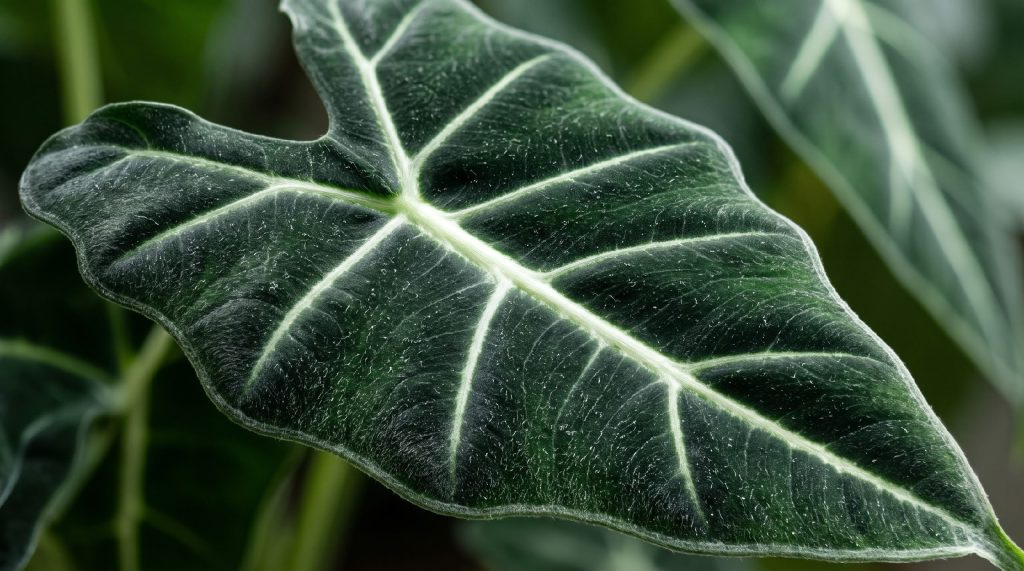
That matte, velvety surface is the quickest way to identify it. The midrib and main veins are white and stand out sharply, and the leaf margins are wavy. Hay separates it from the similar A. sanderiana by its brighter, matte green upper surface and an underside that is not purple.
In the wild the stem reaches about 50 cm and the leaf blade about 40 cm long by 13 cm wide (Hay). UF/IFAS lists Frydek at 1–3 ft tall and wide, and the RHS gives a mature height of 0.5–1 m, reached in 2–5 years. Expect a plant that stays below waist height.
Frydek, Green Velvet and Freydyk: why the name is confusing
Shops use “Frydek” and “Green Velvet” for the same solid green plant with white veins, and that is the plant this guide covers. The history of the name is less tidy. Aroid reference sites say “Frydek” is most likely a misspelling of ‘Freydyk’, a yellow-variegated plant first sold by the US nursery Glasshouse Works, and the RHS plant database still lists ‘Freydyk’ as a variegated plant with its name status marked “Unresolved.” The UF/IFAS fact sheet on Alocasia even describes ‘Frydek’ with “light yellow variegation along the veins.”
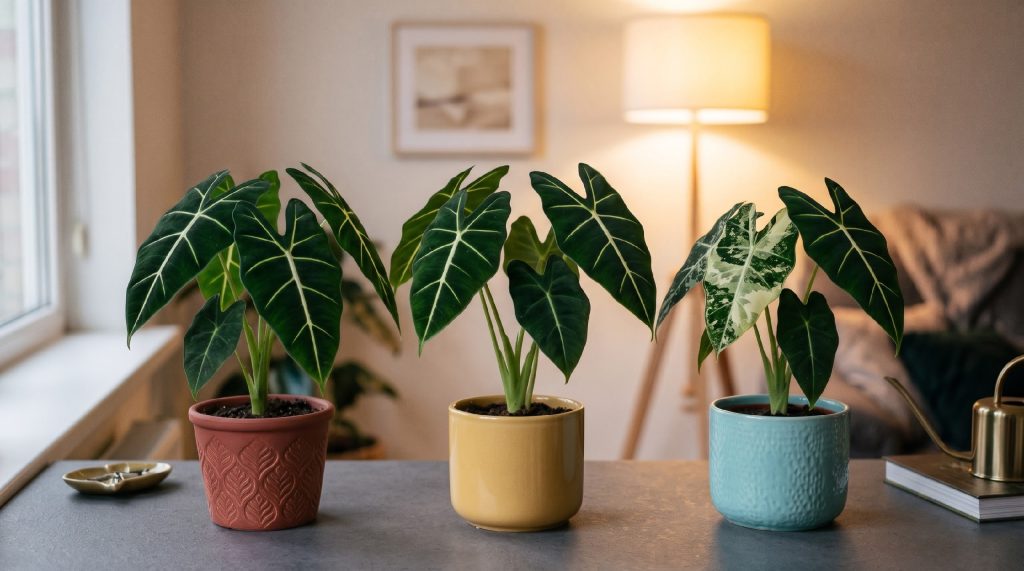
For practical care this does not matter: green and variegated plants want the same conditions. What it does mean is that “Frydek Variegata” in a listing usually refers to a plant with white or cream sectors on the leaves, and those sell at a much higher price. Variegated sectors carry less chlorophyll, so the plant grows more slowly. I would give a variegated Frydek the brightest indirect spot you have and avoid any direct midday sun, because the pale sectors scorch first.
Frydek vs Alocasia Polly
The two are often confused at the garden center, but they are different plants. Polly is not a form of A. micholitziana: NC State Extension treats it as a cultivar of the hybrid A. × mortfontanensis, a cross of A. longiloba and A. sanderiana.
| Alocasia Frydek | Alocasia Polly | |
|---|---|---|
| Botanical name | A. micholitziana ‘Frydek’ | A. × mortfontanensis ‘Polly’ (NC State) |
| Leaf surface | Matte and velvety | Glossy |
| Veins | Bright white | Silvery green |
| Size | 1–3 ft (UF/IFAS) | Compact, up to about 2 ft (NC State) |
Is Alocasia Frydek rare?
Not in the plant trade: the green form is mass-produced and sold widely. The wild species is a different matter. A. micholitziana is listed as Vulnerable on the Philippine national list of threatened plants (DENR Administrative Order 2026-20), and collecting it from the wild without a permit is illegal. It has not been assessed on the global IUCN Red List. Buy nursery-propagated plants only.
How Much Light Does Alocasia Frydek Need?
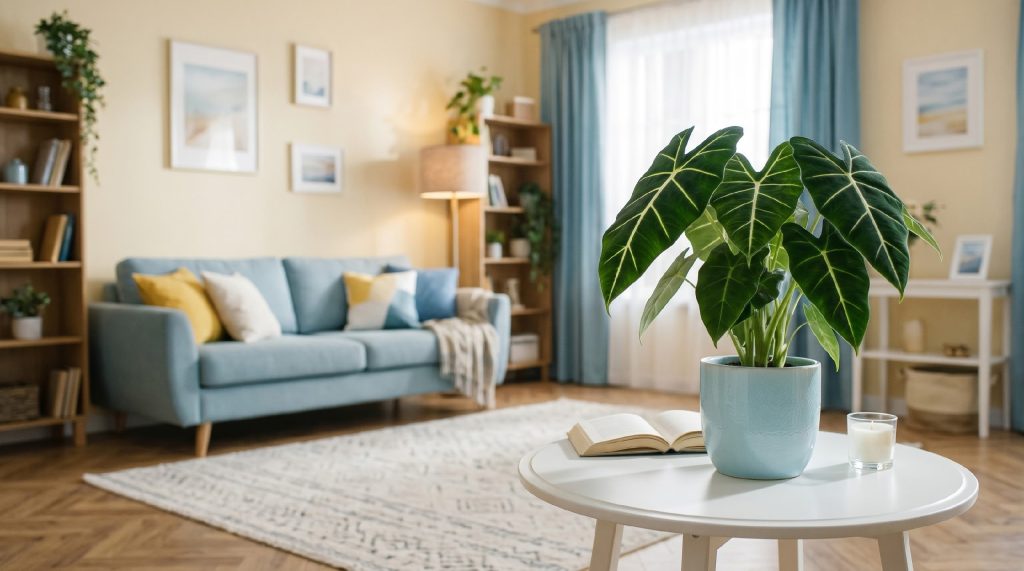
Frydek needs bright, indirect light: a spot near an east window, a few feet back from a south or west window, or behind a sheer curtain. The RHS warns that “Strong sunlight can scorch the foliage,” and the velvety leaves show scorch as bleached or brown patches.
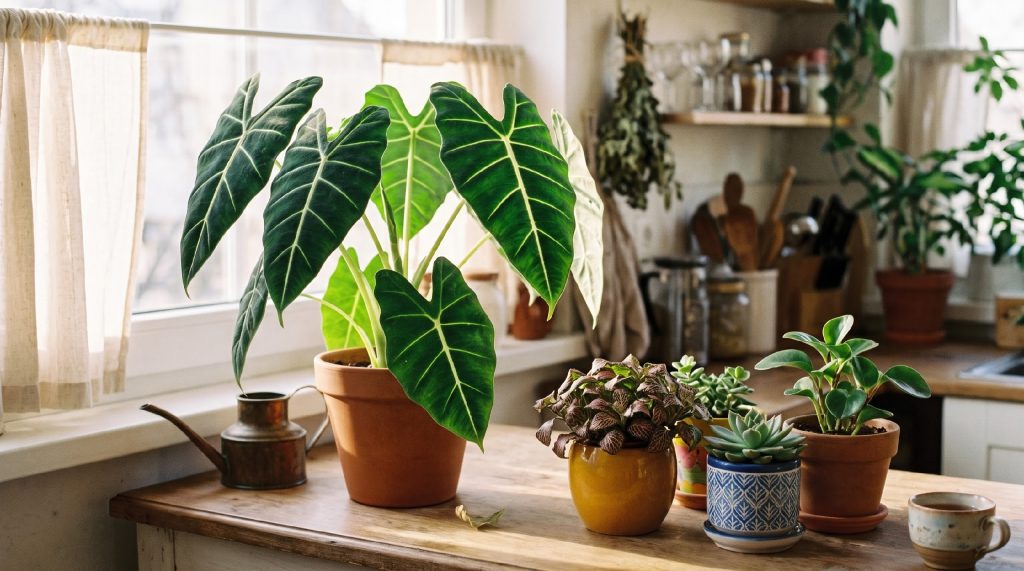
If you use a light meter or a phone app, a useful reference is Houseplant Journal’s grow-light table: about 200 foot-candles to keep an alocasia going through winter and about 400 for steady growth. Below that range, Frydek grows long, leaning petioles and smaller new leaves, and it is more likely to shed leaves in winter.
A Frydek does not need a windowsill, but it does need a bright room. A plant on a table well inside a sunny living room usually does fine; the same plant in a dim corner or a north-facing hallway will decline slowly. Turn the pot a quarter turn every week or two, because the leaves face the light and the plant becomes lopsided quickly.
How Often Should You Water Alocasia Frydek?
Water when the top 2 inches (5 cm) of the mix are dry, which is the RHS guideline for alocasias during the growing season. In a warm, bright room that is often every 5–7 days in summer; in winter it can stretch to two weeks or longer.
Wet soil is the real danger. Iowa State Extension says Alocasia “do not tolerate overly wet conditions in the slightest,” and the RHS links overwatering, especially in winter, to root rot. My advice is to judge water by the soil, not the calendar: push a finger into the mix, or lift the pot and learn how much a dry pot weighs. Water thoroughly until it runs from the drainage holes, then empty the saucer within 15 minutes.
In winter, the RHS advice is to “reduce watering to a minimum” when the plant slows down. A Frydek in a cool room with damp soil is the most common route to yellow leaves and a mushy corm.
What Humidity and Temperature Does Frydek Need?
Frydek needs warmth and moderate to high humidity. The RHS asks for “medium to high humidity,” at least 60°F (16°C) during the growing season and never below 50°F (10°C). Its species page for A. micholitziana is stricter: it rates the plant for growing “under glass all year (>15C)” and advises keeping it above 15°C (59°F) in winter.
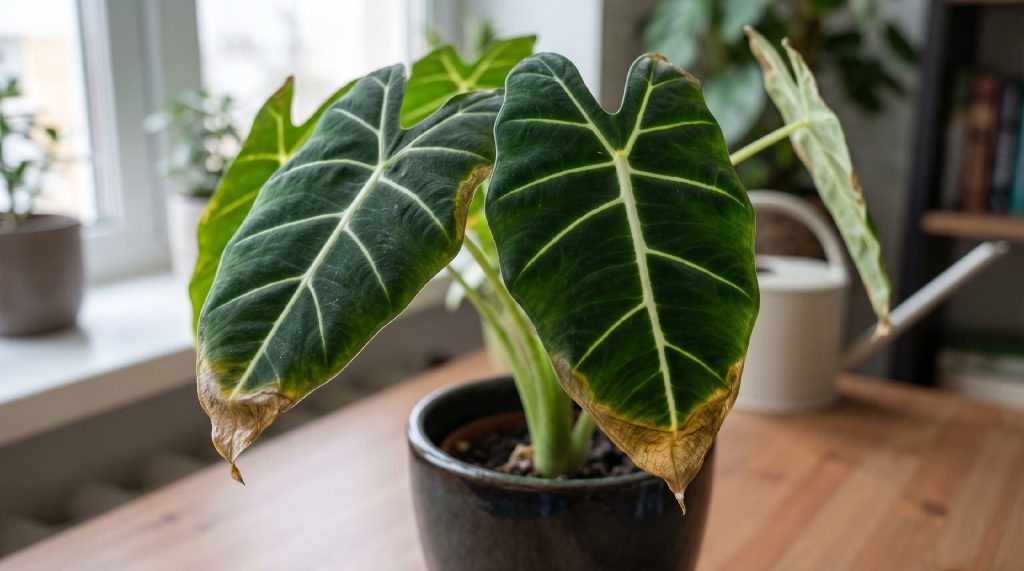
Low humidity shows up first on the leaf edges. The RHS notes that dry air “can cause browning on the leaf edges and may attract red spider mites, which thrive in a dry atmosphere.” In winter, indoor heating can push room humidity into the 20s or 30s, which is why brown edges and mites tend to arrive together in December.
NYBG’s plant information service puts the ideal for alocasias at about 70%, and in another answer calls humidity above 50% ideal. Few living rooms reach 70%, so I would aim for 50% at minimum and treat anything above 60% as a bonus. A cheap digital hygrometer next to the plant tells you where you stand. If the reading is in the 30s, a small humidifier is the fix that works; pebble trays and misting raise humidity only briefly. Our guide to choosing and placing a humidifier for houseplants covers sizing and placement.
Cold matters as much as dry air. Keep Frydek away from drafty doors, air-conditioning vents and cold windowpanes in winter; the RHS warns that “Cold draughts, particularly in winter, can be damaging.” Keep it away from radiators and heating vents too, which dry the leaves out.
What Soil and Pot Does Alocasia Frydek Need?
Frydek needs a mix that holds some moisture but drains fast. The RHS recommends about 3 parts peat-free houseplant compost to 1 part horticultural grit. NC State describes the genus as preferring “slightly acidic, moist, well-drained, humus-rich” soil. Published Frydek mixes vary widely, from equal parts peat and perlite to blends with orchid bark and charcoal; they agree on drainage, not on a recipe.
Any of these works if water drains through within seconds and the mix does not stay soggy for days. A typical aroid mix is roughly half potting mix, with the rest split between orchid bark and perlite or pumice. Use a pot with drainage holes. Terracotta dries faster than plastic, which helps if you tend to overwater.
Repot every couple of years, into a pot “only about 5cm (2in) in diameter larger each time” (RHS). A pot that is too large holds wet soil around a small root system, and that is how rot starts. I would not repot a Frydek in fall or winter: the plant is slowing down, and a disturbed root system sitting in cool, wet mix is the setup for losing it. Late spring is the safe window. Expect one or two older leaves to yellow after repotting; that is a normal response to root disturbance.
How Often Should You Fertilize Alocasia Frydek?
Feed with a general liquid fertilizer every 2–3 weeks from spring to autumn, as the RHS recommends for A. micholitziana, and stop in winter. University of Wisconsin Extension calls elephant ears (Alocasia, Colocasia and Xanthosoma) “heavy feeders,” so a Frydek in active growth uses more food than most foliage plants.
A balanced fertilizer diluted to half the label strength is the safer middle ground indoors, where salts build up in the pot. If you see a white crust on the soil or brown leaf tips despite good humidity, flush the pot: run plain water through it several times and let it drain. Feed only while the plant is producing new leaves. A Frydek that has stalled in winter cannot use fertilizer, and the salts simply accumulate.
Does Alocasia Frydek Go Dormant in Winter?
It can. When light drops and temperatures fall, alocasias slow down and may lose some or all of their leaves. The RHS describes this as normal: in cooler, drier winter conditions (still above 50°F), “They may lose some of their foliage during this time, but this is nothing to worry about.” In a warm, bright, humid home a Frydek may keep growing all winter; Iowa State notes alocasias can be kept as houseplants year-round “provided the humidity and temperatures are high enough.”
The test for dormant vs dead is the corm, the bulb-like storage organ at the base. Gently scrape away the top of the soil and press it. Firm means alive; soft, hollow or foul-smelling means rot. A dormant plant needs only occasional light watering to keep the corm from shriveling, warmth, and patience until spring. Our guide to alocasia dormancy walks through the full process, including how to wake the plant in spring.
Frydek also replaces leaves through the growing season. Growers commonly see the oldest leaf yellow around the time a new one unfurls, and I would treat a single old leaf yellowing that way as normal. Several leaves yellowing at once, or a new leaf yellowing, is a problem, and the next section covers it.
Why Is My Alocasia Frydek Drooping, Yellowing or Dripping?
Most Frydek problems come from water, temperature or pests, and the symptoms overlap. Start with the table, then check the details below.
| Symptom | Most likely cause | What to check | Fix |
|---|---|---|---|
| Several leaves yellowing at once, soil wet | Overwatering, root rot | Soil moisture; roots and corm | Let it dry; cut soft roots; repot in fresh mix if rotten |
| Oldest leaf yellows as a new one opens | Normal leaf turnover | New leaf healthy? | Remove the old leaf once it is fully yellow |
| Leaves droop, soil dry | Underwatering | Pot weight, dry mix | Water thoroughly |
| Leaves droop, soil wet, room cool | Cold plus wet roots | Temperature at the plant | Move somewhere warmer; let the mix dry |
| Brown, crispy edges and tips | Dry air, heat source, salt buildup | Hygrometer reading; white crust on soil | Raise humidity; move from heaters; flush the pot |
| Pale speckling, fine webbing | Spider mites | Leaf undersides with a flashlight | Shower, then soap or oil sprays, repeated |
| Brown or water-soaked spots with yellow halos | Bacterial or fungal leaf spot | Wet foliage; overwatering | Remove affected leaves; keep leaves dry |
| Water drops on leaf tips | Guttation | After watering, overnight | Usually nothing; water a little less |
| Leaves dropping in autumn, firm corm | Dormancy | Corm firmness | Water sparingly; keep warm; wait for spring |
Why are my Alocasia Frydek leaves turning yellow?
If one old leaf yellows while the rest look healthy, it is usually turnover. If several leaves yellow at once, check the soil. NC State lists overwatering, too little water and inadequate light as causes of yellowing in alocasias, and wet soil is by far the most common of the three indoors.
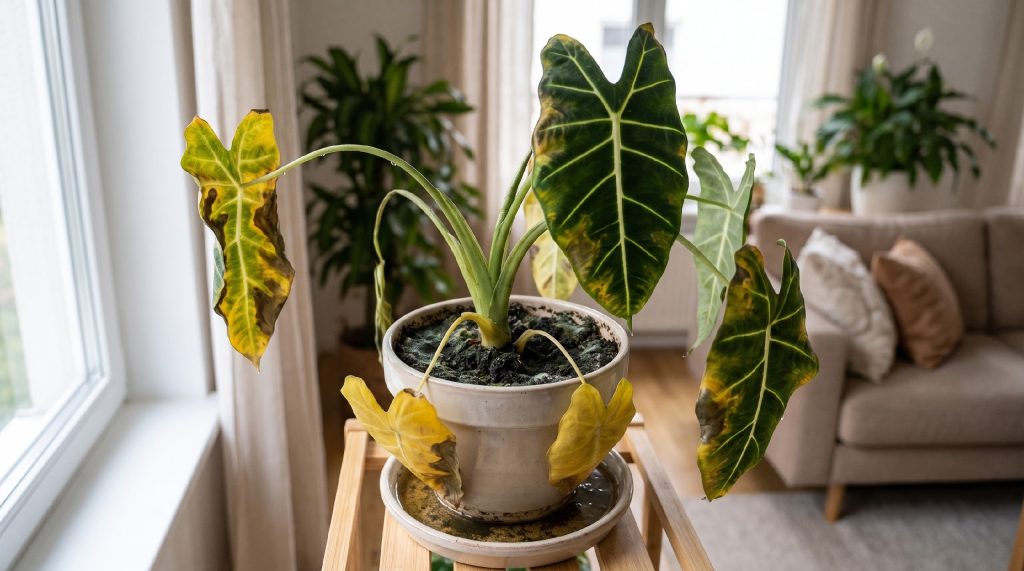
The Missouri Botanical Garden describes overwatered plants as having “dull, light green or yellowing leaves,” with roots that are “brown and soft” and soil that may smell bad. Slide the plant out of the pot. Healthy roots are pale and firm; rotten ones are dark and soft (University of Maryland Extension). Cut away rotten roots, check that the corm is still firm, and repot into fresh, dry mix in a pot only slightly larger than the root ball.
Yellowing on the oldest leaves that starts at the margins and moves inward can also point to low nitrogen, according to the Missouri Botanical Garden. That is more likely in a plant that has not been fed all summer.
Why is my Alocasia Frydek drooping?
Drooping means the petioles (leaf stalks) cannot hold the leaves up, and both too little and too much water cause it. As the Missouri Botanical Garden puts it, “Wilted leaves may indicate the soil is too dry OR too wet – rotting roots cannot take up water!” Check the soil before you water.
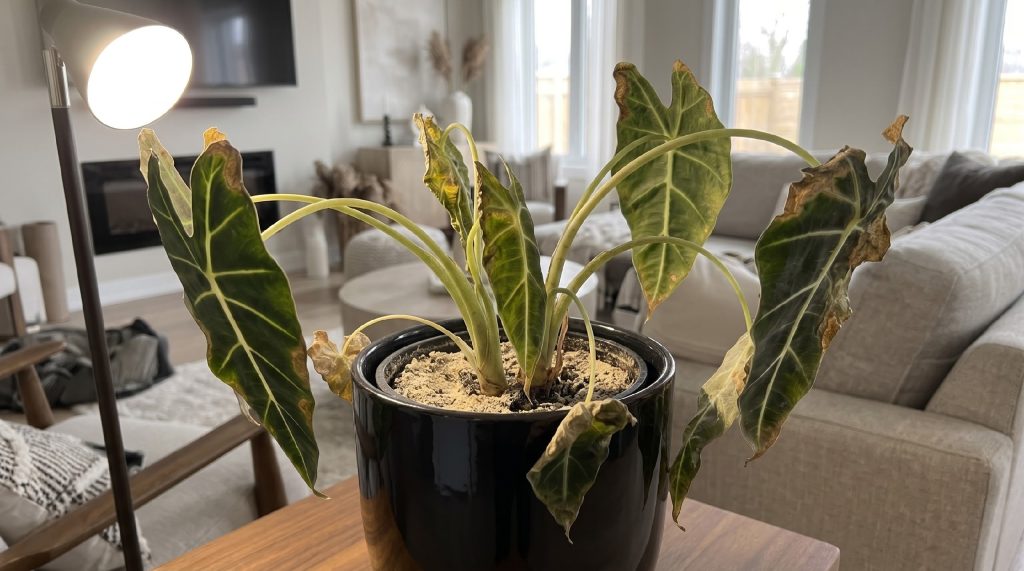
If the mix is dry, water thoroughly and the leaves should lift within a day. If the mix is wet, do not water. Check for root rot and the temperature: the Missouri Botanical Garden lists dropping, wilting or discolored leaves among signs of chilling injury in tropical plants, and “Wet soil and cold temperatures often lead to root rots.” A Frydek also commonly droops for a week or two after being moved or repotted while its roots settle. Weak light is another cause: petioles stretch toward the window and then cannot support the leaf.
Why does my Alocasia Frydek drip water from the leaf tips?
Those drops are guttation, not a leak or a pest. The RHS explains that plants release droplets “overnight through specialized pores called hydathodes, usually found at leaf margins,” usually after warm days followed by cooler nights, to “relieve water pressure in their cells.” It is most noticeable on a Frydek shortly after watering.
Guttation itself does no harm. Wipe drops off furniture, and if the plant drips every day, water a little less: the RHS notes that guttation “is often seen as a result of overwatering.”
What causes brown or black spots on Frydek leaves?
Spots with a yellow halo are usually a bacterial or fungal leaf spot. Clemson’s Home & Garden Information Center describes bacterial spots as “water-soaked spots, sometimes with a yellow halo,” and fungal leaf spots as “small, brown spots with yellowish margins.” NC State notes that “Root rot and leaf spots can occur from overwatering” in alocasias. A halo alone does not tell you which one you have, and the two are hard to tell apart at home.
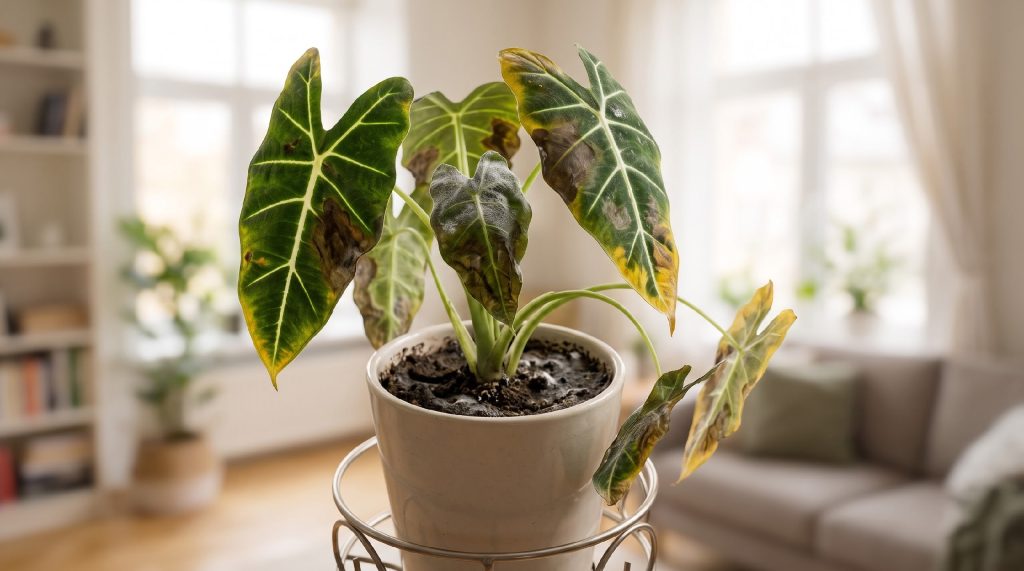
The treatment for both is the same at home: cut off affected leaves, avoid wetting the foliage when you water, improve air movement, and let the mix dry more between waterings. Clemson advises against “spraying or splashing water onto the foliage,” which spreads both bacteria and fungal spores.
How do you get rid of spider mites on Alocasia Frydek?
Spider mites are the main pest of Frydek. NC State Extension says plainly that “Alocasia are prone to spider mites,” and the RHS notes that A. micholitziana may be susceptible to glasshouse red spider mite and mealybugs. Dry, heated winter air makes them worse.
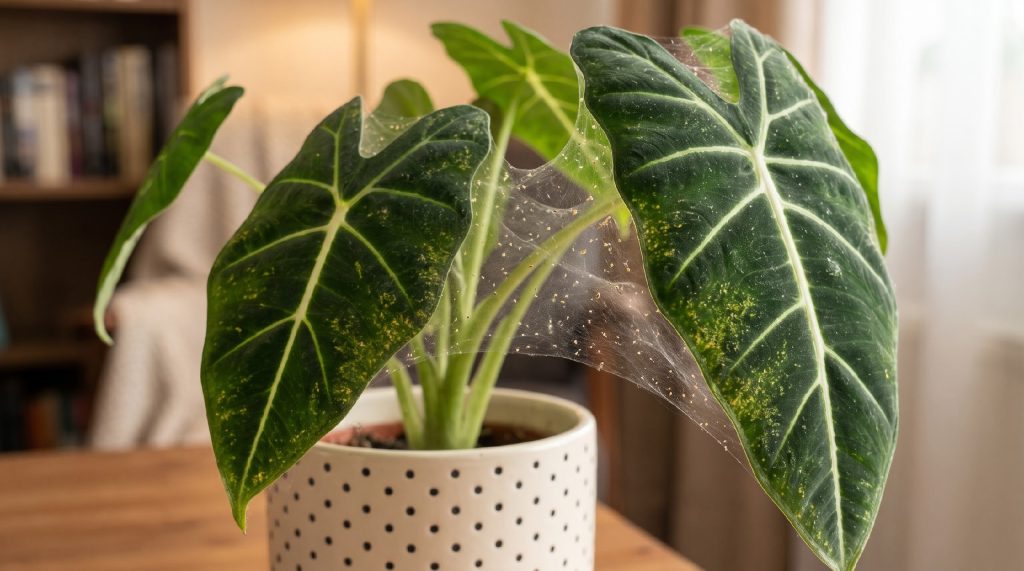
The first sign is pale stippling on the leaves. UC IPM describes the damage as “a stippling of light dots on the leaves”; later the leaves turn yellowish and drop, and fine webbing appears on the leaves and stems. The mites themselves are tiny: adult females are “less than 1/20 inch long” (UC IPM), so look at the leaf undersides with a flashlight or a hand lens.
- Isolate the plant from your other houseplants.
- Wash it off. Iowa State Extension recommends taking the plant to a shower or tub and using “a forceful spray of water,” paying attention to the undersides.
- Spray insecticidal soap or horticultural oil with full coverage of the leaf undersides. UC IPM notes that “repeat applications may be required” and warns against soaps or oils on water-stressed plants or above 90°F, so water the plant the day before.
- Repeat weekly for at least three to four weeks, because sprays miss eggs.
- Raise the humidity and keep the plant well watered; UC IPM notes that water-stressed plants are “highly susceptible.”
Avoid broad-spectrum insecticides: UC IPM warns they “frequently cause mite outbreaks” by killing the mites’ natural enemies. Iowa State advises discarding plants that are heavily infested. My advice is to check Frydek’s leaf undersides once a week from October to March, when heating is on. Catching mites at the stippling stage takes a shower and a few sprays; catching them at the webbing stage can cost most of the leaves.
How to Propagate Alocasia Frydek
Frydek is propagated by division of offsets or by growing the small corms (cormlets) that form around the main corm. Both are easiest at repotting time in late spring or early summer, which is when the RHS recommends dividing alocasias. Wear gloves: the RHS warns that the sap “can irritate skin.”
Division
Division is the fastest way to a second plant, because each piece already has roots and leaves.
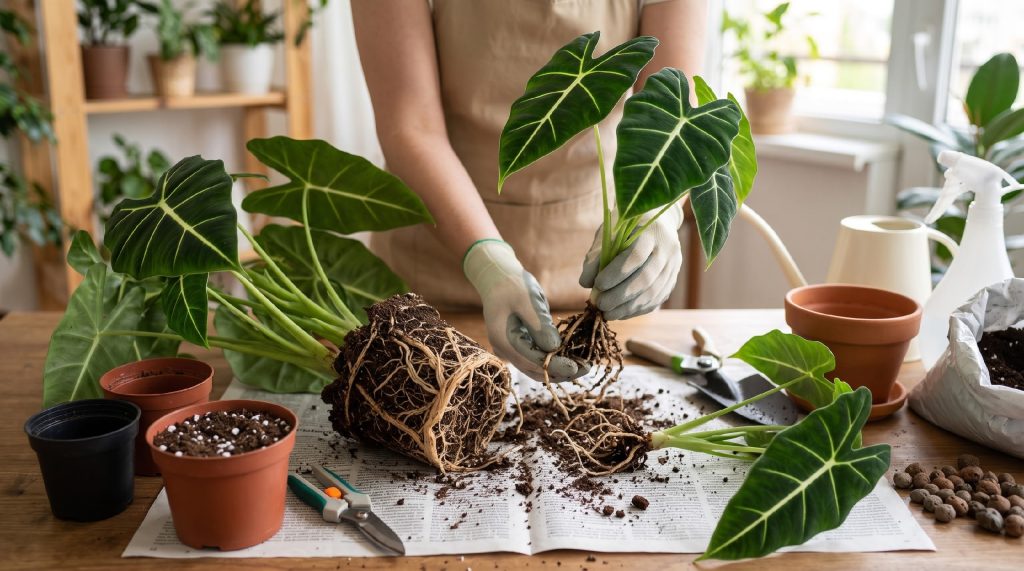
- Water the day before so the root ball holds together.
- Slide the plant out and gently loosen the soil to see where offsets join the main plant.
- Separate offsets that have their own roots and at least one leaf. Tease the roots apart by hand; use a clean knife only where they are joined.
- Pot each piece in a small pot of fresh, slightly moist mix.
- Keep it warm and in bright indirect light, and water lightly until new growth appears. The RHS advises keeping divisions “in warmth and good light.”
Corms
When you repot a mature Frydek you will often find small corms in the soil, from pea-sized to marble-sized. UK Houseplants, a specialist care site, notes that a mature plant can carry “over ten corms.”
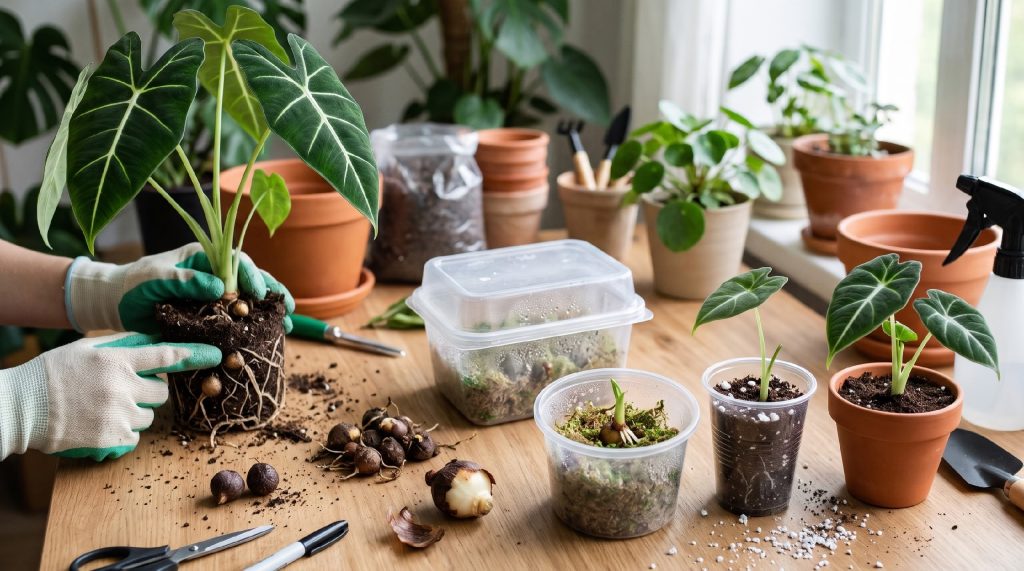
- Collect firm corms and discard soft or shriveled ones.
- Place them on damp sphagnum moss or perlite in a clear container with a lid, growing tip up.
- Keep the container warm and in bright indirect light. Open the lid every few days to let air in and check for mold.
- Expect roots within a few weeks. UK Houseplants, which roots corms on their side in a little water instead, reports roots in 2–8 weeks and pots them into 5–7 cm (2–3 in) pots once the roots are about 3 cm (1 in) long.
Corms are slow: a corm-grown Frydek can take a year or more to look like a small plant. Corms can also sit for weeks without visible change. Do not throw them out as long as they stay firm.
Is Alocasia Frydek Toxic to Cats and Dogs?
Yes. The ASPCA lists Alocasia spp. as toxic to dogs, cats and horses. The toxic principle is insoluble calcium oxalate, and the clinical signs are “Oral irritation, pain and swelling of mouth, tongue and lips, excessive drooling, vomiting (not horses), difficulty swallowing.” Poison Control notes that “All parts of the plant contain tiny calcium oxalate crystals.”
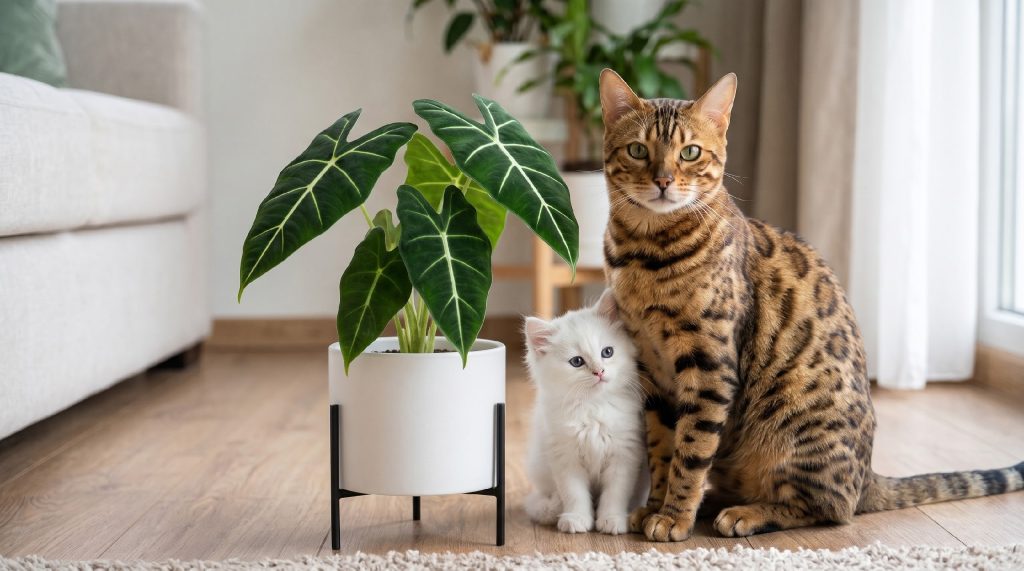
The crystals are needle-like and sit in specialized cells. As the Merck Veterinary Manual explains, chewing releases them into the tissues of the mouth, which causes immediate pain. Serious cases are uncommon. In an October 2025 article, ASPCA Poison Control said of insoluble oxalate plants that “the severity is low,” with throat swelling and breathing difficulty only in rare, large exposures. Merck gives most cases “a good to excellent prognosis.” Unlike some plants, insoluble oxalates do not damage the kidneys (Merck).
If your pet chews a Frydek:
- Remove plant pieces from the mouth and rinse or wipe the mouth with water.
- ASPCA suggests offering a small amount of milk, yogurt or vanilla ice cream to soothe the mouth; check that the product contains no xylitol.
- Call your veterinarian, ASPCA Animal Poison Control at (888) 426-4435 or Pet Poison Helpline at (855) 764-7661. Both lines may charge a consultation fee.
- Go to an emergency vet immediately if your pet has trouble swallowing or breathing. Merck warns that swelling around the larynx can cause respiratory distress.
For people, Poison Control (poison.org) says symptoms usually start quickly and “can last for up to half a day.” If a child chews a leaf, have them rinse and spit, and call 1-800-222-1222. NC State also lists contact dermatitis, so wear gloves when dividing or repotting.
For a home with a cat that chews plants, I would choose a pet-safe plant instead and keep Frydek for a room the cat cannot enter. If you want a similar dramatic leaf without the risk, calatheas are listed as non-toxic to cats by the ASPCA.
Alocasia Frydek Care Through the Year
Most Frydek losses happen in the transition seasons, when the plant slows down but watering habits stay the same. Use this as a checklist.
| Season | Water | Feed | Watch for |
|---|---|---|---|
| Spring | Increase as new leaves appear; water when the top 2 in is dry | Start every 2–3 weeks once growth resumes | Best time to repot, divide and harvest corms |
| Summer | Most often, sometimes every 5–7 days | Every 2–3 weeks | Scorch if moved into direct sun; guttation after watering |
| Autumn | Cut back as growth slows | Stop when new leaves stop | Leaf drop from shorter days; cold windows; heating switched on |
| Winter | Minimal; let the mix dry deeper | None | Spider mites in dry air; temperatures below 60°F; mushy corm |
Who Should Not Buy an Alocasia Frydek?
Frydek is a poor choice in a few situations, and it is better to know before buying than after the plant declines.
- Dim rooms with no grow light. A north-facing room or a corner far from windows will not support it for long.
- Cold rooms in winter. If the room regularly drops below 60°F at night, expect dormancy or rot. The RHS gives 50°F as the floor for alocasias in general and 59°F (15°C) for this species; neither is a growing temperature.
- Very dry apartments without a humidifier. Dry air means brown edges and recurring spider mites every winter.
- Homes with pets or small children that chew plants. All parts are toxic.
- Anyone wanting a plant that looks the same all year. Frydek replaces leaves, may lose most of them in winter and comes back in spring. If that sounds stressful, a ZZ plant or pothos is a better fit.
Frequently Asked Questions
How big does Alocasia Frydek get?
Usually 1–3 ft tall and wide (UF/IFAS). The RHS gives a mature height of 0.5–1 m, reached in 2–5 years. In the wild, leaf blades reach about 40 cm (16 in) long (Hay 1999).
How fast does Alocasia Frydek grow?
Moderately in summer, slowly or not at all in winter. Growth depends heavily on light and warmth; a Frydek in a bright, warm room puts out new leaves through the growing season, while one in low light may only replace the leaves it loses.
Can Alocasia Frydek grow outdoors?
Only in warm, humid climates or as a summer container plant. NC State lists the genus for zones 10a–12b. UF/IFAS notes that, for alocasias in general, freezing temperatures kill the foliage, though plants in zone 8A and south can regrow from the base. Bring container plants inside before nights drop below 50°F.
Should I mist my Alocasia Frydek?
Misting does little for humidity, and wet foliage encourages leaf spot. A humidifier is more effective. If you clean the leaves, wipe them gently with a damp cloth.
Why are the new leaves on my Frydek smaller?
Most often low light, a root-bound pot or a lack of fertilizer during the growing season. The first leaves after winter dormancy are also often smaller; leaf size usually recovers as the season goes on.
Is Alocasia Frydek hard to care for?
It is moderately demanding. It needs more light, warmth and humidity than common beginner plants and does not tolerate soggy soil. In a bright, warm room with a humidifier in winter, it is manageable.
Is Frydek the same as Alocasia Green Velvet?
In shops, yes: both names are used for A. micholitziana with dark green velvet leaves and white veins. The name ‘Frydek’ itself has a confused history, and the RHS still lists ‘Freydyk’ as a variegated plant with an unresolved name.