Fuchsia is almost never marketed as a houseplant — it is sold as a seasonal hanging basket or patio annual in most of the US and northern Europe. But fuchsia is not an annual; it is a perennial shrub that can live for decades with the right overwintering approach. Kept indoors through winter and given the conditions it needs to rest and then re-bloom, it is a rewarding long-term plant. This guide covers what those conditions are, and why most attempts to keep fuchsia fail in the first winter.
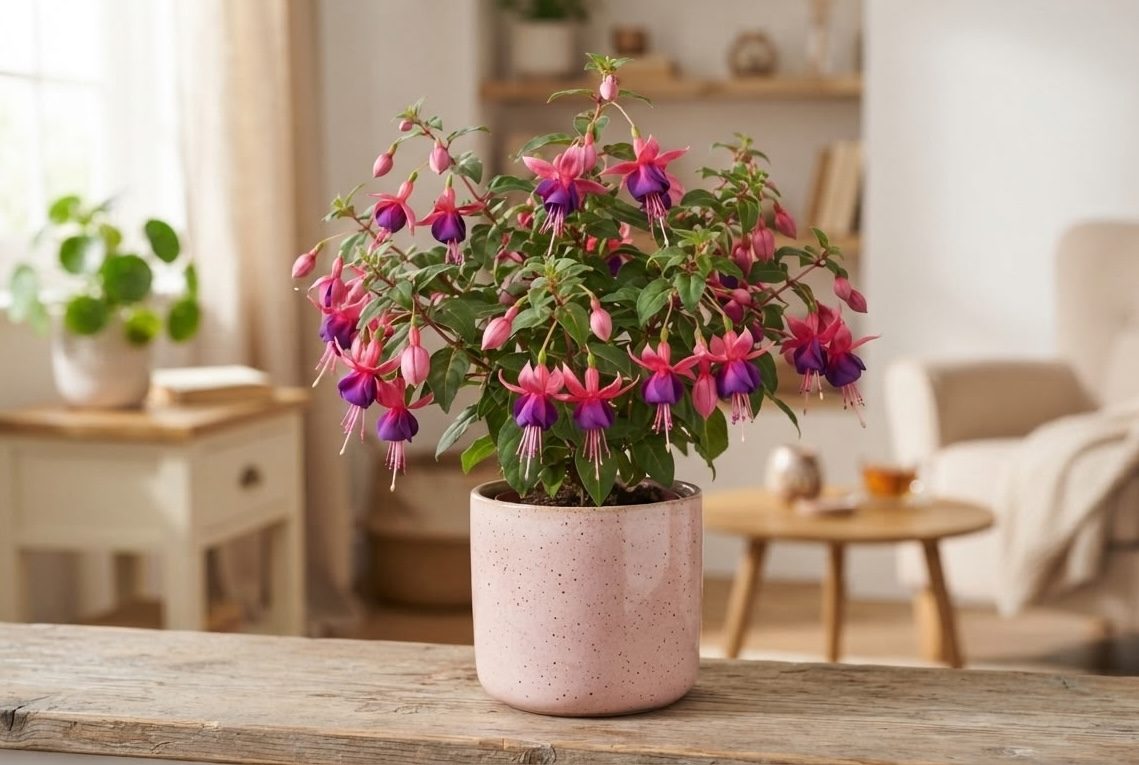
| Indoor Fuchsia Quick Care Summary | |
|---|---|
| Light | Bright indirect light with some morning sun; no harsh afternoon sun |
| Water | Every 5–7 days; keep evenly moist during growth |
| Humidity | 50–70% |
| Temperature | 55–75°F (13–24°C); dormancy at 40–50°F (4–10°C) |
| Fertilizer | Weekly high-potassium formula during blooming season |
Why Does Fuchsia Stop Blooming Indoors?
Fuchsia blooms on new growth — specifically, on the tips of stems produced in the current growing season. Old wood does not rebloom. There are three reasons an indoor fuchsia stops producing flowers:
Similar bloom-cycle logic applies to other flowering tropicals — see our indoor hibiscus care guide for a sun-hungry counterpart.
No Pruning to Stimulate New Growth

Without pruning, fuchsia produces long, bare stems with flowers only at the tips. Tip-pruning — cutting back the growing tips of stems — causes each pruned shoot to branch into 2-4 new shoots. More shoots from pruning means more flowering tips. Pinch back stem tips every 2-3 weeks during the growing season to build a dense, floriferous plant.
Insufficient Light
Fuchsia needs bright indirect light to full morning sun indoors. A south or east-facing window is ideal. In low light, the plant produces abundant foliage but few flowers. Supplemental grow lights (14 hours daily) maintain blooming through winter if a bright window is not available.
Skipping the Winter Rest

Fuchsia naturally wants to go semi-dormant in winter. In its native habitat (Central and South America, New Zealand), it experiences a cool, less active period. Indoors without a rest period, many fuchsias exhaust themselves and produce progressively fewer blooms over years. Giving the plant a proper cool winter rest is what sets up strong spring and summer flowering.
How to Overwinter Fuchsia Indoors

This is the most important skill for keeping fuchsia long-term. Two approaches work:
Cool Dormancy (Recommended for Maximum Flowering)
In autumn (September-October), begin reducing watering and stop fertilizing. Move the plant to a cool location — 40-50°F (4-10°C) is ideal. An unheated but frost-free garage, basement, or cool spare room works. The plant will drop most or all of its leaves. This is normal. Water just enough to prevent the stems from desiccating — once every 3-4 weeks. The dormant plant is alive.
In late winter (February-March), bring the plant back to a warm, bright location. Resume light watering. New growth will emerge from the bare stems within 2-4 weeks. Once 2-3 inches of new growth are present, prune hard (cut back by one-half to two-thirds) to stimulate maximum branching. Begin fertilizing with high-potassium fertilizer. Flowering typically begins 8-12 weeks after the growth resumes.
Active Overwintering (Easier, Less Flowering in Spring)
Keep the plant in a cool but heated room (55-65°F/13-18°C) near a bright window. Reduce watering and fertilizing. The plant stays semi-active and may drop some leaves but won’t fully dormantize. Growth and flowering resume in spring without the forced dormancy. Easier to manage, but typically produces less vigorous spring flowering than the cool dormancy method.
Full Fuchsia Care Requirements
What Light Does Indoor Fuchsia Need?

Bright indirect light to gentle direct morning sun. A spot near an east or north-facing window suits fuchsia well — it prefers cooler, filtered light over the intensity of afternoon sun, which causes wilting and bud drop. Unlike many flowering plants, fuchsia actually does better without hot direct sun, which is why it thrives in hanging baskets on shaded patios and porches.
How Often Should You Water Indoor Fuchsia?
Keep the soil consistently moist during active growth — fuchsia wilts quickly when underwatered, and leaf and bud drop follow. Check soil every 2-3 days in summer and water when the top inch feels barely dry. Fuchsia is thirstier than most houseplants during peak blooming. In winter (dormancy), reduce to once every 3-4 weeks.
What Temperature Does Fuchsia Need?
60-75°F (15-24°C) during active growth. Fuchsia prefers cooler temperatures than most tropical houseplants — high heat (above 80°F/27°C) triggers bud drop and reduces flowering. It is one of the few flowering houseplants that performs better in a cool, north-facing room than a warm south-facing one. For winter rest: 40-50°F (4-10°C).
What Humidity Does Indoor Fuchsia Need?
Moderate — 50-60%. Fuchsia tolerates typical household air better than calathea or alocasia, but very dry air (below 35%) causes bud drop and brown leaf tips. A pebble tray helps in dry, heated rooms. Do not mist directly onto open flowers — this causes petal spotting.
How Often Should You Fertilize Indoor Fuchsia?
Every 2 weeks during the growing season (spring through early autumn) with a high-potassium liquid fertilizer — look for formulas with a high third number in the NPK ratio (such as 7-2-7 or similar bloom-boosting formulas). High potassium drives flower production; high nitrogen drives leafy growth. Do not fertilize during winter dormancy.
How to Propagate Indoor Fuchsia

Softwood tip cuttings are the standard way to propagate fuchsia. Clemson HGIC recommends taking cuttings in spring — about 6 inches long, with 2-3 pairs of leaves. Remove the bottom leaf pair and insert the cutting up to the base of the lowest remaining leaves.

Clemson HGIC recommends a rooting medium of equal parts peat and perlite, kept consistently moist. Enclosing the cutting in a plastic bag creates the humidity tent that helps it root — but watch for excess moisture, since fuchsia is prone to Botrytis (gray mold) in overly humid, poorly ventilated conditions. Keep cuttings warm with bright, indirect light. Roots typically form in 3-4 weeks; new leaf growth and gentle resistance when tugged are signs it’s ready to pot up.

Fall cuttings are also possible, but Clemson HGIC notes they need to overwinter indoors at 45-50°F in bright, indirect light until spring before they’re ready to grow on.
Is Fuchsia Toxic to Cats and Dogs?
Fuchsia is not listed as toxic to cats, dogs, or horses by the ASPCA. Fuchsia berries are edible for humans — they are used to make jams and drinks — which is consistent with the plant’s general non-toxic profile. There are no documented cases of fuchsia toxicity in domestic animals.


What Pests Attack Indoor Fuchsia?
Whiteflies

The most common pest on fuchsia. Small white insects that rise in a cloud when the plant is disturbed. They feed on leaf undersides and excrete honeydew, which leads to sooty mold. Treat with yellow sticky traps plus weekly insecticidal soap sprays. Whitefly populations build quickly; early treatment is much easier than controlling a large infestation.
Aphids

Soft-bodied insects clustered on new growth and flower buds. Dislodge with a strong water spray, then treat with insecticidal soap or neem oil. Ants farming aphids for honeydew protect them from natural predators — if bringing an outdoor fuchsia indoors, treat for ants separately.
Spider Mites

More common in hot, dry conditions. Fine stippling on leaves with possible webbing. Raise humidity, rinse the plant, and treat with neem oil or insecticidal soap weekly until clear.
Common Mistakes With Indoor Fuchsia


Throwing it away after the first winter. Many people see a fuchsia drop its leaves in autumn and assume it has died. This is normal pre-dormancy behavior. Put it in a cool location, water minimally, and wait. It will re-leaf in spring.
Keeping it warm and bright all winter. Without a cool rest period, fuchsia exhausts its energy reserves and produces progressively fewer blooms over subsequent years. The cool dormancy is not optional for long-term plant health.
Not pinching back the tips. An unpruned fuchsia produces long, sparse growth with flowers only at stem tips. Regular tip-pruning during the growing season is what creates the dense, heavily blooming plants seen in show gardens.
Frequently Asked Questions
Can fuchsia live indoors permanently?
Yes — with bright indirect light, cool temperatures, regular moisture, and a winter rest period. Fuchsia is a perennial that can live many years indoors. The main challenge is providing the cool winter dormancy it needs for maximum spring flowering.
Why are my fuchsia buds dropping before opening?
Bud drop is usually caused by high temperature (above 80°F/27°C), low humidity, inconsistent watering, or moving the plant while buds are forming. Keep conditions stable once buds appear — move to a cooler location if heat is the issue, and do not water erratically.
When should I prune fuchsia?
Hard prune in late winter, just before or after bringing out of dormancy (February-March). This stimulates the branching that produces summer flowers. Tip-prune throughout the growing season (every 2-3 weeks) to maximize branching and flower production.
What type of fuchsia grows best indoors?
Upright (standard) fuchsia varieties are generally easier to manage indoors than trailing types. Fuchsia triphylla hybrids (longer tubular flowers) tolerate warmer conditions than Fuchsia × hybrida cultivars, making them better suited to typical heated homes.