Three very different plants go by the name “zebra plant” — and if your cat or dog has chewed on one, you need a specific answer for the plant you actually have. Short version: all three plants commonly sold as zebra plant are non-toxic to cats and dogs according to the ASPCA. Here is the full breakdown.
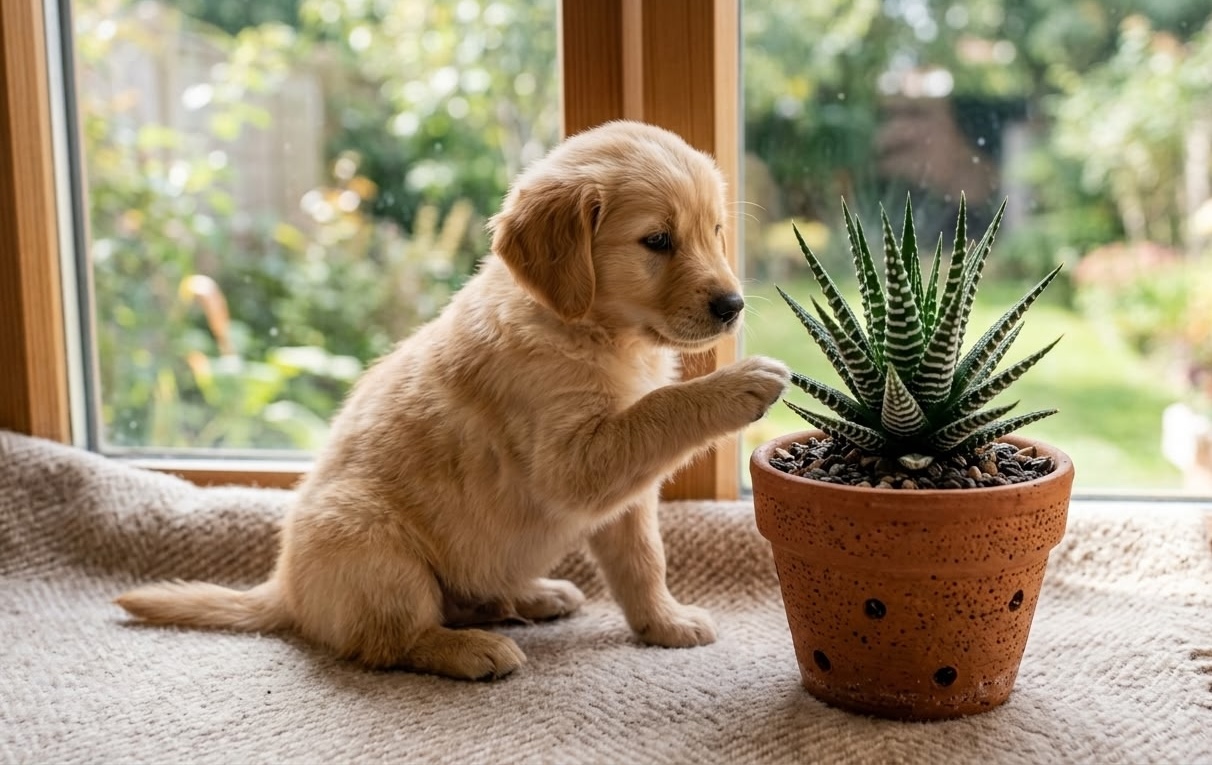
Which Zebra Plant Do You Have?
Before checking toxicity, identify your plant — the three most common zebra plants look very different from each other.
Haworthia fasciata (Zebra Haworthia, Zebra Cactus)
A compact succulent with dark green, pointed leaves covered in raised white horizontal bumps (tubercles) that form stripes across the outer surface. Typically under 6 inches tall, grows in a tight rosette, and produces small offshoots around the base. Commonly sold in 2–4 inch pots at grocery stores, garden centers, and big-box stores. This is the most widely sold “zebra plant” in succulent collections.
Care guide: Haworthia fasciata care
Aphelandra squarrosa (Tropical Zebra Plant)
A tropical shrub that grows 12–18 inches tall as a houseplant. Recognized by its large, glossy dark green leaves with dramatic bright white veins running perpendicular to the midrib — like a bold graphic pattern across the leaf surface. Produces showy yellow or orange flower bracts at the top. Sold at specialty plant shops and florists, usually in 4–6 inch pots.
Care guide: Aphelandra squarrosa care
Calathea zebrina (Zebra Prayer Plant)
A prayer plant with large, velvety leaves marked in alternating light and dark green horizontal stripes on the upper surface and purple-red underneath. Grows 12–24 inches tall. Folds its leaves upward at night (nyctinasty) — if your plant’s leaves move throughout the day, it’s likely a Calathea. Needs high humidity and consistent moisture, very different from Haworthia care.
Is Zebra Plant Toxic to Cats?
No — none of the three plants commonly called zebra plant are toxic to cats.
| Plant | Scientific Name | ASPCA Status | Toxic Compounds |
|---|---|---|---|
| Haworthia fasciata | Haworthiopsis fasciata | Non-toxic ✅ | None identified |
| Aphelandra squarrosa | Aphelandra squarrosa | Non-toxic ✅ | None identified |
| Calathea zebrina | Calathea zebrina | Non-toxic ✅ | None identified |
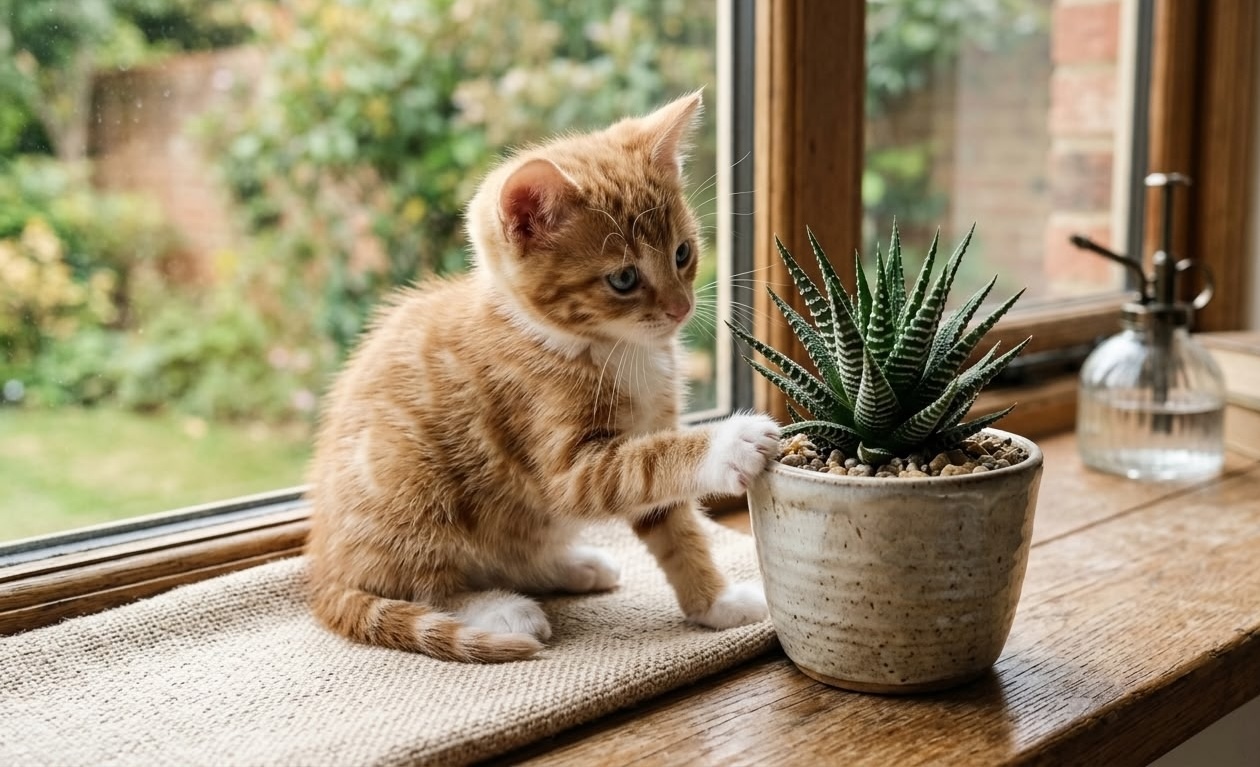
The ASPCA lists Haworthia under “Haworthia species” and Aphelandra squarrosa under “Saffron Spike Zebra” — both with no toxic compounds listed and no expected clinical signs from ingestion. Calathea species are similarly listed as non-toxic.
Is Zebra Plant Toxic to Dogs?
No — all three zebra plant species are also non-toxic to dogs. The ASPCA classifications cover cats, dogs, and horses for all three plants, with non-toxic status across all three.

What If My Pet Ate a Zebra Plant?
Because none of the three zebra plants contain toxic compounds, ingestion of leaves or roots is not a medical emergency. A pet that eats plant material may experience mild GI upset — nausea, loose stools — simply from ingesting fibrous plant matter. This typically passes on its own within 24 hours.
What to watch for:
- Normal reaction: mild drooling, brief nausea, one episode of vomiting or loose stools. Resolves on its own.
- Call your vet if: vomiting more than twice, lethargy lasting more than a few hours, or you are not certain which plant your pet ate.
If you’re ever unsure whether a plant is toxic after your pet eats it, the ASPCA Animal Poison Control Center is the most reliable resource: (888) 426-4435. They maintain a database of over 1,000 plants tested for toxicity.
One Practical Consideration: Sharp Leaf Tips
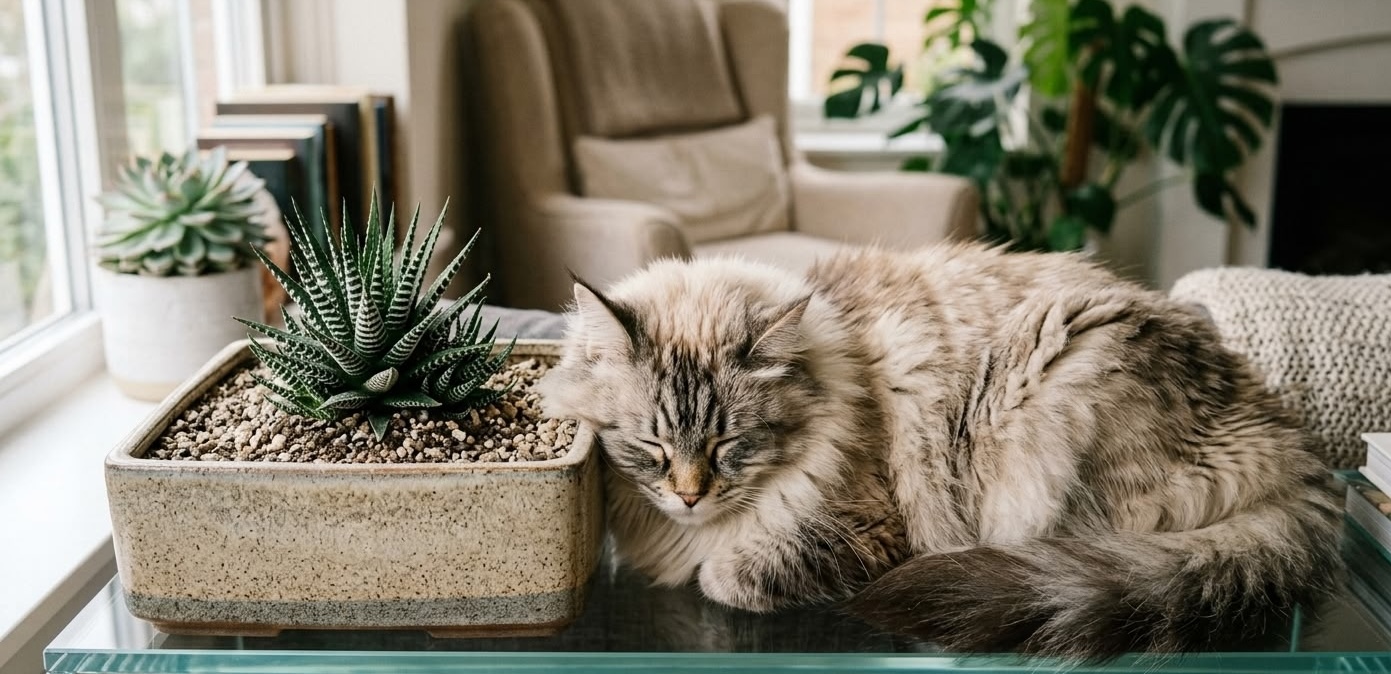
Haworthia fasciata has firm, pointed leaf tips. A cat that chews on it may experience minor mouth irritation from the physical sharpness — this is mechanical, not chemical toxicity. The plant is not producing any irritating compounds; it’s simply pointy. Most cats learn quickly to leave it alone. If you have a very persistent plant-chewer, placing the Haworthia slightly out of reach is sensible.
Plants Sometimes Confused With Zebra Plant That ARE Toxic
While zebra plant itself is safe, some plants with similar-sounding names or similar appearance are toxic to cats and dogs:
- Aloe vera — sometimes called “aloe zebra” or “torch aloe.” Toxic to cats and dogs (ASPCA). The toxic component is the latex layer beneath the skin (contains anthraquinones and saponins), not the inner gel. Clinical signs: vomiting, diarrhea, lethargy, tremors.
- Peace lily (Spathiphyllum) — sometimes grouped with “safe-looking” houseplants but toxic. Contains calcium oxalate crystals. See our guide on peace lily toxicity.
The key takeaway: always verify the botanical name (Latin species name), not just the common name. Common names are unreliable — “zebra plant” can be safe or toxic depending on the species.
Non-Toxic Houseplants Safe for Cats and Dogs
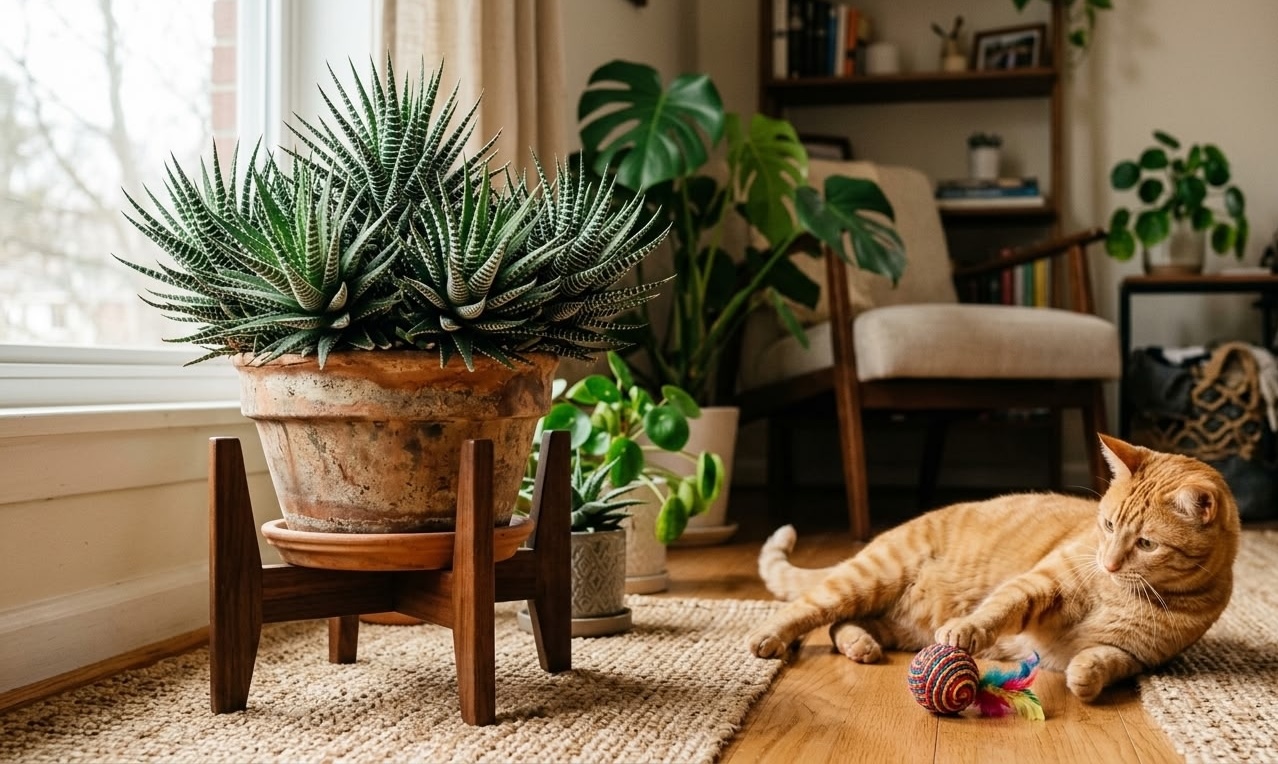
If you’re looking for pet-safe houseplants, all three zebra plants are good choices. Other ASPCA-confirmed non-toxic options include:
- Spider plant (Chlorophytum comosum) — non-toxic to cats and dogs (ASPCA); may cause mild vomiting or diarrhea if eaten in large quantities
- Polka dot plant (Hypoestes phyllostachya) — non-toxic to cats, dogs, and horses
- Haworthia fasciata — non-toxic and low maintenance
- Wandering dude (Tradescantia) — non-toxic, though it can cause contact dermatitis in some cats
FAQ: Zebra Plant and Pet Safety
Is zebra plant toxic to cats?
No. All three plants commonly called “zebra plant” — Haworthia fasciata, Aphelandra squarrosa, and Calathea zebrina — are non-toxic to cats according to the ASPCA. No toxic compounds have been identified in any of them.
My cat chewed on my zebra plant. What should I do?
If the plant is one of the three zebra plant species (Haworthia, Aphelandra, or Calathea), no treatment is needed. Monitor for mild GI symptoms — nausea, loose stools — that may appear within a few hours and should resolve on their own within 24 hours. If symptoms persist or your cat seems lethargic, call your vet.
Is Haworthia fasciata safe for cats?
Yes — Haworthia fasciata is listed as non-toxic by the ASPCA. The pointed leaf tips may cause minor mouth irritation if a cat bites into them, but there are no toxic chemical compounds involved.
Are all succulents safe for cats?
No. Some common succulents are toxic: aloe vera is toxic to cats and dogs, and euphorbia species (which look like cacti) contain caustic latex. Always verify the species name before assuming a succulent is pet-safe. Haworthia fasciata is one of the succulents confirmed safe.
Is zebra plant safe for dogs?
Yes. All three zebra plant species are non-toxic to dogs and horses, as well as cats. The ASPCA classification covers all three species across all three animal types.